

Multifamily Investing for Beginners: The 2026 Blueprint to Apartment Wealth
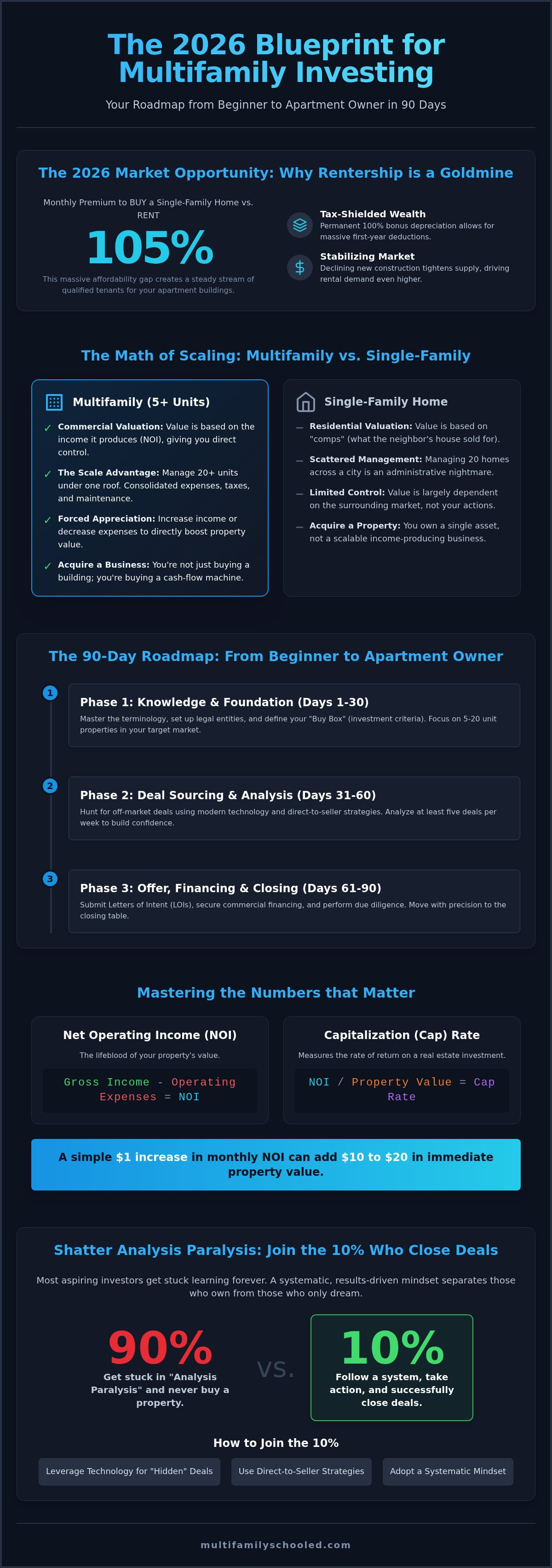
In 2026, the monthly premium to buy a single-family home has hit a staggering 105% over renting. This gap isn't just a statistic; it’s your invitation to build massive wealth. If you’ve been looking for the right way to start multifamily investing for beginners, the market is practically screaming at you to take action. You likely feel the pressure of a competitive landscape and the paralyzing fear of making a huge financial mistake. It’s frustrating to want freedom but lack the clear, repeatable system to actually buy your first building.
Stop overthinking and start executing. This article gives you the exact system to find, analyze, and close your first multifamily deal in just 90 days. You’ll gain the confidence to crunch commercial numbers like a seasoned pro and learn how to use permanent 100% bonus depreciation to protect your gains. We are breaking down the 2026 Blueprint, from using proprietary software to hunt off-market deals to navigating the new $176 billion enterprise loan caps. Your journey to apartment wealth starts with this roadmap. Follow the steps, master the process, and claim your independence today.
Key Takeaways
- Scale your wealth faster by targeting 5+ unit commercial properties that offer superior management efficiency over single-family homes.
- Follow a battle-tested 90-day roadmap for multifamily investing for beginners designed to eliminate hesitation and secure your first deal.
- Unlock access to high-margin "hidden" deals by leveraging modern technology and direct-to-seller strategies that bypass the crowded public market.
- Master the critical math of Net Operating Income and Cap Rates to analyze commercial deals with the precision of a veteran investor.
- Shatter the analysis paralysis trap and join the 10% of investors who actually close deals by adopting a results-driven, systematic mindset.
Why Multifamily Investing is the Ultimate Wealth Vehicle in 2026
Stop playing small with single-family rentals. True economic empowerment comes from assets that scale. Multifamily investing for beginners focuses on properties with five units or more, which are officially classified as commercial real estate. This distinction is vital because it changes how your wealth is calculated. You aren't just buying a building; you're acquiring a cash-flow business. To understand the foundational structure of these assets, you can explore this overview of What is Multifamily Housing? and how it differs from residential property. In 2026, this asset class remains the gold standard for anyone seeking long-term independence.
Multifamily vs. Single-Family: The Math of Scaling
Efficiency is your secret weapon. Managing 20 units in one location beats 20 houses spread across the city every single time. Think about the logistics. You have one roof to maintain, one tax bill to pay, and one insurance policy to manage. This consolidated management is the "Scale Advantage" that professional investors use to dominate. It allows you to build a massive portfolio without the administrative nightmare of scattered residential homes.
The real magic happens in the valuation. Residential homes rely on "comps," or what the neighbor's house sold for. Commercial buildings are valued based on the income they produce. This gives you total control through forced appreciation. By increasing your Net Operating Income (NOI) through better management or decreased expenses, you directly boost the property's worth. A simple $1 increase in monthly NOI adds $10 to $20 in immediate property value based on current market cap rates.
The 2026 Economic Outlook for Apartment Owners
The "rentership society" is no longer a theory; it's a permanent reality. Current data shows a 105% monthly premium to buy a home versus renting in 2026. This massive gap ensures a steady stream of qualified tenants for your buildings. While some people on Reddit wonder if it's too late to start, the numbers tell a different story. National vacancy rates are projected to ease to a healthy 6.7% this year, and new construction starts are declining across the Western U.S., which will tighten supply and drive demand even higher.
Don't let hesitation rob you of this opportunity. With 100% bonus depreciation now a permanent fixture of the tax code, you can deduct the full cost of eligible assets in the first year. This creates a tax-shielded wealth machine that single-family investors simply can't match. The 2026 market is stabilizing, creating the perfect entry point for those with a clear system and the guts to take action.
The 90-Day Roadmap: From Beginner to Apartment Owner
Most people spend years "learning" without ever making an offer. That ends now. Speed is your greatest asset because it prevents your brain from finding excuses to quit. In the world of multifamily investing for beginners, a 90-day timeline isn't just a goal; it's the standard for serious players. If you don't have a deal under contract within three months, you're likely stuck in analysis paralysis. This blueprint forces you to move from theory to ownership with clinical precision.
Your journey is divided into three high-impact phases:
- Phase 1: Knowledge and Foundation (Days 1-30). Master the terminology, set up your legal entities, and define your specific investment criteria.
- Phase 2: Deal Sourcing and Analysis (Days 31-60). Start hunting. You'll use technology to find off-market opportunities and run numbers on at least five deals a week.
- Phase 3: Offer, Financing, and Closing (Days 61-90). Submit your letters of intent, secure your commercial debt, and move through due diligence to the closing table.
Setting Your Investment Criteria
You cannot hit a target you haven't defined. Successful investors use a "Buy Box" to filter out distractions. Start by deciding on your target market. Local markets offer the advantage of proximity, but emerging markets in the Midwest or undersupplied gateway cities often provide better cap rates in 2026. Focus your search on properties with 5 to 20 units. This range is the "sweet spot" for beginners. It's large enough to enjoy commercial valuation but small enough to manage without a massive corporate infrastructure. Write down your criteria and stick to them. If a deal doesn't fit your box, delete the email and move on.
Building Your Power Team
Multifamily is a team sport. You can't do this alone, and you shouldn't try. You need a commercial broker to bring you deals, a lender to provide the leverage, and a mentor to keep you from making a million-dollar mistake. To be taken seriously, you must speak the language of "Commercial." Brokers don't want to hear about "pretty houses"; they want to hear about debt coverage ratios and expense loads. Engaging in high-level real estate investment training early on gives you the vocabulary and the confidence to stand toe-to-toe with industry veterans.
Your mentor is the most critical piece of this puzzle. A mentor provides the proven framework that turns guesswork into a systematic process. They force you into action when you feel hesitant. If you're ready to stop watching from the sidelines and start building real equity, consider joining a structured Mentorship Program to accelerate your results. Don't just learn the game. Own the field.
How to Find "Hidden" Deals Using Modern Technology
If you're looking for deals on the MLS, you've already lost the race. That's where every other amateur is bidding up prices and shrinking your margins. For multifamily investing for beginners, the real wealth is built in the "shadow market." These are properties owned by people who are ready to sell but haven't listed yet. You need to find them before they ever talk to a broker. This is about being proactive, not reactive. You don't wait for deals to find you. You hunt them down with clinical precision.
The game has changed. You no longer have to drive for dollars or cold call every building in your zip code. Modern investors use data to identify "motivated" sellers before they even realize they're ready to exit. We look for specific triggers: owners who have held their property for over 10 years, high vacancy rates, or properties with massive equity. These sellers are often exhausted by maintenance and tenant complaints. They aren't looking for the highest bidder; they're looking for the easiest exit. You are that exit.
Using Deal-Finding Software to Beat the Competition
Stop guessing and start targeting. Using Real Estate Radar AI allows you to pinpoint high-probability sellers with surgical accuracy. You can filter your search by ownership length, debt-to-equity ratios, and specific asset classes. This proprietary software cuts sourcing time by 80%, allowing you to focus on closing rather than endless searching. By focusing on buildings with high equity, you unlock the potential for creative financing or seller-carry options that simply don't exist on the open market. Get the data. Own the advantage.
The Art of the Off-Market Approach
Once you have your list, it's time to strike. Your first outreach shouldn't be a hard sell. It should be a professional conversation starter. You're an investor looking to solve a problem, not a salesperson looking for a commission. Many owners are tired of property management and the constant headache of "toilets and tenants." Position yourself as the solution. Using the Multifamily Tool Kit gives you the exact scripts and outreach templates needed to build trust fast.
Don't ignore brokers entirely, but change how you interact with them. Show them you have the software and the systems in place. When a broker sees you're a serious player in multifamily investing for beginners, you become their first call for "pocket listings." These are the elite deals they keep in their back pocket for their best buyers. Be the person who closes, and the hidden deals will start finding you.
Multifamily Analysis: Understanding the Numbers That Matter
Numbers don't lie, but they can hide the truth if you don't know where to look. In multifamily investing for beginners, your ability to dissect a Profit and Loss (P&L) statement is your most valuable skill. You aren't just buying a building; you're buying an income stream. If the numbers don't work, the deal doesn't work. Period. Move on to the next one immediately. Master these four metrics to protect your capital and ensure your path to wealth is built on a solid foundation.
- Net Operating Income (NOI): This is the heartbeat of your investment. It's your total income minus all operating expenses. Crucially, it does not include your mortgage payment. This number tells you the raw earning power of the asset.
- Cap Rate: This represents the market-specific return expectations. If you paid all cash, what would your yield be? In 2026, understanding local cap rates prevents you from overpaying in a stabilizing market.
- Cash-on-Cash Return: This is the actual dividend hitting your pocket. It's the annual pre-tax cash flow divided by the total cash you invested. Aim for double digits to outpace inflation.
- Debt Service Coverage Ratio (DSCR): This is what your lender cares about. It measures the property's ability to cover its debt. Most lenders in 2026 require a DSCR of at least 1.20x to 1.25x, meaning the property makes 25% more than the mortgage payment.
The 5-Minute Deal Filter
Stop wasting days on deals that should die in minutes. Use a quick filter to see if a building is worth a deep dive. While the "1% Rule" is rare in commercial assets in 2026, a 0.7% or 0.8% rent-to-price ratio often signals a potential winner. Scrutinize the P&L for red flags. If the "Repairs and Maintenance" line is suspiciously low, the owner is likely deferring costs to inflate the NOI. If the numbers feel "too clean," they probably are. Kill the deal and save your time for real opportunities.
Financing Your First Apartment Building
You have powerful options in 2026. Interest rates for apartment loans currently range from 5.33% to 12.75% depending on your financial strength and the property's performance. Fannie Mae and Freddie Mac have a combined $176 billion to lend this year, with at least 50% dedicated to mission-driven, affordable housing. If you lack a massive down payment, pivot to seller financing. It's a game-changer for beginners, allowing you to acquire assets with less personal capital and bypass traditional bank hurdles. You can also leverage Other People's Money (OPM) through syndication to scale your portfolio at lightning speed.
Ready to master the math and secure your first building? Download the Multifamily Tool Kit and start analyzing deals with the precision of a veteran investor today.
Overcoming the Beginner Plateau: Mentorship and Mastery
Knowledge is only half the battle. If information alone were enough, everyone with an internet connection would be a millionaire. The truth is that 90% of people who start looking into multifamily investing for beginners never actually close their first deal. They get stuck in a loop of endless research and "what-if" scenarios. This is the analysis paralysis trap. It feels like progress, but it is actually a sophisticated form of procrastination. To break out, you need more than a spreadsheet. You need a mentor who has been in the trenches and a system that demands execution.
A mentor does more than teach you the math. They provide the accountability that forces you to step outside your comfort zone. When you feel the weight of a multi-million dollar decision, a mentor is the voice of experience that confirms your analysis and pushes you to sign the contract. This is how you join the 10% who actually build generational wealth. You don't have to guess. You just have to follow the blueprint. Your path to independence is already paved; you just need the guts to walk it.
The Power of a Proven System
Stop trying to reinvent the wheel. Following a battle-tested blueprint beats "figuring it out" alone every single time. Our multifamily investing mentorship is built on this philosophy. We are so confident in our process that we offer a 90-day guarantee. You get a deal under contract in 90 days, or we provide one for you. You also gain immediate access to a community of high-level apartment hunters who are closing deals in the same 2026 market conditions you face. You aren't just buying a course. You're joining a movement of strategic investors.
Take Action Today
Your journey doesn't start tomorrow. It starts the moment you decide to stop being a spectator. If you're ready to kickstart your momentum, master the 5-Day Multifamily Challenge to see how we find and analyze properties in real-time. Your next step is clear. Visit our store to download the eBook and master the essential vocabulary of the commercial game. Then, register for the next 3-Day Live Workshop at Multifamily Schooled for a deep-dive into advanced acquisition strategies. The 2026 market is moving fast. Start your 90-day clock right now and claim your seat at the table.
Your 90-Day Countdown to Apartment Wealth Starts Now
The 2026 market doesn't wait for the hesitant. You now have the blueprint to master multifamily investing for beginners by leveraging the scale of commercial assets and the precision of modern data. You've seen how proprietary software and a clinical approach to numbers can bypass the competition and secure off-market deals. Stop being a spectator while others build generational equity. It's time to execute with a proven system that eliminates guesswork.
Led by multi-generational expert Justin Brennan, our program provides the elite tools and the network you need to win. We offer a bold 90-Day Deal Guarantee; find a deal in three months or we provide one for you. You'll gain exclusive access to our proprietary deal-finding software to hunt like a pro. Don't let another year pass you by without an asset to your name. Your future is waiting. Take the first step and own your destiny today.
Join the 90-Day Mentorship and Find Your First Deal
Frequently Asked Questions
How much money do I need to start multifamily investing?
You can start with as little as 3.5% down for small owner-occupied properties or 20% to 25% for larger commercial assets. In 2026, the Fannie Mae loan limit is $832,750 for contiguous U.S. properties. You don't need millions to begin multifamily investing for beginners; you just need a strategy. Many successful investors use syndication or seller financing to bridge the gap. Focus on the deal's ability to cover debt first.
Is multifamily investing better than single-family for beginners?
Multifamily is superior because of the scale advantage and income-based valuation. While single-family depends on neighborhood comps, a 20-unit building's value increases when you raise the Net Operating Income. Managing one roof instead of twenty separate houses saves you significant time and management costs. It's the fastest path to financial independence because you aren't trading your time for one small rent check at a time. Scale is your secret weapon.
What is a good cap rate for an apartment building in 2026?
A good cap rate in 2026 typically ranges between 5% and 7% depending on the location. Midwest and undersupplied gateway markets often offer higher yields than saturated Sun Belt cities this year. You want a cap rate that is higher than your mortgage interest rate to ensure positive leverage. Always compare the property's cap rate to current market averages to ensure you aren't overpaying for a stabilized asset in this market.
How do I find multifamily deals that are not on the market?
Use proprietary data tools to find owners with high equity or long ownership periods. You can reach out directly to these owners before they list with a broker. Many apartment owners are tired of property management and the 2026 economic headwinds. Building trust through direct mail or professional outreach often results in a better price. This strategy allows you to bypass bidding wars and secure much higher profit margins from the start.
Can I invest in multifamily real estate with a full-time job?
You absolutely can invest while working a 9-5 by using a systematic 90-day roadmap. High-level multifamily investing for beginners is about being the deal sponsor or owner, not the property manager. By building a power team of brokers, lenders, and third-party managers, you can scale your portfolio without sacrificing your day job. The key is using software to automate your deal sourcing and analysis during your off-hours or on weekends.
What are the biggest mistakes beginners make in apartment investing?
The biggest mistake is overestimating the Net Operating Income by undercounting expenses like insurance and labor. In 2026, operating costs are rising due to inflation and geopolitical uncertainty. Beginners often fail to account for a realistic vacancy rate, which hit 6.8% in the second quarter of 2026. Another fatal error is waiting for the perfect time to start. Speed and execution beat waiting for market conditions that may never actually arrive.
How do I analyze a multifamily property quickly?
Use a 5-minute filter to check the rent-to-price ratio and the debt service coverage ratio. If a property doesn't hit a DSCR of at least 1.25x based on the current 2026 interest rates, kill the deal. Don't waste hours on deep-dive due diligence until the basic math proves the property can pay for itself and provide a profit. Focus your energy on properties that show immediate potential for forced appreciation and cash flow.
Is a real estate mentor worth the investment?
A mentor is the ultimate shortcut to apartment wealth because they prevent million-dollar mistakes. They provide the proven framework that turns a daunting process into a repeatable system. When you're facing a competitive market, a mentor gives you the confidence to pull the trigger on a deal. The risk of doing it alone is much higher than the cost of professional guidance from someone who has already achieved massive success in this industry.



