

Multifamily Financing for Beginners: The 2026 Blueprint to Funding Your First Deal
Stop waiting for the "perfect" economy to build your legacy. You don't need millions in the bank to acquire a 20-unit building. You just need to understand the mechanics of multifamily financing for beginners. While most people are paralyzed by shifting interest rates, savvy investors are currently tapping into a $176 billion lending pool from Fannie Mae and Freddie Mac. You can join them right now.
It's natural to feel overwhelmed by the jump from residential rules to commercial liability. You want a clear path to economic independence without risking everything you've already built. This guide delivers the exact 2026 blueprint to funding your first deal. You will learn how to use Other People’s Money safely and gain the absolute confidence to speak the lender's language. We are diving into the 5-unit commercial threshold, current 5.33% agency rates, and the step-by-step roadmap to your first successful closing. Your journey to asset mastery starts here.
Key Takeaways
- Identify the 5-unit threshold to move beyond limited residential rules and start playing in the big leagues of commercial real estate.
- Master the mechanics of multifamily financing for beginners to leverage the velocity of money for rapid, sustainable portfolio growth.
- Decode the 2026 loan landscape so you can confidently choose the right bridge or agency financing for your specific deal.
- Build a professional Investor Bio and Property Package that forces lenders to take you seriously from day one.
- Implement creative funding strategies like seller financing to close your first apartment deal in as little as 90 days.
Multifamily Financing: Your Fast Track to Generational Wealth
Stop thinking like a consumer and start thinking like a mogul. Multifamily financing for beginners isn't just a way to borrow money; it's the high-octane fuel for your wealth engine. If you want to retire in thirty years, keep buying single-family houses. If you want to change your life in the next 24 months, you must master the mechanics of apartment loans. This is the only asset class where you can scale your portfolio exponentially without waiting decades for organic appreciation.
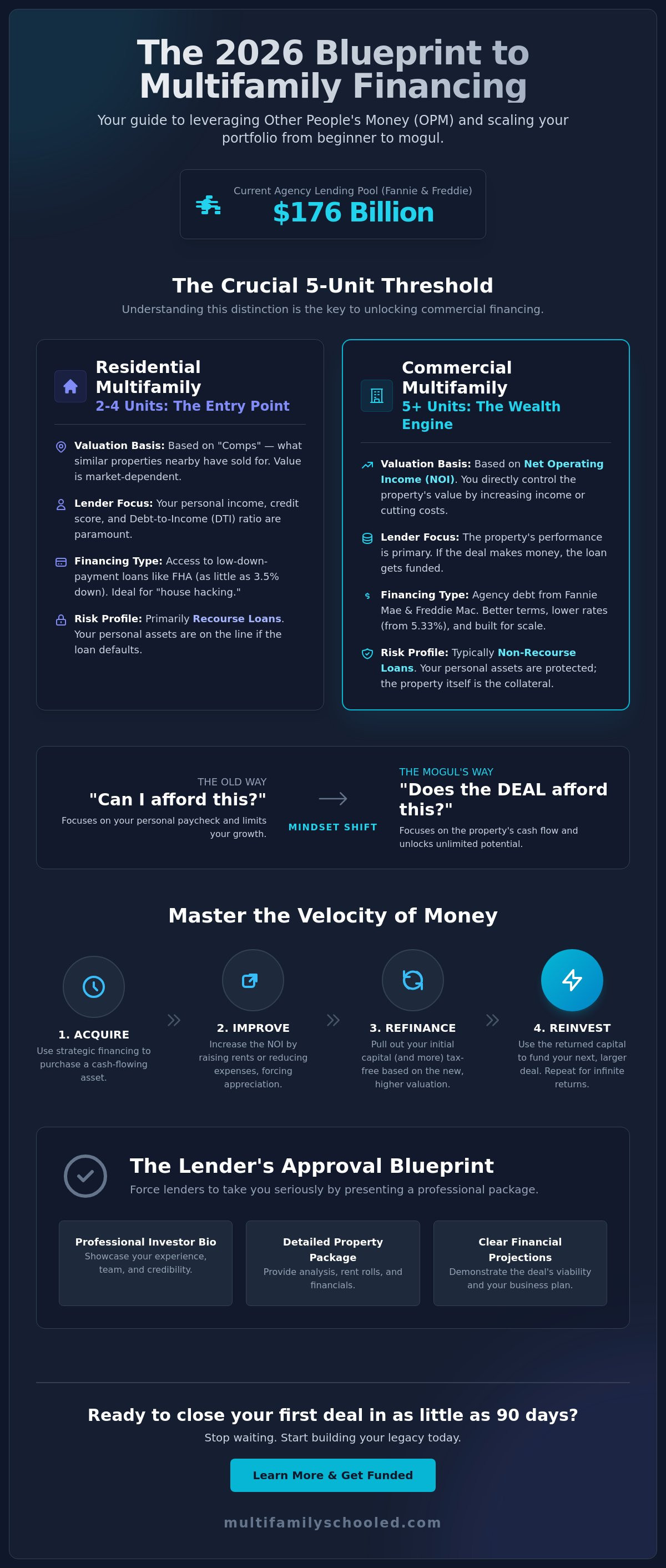
The secret lies in the velocity of money. In the residential world, your capital stays trapped for years. In the multifamily world, you use financing to acquire, improve, and refinance, pulling your initial investment back out to fund the next deal. You aren't just buying a building; you're creating a cycle of infinite returns. Lenders aren't obstacles in this journey. They are your most powerful partners. They want to deploy capital into stable, cash-flowing assets, and you are the one providing the opportunity.
To better understand how these deals actually get funded, watch this helpful video:
Why Lenders Love Multifamily More Than Single-Family
Banks and agency lenders like Fannie Mae and Freddie Mac have a massive appetite for apartments. For 2026, they've set a combined lending cap of $176 billion. Why? Because multifamily is safer. Consider the risk mitigation. If a single-family rental goes vacant, you're 100% out of luck. If one tenant leaves your 10-unit building, you still have 90% of your income. This stability allows you to access better terms and lower interest rates, often starting as low as 5.33% for agency debt. You also benefit from economies of scale. It's much more efficient to manage and finance ten units under one roof than ten separate houses scattered across town.
The Beginner’s Mindset Shift: From Consumer to Commercial
The biggest hurdle in multifamily financing for beginners is the mental transition. In residential lending, the bank looks at your salary and your debt-to-income ratio. In the world of commercial property, the property's performance takes center stage. Lenders care more about the Net Operating Income (NOI) than your personal paycheck. This opens the door to non-recourse debt, which protects your personal assets if the deal goes south. Stop asking "Can I afford this?" and start asking "Does the deal afford this?" If the numbers work, the money will follow. If you're ready to master these conversations and look like a pro to every lender you meet, our Mentorship Program gives you the exact scripts and frameworks to secure your first closing.
Residential vs. Commercial: The Crucial 5-Unit Threshold
Draw a line in the sand at five units. This is the most important boundary in your real estate career. Properties with two to four units fall under residential rules. Anything with five or more units is a commercial asset. This distinction changes everything from your down payment to how a lender views your worth. Understanding this threshold is the first step in multifamily financing for beginners. You must choose the path that fits your current capital and your long-term vision. Don't get stuck in the slow lane because you didn't know the rules of the road.
The shift in valuation is massive. Residential properties are valued based on "comps," or what the house next door sold for. Commercial properties are valued based on the income they produce. This means you control the value. If you increase the rent or decrease expenses, the building's worth skyrockets. You aren't at the mercy of the market. You are the driver of your own equity. If you are struggling to decide which path is yours, check out our Multifamily University resources to see the numbers side-by-side.
Residential Multifamily (2-4 Units): The Entry Point
If you have limited capital, start here. You can leverage FHA loans with as little as 3.5% down. For 2026, the standard FHA loan limits for owner-occupied properties are $693,050 for two units and up to $1,041,125 for four units. This is the ultimate "house hacking" strategy. You live in one unit and let the tenants in the other three pay your mortgage. In this category, your personal credit score and debt-to-income ratio are the primary focus for the lender. It is a powerful way to get your feet wet while building a massive equity cushion.
Commercial Multifamily (5+ Units): The Real Scale
Ready to play in the big leagues? Commercial financing is where you find true scale. Lenders focus on the Debt Service Coverage Ratio (DSCR). Usually, they want to see a ratio of at least 1.25x. This means the property's net income must be 25% higher than the annual mortgage payments. While they still check your credit, they are far more interested in the asset's performance and your professional track record. You can explore various Fannie Mae financing options that offer non-recourse debt for these larger deals. This protects your personal assets and allows you to build a massive portfolio without the limitations of your personal income. Master the DSCR, and you master the game.
Navigating the 2026 Loan Landscape: Bridge, Agency, and Beyond
The 2026 lending market is not a mystery; it is a map to your first closing. Capital is flowing, but lenders are more strategic than ever. This May, Fannie Mae and Freddie Mac have been handed a combined $176 billion lending cap. Interest rates have stabilized, with agency options starting as low as 5.33%. This is a massive window of opportunity for anyone mastering multifamily financing for beginners. You don't need to be a Wall Street pro to win. You just need to know which tool to pull from your belt for your specific deal.
Lenders are currently prioritizing "mission-driven" affordable housing and strong sponsors. If your property meets these criteria, you are at the front of the line. The key is matching your loan type to your business plan. Are you holding for thirty years or flipping the building's value in twenty-four months? Your answer determines your debt. If you are ready to stop guessing and start executing, our Deal Finding Software can help you identify properties that fit these exact lending profiles.
Agency Debt: The Gold Standard
Fannie Mae and Freddie Mac are the heavy hitters. Their Small Balance Loan (SBL) programs are designed for properties between $1 million and $7.5 million. This is perfect for your first major acquisition. These loans offer 30-year amortization, which keeps your monthly payments low and your cash flow high. Most agency debt is non-recourse. This means the lender cannot come after your personal assets if the property fails. It provides a level of long-term stability that residential loans simply cannot match.
Bridge Loans: The Value-Add Accelerant
If you find a "fixer-upper" apartment building, agency debt might not be an option yet. This is where bridge loans shine. Rates are higher, currently ranging from 9.5% to 10.95%, but the money is fast. You use this capital to renovate the units, improve the property, and "force" the appreciation by raising rents. The goal is a "Bridge to Permanent" strategy. You renovate, stabilize the income, and then refinance into a low-interest agency loan. It is a high-speed way to build massive equity.
SBA and Local Bank Loans
Do not overlook the community bank on your local corner. These institutions thrive on "relationship banking." A local loan committee might overlook your lack of experience if the property is in their backyard and the numbers are rock solid. They often keep these loans on their own books, giving them the flexibility to work with you on terms. Pitching a local bank is about showing your commitment to the community. It is often the fastest way to get a "yes" when the big national banks are being too selective.
The 'Approval' Blueprint: What Lenders Actually Want to See
Lenders don't care about your dreams; they care about the data. To win at multifamily financing for beginners, you must present yourself as a professional operator from day one. This starts with your Investor Bio. Even if you haven't closed a deal yet, your bio highlights your team, your specific education, and your strategic vision. You are selling your capability to manage a multi-million dollar asset. If you look like a risk, you'll get a rejection. If you look like a pro, you'll get the capital.
The Property Package is your primary pitch deck. You need the Offering Memorandum (OM), the Trailing 12-month financial statement (T-12), and the current Rent Rolls. Amateurs guess. Professionals use data. Using software like Real Estate Radar allows you to find financeable data instantly, seeing the property's true potential before the bank's underwriters even open your file. Having these documents organized shows the lender that you understand the mechanics of the deal.
Don't try to go it alone. A mentor's endorsement is the ultimate secret sauce for a first-time buyer. When an experienced investor with a massive track record stands behind your deal, the lender's risk perception drops significantly. If you want that level of authority and a proven path to your first closing, join our Mentorship Program and leverage our reputation to get your first deal funded.
Mastering the Math: NOI, Cap Rates, and DSCR
Net Operating Income (NOI) is simply your total annual income minus all operating expenses, excluding debt service. Memorize that. Most lenders demand a 1.25 DSCR, which is the magic number meaning your income covers the mortgage plus a 25% safety margin. Unlike residential houses, your building's value is calculated by dividing your NOI by the market Cap Rate. This means you have total control over the equity you create. If you increase the income, you increase the wealth.
Building Your Professional 'Dream Team'
You need a commercial mortgage broker who has deep relationships with dozens of lenders. They do the heavy lifting and the shopping for you. Pair them with an experienced property manager who can provide a realistic 'pro forma' to satisfy the bank's rigorous underwriting process. To ensure your analysis meets industry standards and impresses every lender you meet, download our eBook or Toolkit today. Success in this game is about the systems you use.
Creative Funding & Mentorship: Getting Your Deal Done in 90 Days
Traditional banks are just one piece of the puzzle. If you want to bypass the red tape and accelerate your path to ownership, you must master the art of creative financing. For many, multifamily financing for beginners starts with a direct conversation rather than a long loan application. Seller financing is the ultimate "No Bank" hack for the 2026 market. It allows you to step into a deal with flexible terms that no institutional lender would ever touch. You aren't just looking for a building; you're looking for a motivated partner who wants to help you succeed while securing their own financial exit.
Beyond seller debt, you have the power of Real Estate Syndication. This is the process of raising capital from private investors to fund your acquisitions. You find the deal, manage the asset, and provide the expertise. Your investors provide the equity. This "Other People’s Money" (OPM) strategy is how you scale from a fourplex to a 100-unit complex in record time. It turns real estate into a team sport where your ability to find and structure deals becomes your greatest currency. Stop letting a lack of personal cash hold you back from the assets you deserve.
Seller Financing: The Win-Win Negotiation
Many owners in 2026 are retiring baby boomers who want to offload the headaches of management without losing their monthly income. They are often willing to "be the bank" for you. You can structure these deals with a balloon payment, typically due in three to five years. This gives you ample time to renovate the property, increase the Net Operating Income, and refinance into a permanent agency loan later. Use Real Estate Radar to identify high-equity, off-market opportunities where owners might be open to this creative exit strategy. It is the fastest way to close a deal without a credit check or a massive down payment.
The Power of the 90-Day System
Speed is your greatest asset. In a competitive landscape, the investor who can move from analysis to offer in days is the one who wins. The "No Experience" objection is the biggest wall beginners face, but you can tear it down instantly. Our Mentorship Program solves this by providing you with the credibility and the exact blueprints lenders demand. You don't have to spend years learning through trial and error. You can get lender-ready in a matter of weeks.
Start your 90-day countdown right now. Commit to the process, use the tools, and leverage the expertise of those who have already achieved what you want. The first deal is always the hardest because it requires the most courage. Once you break that barrier and close your first building, your growth becomes inevitable. Seize this opportunity. Your journey to generational wealth is one deal away. Take the first step and secure your future today.
Your 90-Day Countdown to Ownership Starts Now
You now have the blueprint. You understand the massive leverage of the 5-unit threshold and how to navigate the 2026 agency debt market. Mastering multifamily financing for beginners is no longer a mystery; it's a strategic process. You know how to build a professional package that lenders can't ignore and how to use creative funding to bridge the gap. The path from where you are to your first closing is clearly defined. All that's left is for you to execute.
Don't let analysis paralysis stop your momentum. Our system is designed to help you find and buy your first apartment building in exactly 90 days. Led by Justin Brennan, a multi-generational multifamily expert, we provide the proprietary software you need to uncover hidden, financeable deals that others miss. You don't have to guess. You just have to follow the framework that's already working for others.
Stop dreaming about generational wealth and start building it. Get the Blueprint: Join our Mentorship and find your first deal in 90 days! Your future self will thank you for the action you take today. The market is moving fast. It's time for you to move faster. You have the tools. You have the knowledge. Now, go get your deal.
Frequently Asked Questions
Can I get multifamily financing with a 600 credit score?
Yes, you can, but you'll likely need a strategic partner or a co-sponsor to bridge the gap. While FHA loans for 2-4 units can accommodate lower scores, commercial lenders for 5+ units typically look for a 680 or higher. If your score is 600, focus on finding a "Key Principal" with strong credit to sign on the loan with you. This is a common move in multifamily financing for beginners to get that first "yes" from a bank.
How much of a down payment do I really need for an apartment building?
Expect to bring between 3.5% and 20% to the closing table depending on the loan type. For an owner-occupied fourplex, an FHA loan allows you to start with just 3.5% down. If you are moving into 5+ units with agency debt, you'll generally need 20% of the purchase price. HUD 221(d)(4) loans are the outlier, offering up to 87% loan-to-value for market-rate properties, which brings your down payment closer to 13%.
What is the difference between a recourse and a non-recourse loan?
Recourse loans make you personally liable for the debt; non-recourse loans limit the lender's recovery to the property itself. Most local bank loans are recourse, meaning the bank can come after your personal bank accounts or home if the deal fails. Non-recourse loans, often provided by Fannie Mae or Freddie Mac, protect your personal wealth. These are the gold standard for scaling a portfolio because they isolate the risk to the specific asset you are buying.
Do I need a business entity (LLC) to get a multifamily loan?
Yes, commercial lenders require you to close in a business entity, typically a Special Purpose Entity (SPE) like an LLC. This structure isolates the property's liabilities from your personal life and your other investments. It is a standard requirement for any building with 5 or more units. Setting this up early shows the lender you are a professional operator who understands the commercial landscape. Don't wait until you're under contract to form your entity.
How does the Debt Service Coverage Ratio (DSCR) affect my loan amount?
The DSCR is the ultimate gatekeeper for your loan size. Lenders use this ratio to ensure the property's income can easily cover the debt payments. In 2026, most lenders demand a minimum DSCR of 1.20x to 1.25x. If the property's net income isn't high enough to meet this mark at your requested loan amount, the lender will simply "right-size" the loan by offering you less money. This is why increasing the property's income is the fastest way to unlock more capital.
What is a 'Value-Add' deal and how do I finance it?
A value-add deal is a property with untapped potential that you unlock through physical renovations or better management. You finance these deals using short-term bridge loans. These loans provide the capital for both the purchase and the construction costs. Once the renovations are complete and you've raised the rents, you refinance into long-term agency debt. This strategy is the core of multifamily financing for beginners because it allows you to "force" appreciation and build equity quickly.
Can I use seller financing for the entire purchase price?
While possible, 100% seller financing is extremely rare and requires a highly motivated owner with no existing mortgage. Most seller-financed deals involve the owner carrying a "second" mortgage for 10% to 20% of the price, which helps cover your down payment. Alternatively, a seller might carry a first mortgage for 75% to 80% if they want a steady monthly income without the headaches of management. It is a powerful negotiation tool to get deals done without a traditional bank.
Is it better to use a local bank or a national agency lender for my first deal?
Start with a local bank to build your reputation and get your foot in the door. Local banks are more flexible with first-time investors and often prioritize the relationship over a perfect resume. They are great for "fixer-upper" projects that national lenders might avoid. Once you have a proven track record and a stabilized property, you can move to national agency lenders to lock in lower interest rates and non-recourse terms for the long haul.



