

Multifamily Due Diligence Checklist: The 2026 Investor’s Blueprint
A clean rent roll can still conceal a costly surprise. The multifamily due diligence checklist you follow could be the difference between uncovering a deal’s real risks and inheriting them after closing. What should you check to make sure an apartment building isn’t a lemon?
It’s reasonable to feel wary. Structural problems can hide in plain sight, financial statements need to be verified against source documents, and paperwork can pile up fast. Due diligence isn’t just a box to tick. It’s a repeatable way to test the deal’s claims and make sound decisions under pressure.
This guide gives you a practical checklist for reviewing the property, financials, leases, operations, and key records. You’ll learn how to spot red flags, decide when to renegotiate or walk away, and keep your review moving toward a 90-day close. The Multifamily Tool Kit can help organize the process, while mentorship can provide a second set of eyes when questions arise. Work through each step with focus, and replace guesswork with evidence before you commit capital.
Key Takeaways
- Use a multifamily due diligence checklist to organize financial, physical, and legal reviews before committing capital.
- Verify the seller’s operating claims against source records, and test proforma assumptions for income or expenses that may be missing.
- Look beyond the paperwork for property risks that could change your deal analysis or negotiation strategy.
- Build a focused 90-day workflow from letter of intent to closing, with clear priorities and decision points.
- Use the Multifamily Tool Kit and a mentor’s second set of eyes to make your review more systematic and identify questions that deserve a closer look.
Mastering Due Diligence: Why Your Deal Lives or Dies Here
A promising apartment deal can look solid on a spreadsheet and still hide a costly roof, overstated income, or an insurance renewal that reshapes the numbers. Your multifamily due diligence checklist helps test the story before your capital is at risk. In 2026, rising borrowing costs make verification especially important: on September 16, the Federal Reserve raised its benchmark rate to a target range of 3.75% to 4.00%, increasing the pressure to confirm that a deal’s assumptions still work.
Desktop underwriting is an initial screen built from seller materials, estimates, and market assumptions. Hands-on due diligence checks those assumptions against records, inspections, and direct questions. The due diligence phase is a critical part of the real estate investment process, but your review needs to go beyond a quick scan. Shift from excited buyer to disciplined investigator.
For a practical overview of the process, watch this multifamily due diligence training workshop:
What Is Multifamily Due Diligence?
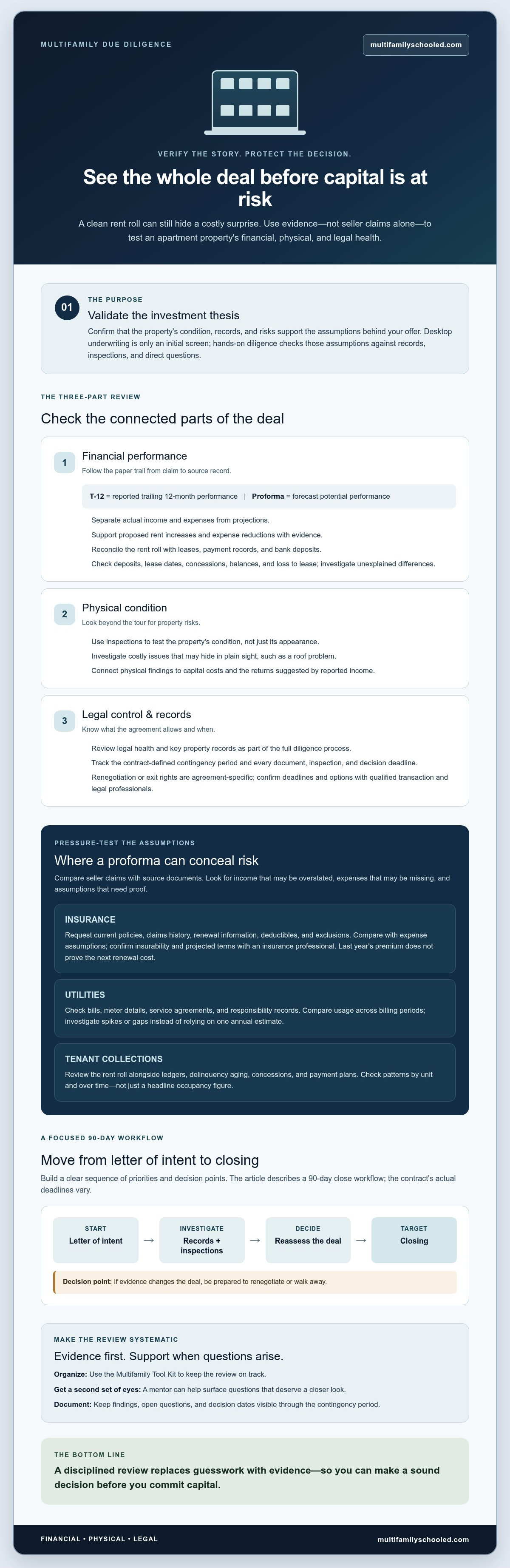
Multifamily due diligence is a comprehensive review of a property’s financial, physical, and legal health. It happens during the contingency period, the contract-defined window when a buyer investigates the asset and may have specific rights to renegotiate or exit under the agreement. Deadlines vary, so confirm them with qualified transaction and legal professionals, then track every document, inspection, and decision date.
The goal of due diligence is to validate your investment thesis by confirming that the property’s condition, records, and risks support the assumptions behind your offer.
The 2026 Reality: Risks to Verify
Make insurance a key financial pressure test. Request current policies, claims history, renewal information, deductibles, and exclusions. Compare them with the seller’s expense assumptions, then confirm insurability and projected terms with an insurance professional. Don’t treat last year’s premium as proof of the next renewal cost.
Verify utilities with bills, meter details, service agreements, and responsibility records. Compare usage across billing periods, and investigate spikes or gaps rather than relying on a single annual estimate. For tenant collections, review the rent roll alongside ledgers, delinquency aging, concessions, and payment plans. Look for patterns by unit and over time, not just a headline occupancy figure.
Use the Multifamily Tool Kit to keep your review organized. The contingency clock won’t wait for your questions to surface. Verify early, document findings, and be prepared to renegotiate or walk away if the evidence changes the deal.
Multifamily Due Diligence Checklist: Financial, Physical, and Legal Verification
A reliable investment decision requires more than a clean-looking property tour or a seller’s spreadsheet. Your multifamily due diligence checklist should test three connected areas: financial performance, physical condition, and legal control. A weakness in any one can affect the others. A roof replacement, for example, can add major capital costs and change the returns suggested by reported income.
Use a structured commercial real estate due diligence checklist as a reference, then tailor your review to the property, contract, and professional advice you receive. Keep evidence organized. A seller’s answer is not proof when records or an inspection can verify it.
Financial Deep Dive: Follow the Paper Trail
Compare the T-12, or trailing 12-month operating statement, with the seller’s proforma. The T-12 describes reported historical performance; the proforma forecasts potential performance. Separate actual income and expenses from projections, and request support for proposed rent increases or expense reductions.
Then reconcile the rent roll with leases and payment records. Check deposits, lease dates, concessions, balances, and loss to lease, the gap between current rents and market or potential rents. Compare reported rental income with bank deposits and investigate differences, including timing, fees, or unexplained shortfalls. Your goal is to calculate a defensible net operating income, not simply accept the figure in the offering materials.
Physical Inspection: Look Beyond the Surface
Walk every unit if access and the transaction allow it. A sample can miss a leak, damaged flooring, unsafe wiring, or a recurring maintenance issue in another apartment. Document what you see, and have qualified inspectors assess systems that require technical expertise.
- Roof: Review visible condition, repair history, and available replacement records.
- HVAC: Check equipment condition, operation, and maintenance documentation.
- Plumbing: Look for leaks, water damage, and recurring repair patterns.
- Electrical: Flag visible concerns for specialist review.
- Foundation: Note cracks, movement, or signs of moisture for further assessment.
Compare inspection findings with maintenance records and recent invoices. Deferred maintenance can be easy to miss when common areas are staged or repairs are cosmetic.
Legal and Title: Confirm What Comes with the Property
Have qualified legal and title professionals review the title commitment for liens, easements, and encroachments that could affect ownership or use. Verify zoning and occupancy documentation with appropriate local sources, and confirm that the property’s current use aligns with the records.
Read service contracts for renewal dates, termination terms, automatic extensions, and fees. A landscaping or trash agreement with restrictive exit terms can limit flexibility after closing. Use the Multifamily Tool Kit to track records and open questions alongside your professional reviews. Each area should support the same conclusion: the asset and its documents match the deal you believe you’re buying.
Myth-Busting the Proforma: Uncovering Hidden Liabilities
A proforma is a projection, not proof. Seller materials present a property’s potential; your job is to determine what its income and expenses can realistically support. Use your multifamily due diligence checklist to test each assumption against records, current quotes, and property condition. A gap isn’t automatically a deal-killer, but it can change your offer or justify renegotiation.
Watch for assumptions that make the numbers look stronger than the operating history supports. A 5% vacancy allowance may be too optimistic if collections, occupancy, or local conditions point to greater risk. Check the actual rent roll, payment history, concessions, and turnover. Make sure operating expenses include management fees, even if the seller self-manages. A future owner may incur that cost whether or not it appears in the current books.
Spotting Creative Accounting
Review the general ledger, invoices, and bank records for personal or non-property expenses mixed into operations. Ask for documentation before accepting claims that costs are one-time or nonrecurring. One unusually strong month of income, for example, may reflect a late payment or temporary fee rather than a repeatable revenue source.
Verify the current property tax bill and ask a tax professional how a sale could affect the assessment. A reassessment may change future taxes, but its timing and impact depend on local rules and property specifics. Model a supportable estimate rather than assuming the seller’s current bill will continue unchanged.
The Capital Expenditure Trap
Unit turns can cost more than a basic paint-and-clean allowance suggests. Inspect representative units, list the work needed to make each one rent-ready, and gather contractor quotes for the actual scope. Build separate allowances for materials, labor, and recurring work rather than relying on an unsupported per-unit guess.
Don’t overlook repairs that a casual walkthrough may miss. Ask qualified inspectors to assess sewer lines and electrical panels where appropriate, and review available service and replacement records. Use inspection findings to draft a five-year capital plan that records each known project, its expected timing, supporting estimate, and uncertainty. Treat it as a working forecast, not a promise that no other repairs will arise.
The Multifamily Tool Kit can help organize assumptions and compare the seller’s case with your re-underwritten numbers. Turn each documented variance into a clear discussion: request a price adjustment, seek a contractual change, or walk away if the risk no longer fits your investment criteria. Bring evidence, not emotion. That’s how red flags become useful negotiating points.
The High-Speed Due Diligence Workflow: Lead to Close in 90 Days
Speed can help you compete. Precision protects your capital. A 90-day target works best as a disciplined workflow, not a reason to rush past unanswered questions. Build your multifamily due diligence checklist around contract deadlines, assign an owner to every task, and keep a shared log of documents, findings, and decisions.
Assemble your due diligence team early: qualified inspectors, a real estate attorney, and a mentor who can offer a second set of eyes. Use Real Estate Radar to support market and comparable-property research, then verify relevant comps and assumptions independently. Software can help you investigate, but it doesn’t replace local expertise or property-level evidence.
Phase 1: The 48-Hour Rapid Screen
Before commissioning inspections, decide whether the opportunity merits deeper review. Run a back-of-the-envelope analysis using the asking price, available operating history, rent roll, major expenses, and your initial financing assumptions. Compare the seller’s value-add story with achievable rents and observable property needs. If the upside depends on unsupported rent increases or expense cuts, pause and request evidence.
Set a professional tone with the seller. Confirm document access, property access, points of contact, and key contingency dates in writing. Move promptly, but don’t treat a preliminary screen as a final investment decision.
Phase 2: On-Site Reconnaissance
Schedule the unit walk as soon as access is arranged. Bring a flashlight, a moisture meter if appropriate, a charged phone or camera, and your checklist. Record unit-specific observations and follow up on patterns, not just dramatic defects. Ask the current property manager which repairs recur, where residents report problems, and what work has been deferred. If access is permitted, ask the maintenance technician about frequent repair calls and parts that repeatedly fail.
Respect tenant privacy and coordinate access through the seller or authorized property representative. Compare what you see with maintenance logs, work orders, and seller-provided records.
Keep the sprint organized: Use the first weeks after the LOI for document collection, site inspections, title and legal review, and updated underwriting. Set internal check-in dates ahead of contract deadlines. Use the middle of the 90-day window to resolve discrepancies, obtain specialist follow-up, and make a documented decision to renegotiate, proceed, or exit. Reserve the remaining time for agreed closing requirements and coordination with your lender, attorney, and closing professionals. Actual timing depends on the contract, access, and transaction complexity.
Multifamily Schooled’s Mentorship Program is designed to help investors find and close a deal in 90 days, while providing a potential second set of eyes as you evaluate the process. Explore the Multifamily Schooled Mentorship Program to learn how it may fit your investing goals.
Executing with Confidence: The Multifamily Schooled Advantage
A strong analysis is even stronger when another investor challenges your assumptions. You’ve built a multifamily due diligence checklist and tested the deal against records, inspections, and your own underwriting. Now step back. A mentor can help you spot gaps in your reasoning, ask sharper questions, and decide what deserves a closer look before you sign.
That’s not a guaranteed win. No mentor can promise investment returns or remove every risk. The value is a more disciplined decision process, especially when a deal feels exciting and the clock is running.
Mentorship: A Second Set of Eyes
Multifamily Schooled’s Mentorship Program, led by Justin Brennan, is designed to help investors find and close a deal in 90 days. The 90-day commitment is about the deal-finding and closing process, not a promise of financial performance. Ask how mentorship applies to your current stage, how deal assumptions are reviewed, and what decisions remain yours.
That perspective may help you avoid costly beginner mistakes, such as accepting unsupported income projections, overlooking recurring expenses, or treating a repair estimate as a complete capital plan. The goal isn’t to outsource judgment. It’s to sharpen it with experienced questions and a clearer framework.
Turn Learning into Action
Keep building your skills alongside your deal review. Multifamily Schooled offers Live Workshops and Online Challenges for investors who want structured learning. Review the Live Workshop details and check the current format before registering. If you’re considering a 5-Day Multifamily Challenge, confirm its current availability and contents before you begin.
Whether you’re learning in a workshop, working through a challenge, or evaluating an active opportunity, bring your numbers and questions. Use the Multifamily Tool Kit to keep your due diligence organized, and treat every assumption as something to verify, not something to hope is true.
Your next step is action, not guesswork. Choose one deal-related question you still need to answer, assign a person and deadline, and follow it through. If you want experienced guidance as you work toward finding and closing a deal in 90 days, explore the Multifamily Schooled Mentorship Program. Build confidence through evidence, careful analysis, and decisions you can explain.
Make Your Next Deal a Decision You Can Defend
A strong multifamily investment starts with evidence, not excitement. Use your multifamily due diligence checklist to verify the financials, inspect the property, and confirm the legal details. Then challenge the proforma, account for future capital needs, and turn documented risks into a clear decision: proceed, renegotiate, or walk away.
Keep the process moving with a defined timeline and the right support. Multifamily Schooled’s Mentorship Program, led by Justin Brennan, is designed to help investors find and close a deal in 90 days. Its stated deal guarantee is that if you don’t find a deal in 90 days, one will be provided; it does not guarantee financial returns.
Ready to turn analysis into action? Explore the Mentorship Program and see whether its support fits your goals. Build your process, ask sharper questions, and take the next step with confidence.
Frequently Asked Questions
What is the most critical document to request in multifamily due diligence?
There isn’t one document that proves a deal is sound, but start with the current rent roll and at least three years of operating statements. The rent roll lists units, lease terms, and rents; operating statements show income and expenses over time. Compare both with leases, payment records, and bank statements. Cross-checking helps expose inconsistencies that one document alone could leave hidden.
How long does the typical due diligence period last for an apartment building?
The due diligence period is set by the purchase contract, so there’s no universal timeline. The property’s size, access, financing, inspections, and document delivery can all affect how much time you need. Confirm the deadline and any notice requirements with your attorney, then work backward to schedule reviews and inspections. Don’t assume a request for more time automatically extends your contractual rights.
What should I do if I find a major structural issue during the inspection?
Get the concern documented and assessed by a qualified structural professional. Ask for a written report that explains the issue, recommended work, and any available cost estimate. Notify your attorney and review your contract deadlines and options before responding to the seller. Depending on the findings and contract, you might negotiate a price or term change, request further investigation, or decide not to proceed.
Do I need to walk every single unit in a 50-unit building?
Inspecting every unit is ideal when access, tenant coordination, and the contract allow it, because issues can vary from apartment to apartment. If a complete walk isn’t possible, have your inspector assess accessible units and prioritize those with known maintenance concerns, past leaks, or repeated work orders. Document which units weren’t seen, why, and what follow-up evidence or inspection could reduce the uncertainty.
How do I verify that the seller's rent roll is actually accurate?
Match the rent roll to signed leases, amendments, deposit records, tenant ledgers, and recent bank statements. Confirm each unit’s rent, lease dates, concessions, deposits, and outstanding balance. Investigate mismatches instead of assuming they’re clerical. Compare occupied units with a site visit or authorized tenant verification process. A current rent roll is a starting point, not proof that every listed rent is collected.
What is a Phase I Environmental Site Assessment and do I need one?
A Phase I Environmental Site Assessment reviews a property’s history and available records, then assesses potential environmental concerns through a site visit and other research. ASTM E1527-21 is the current standard, and most commercial real estate lenders require a Phase I ESA. Ask your lender and a qualified environmental professional whether one is needed for your transaction and what follow-up may be appropriate.
Can I renegotiate the purchase price after the due diligence period starts?
Yes, you can ask to renegotiate after the period starts, particularly if inspections or verified records reveal material issues. The seller doesn’t have to accept your request. Your options and leverage depend on the purchase contract, evidence, and timing. Share clear documentation, propose a specific adjustment or term change, and consult your attorney before a deadline or before deciding to proceed or terminate.
How much should I expect to spend on third-party reports during DD?
Costs depend on the property, location, scope, and specialists required, so get quotes for the actual asset rather than relying on one total. As of September 2026, a Phase I ESA typically costs $2,200 to $4,000 for most commercial properties, while multifamily inspections may run $700 to $1,500. These are separate report estimates, not a complete due diligence budget; other reviews add costs.



