

Multifamily Due Diligence Checklist: The 2026 Investor’s Blueprint
Your next apartment deal isn't just a financial transaction. It's a high-stakes hunt for the truth where one missed structural flaw or a single manipulated spreadsheet can evaporate your hard-earned capital. You've likely felt that crushing anxiety while staring at a mountain of paperwork, wondering if the seller is hiding a massive liability. It's exhausting to second-guess every pro-forma number while the clock ticks toward your closing date.
You deserve to invest with absolute certainty. This 2026 multifamily due diligence checklist is your tactical blueprint to strip away the fluff and expose the real numbers. We'll show you how to master the "second set of eyes" approach that protects your downside and ensures your deal delivers the returns you were promised. With national vacancy rates hitting 8.6 percent and new NSPIRE inspection standards in full effect, you need a system that catches what others miss.
We're diving into a repeatable, 90-day framework to audit financials, inspect physical assets, and verify every lease. It's time to stop guessing and start executing like a pro. Success is attainable for anyone who follows this prescribed system.
Key Takeaways
- Stop guessing and start hunting for the truth to protect your capital from hidden liabilities.
- Follow our multifamily due diligence checklist to systematically audit the triple-threat of financial, physical, and legal property data.
- Identify broker "fluff" immediately by uncovering manipulated vacancy rates and missing management fees in the proforma.
- Master a high-speed, 90-day workflow designed to take you from LOI to closing with total confidence.
- Gain the "unfair advantage" of expert mentorship to ensure your apartment deal delivers the massive returns you expect.
Mastering Due Diligence: Why Your Deal Lives or Dies Here
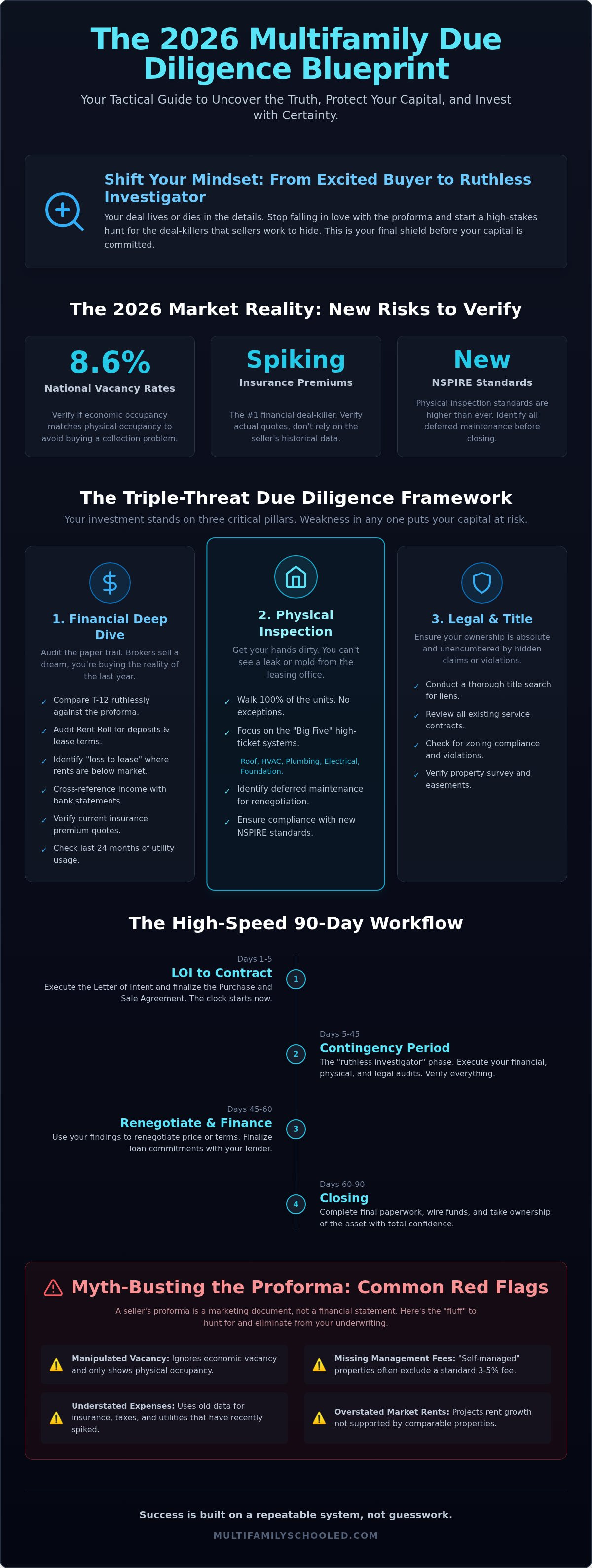
Your deal lives or dies in the details. Most investors fail because they fall in love with the proforma instead of the property. You must shift your mindset immediately from an "excited buyer" to a "ruthless investigator." This isn't a formality; it's a high-stakes search for the deal-killers that sellers work hard to hide. Due diligence is your final shield before your capital is committed to the fire.
To master the tactical execution of this process, watch this expert breakdown of the strategies that protect your downside:
Stop relying on "Desktop Underwriting." Anyone can look at a spreadsheet and dream of returns. Real winners get their hands dirty. You need to walk every unit, touch every pipe, and audit every lease. A multifamily due diligence checklist is your tactical roadmap to ensure no stone is left unturned. In the 2026 market, where interest rates for Fannie Mae 10-year fixed loans sit at 5.99 percent, you can't afford a single error in your underwriting. Precision is your only protection.
What is Multifamily Due Diligence?
It's the comprehensive audit of a property's financial, physical, and legal health. Once you're under contract, the "Contingency Period" starts. Every second counts. You have a limited window to prove your investment thesis is correct or walk away with your earnest money intact. The goal of due diligence is the validation of your investment thesis to ensure the asset can actually perform as projected.
The 2026 Reality: New Risks to Verify
The market has changed. Insurance premium audits are now the number one financial deal-killer. You must verify actual quotes rather than relying on historical data, as many regions are seeing premiums spike. Utility costs are also volatile. Don't trust the seller's "average" bills; check the last 24 months of usage. With national vacancy rates reaching 8.6 percent in early 2026, you must also assess tenant delinquency trends. Is the "economic occupancy" matching the "physical occupancy"? If not, you're buying a collection problem. Use the Multifamily Tool Kit to track these variables and get the "second set of eyes" you need through a professional Mentorship Program.
The Triple-Threat Framework: Financial, Physical, and Legal Verification
Success isn't built on hope. It's built on verified data. Your investment stands on three critical pillars: financial, physical, and legal. If any one of these is weak, your capital is at risk. Treat this framework as your fortress. A comprehensive multifamily due diligence checklist ensures you aren't just buying a building; you're securing an income stream that actually exists.
Financial Deep Dive: The Paper Trail
The T-12 (Trailing 12 Months) is your source of truth. Compare it ruthlessly against the seller's proforma. Brokers are paid to sell a dream, but you're buying the reality of the last year. Audit the Rent Roll to verify security deposits and lease terms. You must identify "loss to lease" where current rents are below market value. Cross-reference every reported dollar with bank statements. If the deposits don't match the reported income, you've found a red flag. Verify insurance quotes immediately. In 2026, premium spikes are common. If your underwriting doesn't account for these increases, your Net Operating Income will vanish before you even take over.
Physical Inspection: Beyond the Surface
Walk every single unit. No exceptions. You can't see a leaking faucet or a moldy corner from the leasing office. Focus on the "Big Five" systems: Roof, HVAC, Plumbing, Electrical, and Foundation. These are the high-ticket items that can turn a profit into a loss overnight. With NSPIRE inspections in full effect as of 2026, your physical standards must be higher than ever. Identify deferred maintenance now so you can renegotiate or walk away before the deal closes. If this process feels daunting, joining a proven Mentorship Program provides the expert guidance you need to spot these physical deal-killers.
Legal and Title Sovereignty
Ensure you actually own what you think you're buying. Review the Title Commitment for hidden liens, easements, or encroachments that could limit your future plans. Check zoning compliance to ensure you aren't violating local laws, especially with new 2026 housing regulations in states like California and Indiana. Audit existing service contracts for landscaping or trash removal. Some contracts contain "poison pills" that make them impossible to cancel without heavy fees. You need total sovereignty over your asset from day one. Don't let a bad contract or a title cloud steal your momentum.
Myth-Busting the Proforma: Uncovering Hidden Liabilities
Brokers are professional dream-sellers. They present a "stabilized" proforma that often ignores the harsh realities of the current market. A common tactic is the 5% vacancy trap. When the national multifamily vacancy rate reached 8.6% in the first quarter of 2026, underwriting at 5% is a recipe for failure. They also frequently understate management fees or omit professional marketing costs entirely. Your multifamily due diligence checklist must serve as a filter for this fiction. Use the Multifamily Tool Kit to re-underwrite the deal with cold, hard facts. Turning these red flags into negotiation leverage is how you secure a price reduction and protect your capital from day one.
Spotting 'Creative' Accounting
You must dig into the general ledger to find what the seller is hiding. It's common to find personal car leases, family cell phone plans, or owner travel expenses buried in the "Repairs and Maintenance" line. These are easy add-backs that increase your value, but you must also look for the inverse. Check for one-time income spikes that won't repeat, such as a large insurance settlement or a massive late fee collection from a single problem tenant. Verify the property tax assessment with extreme caution. Many jurisdictions trigger a reassessment upon sale. If you buy based on the current tax bill, your first-year Net Operating Income will take a massive hit when the new bill arrives. Don't get caught off guard by a tax jump that evaporates your cash flow.
The Capital Expenditure (CapEx) Trap
Underestimating unit turns is a classic rookie mistake that kills deals. Construction costs have increased by approximately 39% since 2020. Budgeting $5,000 per unit when the market demands $8,500 will bankrupt your business plan before you finish the first building. You must also look for the invisible liabilities that don't show up on a proforma. Aging sewer lines, outdated electrical panels, and structural settling are silent profit-killers. Use your inspection period to create a comprehensive 5-year CapEx plan. This plan isn't just for your records; it's your "unfair advantage" at the negotiation table. If you find $200,000 in deferred maintenance, that's $200,000 off the purchase price. Precision in your budgeting is the difference between a successful turnaround and a financial disaster.
The High-Speed Due Diligence Workflow: Lead to Close in 90 Days
Speed is your competitive advantage. Precision is your safety net. In the fast-moving 2026 market, you don't have months to linger on a deal. You have a 90-day window to execute your system and win. This isn't just about moving fast; it's about moving with intent. Use a multifamily due diligence checklist to stay on track while you outpace the competition. Success is attainable for anyone who follows this prescribed system.
Start by leveraging Real Estate Radar to verify market comps in seconds. Don't wait for a broker's report to tell you what a property is worth. Verify the data yourself. You must also build a "DD Dream Team" that includes a battle-tested mentor, a sharp attorney, and a meticulous inspector. This team acts as your second set of eyes, ensuring you never commit capital to a deal with a fatal flaw.
Phase 1: The 48-Hour Rapid Screen
Perform a "Back of the Envelope" check before you commit your time. Does the math hold up? With multifamily interest rates ranging from 5.41% to 12.75% in late 2026, your margins are tighter than ever. Verify the "Value-Add" potential before you spend a dime on professional fees. Due diligence costs for small deals under $10 million typically range from $25,000 to $75,000. Don't waste that capital on a dead deal. Set the tone with the seller immediately. Be professional, fast, and firm. They need to know you're a serious closer, not a tire-kicker.
Phase 2: The On-Site Reconnaissance
This is where your multifamily due diligence checklist becomes your tactical field guide. Schedule the unit walk and bring a high-powered flashlight and a moisture meter. Walk every square inch of every unit. Interview the current property manager to find the "real" problems the owner won't mention. Shadow the maintenance tech to identify the "frequent flyer" units that suffer from constant leaks or electrical issues. This ground-level intel provides the leverage you need to renegotiate the price if the reality doesn't match the proforma.
Ready to master this high-speed system? Join our Mentorship Program today and get the blueprint to close your first deal in 90 days.
Executing with Confidence: The Multifamily Schooled Advantage
Analyzing a complex apartment deal in a vacuum is the fastest way to lose your shirt. You now have the multifamily due diligence checklist, but data without experience is a dangerous gamble. You need the "unfair advantage" that only expert eyes can provide. Don't settle for a "good guess" when you can secure a "guaranteed win." A world-class mentor doesn't just check boxes; they see the traps that sellers and brokers have spent months camouflaging. Success is attainable for anyone who follows our prescribed system. The 90-day clock starts the moment you decide to stop being a spectator and start being an owner.
The Mentorship Program is designed to turn your ambition into a life-transforming journey. We provide a complete ecosystem, from proprietary software to strategic coaching, to ensure your capital is protected. We help you find the deal, vet the numbers, and cross the finish line. This is about more than just one transaction. It is about economic empowerment and the accumulation of assets that provide long-term independence. You have the blueprint. Now, you need the leadership to execute it with total precision.
Mentorship: Your Due Diligence Safety Net
Justin Brennan’s system is built on multi-generational industry expertise. We vet your deals before you ever sign the bottom line. This is your primary defense against the "Beginner’s Tax." These are the expensive, soul-crushing mistakes new investors make when they miss a foundation crack or overlook a $50,000 utility discrepancy. Our 90-day deal guarantee is a proven path from student to apartment owner. We provide a second set of eyes on every line item of your multifamily due diligence checklist. This strategic oversight ensures you only commit your capital to assets that perform exactly as promised. Don't pay for your education through lost deals; invest in a system that works.
Join the Movement
Seize the current opportunity before the market shifts again. The National Multifamily Housing Council estimates a need for 4.3 million new apartments by 2035. The demand is massive, but only the prepared will profit. Register for the next 3-Day Live Workshop to master underwriting in person. You will learn to strip away broker fluff and see the real numbers alongside a community of high-performers. If you want to build your foundation today, take our 5-Day Multifamily Challenge. This is your final call to action. Secure your financial freedom through master-level analysis. Start your journey now.
Take Control of Your Financial Destiny Now
Success in the 2026 apartment market isn't about luck. It's about having a system that forces the truth to the surface. You've learned how to audit the triple-threat pillars and expose broker fluff before it costs you a fortune. This multifamily due diligence checklist is your tactical shield against the hidden liabilities that sink amateur investors. You don't have to analyze in a vacuum or guess your way through a closing anymore.
It's time to stop dreaming and start executing. Under the guidance of multi-generational expert Justin Brennan, you'll gain access to our proprietary Real Estate Radar software to verify every deal with surgical precision. We are so confident in our system that we promise you'll find a deal in 90 days or we'll provide one for you. This is your moment to join a movement of high-performers who are securing their independence one asset at a time. The path to mastery is right in front of you.
Secure Your 90-Day Path to Property Ownership; Join the Mentorship Program Today!
Your future self will thank you for the decisive action you take today. Believe in the system and take the leap. Let's get to work.
Frequently Asked Questions
What is the most critical document to request in multifamily due diligence?
The certified Rent Roll and the Trailing 12-Month (T-12) financial statement are the most critical documents to request immediately. These provide the raw data needed to verify the property's actual performance versus the seller's claims. Without a verified T-12, you're flying blind. You must cross-reference these with bank statements to ensure reported income actually hit the account. This verification is a core step in any professional multifamily due diligence checklist to protect your capital.
How long does the typical due diligence period last for an apartment building?
A typical due diligence period usually lasts between 30 and 45 days, though complex deals may extend to 60 days. In highly competitive markets, sellers often push for shorter windows to increase certainty. You must move with urgency to coordinate inspectors, attorneys, and lenders within this timeframe. Our system emphasizes a high-speed workflow because precision and speed are your greatest competitive advantages when securing high-performing assets in a crowded 2026 market.
What should I do if I find a major structural issue during the inspection?
You have two primary options: renegotiate the purchase price or walk away with your earnest money intact. If an inspector finds a foundation crack or failing roof, get a licensed contractor to provide a firm repair estimate immediately. Use this data as a credit request against the sales price. If the seller refuses to budge on a deal-killing issue, have the confidence to walk. It's better to lose a deal than to inherit a massive financial disaster.
Do I need to walk every single unit in a 50-unit building?
Yes, you must walk every single unit without exception. Sellers often try to hide "down units" or significant damage by showing only a few model apartments. Walking all 50 units allows you to spot consistent plumbing leaks, electrical hazards, or unauthorized tenants. This ground-level data is essential for your multifamily due diligence checklist. It ensures your renovation budget is accurate and prevents expensive surprises after you take ownership. This process helps you invest with absolute certainty.
How do I verify that the seller's rent roll is actually accurate?
Verify the rent roll by requesting tenant estoppel certificates and matching them against the last 12 months of bank deposits. An estoppel is a document signed by the tenant that confirms their current rent, security deposit, and lease terms. If the seller's numbers don't match what the tenants say or what the bank records show, you've found a major red flag. This "hunt for truth" separates successful owners from those who overpay for ghost income.
What is a 'Phase I Environmental Site Assessment' and do I need one?
A Phase I Environmental Site Assessment is a report that identifies potential soil or groundwater contamination from historical property use. Lenders almost always require this to protect their collateral. If the report uncovers issues like old underground storage tanks or chemical spills, you may need a more invasive Phase II study. Skipping this step can leave you liable for millions in cleanup costs. Always ensure environmental safety is a non-negotiable part of your verification process.
Can I renegotiate the purchase price after the due diligence period starts?
You can and should renegotiate if your inspections reveal significant undisclosed liabilities. The due diligence period is your opportunity to find deal-killers that justify a price reduction or a seller credit at closing. If the roof is older than claimed or the insurance premiums are higher than the proforma stated, the original valuation is no longer valid. Use the facts you've gathered to demand a fair adjustment that reflects the property's true condition and actual market value.
How much should I expect to spend on third-party reports during DD?
Expect to spend between $25,000 and $75,000 on third-party reports for deals under $10 million. These costs cover your property condition assessment, Phase I environmental report, appraisal, and legal fees. While these fees seem high, they're a small price to pay to protect millions in investment capital. Professional investors view these costs as an essential insurance policy against buying a lemon. Always budget for these expenses before you sign the Letter of Intent.



