

Multifamily DSCR: The Ultimate 2026 Investor Guide
Your lender doesn't care about your "dream" pro-forma; they care about the math that keeps the doors open. It's frustrating to spend weeks analyzing a deal only to have a bank tell you the debt service coverage ratio multifamily lenders demand isn't there. You're likely tired of the confusion between your projected numbers and the bank's conservative reality. We've all felt that anxiety as interest rates fluctuate between 5.33% and 12.75%, wondering if a deal still makes sense. Stop guessing and start closing.
Mastering this metric is your ultimate shield against bankruptcy and the key to scaling your portfolio safely. This guide will show you exactly how to calculate ratios to meet the 1.25x minimums required by Fannie Mae and the new Freddie Mac Conventional Small program. You'll learn to see your investments through the eyes of a bank, ensuring every deal you present is a winner. We'll break down the secret bank math, explain how to find safety margins in a shifting market, and provide the proven blueprint to find and buy your first apartment building in 90 days.
Key Takeaways
- Understand why lenders prioritize a "cash flow cushion" over appreciation to protect your assets from market volatility.
- Master the debt service coverage ratio multifamily formula to underwrite deals with the same conservative lens used by major banks.
- Navigate the 2026 lending environment by targeting the 1.25x golden standard required for Fannie Mae and Freddie Mac agency financing.
- Discover proven strategies to aggressively boost your Net Operating Income and rescue acquisitions that don't initially meet lender requirements.
- Learn how to use a systematic 90-day blueprint and professional software to identify high-performing deals that lenders are eager to fund.
Why DSCR is the Make-or-Break Metric for Your First Multifamily Deal
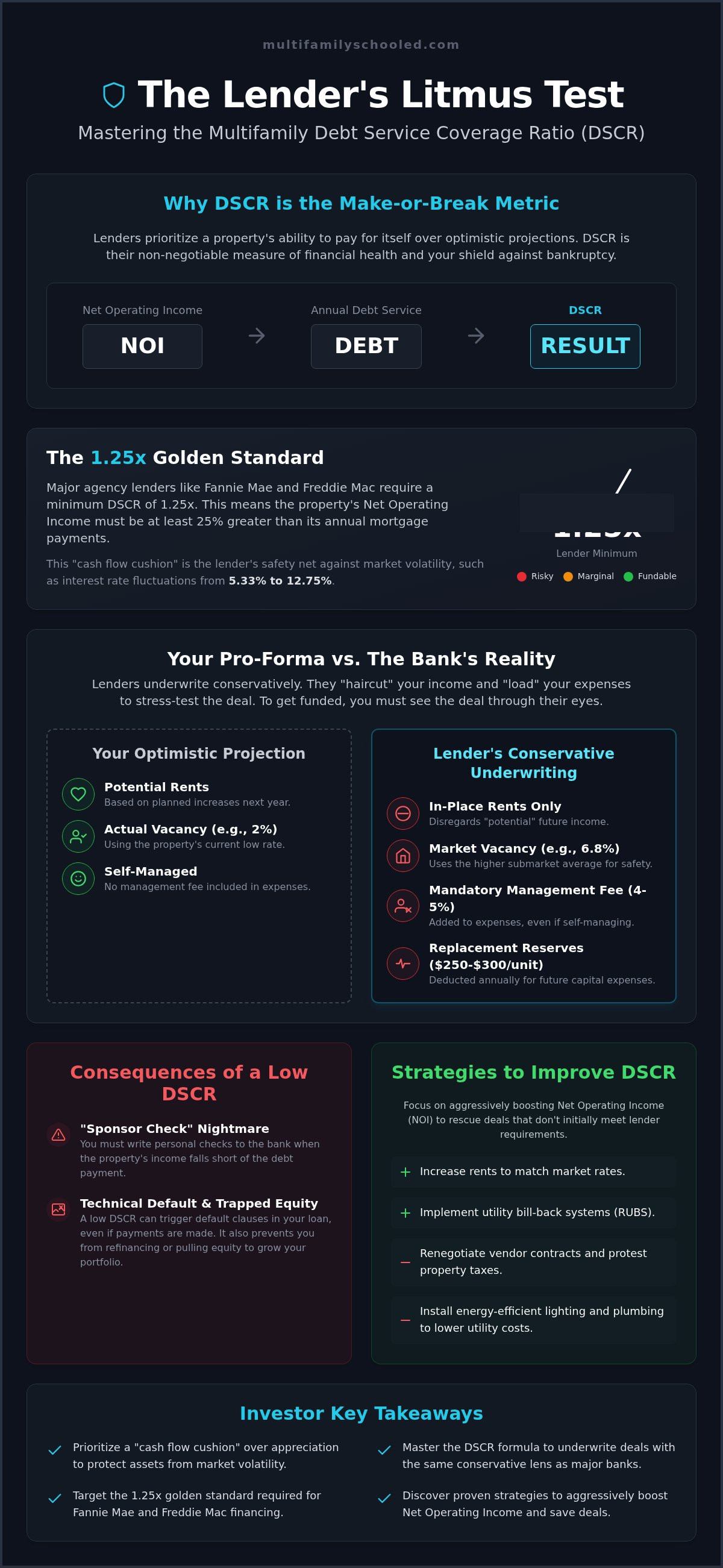
Forget the "dream" pro-forma you spent weeks building. When you step into a lender's office in 2026, they only care about one thing: can this property pay for itself? The Debt Service Coverage Ratio (DSCR) is the ultimate measure of a property's ability to survive. It's the ratio of your Net Operating Income to your annual debt payments. Lenders aren't interested in your vision of future appreciation. They demand a "cushion" between the income the building generates and the check you write to the bank every month. This cushion protects them from market dips, and it protects you from losing everything. In a market where interest rates range from 5.33% to 12.75%, this safety margin isn't optional. It's your license to operate.
Many new investors obsess over the Cap Rate, thinking it's the gold standard of value. While Cap Rates tell you what a property is worth relative to its income, the debt service coverage ratio multifamily lenders require tells you if you can actually own it. Cash flow is king in 2026. A high DSCR represents economic freedom and the ability to scale. A low DSCR means you've just bought yourself a high-stress, low-paying job. You must master this metric to ensure your portfolio is recession-proof from day one.
DSCR vs. Cash Flow: What is the Difference?
Cash flow is the money you keep in your pocket after every expense and mortgage payment is settled. DSCR is the specific requirement the bank sets to ensure that cash flow exists. Think of it like a safety net for a tightrope walker. You might be walking across the rope with $500 in your pocket (positive cash flow), but if the bank requires a 1.25x safety net and your income only covers the debt by 1.10x, they'll pull the net away. A property can technically have positive cash flow but still fail the DSCR test. If the bank isn't satisfied with the margin of safety, your deal is dead before it starts.
The Consequences of Ignoring Your Coverage Ratio
Ignoring your ratio leads to a "Sponsor Check" nightmare. This happens when the building's income drops, and you have to write a personal check to the bank to keep the doors open. Even if you make every payment on time, a low DSCR can trigger a technical default. Most loan documents include debt covenants that allow the bank to call the loan if the property performance slips. You'll also find yourself trapped. A weak coverage ratio prevents you from refinancing or pulling equity to buy your next deal. Don't let a math error stop your 90-day deal-finding momentum. Use the Real Estate Radar AI software to verify these numbers instantly so you never get stuck with a liability instead of an asset.
Mastering the DSCR Formula: How Lenders Actually Underwrite Your NOI
The math behind the debt service coverage ratio multifamily lenders use is deceptively simple. You take your Annual Net Operating Income (NOI) and divide it by your Annual Debt Service. That's the basic calculation. However, the numbers you put into that formula are rarely the numbers the bank uses. Lenders don't care about your optimistic "Pro Forma" projections. They don't care about the "potential" rent increases you have planned for next year. They want to see what the building is doing right now, adjusted for risk. This is where most first-time deals fall apart. You're looking at the future; they're looking at the facts.
Lenders engage in a process called "haircutting" and "loading" during underwriting. They "haircut" your income by assuming higher vacancy and lower collections than you might actually have. Then, they "load" your expenses by adding costs you might have missed or underestimated. Your spreadsheet says the deal is a home run. The bank's term sheet says it's a strikeout. To win, you must learn to underwrite like the bank. If you can't speak their language, you can't get their money. It's time to stop guessing and start calculating with precision.
Calculating the "Lender Version" of NOI
Banks use standardized benchmarks to protect their capital. If your property has a 2% vacancy rate but the submarket average is 6.8% as of Q2 2026, the lender will likely use the higher number. They also insist on a mandatory management fee, typically between 4% and 5% of gross income. It doesn't matter if you plan to self-manage for free. The bank assumes a professional will eventually need to take over. Additionally, they'll deduct replacement reserves of $250 to $300 per unit annually. This ensures there's money for new roofs and water heaters. If you want to see how these adjustments impact your deal instantly, you can leverage Real Estate Radar AI software to run the numbers like a pro.
Determining Total Annual Debt Service
The bottom half of the formula is your total annual debt service. This includes both principal and interest payments. In 2026, lenders are applying aggressive interest rate stress tests. Even if your quoted rate is 6%, the bank might stress the deal at 7% or 8% to ensure it remains viable if rates climb. If you're using mezzanine financing or hard pay preferred equity, those costs must be factored in too. Every dollar of debt service eats into your ratio. If your debt service is $100,000 and your underwritten NOI is $125,000, your DSCR is exactly 1.25x. That's the edge of the cliff. Give yourself more room to breathe by finding deals with stronger margins.
The 1.25 Standard: Navigating Lender Requirements and Debt Covenants
In institutional financing, 1.25x isn't just a number. It's the "Golden Standard." For Fannie Mae and the updated Freddie Mac Conventional Small program, this debt service coverage ratio multifamily requirement is non-negotiable. If your property doesn't produce at least $1.25 in underwritten income for every $1.00 of mortgage payment, the bank will cut your loan amount. This creates a "leverage constraint." You might dream of an 80% Loan-to-Value (LTV) deal, but if the income isn't there, the lender will force you down to 70% or 65% to protect their position. You must identify these constraints before you're too deep in due diligence.
Market conditions change the game constantly. While some bridge loans might allow a temporary dip to 1.15x during a value-add phase, permanent debt is far more conservative. Some lenders in volatile markets even push requirements to 1.35x. You aren't just fighting for an approval; you're fighting for the best terms. High-performance deals with strong coverage ratios give you the leverage to negotiate lower interest rates and better amortization periods. Don't settle for a deal that barely clears the hurdle. Aim for a margin that makes you the lender's favorite client.
Agency Loans vs. Local Bank Requirements
Agency lenders follow a rigid playbook. They categorize markets into tiers, and your required ratio often depends on where your property sits. A Tier 1 metro area might allow a tighter margin, while a Tier 4 rural market will face much stricter scrutiny. Local banks and credit unions offer a different path. They value relationships. If you've shown you can find and buy buildings in 90 days, a local lender might offer flexibility that Fannie Mae won't. They may accept a 1.20x ratio if they trust your local market expertise and management strategy. Your experience is a currency. Use it to find the best financing fit for your portfolio.
Understanding DSCR as a Loan Covenant
The closing table isn't the finish line. Most commercial loans include "ongoing covenants" that allow the bank to monitor your property's health. If your performance slips, you risk a "Technical Default." You've made every payment on time, but your debt service coverage ratio multifamily fell below the agreed threshold. This can trigger a "Cash Trap" provision. Suddenly, the lender takes control of all excess revenue, preventing you from paying investors or making improvements. You must read the fine print in your loan documents. Look for these specific clauses:
- Springing Covenants: Triggers that activate only if the market shifts or occupancy drops.
- Reporting Requirements: Deadlines for submitting your T-12 and rent rolls to the bank.
- Cure Periods: The amount of time you have to fix a ratio violation before the bank calls the loan.
- Debt Yield Minimums: A secondary metric lenders use to ensure the property isn't over-leveraged.
Strategies to Improve Your DSCR and Rescue Your Acquisition
Your lender just called. They're cutting your loan amount because the deal doesn't pencil. Don't panic. A low debt service coverage ratio multifamily score isn't a deal-breaker; it's an invitation to innovate. You can rescue your acquisition by aggressively attacking both sides of the mathematical equation. You have the power to shift the numbers in your favor before you even reach the closing table. If the deal has strong fundamentals, these strategies will help you bridge the gap between a "no" and a funded deal.
With rent growth slowing in 2026, you can't just hope for organic appreciation. The average U.S. rent sat at $1,741 in January 2026. If you can't push rents, you must find other ways to expand your margin. You need a systematic approach to forced appreciation that lenders will recognize and respect. This requires looking past the surface level of the profit and loss statement to find hidden value that the previous owner ignored.
Boosting the Numerator: Revenue and Expense Optimization
Focus on the income side first. Implementing a Ratio Utility Billing System (RUBS) is the fastest way to spike your Net Operating Income. By shifting the cost of water, sewer, and trash back to the tenants, you immediately reduce your operating expenses. This isn't just a suggestion; it's a requirement for high-performance portfolios. Lenders love seeing RUBS because it makes the property more resilient to utility rate hikes.
Look for ancillary income streams that add up quickly. Storage locker rentals, reserved parking fees, and upgraded laundry facilities can add thousands to your annual revenue. On the expense side, be relentless. Audit every line item. Appeal your property tax assessment based on the purchase price if it's favorable. Shop your insurance with multiple brokers to find a better rate. Every dollar you save in expenses is a dollar that directly improves your coverage ratio. If you need to see how these changes impact your deal in real-time, use Real Estate Radar AI software to run the numbers instantly.
Lowering the Denominator: Financing Adjustments
If you've maxed out the numerator, you must attack the debt service. Negotiate for an Interest-Only (IO) period. Getting 12 to 24 months of IO can drastically lower your annual debt service, pushing your ratio well above the 1.25x mark. This gives you time to implement your value-add plan and stabilize the asset before the principal payments kick in. It's a powerful tool for rescuing deals that are tight on day one.
Consider requesting a longer amortization schedule. Shifting from a 25-year to a 30-year amortization spreads the principal over a longer timeline, which lowers your monthly obligation. You might also consider the bridge-to-permanent strategy. Use short-term debt to renovate and boost your NOI, then refinance into long-term agency debt once your debt service coverage ratio multifamily is rock solid. To master these complex financing maneuvers, join our Mentorship Program and learn the exact system we use to secure funding in any market environment.
Get Funded in 90 Days: Join the Multifamily Schooled Movement
You've seen the numbers. You understand that a 1.25x ratio is the baseline for safety in a market where interest rates can swing up to 12.75%. Now, you must execute. Knowledge without action is just a hobby; in 2026, hobbies are expensive. Analysis paralysis is the only thing standing between you and your first apartment building. You don't need another spreadsheet. You need a proven vehicle to reach the closing table. Our system removes the guesswork so you can move with total confidence and build a portfolio that stands the test of time.
The 2026 market is complex. High supply is slowing rent growth, but demand remains massive due to the housing affordability gap. This environment creates incredible opportunities for those who know where to look. You can't rely on the same tired "on-market" deals that everyone else is fighting over. You need a strategy that targets high-margin assets before the rest of the world even knows they're for sale. Stop waiting for the perfect moment. Create it by following a roadmap that has already been tested and refined.
The 90-Day Deal Finding Blueprint
We don't just teach theory; we provide a tactical execution plan. Our blueprint is designed to help you find off-market deals where the debt service coverage ratio multifamily lenders require is actually achievable. Most investors fail because they look at properties with compressed margins and "skinny" cash flow. We show you how to identify motivated sellers and value-add opportunities that allow you to force appreciation and boost your NOI rapidly. This is the exact path to securing your first deal in just three months.
If you're ready to stop watching from the sidelines, the 5-Day Multifamily Challenge is your perfect entry point. It's a high-intensity immersion into the world of large-scale investing. You'll learn the proprietary methodologies used by industry leaders to vet properties in minutes. Don't let another quarter slip by without adding units to your name. Join the 90-Day Mentorship and start your journey toward economic empowerment today.
Leveraging AI for Instant Deal Analysis
Speed wins deals. Delay kills them. In a competitive market, the investor who underwrites the fastest usually gets the contract. Real Estate Radar AI was built to solve this exact problem. It automates the complex underwriting process, including the "haircutting" and "loading" adjustments that banks use. You can calculate the debt service coverage ratio multifamily lenders expect for any property with a few clicks. This allows you to filter through hundreds of leads and focus only on the ones that will actually get funded.
Using AI gives you a strategic advantage that traditional investors simply can't match. You'll know the bank's answer before you even submit your LOI. This level of precision is how you scale a portfolio safely without risking a technical default or a cash trap. Your path to financial independence starts with the first deal; don't let the math stop you. Analyze Deals with Real Estate Radar AI and see how easy it is to spot high-performance opportunities in real-time.
Master the Math and Secure Your Legacy
The numbers don't lie, and in 2026, they're your only path to true independence. You now have the blueprint to navigate the debt service coverage ratio multifamily requirements that keep most beginners on the sidelines. Remember that the 1.25x standard is your shield. It protects your cash flow and ensures your portfolio can withstand any market shift. Don't let another day pass over-analyzing deals that don't pencil. It's time to step into the role of a sophisticated investor who speaks the bank's language and closes with absolute certainty.
You don't have to do this alone. Get direct guidance from Justin Brennan and leverage our proprietary Real Estate Radar AI software to spot high-margin opportunities instantly. We're so confident in our system that we promise you'll find a deal in 90 days or we'll find one for you. Stop letting fear and confusion hold you back from the life you deserve. STOP GUESSING AND START INVESTING: Join the 90-Day Mentorship Program Now! Your future self will thank you for the massive action you take today. Let's get to work.
Frequently Asked Questions
What is a good DSCR for a multifamily property?
A 1.25x ratio is the golden standard for agency lenders like Fannie Mae in 2026. This means the property generates 25% more income than the debt requires. While 1.25x gets you in the door, a "good" ratio for maximum safety and leverage is 1.35x or higher. Aiming for this higher margin gives you a buffer against market dips and rising expenses. It makes you a low-risk borrower lenders are eager to fund.
Can I get a multifamily loan with a DSCR below 1.25?
Yes, but you'll likely step outside of agency financing. While Fannie and Freddie are rigid, some local banks or bridge lenders might accept 1.15x to 1.20x for value-add deals. These loans often come with higher interest rates or shorter terms. You'll need a clear plan to boost the property's income quickly. Once you stabilize the asset and hit that 1.25x mark, you can refinance into long-term, lower-cost debt.
How does interest rate affect my debt service coverage ratio?
Interest rates directly impact your debt service, which is the denominator in the debt service coverage ratio multifamily formula. When rates rise, your annual debt payments increase. This causes your DSCR to drop even if your income stays the same. With 2026 rates ranging from 5.33% to 12.75%, you must stress test every deal. A small rate hike can turn a funded deal into a rejected application instantly.
What is the difference between DSCR and a Cap Rate?
Cap Rate measures a property's yield relative to its purchase price, assuming you paid all cash. DSCR measures the property's ability to cover its specific mortgage debt. A high Cap Rate suggests a good value, but it doesn't guarantee you can get a loan. Lenders prioritize DSCR because it tells them if the building can pay for itself. You need both metrics to confirm a deal is profitable and fundable.
Does DSCR include property taxes and insurance?
Yes, indirectly. Property taxes and insurance are critical operating expenses that are subtracted from your gross income to calculate Net Operating Income (NOI). Since DSCR is NOI divided by debt service, these costs directly affect the numerator. If your insurance premiums spike, your NOI drops, and your coverage ratio follows. Lenders always audit these line items carefully to ensure your underwritten income is realistic and sustainable.
How often do lenders check my DSCR after the loan closes?
Most commercial lenders require annual financial statements to verify your ongoing compliance. They'll review your T-12 and rent rolls to ensure the building is still meeting the debt covenants agreed upon at closing. Some bridge lenders or high-leverage programs might check quarterly. If your ratio slips below the required threshold, it could trigger a technical default or a cash trap. Always keep your books clean and your performance high.
What happens if my DSCR falls below 1.0?
A ratio below 1.0 means the property is losing money and cannot pay its own mortgage. This is a critical failure. You'll have to pay out of pocket to cover the shortfall, often called a "Sponsor Check." Lenders will likely declare a default and may take control of the property's revenue. You'll be unable to refinance or sell without bringing cash to the table. Avoid this nightmare by using conservative underwriting from day one.
Can I use a DSCR calculator for apartment buildings?
You can use basic calculators, but they often miss the "haircuts" and "loads" that lenders apply. For a professional result, you need a system that mimics bank underwriting. Our Real Estate Radar AI software automates this entire process for you. It factors in submarket vacancy and mandatory reserves to give you a real-world look at your deal. Speed is your advantage. Stop wasting time on manual math and start using professional tools.



