

Multifamily Debt Service Coverage Ratio: The Investor’s Ultimate Guide (2026)
Your lender doesn't care about your "gut feeling" or how beautiful the landscaping looks. They only care about one specific number. It's the ultimate green light for your real estate empire. You've likely felt that spike of anxiety when staring at complex financial spreadsheets. It is frustrating to find a property you love only to wonder if a bank will actually fund it. You want financial freedom, but the fear of a bad deal or a cold rejection can keep you on the sidelines. This guide will turn that confusion into total confidence. You'll master the multifamily debt service coverage ratio to ensure every deal you touch is profitable and bulletproof. We are going to dive into the 2026 benchmarks, the exact math you need to talk to lenders, and the strategies our mentors use to get deals funded in 90 days or less. By the end of this, you'll know exactly how to filter for winning properties and build a legacy of sound, cash-flowing investments. Let's get to work.
Key Takeaways
- Master the multifamily debt service coverage ratio to understand exactly how lenders evaluate your risk and potential.
- Discover why 1.25x is the critical 2026 benchmark for securing the most competitive financing in today's market.
- Learn the proven value-add strategies to force appreciation and significantly boost your property's cash flow.
- Stop guessing with manual spreadsheets and use proprietary software to analyze complex deals in seconds.
- Execute a systematic blueprint to find, fund, and close your first apartment building in just 90 days.
What is Multifamily Debt Service Coverage Ratio (DSCR)?
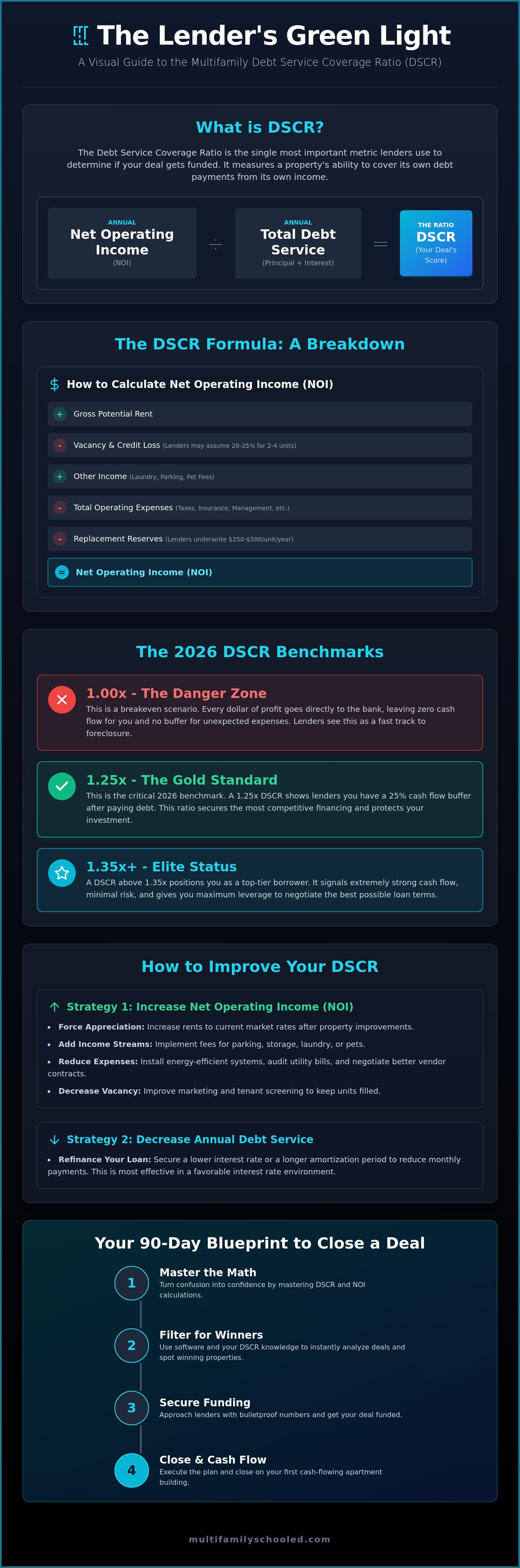
Stop looking at gross rent. It's a vanity metric that will lead you into a trap. If you want to scale your portfolio and achieve true independence, you must master the Debt Service Coverage Ratio (DSCR). This is the "Green Light" metric that determines if your deal lives or dies. Simply put, the multifamily debt service coverage ratio is the ratio of a property's annual Net Operating Income (NOI) to its total annual debt service.
Lenders obsess over this number because it's the most accurate predictor of default risk. They don't care about your passion; they care about the property's ability to pay its own bills. From an investor's perspective, a high ratio is your armor. It protects your cash flow from the inevitable swings of the market. You aren't just buying a building; you're buying a predictable income stream that must remain profitable even when the economy shifts.
To see exactly how lenders use this metric to size your loan, watch this breakdown:
The Core Purpose of DSCR in Real Estate
DSCR serves three vital functions in your 90-day deal-finding journey. First, it dictates the maximum loan amount you can secure. In 2026, lenders often prioritize DSCR over Loan-to-Value (LTV) when credit markets tighten. Second, it provides a safety cushion. This margin ensures you can handle a sudden HVAC repair or a 10% vacancy spike without dipping into your personal savings. Finally, it allows you to compare different multifamily deals on an apples-to-apples basis. It levels the playing field so you can spot the winners instantly and ignore the duds.
Why 1.00 is the 'Danger Zone'
A ratio of 1.00 is a ticking time bomb. It means every single dollar of profit goes straight to the bank. You are left with zero profit for yourself and no room for error. This "breakeven" trap is exactly how amateur investors lose everything during a downturn. In 2026, lenders demand a margin of safety. They typically require a minimum of 1.20x to 1.25x for stabilized properties. They know that a 1.00 ratio isn't just risky; it's a fast track to foreclosure. Don't settle for "just enough." Build a margin that makes your investments unstoppable.
The Multifamily DSCR Formula: Math Made Simple
Math is the language of the wealthy. If you want to play at the highest level and secure the lifestyle you deserve, you must speak it fluently. The multifamily debt service coverage ratio formula is your primary tool for separating gold mines from money pits. Don't let the spreadsheets intimidate you. It's a simple calculation that tells you exactly how much breathing room your property has after the bank gets its cut.
The formula is: DSCR = Annual Net Operating Income (NOI) / Annual Debt Service. You must use annual figures for this calculation. Monthly numbers fluctuate too much to be reliable. Annualizing your data accounts for seasonal spikes in utility costs or one-time maintenance hits. It gives you the "big picture" view that lenders demand in 2026. Without an annual view, you're just guessing, and guessing is the fastest way to go broke in this industry.
Calculating Net Operating Income (NOI) Correctly
Your NOI is the engine of your investment. To find the true number, start with your Gross Potential Rent. This is the total income if every unit was occupied at market rates. Next, subtract vacancy and credit losses. In the current 2026 market, lenders are applying aggressive vacancy "haircuts," often between 20% and 25% for smaller 2-4 unit properties. For 5+ unit commercial deals, focus on stabilized NOI rather than just current collections.
Don't forget to add "other income." This includes laundry machines, reserved parking, and pet fees. Finally, subtract every operating expense. This includes property taxes, insurance, management fees, and routine maintenance. One critical detail: always include annual replacement reserves. For properties with 5 or more units, 2026 lenders typically underwrite with $250 to $500 per unit to cover future capital expenditures. This ensures your deal is actually safe to purchase.
What Counts as 'Debt Service'?
Debt service is the total amount of principal and interest you pay on all mortgage liens over a 12-month period. If you have a second mortgage or a bridge loan, include those payments too. It's vital to remember that property taxes and insurance are usually handled in the NOI section, not here. Including them twice will crush your ratio and kill a perfectly good deal.
Be strategic with interest-only periods. They can make your cash flow look incredible on paper, but savvy lenders will often underwrite based on the fully amortizing payment. They want to know the deal works even when the principal payments kick in. If you want to stop guessing and start analyzing like a pro, use our Deal Finding Software to run these numbers instantly and keep your momentum high.
What is a 'Good' DSCR for Multifamily Properties in 2026?
Lenders aren't your friends. They're your partners in risk. To win their trust and their capital, you must present a deal that breathes easily. In the 2026 market, a 1.25x multifamily debt service coverage ratio is the universal baseline for stabilized properties. This isn't just a random suggestion. It's the threshold where lenders start offering better pricing and more favorable loan terms. If your deal sits at 1.25x, it means you have 25% more income than you need to cover the mortgage. That's the margin of safety that keeps you in the game when others are failing.
Location dictates the cushion you need. Tier 1 markets like major metropolitan hubs often allow for a tighter 1.20x ratio because the demand is consistent. However, if you're looking at Tier 2 or Tier 3 markets, banks will likely demand a 1.30x or higher. They want protection against the higher volatility of smaller economies. If you can hit the "Golden Ratio" of 1.35x or above, you've reached the promised land. At this level, you aren't just getting funded; you're dictating terms. You'll secure the lowest interest rates and the highest leverage because your deal is undeniably bulletproof.
Agency vs. Bank Requirements
Agency lenders like Fannie Mae and Freddie Mac are the gold standard for long term wealth. They typically stick to a strict 1.20x to 1.25x requirement. If you're pursuing affordable housing, HUD programs offer a massive advantage with minimums as low as 1.11x to 1.176x. Local community banks provide more flexibility. They might accept a lower ratio if you have a strong personal track record or a deep relationship with them. Bridge loans are different. They often ignore current low DSCRs for value-add deals, but they'll underwrite strictly based on what the ratio will be once you've stabilized the property.
The Impact of Amortization on Your Ratio
Amortization is the hidden lever of your multifamily debt service coverage ratio. Most commercial loans use a 25-year or 30-year schedule. Choosing a 30-year amortization lowers your annual principal payments. This reduces the denominator in your DSCR calculation and makes your ratio look significantly healthier to a lender. It's a strategic move to secure higher loan amounts. While a shorter term builds equity faster, a longer term maximizes your cash flow and makes your deal easier to fund. Balance your long term equity goals with the immediate necessity of getting the deal across the finish line. Master this math, and you'll close your first deal in 90 days with total confidence.
How to Improve Your DSCR to Secure the Best Funding
A weak ratio is not a "no." It's a challenge to your creativity. If you find a property in a prime location with a failing multifamily debt service coverage ratio, you've found a potential gold mine. Most amateurs will walk away. You will fix it. You have the power to manipulate both the numerator and the denominator to force this deal into the "Green Light" zone. This is where you transform from a spectator into a high-performance investor who builds a legacy of wealth.
The Revenue Side: Boosting the Top Line
Forced appreciation is the heart of multifamily success. Start by identifying renovations that justify immediate rent premiums. A $5,000 kitchen upgrade can often yield a $150 monthly rent increase. Across a 50-unit complex, that's $90,000 in additional annual income. Look for ancillary income streams that others overlook. Can you add covered parking? Can you install high-speed internet and charge a convenience fee? Every dollar added to the top line makes your DSCR look better to a lender.
Reducing economic vacancy is just as vital. If your management is slow to turn units, your ratio suffers. Implementing a Ratio Utility Billing System (RUBS) is the ultimate secret weapon. By billing tenants for their share of water, sewer, and trash, you instantly move those costs off your books. This shift directly increases your NOI. To find these hidden leaks in your budget, use the Multifamily Tool Kit to audit your property costs with surgical precision. Stop guessing and start optimizing.
The Debt Side: Optimizing the Bottom Line
Sometimes the property is performing well, but the debt is too expensive. You can rescue a borderline DSCR by negotiating better terms. Consider buying down the interest rate with points. In 2026, interest rates for mixed-use and multifamily loans typically range from 7.75% to 9.75%. Spending a little capital upfront to lower that rate can drastically reduce your annual debt service. This move alone can push a deal from rejection to approval.
Another powerful move is exploring interest-only (IO) periods. By removing the principal component of the payment for the first few years, your DSCR will skyrocket. This gives you the runway needed to execute your value-add plan and stabilize the property. You can use Real Estate Radar to find properties that already have high-yield potential or assumable debt. Don't let a great deal slip through your fingers because of a spreadsheet error. Join our Mentorship Program and learn the exact frameworks we use to turn "maybe" deals into funded empires.
Master Multifamily Math and Close Your First Deal in 90 Days
Stop guessing. Manual spreadsheets are the enemy of speed. They are the graveyard where great deals go to die. If you are still punching numbers into a clunky Excel file, you are losing to faster, more agile investors. Speed is the ultimate currency in 2026. You need to know if a deal is a "Green Light" before the broker even finishes their pitch. Technology allows you to analyze the multifamily debt service coverage ratio in seconds, not hours. This isn't just about efficiency; it's about survival. By the time your competitor finishes their formula, you should already be on the phone with the lender. Mastery of this metric gives you the power to act while others hesitate.
Automate Your Due Diligence
Fear of the math stops most people before they even start. You don't need a finance degree to build an empire. You need the right system. Automation eliminates human error and gives you the confidence to move with total certainty. Use the Multifamily Tool Kit to access professional analysis templates that do the heavy lifting for you. These tools allow you to quickly filter through hundreds of listings to find those 1.25x gems that meet strict 2026 lender requirements. When the math is automated, your only job is to execute. You can stop worrying about the decimals and start focusing on your legacy. Technology is the bridge between where you are and where you want to be.
The 90-Day Blueprint to Ownership
Mastering the multifamily debt service coverage ratio is your ticket to the inner circle. Lenders smell uncertainty, but they respect data. When you present a professional DSCR analysis, the dynamic of the conversation changes instantly. You aren't a dreamer asking for a favor; you're a strategist presenting a low-risk opportunity. This level of authority is exactly what our Mentorship Program is designed to provide. You'll learn the "banker's language" from multi-generational industry experts who have closed thousands of units.
This mastery accelerates your path from "looking" to "closing" in record time. Our 90-day blueprint is a proven system that removes the guesswork from the acquisition process. You don't have to navigate the complexities of the 2026 market alone. We provide the tools, the frameworks, and the guidance to ensure your first deal is both funded and profitable. Don't let another month pass you by while you sit on the sidelines. The path to financial freedom is paved with sound, funded investments. Start your journey today at Multifamily Schooled and take control of your economic future.
Take Control of Your Financial Empire
You now hold the master key to multifamily success. You've moved beyond the fear of lender rejection and the confusion of complex spreadsheets. By mastering the multifamily debt service coverage ratio, you can speak the language of banks with total authority. You know that 1.25x is your baseline for safety and that 1.35x is your ticket to elite financing. You've seen how to force appreciation and use technology to outpace every other investor in the market. Knowledge is powerful, but decisive action is what builds a legacy.
Don't let this momentum fade. You have a choice to make. You can continue guessing on your own, or you can follow a proven system with a track record of success. Get expert guidance from industry veterans and use our proprietary Deal Finding Software to find your "Green Light" deal in record time. We are so committed to your success that we guarantee you'll find a deal in 90 days or we'll provide one for you. Secure Your Future: Join the 90-Day Mentorship Program and start your journey toward true independence. Your empire starts today. Let's go win.
Frequently Asked Questions
Is a higher DSCR always better for an investor?
Not necessarily. A sky-high ratio means you aren't using enough leverage to maximize your cash-on-cash returns. While a 2.0x ratio is incredibly safe, it suggests your capital is sitting idle rather than building your empire. Aim for the "sweet spot" around 1.30x to 1.50x. This provides a massive safety cushion while still allowing you to scale your portfolio at a rapid pace.
What is the difference between DSCR and Cap Rate?
Cap rate measures property value based on income, while DSCR measures the ability to pay debt. Cap rate is your NOI divided by the purchase price. DSCR is your NOI divided by the annual debt service. Use the cap rate to evaluate the deal's price and use the multifamily debt service coverage ratio to evaluate the loan's risk and your margin of safety.
Can I get a multifamily loan if my DSCR is below 1.20?
Yes, but you'll need a strategic approach. HUD financing programs allow for lower minimum ratios, sometimes as low as 1.11x to 1.176x for affordable housing deals. You can also look at bridge loans or local community banks that offer more flexibility. Expect to pay higher interest rates or bring more cash to the table if you dip below the 1.20x standard.
How does vacancy affect the DSCR calculation?
Vacancy directly reduces your Net Operating Income, which causes your ratio to drop. Lenders apply a "haircut" to your gross rental income to account for this risk. In the 2026 market, lenders often apply vacancy factors between 20% and 25% for smaller 2-4 unit properties. For larger commercial assets, they typically underwrite based on stabilized NOI rather than just your current collections.
Does DSCR include personal income or just property income?
Commercial multifamily loans focus strictly on the property's ability to generate cash flow. Your personal salary or other business ventures don't factor into the calculation for properties with five or more units. Lenders want to see that the asset can stand on its own. For 1-4 unit residential rentals, your personal debt-to-income ratio still plays a major role in the approval process.
What happens to my DSCR if interest rates rise?
Rising interest rates increase your annual debt service, which causes your ratio to drop instantly. If you have a variable-rate loan, a spike in rates could push you into the "danger zone" below 1.00. This is why fixing your rate or buying an interest rate cap is vital for your long-term stability. Always stress-test your numbers before signing the closing documents.
Is DSCR the same for commercial and residential multifamily?
No. In commercial deals with 5+ units, the multifamily debt service coverage ratio is the primary metric for sizing the loan. In residential multifamily with 2-4 units, lenders rely more on your personal credit and debt-to-income ratio. Commercial lenders prioritize the building's performance; residential lenders prioritize the borrower's personal financial history and creditworthiness.
How often do lenders check DSCR after the loan is closed?
Most commercial lenders require annual financial statements to verify your property is still performing. If your ratio falls below a certain "covenant" level, the bank might require you to set up a cash trap or pay down the principal. Stay proactive with your property management to keep your numbers strong. Consistent reporting builds trust and opens the door for future funding opportunities.



