

Multifamily Deal Analyzer Spreadsheet: Your Blueprint for 2026 Apartment Wealth
Why are 82% of multifamily investors planning to expand their portfolios right now, even while national vacancy rates hit 6.8%? They aren't guessing. They're using a proven system to find the signal in the noise. You've likely felt the weight of analysis paralysis while staring at a potential deal. It's the fear that a hidden insurance spike or a miscalculated cap rate will turn your dream investment into a financial nightmare. You want a clear roadmap to replace your 9-to-5 income, but the math feels like a wall.
Stop guessing. Start winning. This multifamily deal analyzer spreadsheet is your blueprint for 2026 apartment wealth. It transforms complex data into a clear path to financial freedom. You'll gain the confidence to pull the trigger on a deal and present professional-grade analysis to any partner. We'll dive into 2026 market benchmarks, navigate the new 21st Century ROAD to Housing Act, and master the metrics that actually matter for your bottom line. Your journey to asset ownership starts with the right numbers.
Key Takeaways
- Learn why Cash on Cash Return is the single most important metric for replacing your salary and achieving true financial independence.
- Master the five critical steps to input data into your multifamily deal analyzer spreadsheet to eliminate guesswork and avoid hidden costs.
- Discover the 2026 benchmarks for "acceptable" returns and why the 8-12% CoC gold standard remains your target for serious wealth.
- Unlock high-octane strategies like forced appreciation and value-add renovations to aggressively explode your property’s net operating income.
- Move from analysis to ownership in just 90 days by following a proven, systematic blueprint that bridges the gap between math and execution.
Why a Multifamily Deal Analyzer is the Speedometer of Financial Freedom
A multifamily deal analyzer spreadsheet isn't just a collection of cells and formulas. It's a predictive engine for your future wealth. Most investors treat analysis like a chore. They're wrong. Analysis is the heartbeat of every successful acquisition. It's the difference between a high-performing asset and a financial anchor. To master real estate investing principles, you must stop viewing properties as buildings and start viewing them as math problems. If the math doesn't work, the deal doesn't exist. Stop guessing and start knowing.
The Passive Income Reality Check
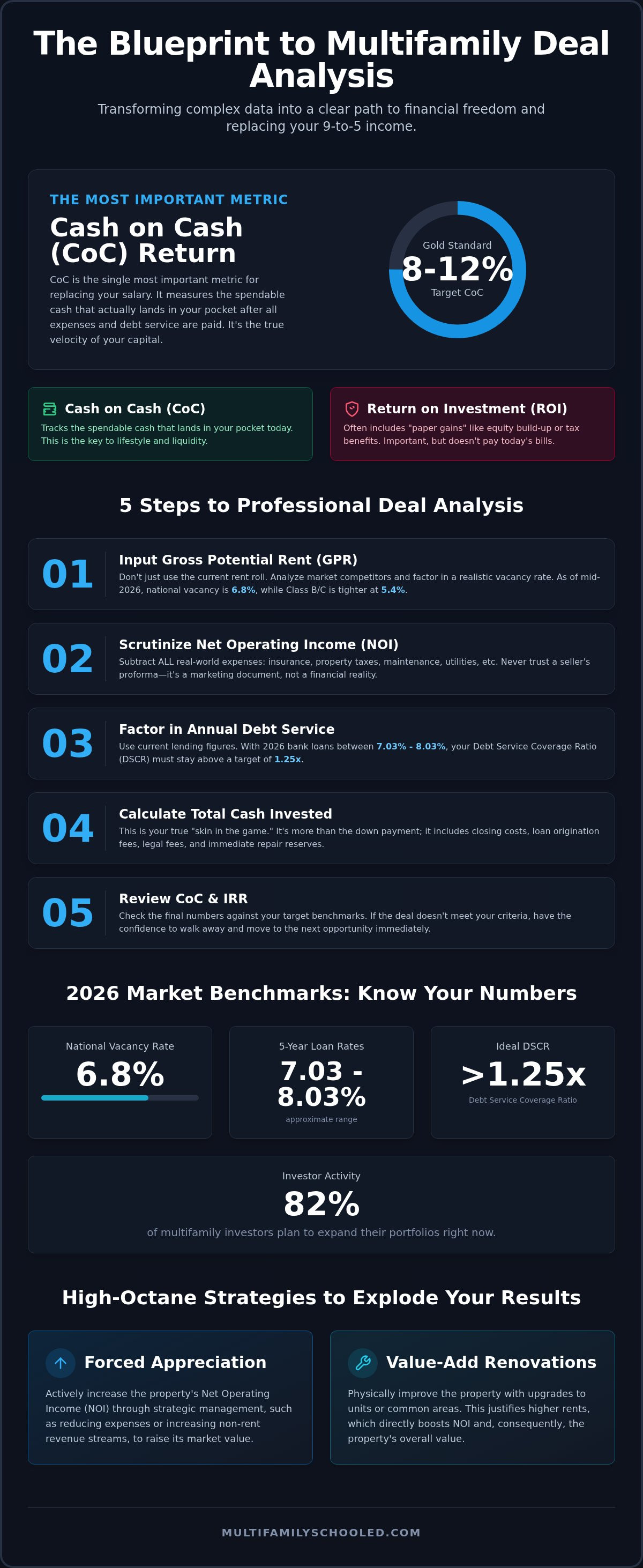
Banking on market appreciation is a rookie mistake in 2026. The market is uneven. Gateway metros are currently outperforming the Sun Belt, and new supply is flooding certain regions. You can't control the market, but you can control your entry point. With national vacancy rates hitting 6.8% in mid-2026, you need precision. Cash on Cash Return (CoC) is your primary metric because it measures the velocity of your capital. It tells you exactly how fast your money works to replace your 9-to-5 income. A deal analyzer is a high-performance filter designed to ensure your path to financial independence is grounded in reality rather than hope.
CoC vs. ROI: Tracking What Actually Lands in Your Pocket
Don't get distracted by Return on Investment (ROI). ROI often includes paper gains like equity build-up or tax benefits. Those metrics are important, but they don't pay your mortgage today. CoC tracks the spendable cash that actually lands in your pocket after all expenses and debt service are paid. High-equity deals can still leave you "house poor" if your monthly cash flow is thin. Using a professional tool like the Multifamily Tool Kit protects your lifestyle during market shifts. It ensures you have the liquidity to survive rising insurance costs, which averaged $777 per unit earlier this year.
Establish a 90-day mindset right now. Analysis paralysis is the silent killer of dreams. Your spreadsheet is meant to drive immediate action, not provide an excuse for delay. If the numbers hit your target, you must move. The window for seizing current opportunities is narrow. Use the data to gain the confidence you need to pull the trigger. Mastery comes through execution. Start your 90-day clock today.
5 Steps to Using Your Deal Analyzer Spreadsheet Like a Pro
Stop treating your analysis like a hobby. Professional results require professional tools. If you want to replace your income in 90 days, you must master the mechanics of your multifamily deal analyzer spreadsheet. Follow these five steps to ensure you aren't just buying a building, but securing an asset that produces real wealth.
- Step 1: Input Gross Potential Rent (GPR). Don't just look at today's rent roll. Look at market competitors. Factor in a realistic vacancy rate. As of mid-2026, national vacancy sits at 6.8%, though Class B and C properties are tighter at 5.4%.
- Step 2: Scrutinize the Net Operating Income (NOI). Subtract every real-world expense. Include everything from insurance to property taxes.
- Step 3: Factor in annual debt service. Use current 2026 lending figures. With 5-year bank loans currently ranging between 7.03% and 8.03%, your debt service coverage ratio (DSCR) should ideally stay above 1.25x.
- Step 4: Calculate Total Cash Invested. This is your "skin in the game." It includes your down payment, closing costs, and immediate capital expenditures.
- Step 5: Review the CoC and IRR. Check these against your 90-day target. If the numbers don't hit your benchmark, move to the next deal immediately.
Calculating Total Cash Invested: The Silent ROI Killer
Your down payment is only the beginning. Rookie investors ignore the "soft" costs that bleed a deal dry. You must factor in loan origination fees, legal costs, and immediate repair reserves. This total sum is your "denominator." If you underestimate this number, your actual Cash on Cash return will be significantly lower than projected. You can use the Multifamily Tool Kit to automate these complex calculations and keep your analysis honest.
NOI Accuracy: Stop Guessing, Start Owning
Never trust a seller’s proforma. It's a marketing document, not a financial reality. Sellers often omit "hidden" expenses like utility leaks or the inevitable property tax reset that occurs after a sale. In 2026, insurance costs are a primary pressure point on NOI, having risen significantly in recent years. Verify every line item. Accurate data gives you the leverage to negotiate a lower purchase price. When you find a discrepancy, use it as a tool to drive the price down. If you're ready to master these numbers, join our Mentorship Program to learn the exact verification system we use to protect our capital.
2026 Benchmarks: What the Spreadsheet Should Tell You to Buy
Data without benchmarks is just noise. To achieve your 90-day goal of property ownership, you must know what a "green light" deal looks like in the current climate. In 2026, the multifamily landscape is uneven. While national vacancy rates sit at 6.8%, Class B and C properties are showing more resilience at 5.4%. Your multifamily deal analyzer spreadsheet must reflect these realities. If your analysis doesn't significantly outperform the risk-free rate of treasury yields, you are working too hard for too little reward. Demand a risk premium for your capital.
The 8-12% Cash on Cash (CoC) return remains the gold standard for serious investors seeking income replacement. While Class A properties offer stability, they often trade at lower cap rates, sometimes near 4.73%. This might not provide the immediate cash flow needed to exit your 9-to-5. Conversely, Class C assets often provide the double-digit yields required for rapid wealth building, provided you have accounted for the higher maintenance and turnover costs typical of these value-add plays.
Market Variations: Core Cities vs. Growth Markets
Location dictates your expected yield. In Tier 1 core cities like New York or Chicago, a 6% CoC might be a massive win due to long-term equity growth and supply constraints. However, if you are looking for "Alpha" or outsized returns, look toward secondary Midwest markets that are currently outperforming the oversupplied Sun Belt. Your spreadsheet is the tool that helps you spot these discrepancies. Use Real Estate Radar to identify these high-growth pockets before the rest of the market catches up. Population shifts in 2026 are rewarding investors who prioritize cash flow durability over speculative appreciation.
Leverage: The Double-Edged Sword in Your Analyzer
Leverage can accelerate your journey or sink your ship. Positive leverage occurs when the property's cap rate is higher than your cost of debt. With 5-year bank loans currently between 7.03% and 8.03%, you must ensure your asset produces enough income to "juice" your CoC rather than drain it. Avoid the temptation to over-leverage to make a mediocre deal look profitable on paper. The "Sweet Spot" for Loan-to-Value (LTV) ratios in 2026 generally hovers between 70% and 75%. This provides a safety buffer against market fluctuations while still allowing your multifamily deal analyzer spreadsheet to show the path to high-velocity wealth. Stick to the fundamentals and the numbers will never lie to you.
High-Octane Strategies to Explode Your Spreadsheet Results
Don't settle for passive market growth. True wealth is created through forced appreciation. Every dollar you add to your Net Operating Income (NOI) increases the property value by a multiple of the cap rate. If you increase NOI by $10,000 in a 5% cap market, you just created $200,000 in equity. Your multifamily deal analyzer spreadsheet should be the scoreboard for these aggressive plays. Stop waiting for the market to move and start moving the market yourself.
Implement a Ratio Utility Billing System (RUBS) to shift water and electricity costs back to tenants. This immediately pads your bottom line without requiring a single rent hike. Combine this with targeted value-add renovations. Modernize kitchens and flooring to justify top-of-market rents and slash your vacancy rates. You can also explore creative financing like seller carry-backs. By asking the seller to finance a portion of the purchase, you reduce your initial cash requirement. This sky-rockets your Cash on Cash return because your denominator is smaller.
Operational Excellence: Cutting the Fat
Identify the top three expense leaks: water, taxes, and turnover. Even if you outsource professional management, you must track their performance via your analyzer. Are they letting units sit vacant for too long? Are they ignoring leaky faucets that drive up utility bills? Stop the bleeding immediately. Maximize every square foot by adding ancillary income streams. Laundry facilities, reserved parking, and storage fees can turn a mediocre deal into a cash-flow machine. Use your multifamily deal analyzer spreadsheet to model these additions and see the impact on your long-term wealth.
Finding Off-Market Alpha
The best analyzer results come from deals that never hit the public market. When a property is listed on the MLS, you're competing with thousands of other sets of eyes. To find true "Alpha," you must go direct to the source. Use Real Estate Radar to identify motivated sellers before they ever call a broker. This allows you to negotiate terms that protect your cash flow from day one. You can solve the seller's problem while securing an asset that meets your 90-day target. If you're ready to stop looking and start owning, join our next Online Challenge and learn to hunt like a professional investor.
Bridge the Gap: From Analysis to Ownership in 90 Days
Math is the foundation, but action is the skyscraper. Your multifamily deal analyzer spreadsheet provides the map, but you still have to drive the car. Most people spend years tweaking formulas while others are out there collecting rent checks. A spreadsheet is only 10% of the journey; execution is the remaining 90%. You don't need more data. You need a decision. It's time to stop being a spectator in the 2026 market and start building your legacy.
The Multifamily Schooled system is designed for speed. We provide a proven blueprint that bridges the gap between a digital file and a physical asset. Our 90-Day Challenge isn't just an educational program. It's a high-octane environment where "spreadsheet watchers" transform into confident building owners. We've simplified the professional process into achievable, systematic steps. You provide the ambition, and we provide the tools to ensure your success is inevitable.
The Power of Professional Mentorship
Most new investors fail within their first 6 months. They get stuck in "analysis paralysis," terrified that a single wrong entry will ruin them. This fear is a wealth-killer. A mentor acts as your strategic filter, helping you avoid the rookie mistakes that drain cash flow and stall momentum. Don't learn through expensive errors. Explore our Mentorship Program to get direct guidance from experts who have already achieved the freedom you're chasing. We provide the authority and track record you need to move forward with absolute certainty.
Your Next Move: Commit and Close
Your journey to apartment wealth requires immediate engagement. Start by downloading the Multifamily Tool Kit and running your first 10 deals through the CoC formula today. Repetition builds mastery. Once you've mastered the math, take the next step and sign up for one of our Live Workshops to sharpen your skills in person with other high-level investors. Surround yourself with winners who are actively closing deals. The 2026 market is moving fast, and the best opportunities are being seized by those who act with urgency. The market doesn't wait for the hesitant. Calculate, commit, and close.
Claim Your Seat at the Table of Apartment Wealth
The math is clear and the 2026 market benchmarks are set. You now understand that a professional multifamily deal analyzer spreadsheet is the engine that drives your financial independence. You've learned to look past the seller's proforma to find the real Cash on Cash return. You've discovered how forced appreciation and operational excellence can explode your property value. Now, the only thing standing between you and your first apartment building is a decision to execute.
Stop watching from the sidelines. Led by multi-generational expert Justin Brennan, our system gives you everything you need to succeed. You'll get access to our proprietary Deal Finding Software, Real Estate Radar, and a proven blueprint for success. We are so confident in our process that we offer a bold promise: find a deal in 90 days or we provide one for you. The window of opportunity is open, but it won't stay that way forever.
Secure Your First Deal in 90 Days; Join Our Mentorship Now!
Your legacy is waiting for you to build it. Take the first step today and turn your analysis into ownership. You have the tools, the math, and the mentor. Now, go get your deal.
Frequently Asked Questions
What is a good cash on cash return for multifamily in 2026?
A good cash on cash return in 2026 targets the 8% to 12% range for value-add assets. While core properties in Tier 1 cities might offer lower yields, serious investors seek double digits to replace their 9-to-5 income. With 5-year bank rates currently between 7.03% and 8.03%, your yield must provide a significant risk premium. Don't settle for thin margins that can't survive a vacancy spike.
Can I find a free multifamily deal analyzer spreadsheet?
You can find free templates online, but they often lack the sophisticated modeling required for the 2026 market. Most free tools ignore critical factors like rising insurance costs, which hit $777 per unit recently. A professional multifamily deal analyzer spreadsheet ensures you don't miss hidden expenses that kill cash flow. Invest in a professional-grade tool like the Multifamily Tool Kit to protect your capital and make confident decisions.
What is the difference between Cap Rate and Cash on Cash Return?
Cap Rate measures a property's unleveraged yield based on its Net Operating Income and purchase price. It's used to determine market value. Cash on Cash Return measures the actual spendable cash you receive relative to the specific capital you invested. While Cap Rate tells you if the building is a good value, CoC tells you if the deal will actually fund your lifestyle and replace your current salary.
How do I calculate total cash invested for a deal?
Calculate your total cash invested by adding your down payment, closing costs, loan origination fees, and initial repair reserves. This total sum represents your actual "skin in the game." Most rookies forget to include legal fees and immediate CapEx, which artificially inflates their projected returns. Accuracy here is vital because this number is the denominator that determines your true financial velocity and path to ownership.
Does a deal analyzer account for taxes and depreciation?
A professional multifamily deal analyzer spreadsheet models property tax resets and operating expenses to show your pre-tax cash flow. While most spreadsheets track the "math of the building," depreciation is a non-cash expense used for tax reporting. You should use your analyzer results to consult with a tax professional. This ensures you maximize the multi-generational wealth benefits that apartment investing offers through cost segregation and strategic write-offs.
What metrics are most important for apartment investing?
The most critical metrics are Cash on Cash Return, Debt Service Coverage Ratio (DSCR), and Net Operating Income (NOI). In 2026, lenders typically require a minimum DSCR of 1.25x. You must prioritize in-place income over speculative proforma projections. Focus on metrics that prove the property can survive current interest rates and rising operating costs. These numbers provide the roadmap you need to move from analysis to closing in 90 days.
How does seller financing impact my analyzer results?
Seller financing can dramatically improve your results by reducing your initial cash requirement and providing more flexible interest rates. When a seller carries back a portion of the equity, your "Cash In" denominator drops. This often results in a massive spike in your Cash on Cash return. Use your analyzer to model these creative terms. It's a powerful strategy to close deals that might not work with traditional bank financing.
Is it better to use a spreadsheet or deal finding software?
It's best to use both tools as a complete ecosystem. Deal finding software like Real Estate Radar helps you locate motivated sellers and off-market opportunities before your competition. Once you find a lead, your spreadsheet handles the deep-dive math to ensure the deal hits your 8-12% target. Combining these tools allows you to work faster and close more properties with the confidence of a professional-grade investor.



