

Multifamily Cap Rate Trends 2026: Is This the Year to Strike?
What if the "perfect time" to buy multifamily property isn't a future date on a calendar, but a narrow window that's already closing? You've likely spent months watching interest rates and waiting for a clear signal to move. The latest data on multifamily cap rate trends 2026 reveals that the market has finally stopped its rapid climb. With average cap rates holding at 5.6 percent in the first quarter, the "tug of war" between occupancy and rent growth is reaching a vital tipping point. You feel the pressure of high borrowing costs, and you're terrified of buying too early or missing the market bottom entirely.
It's time to stop second-guessing and start executing. You can master the 2026 landscape and secure your financial independence before cap rate compression returns in full force. This article gives you a clear understanding of current pricing, from Class A gateway assets at 4.5 percent to high-yield Class C opportunities. You'll discover a strategic framework to identify regional winners and build a 90-day acquisition plan that actually works. The market recovery is gradual, but the biggest gains go to those who strike while others hesitate. Let's dive into the numbers and get you back in the game.
Key Takeaways
- Stop waiting for a market crash and understand why "flat is the new up" for savvy investors in this stabilizing landscape.
- Identify hidden regional gems by analyzing the unique supply and demand shifts across Sun Belt and Mountain markets.
- Capitalize on the massive 105 percent homeownership premium that is driving historic rental demand and lease renewals.
- Master the multifamily cap rate trends 2026 and implement a proven framework to hunt down off-market deals before compression returns.
- Commit to a systematic 90-day acquisition plan to secure your next asset while the window of opportunity remains open.
The State of Multifamily Cap Rates in 2026
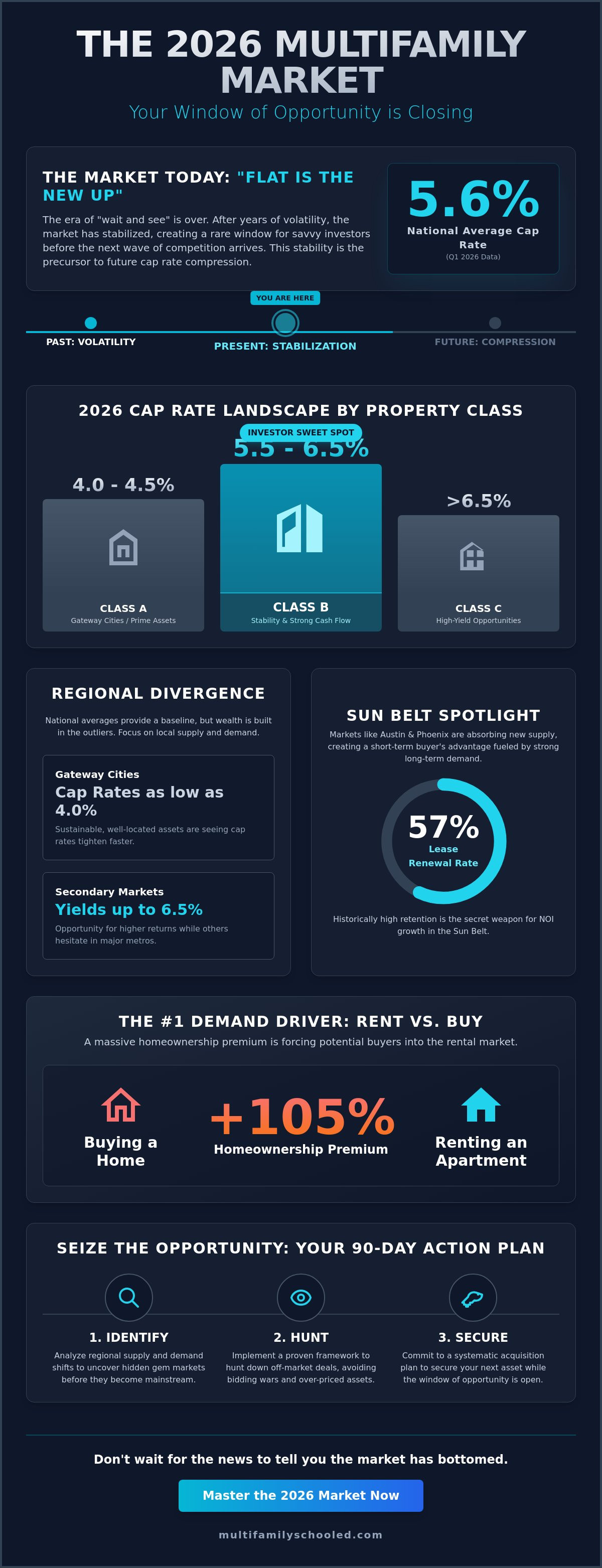
The market noise is finally quieting down. After years of rollercoaster volatility, the data shows a clear, solid baseline. As of the first quarter of 2026, the national average cap rate for all classes combined has stabilized at 5.6 percent. This isn't just a statistical plateau; it's a massive green light for investors who have been sitting on the sidelines. The era of "wait and see" is officially dead. If you wait for the evening news to tell you the market has bottomed, you've already missed the most profitable window of the decade.
Savvy investors recognize that "flat is the new up." While the general public hesitates, the pros understand that stabilization is the precursor to the next big squeeze. We are seeing a rare moment where pricing has found its floor, but the competition hasn't yet reached a fever pitch. To better understand how fear and greed are shaping these current shifts, watch this helpful market update:
Defining the 2026 Cap Rate Landscape
In the current economy, your capitalization rate is the direct ratio of Net Operating Income to property value, serving as the ultimate pulse check for your acquisition strategy. Success in 2026 depends on your ability to balance yield and price in a high-demand environment. Institutional "slippage" is creating a massive opening for individual owners. While large funds are bogged down by red tape and portfolio rebalancing, you can move faster to secure mispriced assets. Class B properties are currently trading in the 5.5 to 6.5 percent range, offering a perfect blend of stability and cash flow that institutional giants often overlook during their slow pivots.
Gradual Recovery vs. Rapid Rebound
Don't fall into the market timing trap. The "Uneven Recovery" means that while some gateway cities are seeing cap rates as low as 4.0 percent, secondary markets are still offering yields up to 6.5 percent. Waiting for a universal "rebound" in 2027 could cost you millions in lost equity growth. Credit is beginning to ease, and mortgage rates saw a dip earlier this year that improved buyer sentiment across the board. You have a narrow 90-day window to find and lock in deals before the next wave of buyers floods the market. Use the Multifamily Tool Kit to analyze these shifting numbers instantly. The multifamily cap rate trends 2026 suggest that the window is open now, but it won't stay that way forever. Move with purpose, or watch the opportunity pass you by.
Regional Divergence: Where the Deals Are Hiding
Don't fall for the myth that every market moves in sync. Regional convergence is a fantasy that keeps amateur investors on the sidelines. While the national average provides a baseline, the real wealth is built in the outliers. The multifamily cap rate trends 2026 reveal a massive gap between primary gateway cities and high-growth secondary markets. To win this year, you must look at the 2026 multifamily market outlook through a localized lens. Some regions are compressing faster than others, creating a high-stakes environment where your entry price is dictated by local supply-side pressure rather than national headlines.
We're currently seeing a "Quality Flight." Sustainable, well-located assets in growth markets are seeing cap rates tighten while others lag. This creates a "twin dilemma" of supply and demand. In some areas, a surge of new units is temporarily pushing vacancy up, but savvy owners are using this to negotiate better entry points. They know that the long-term demand for rentals remains unshakable. Strike while the market is still figuring out these regional differences. If you want to master these local nuances, our Mentorship Program provides the specific blueprint to find these hidden gems in under 90 days.
The 2026 Sun Belt Outlook
The Sun Belt is facing a unique supply-side challenge. Markets like Austin and Phoenix are working to absorb a massive wave of new inventory. This supply has temporarily slowed rent growth, but it's also creating a buying opportunity you won't see again. The secret weapon for Sun Belt NOI in 2026 is lease renewal activity. Currently, 57 percent of renters are renewing their leases. This historically high retention rate provides the stability you need to weather any short-term supply spikes. When you spot the pivot in these high-growth zones, move fast. The window to buy at a 5.5 to 6.0 percent cap rate in a "future-proof" market is closing.
Emerging Growth Markets to Watch
Secondary and tertiary markets are the true stars of 2026. While gateway cities offer lower yields between 4.0 and 5.0 percent, secondary markets are still delivering cap rates in the 5.0 to 6.5 percent range. These areas are outperforming national averages because of job growth momentum. When employers move in, cap rate compression follows. You can use the Real Estate Radar to identify these high-yield regional opportunities before the institutional funds catch on. Don't guess where the next boom will happen. Use data to verify the job numbers and population shifts. The best deals aren't found on the news; they're found in the local data points that others are too lazy to track.
Rent vs. Buy: The 2026 Demand Driver
The wall between renting and owning has never been higher. In 2026, it costs a staggering 105 percent monthly premium to buy a home compared to leasing a multifamily unit. This isn't just a temporary spike; it's a fundamental shift in the American housing landscape. For you, the investor, this affordability crisis is the ultimate safety net. While high borrowing costs might feel like a burden on your acquisitions, they are simultaneously locking your tenants into your properties. The multifamily cap rate trends 2026 are anchored by this massive demand imbalance. There is an estimated shortage of 3.4 million single-family homes, ensuring that your units remain the primary solution for millions of households. Stop worrying about a sudden drop in demand. The math simply doesn't allow for it.
According to the 2026 multifamily market snapshot, investor sentiment is rising because these fundamentals are too strong to ignore. The mortgage "lock-in" effect is also playing a massive role. Millions of homeowners are sitting on 4 percent rates from years ago and refuse to sell, which keeps the supply of starter homes non-existent. This forces even high-earning households to remain in the rental pool longer. You're no longer just providing "affordable" housing; you're providing the only housing available for a huge segment of the population. This is your moment to strike while others are paralyzed by headline news.
The Affordability Crisis Fueling Your NOI
Renter households are staying put longer than ever before. The cost of homeownership vs. multifamily leasing in 2026 has reached a breaking point, making lease renewals the path of least resistance for most families. Currently, lease renewal rates are holding at a historically high 57 percent. Every renewal saves you thousands in turnover costs, marketing fees, and lost rent, directly padding your Net Operating Income (NOI). This stability is what protects your investment downside in a shifting market. You're buying a captured audience that literally cannot afford to leave, creating a floor for your property value that didn't exist in previous cycles.
Strategic Concessions and Occupancy
Smart operators are shifting their 2026 playbook to prioritize "heads in beds" over aggressive rent hikes. While rent growth has slowed from the post-pandemic frenzy, maintaining high occupancy is your most valuable strategic move. Using targeted concessions to lower vacancy is a sign of a sophisticated manager, not a struggling asset. A property at 96 percent occupancy with stable rents is far more attractive to lenders and future buyers than a building with 10 percent vacancy and "paper" rent growth. Stable occupancy translates directly to predictable cap rates. If you're ready to master these numbers, use the Multifamily Tool Kit to run your own 2026 scenarios and see the impact on your cash flow.
How to Find Deals in a Compressing Market
Stop waiting for the perfect deal to land in your inbox. It won't happen. In a compressing market, the most profitable assets never see the light of day on public listing sites. You must transition from a passive observer to an active hunter. The multifamily cap rate trends 2026 show that while institutional giants are fighting over overpriced Class A gateway assets, the real "meat on the bone" is in off-market Class B and C properties. Deal finding is a high-income skill you can master. It's not about being lucky. It's about being systematic. You need a proven framework to identify, analyze, and strike before the window of opportunity slams shut.
Most industry reports focus on billion-dollar portfolios. They completely ignore the individual investor looking for 20-unit to 100-unit properties. This is your competitive advantage. You can move faster, build personal relationships with owners, and uncover value that big funds can't touch. Leveraging the Multifamily Tool Kit allows you to perform rapid analysis on the fly. You need to know if a deal works in minutes, not days. Speed is the ultimate currency in 2026. If you're ready to stop guessing and start winning, join our Mentorship Program to find a deal in 90 days or we'll provide one for you.
Using Data to Beat the Institutions
Identify motivated sellers by looking for signs of fatigue before they ever call a broker. Owners facing loan maturities or those tired of managing "mom and pop" operations are your primary targets. Specialized software allows you to spot cap rate anomalies that the general public misses. Real Estate Radar automates the heavy lifting of deal analysis so you can focus on building your empire. You don't need a massive team of analysts when you have the right tech stack in your pocket. Use data to verify your gut feeling and move with absolute confidence.
Executing the 90-Day Plan
Success requires a deadline. Our 90-day acquisition system takes you from market research to a signed contract with zero guesswork.
- Step 1: Market selection based on 2026 cap rate slippage trends. Focus on the secondary and tertiary markets that show strong job growth momentum.
- Step 2: Rapid NOI calculation and stress-testing. Always calculate your own numbers rather than trusting a broker's pro forma.
- Step 3: Making offers that stick. In a competitive landscape, your ability to close quickly is often more valuable to a seller than the highest price.
Master the 2026 Market with Multifamily Schooled
You've seen the data. You know the multifamily cap rate trends 2026 are creating a once-in-a-decade window. But knowledge without execution is worthless. Navigating this recovery alone is a recipe for expensive mistakes. High borrowing costs and regional divergence are traps for the uninitiated. You need a guide who has been through the cycles. You need a system that works in the real world, not just on paper. This is your chance to stop being a spectator and start being an owner. Take the lead while others are still checking the headlines.
The Power of Expert Mentorship
Justin Brennan’s proven system removes the guesswork from complex cap rate analysis. We don't just teach you; we provide the tools for a guaranteed path to success. Our Mentorship Program is built on a "mentor-as-provider" stance. This means we are personally invested in your results. We offer a bold performance guarantee: Find a deal in 90 days or we provide one for you. This is the ultimate shortcut to financial independence. Why spend years trying to figure it out when you can follow a blueprint used by successful investors across the country? Mastery is a choice. Choose to follow a proven leader.
Take Action Now
Don't let 2026 be the year of "what if." The market recovery is happening right now, and the biggest gains go to those who move first. Whether you are a seasoned pro or just starting out, we have the entry point you need to dominate.
- Start your journey today with our 5-Day Multifamily Challenge. It's a high-impact, fast-paced introduction to the world of apartment investing.
- Claim your seat at our next 3-Day Live Workshop. This is an immersive experience where you'll learn our proprietary methodologies and network with like-minded action-takers.
- Join Multifamily University to access a complete ecosystem of educational tiers and deal-finding software.
Your blueprint for multi-generational wealth starts with one strategic deal. The multifamily cap rate trends 2026 suggest that the window is closing fast. Stop hesitating. Stop over-analyzing. Join the movement of investors who are taking control of their destinies. Change your life. Build your legacy. The time to strike is now. We have the map; you just need to start walking.
Strike While the Window is Open
The data is clear. The noise has finally settled. You now understand the multifamily cap rate trends 2026 and why the 105 percent homeownership premium is your ultimate safety net. You've seen that regional divergence isn't a hurdle; it's a massive opportunity to find high-yield assets while others wait for a sign. The 5.6 percent national average is a floor. Don't wait for it to become a ceiling. This is the year to transition from a spectator to a sophisticated owner.
Mastery requires a mentor who has lived through every market cycle. Justin Brennan, a multi-generational industry expert, has built the exact system you need to win. When you join us, you get our proprietary deal-finding software to automate your hunt. We're so confident in our framework that we offer a bold guarantee: find a deal in 90 days or we provide one for you. Stop watching the market from the sidelines. Start building your legacy today.
JOIN THE MENTORSHIP: Find Your First Deal in 90 Days!
Your journey toward financial independence starts with a single, strategic move. Take it now. Success is waiting for those who act.
Frequently Asked Questions
What is the average multifamily cap rate in 2026?
The average national multifamily cap rate for all property classes combined reached 5.6 percent in the first quarter of 2026. This baseline represents a stabilization after the significant 9 percent rise seen throughout 2025. While gateway cities offer lower yields between 4.0 and 5.0 percent, secondary and tertiary markets provide higher entry points for investors seeking immediate cash flow. Understanding these multifamily cap rate trends 2026 is vital for setting your acquisition targets.
Are cap rates expected to go up or down for the rest of 2026?
Analysts anticipate a gradual decline, or compression, in cap rates throughout the remainder of 2026 as market fundamentals improve and credit conditions ease. After flattening in the first quarter, the market is poised for a shift as investor confidence grows. Many experts believe yields have reached their cyclical high. Striking now allows you to secure assets before this expected compression drives property values higher and narrows your profit margins.
How do interest rates affect multifamily cap rates in the current market?
Interest rates act as a primary driver of property pricing by influencing buyer sentiment and borrowing costs. A slight dip in mortgage rates in early 2026 improved market activity, though subsequent rises have kept property prices from climbing too rapidly. High interest rates also create massive barriers to homeownership. This dynamic forces more households into the rental market, supporting the Net Operating Income that sustains current cap rate levels.
Is 2026 a good year to start investing in apartment buildings?
Yes, 2026 is widely considered the year to strike before the window of opportunity closes on the market bottom. With a 105 percent monthly premium to buy a home versus renting, the demand for multifamily units is guaranteed. Renter household formation is up 2.7 percent year over year. You can capitalize on this demand by using a systematic approach to find deals while others are still paralyzed by uncertainty.
What markets have the best multifamily cap rates right now?
Tertiary markets currently offer the highest yields, with cap rates ranging between 6.5 and 8.5 percent. Secondary markets follow closely, providing a balance of stability and growth with rates between 5.0 and 6.5 percent. While the Sun Belt and Mountain regions are working to absorb new supply, their long term growth prospects remain elite. Use data to spot these regional outliers where job growth is outpacing the national average.
How much NOI do I need to justify a 5.7% cap rate?
To justify a 5.7 percent cap rate, your property must generate $57,000 in Net Operating Income for every $1 million of property value. You calculate this by multiplying the purchase price by the cap rate. If you are targeting a $5 million asset, you need an annual NOI of $285,000 to hit that 5.7 percent target. Always verify these numbers through independent analysis rather than relying solely on broker pro formas.
Can I find multifamily deals with no money down in 2026?
Finding deals with no money down is challenging in a high interest rate environment, but it remains possible through creative financing and strategic partnerships. Success requires you to bring massive value to the table, such as finding an off market gem or having a proven management plan. Our mentorship focuses on teaching you how to structure these sophisticated deals. Master the skill of deal finding first, and the capital will often follow the opportunity.
What is the difference between a cap rate and a cash-on-cash return?
A cap rate measures a property's natural, unleveraged yield by comparing Net Operating Income to the purchase price. Cash-on-cash return measures the actual cash flow you receive after paying your mortgage, relative to the initial cash you invested. While the multifamily cap rate trends 2026 give you a baseline for market value, your cash-on-cash return tells the true story of your personal wealth building. Both metrics are essential for a complete 90 day acquisition strategy.



