

Money Needed to Buy an Apartment Building in 2026
You don't need a million dollars sitting in a bank account to own a $2 million apartment complex. Many aspiring investors stay on the sidelines because they believe the myth that a massive personal fortune is the only way into the game. If you're wondering exactly how much money do you need to buy an apartment building in 2026, the reality will surprise you. While standard commercial lenders often look for 20% to 25% down, that cash doesn't have to come from your pocket. Stop letting the fear of lender rejection or a lack of personal savings kill your dreams of economic empowerment.
We know the confusion between closing costs and down payments feels like a brick wall. That's why we're giving you the exact dollar-for-dollar breakdown of what it takes to get a deal done right now. You'll discover how to leverage Other People's Money (OPM) and creative financing to bypass traditional barriers. This article provides the strategic roadmap you need to identify high-value opportunities and secure funding. Get ready to master the capital requirements of multifamily investing and follow a proven system to close your first deal within 90 days.
Key Takeaways
- Master the full acquisition math, including due diligence and operating reserves, so you never get caught off guard at the closing table.
- Get a clear, tiered breakdown of how much money do you need to buy an apartment building across different property sizes, from 5-unit buildings to 50-unit complexes.
- Unlock the power of non-recourse debt and learn why commercial lenders prioritize the property’s performance over your personal credit score.
- Fund your portfolio using creative strategies like syndication and seller financing to acquire massive assets without having millions of your own cash in the bank.
- Execute with speed and confidence by following a strategic roadmap designed to help you find and close your first multifamily deal in just 90 days.
The Reality of Apartment Building Costs: It’s Not Just a Down Payment
Stop thinking like a homeowner. Buying a multifamily property isn't a personal purchase; it's a business acquisition. If you're asking how much money do you need to buy an apartment building, you have to look beyond the sticker price. In the 2026 market, commercial lenders typically demand a down payment between 20% and 30%. While that sounds like a massive hurdle, it's actually your gateway to massive scale. You don't need to have millions of your own cash sitting in a vault. You need a great deal. High-quality deals attract capital like a magnet. When you use a proven system to find off-market opportunities, the money often finds you.
Commercial real estate math is fundamentally different from residential home buying. In residential deals, banks grill you on your personal debt and salary. In the world of Real estate investing, the building's performance takes center stage. You are buying a cash-flow engine. The total acquisition cost includes the purchase price plus the essential "soft costs" that beginners often overlook. Missing these details can kill your momentum before you even start. You must account for every dollar to ensure your path to economic empowerment stays on track.
The Three Pillars of Acquisition Capital
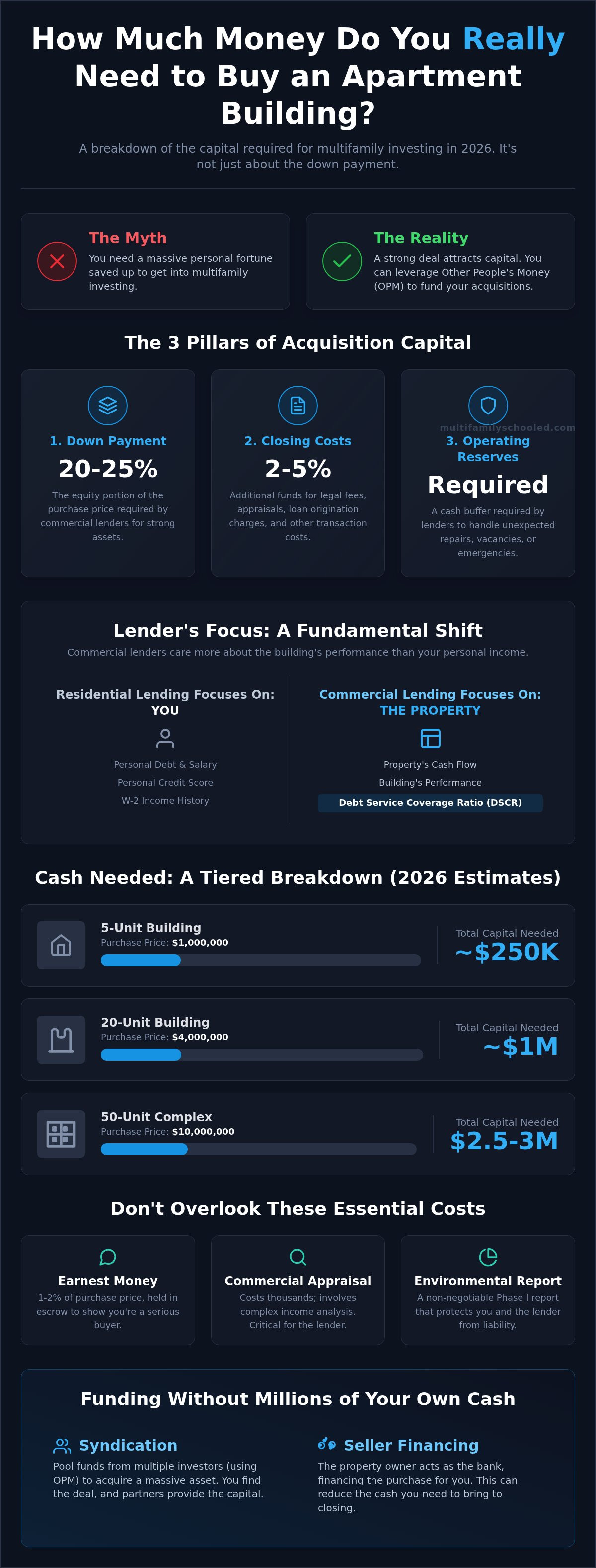
Successful investors categorize their capital into three specific buckets. First is the down payment, which is the equity portion required by the lender, usually ranging from 20% to 25% for strong assets. Next, you must budget for closing costs. These include legal fees, appraisals, and loan origination charges, which typically add 2% to 5% to your total. Finally, don't forget operating reserves. Lenders in 2026 require a cash buffer in the bank to ensure you can handle unexpected repairs or vacancies without breaking a sweat. This liquidity shows you're a pro who's ready for long-term stability.
Why Commercial Lenders Care More About the Building Than You
Commercial lending is asset-based, not income-based. Lenders want to know if the property can pay for itself and the loan. They use a specific metric called the Debt Service Coverage Ratio (DSCR) to make this call. Debt Service Coverage Ratio (DSCR) is the primary metric for loan approval, measuring the building's ability to cover its own debt with its net operating income. If the building's income is strong, your personal credit score matters much less than the deal's quality. This is why using Real Estate Radar to find undervalued properties is so critical. When the math works, the bank says yes. Focus on the asset, follow the framework, and you'll see that how much money do you need to buy an apartment building depends entirely on the strength of the deal you find.
Breaking Down the Numbers: How Much Cash You Actually Need
Stop guessing and start calculating. In 2026, commercial mortgage rates for apartment buildings under $6 million start at 6.11%. These rates directly impact your required equity. When interest rates rise, lenders often demand higher down payments to ensure the property can still cover its debt. To truly understand how much money do you need to buy an apartment building, you must look at the specific tier of property you're targeting. For a 5-unit building valued at $1 million, expect to bring roughly $250,000 in equity. A 20-unit mid-market asset at $4 million will likely require $1 million in total capital. If you're scaling to a 50-unit complex at $10 million, you're looking at a $2.5 million to $3 million requirement. These numbers aren't just suggestions; they're the baseline for entry in today's competitive market.
You must also account for earnest money. This is a deposit, usually 1% to 2% of the purchase price, that shows the seller you're serious. It's typically held in escrow and becomes non-refundable once your due diligence period expires. If you're feeling overwhelmed by these capital requirements, the Multifamily Tool Kit can help you organize your deal math and find the gaps in your funding strategy before you make an offer.
The Hidden Costs of Due Diligence
Due diligence is where many beginners fail. Commercial appraisals are not like residential ones; they cost thousands of dollars because they involve complex income analysis. You'll also need a Phase I Environmental Report. This is a non-negotiable cost that protects you and the lender from future liability. Physical inspections must go "behind the walls" to check plumbing, electrical systems, and roofs across every unit. Budget at least $15,000 to $30,000 for these reports on mid-sized deals. Think of this as insurance for your future cash flow.
Lender Liquidity and Net Worth Requirements
Lenders care about your "Post-Closing Liquidity." They want to see that you have enough cash left in the bank to cover 6 to 12 months of debt service after the deal closes. Additionally, many conventional commercial loans require your total net worth to equal or exceed the loan amount. If your personal balance sheet isn't there yet, don't stop. You can partner with a "key principal" or a guarantor who has the required net worth to sign on the loan. Utilizing Creative Financing for Rental Properties allows you to bridge these gaps by pooling resources with others who share your vision for economic empowerment.
Commercial Loan Requirements: Why Your Credit Score Isn’t Everything
Forget your personal credit score for a moment. While it matters, it's not the deal-breaker you think it is. In commercial lending, the property is the star. If you're stressed about how much money do you need to buy an apartment building, understand that lenders prioritize the asset's cash flow over your individual income. They want to see that the building can sustain itself and pay the mortgage even in a downturn. This shift from personal to asset-based evaluation is the key to unlocking massive portfolios without needing a CEO's salary.
Non-recourse debt is the holy grail of multifamily investing. Unlike residential mortgages, many commercial loans are non-recourse, meaning the lender's only collateral is the property itself. If things go wrong, your personal assets like your home or car are generally protected. This protection is a core pillar of economic empowerment. It allows you to take calculated risks and scale your wealth with confidence. To get there, you'll need to present a professional package including a Personal Financial Statement (PFS) and a Schedule of Real Estate Owned (SREO). These documents prove you understand the game and are ready for long-term stability.
Agency vs. Bank Financing
You have choices in how you fund your future. Agency loans from Fannie Mae and Freddie Mac offer some of the most attractive rates in 2026, often starting around 5.70% for larger multifamily deals. These loans are prized for their non-recourse terms, though they demand pristine property conditions. If you're targeting high-leverage entry points, look into FHA Multifamily Loan Programs, which can offer up to 87% loan-to-value for market-rate projects. For your first 5-10 unit building, local banks are often the best path. They're more flexible and value local relationships. If the building needs significant work, bridge loans provide short-term funding with rates between 7.75% and 14.5% until you can stabilize and refinance.
Qualifying with a Limited Track Record
Lenders fear incompetence more than they fear low liquidity. They want to know who is running the day-to-day operations. If you don't have a track record yet, hire a professional property management company with a deep portfolio. Their experience becomes your experience in the eyes of the bank. Another powerful strategy is bringing on a "Sponsor." This is a partner with a strong financial resume who signs on the loan to provide the credibility you might currently lack. This completely reframes how much money do you need to buy an apartment building because a strong sponsor bridges the gap in your financial resume. To ensure your loan package is airtight, use the Multifamily Tool Kit to organize your PFS, SREO, and property data into a format that lenders respect. Stop guessing and start presenting like a pro.
Funding Without Your Own Cash: Creative Financing and Syndication
The biggest secret in multifamily investing is that your bank account balance isn't the limiting factor. Your ability to find a deal is. In this industry, finding a high-value asset is the most valuable currency you can hold. If you have a contract on a property with massive upside, capital will chase you. This completely changes the answer to how much money do you need to buy an apartment building. When you master creative funding, you can control millions in assets with very little of your own capital at risk. It's about your hustle and your system, not your current net worth.
Syndication is the art of pooling capital from passive investors to take down large buildings. You act as the General Partner, finding the deal and managing the asset, while your investors provide the equity. It's a win-win for everyone involved. For smaller apartment deals, a Joint Venture (JV) allows you to partner with one or two people to split the down payment and the workload. These strategies allow you to scale at a pace that is impossible if you're only using your own savings. Stop letting a lack of personal cash keep you on the sidelines.
The 5-Step Process to Syndicating Your First Deal
- Step 1: Find an undervalued asset using Real Estate Radar to identify off-market opportunities.
- Step 2: Secure the deal under contract with a "due diligence" period to protect your interests.
- Step 3: Create a professional investment summary that highlights the property's potential for partners.
- Step 4: Raise the down payment from private investors who want the tax benefits and cash flow of real estate.
- Step 5: Close the deal and manage the asset for a significant share of the profits.
Seller Financing: The Ultimate Low-Cash Strategy
Many aging owners are tired of the "Three Ts": tenants, toilets, and trash. They want to exit the business but don't want a massive tax hit from a lump-sum sale. Seller financing allows them to act as the bank. They receive monthly payments with interest, providing them with a steady retirement income while you take control of the asset. You can even structure a "Master Lease Option" to control a building's operations and cash flow with almost zero money down. Negotiate interest-only periods to maximize your initial cash flow and accelerate your path to economic empowerment. This reframes how much money do you need to buy an apartment building into a question of how well you can negotiate.
Stop waiting for your bank account to grow and start taking action on the deals that will change your life. Join the Mentorship Program today to get the exact blueprint for funding your first apartment building using other people's money.
Mastering the Deal: How to Secure Funding in 90 Days
Speed isn't just a bonus. It's your greatest competitive advantage in 2026. In a market where sellers value certainty, being the fastest person to the table wins the deal. If you're still paralyzed by the question of how much money do you need to buy an apartment building, you're looking at the wrong variable. The most successful investors don't wait until they have the cash; they build the system that attracts it. By following a structured framework, you eliminate the "fear factor" and move with the confidence of a seasoned pro.
Trial and error is a luxury you can't afford. One mistake in your property analysis or loan package can cost you years of progress. You need a proven system that turns the complex process of multifamily investing into a repeatable machine. When you have a roadmap, you stop wondering if you can do it and start knowing when you'll finish. It's time to stop saving pennies and start hunting for the assets that will fund your future independence.
The 90-Day Roadmap to Your First Apartment
- Weeks 1-4: Master your market selection. Use high-speed lead generation tools to identify off-market properties before they hit the general market.
- Weeks 5-8: Transition to aggressive analysis and offer submission. This is the phase where you identify and secure an "anchor" investor to back your vision.
- Weeks 9-12: Finalize your due diligence and secure your loan commitment. Cross the finish line and take title to your first cash-flowing asset.
Why You Need a Mentor to Cross the Finish Line
The "lone wolf" approach is the slowest and most expensive way to invest. A single "bad deal" can wipe out your entire net worth. Compare that risk to the investment in a mentorship program that provides a direct line to success. Mentorship gives you access to a curated network of lenders and equity partners that outsiders never see. These relationships are the ultimate answer to how much money do you need to buy an apartment building, as they provide the leverage you need to close.
Don't let another year pass you by. Join our Mentorship Program and we'll help you find a deal in 90 days. We provide the proprietary software, the multi-generational expertise, and the community support to ensure you succeed. Your journey to economic empowerment starts with the decision to stop guessing and start following a system that works.
Seize Your Future in Multifamily Today
Stop obsessing over the exact dollar amount in your bank account. You've learned that while commercial deals require capital, that capital doesn't have to be yours. Whether you use syndication, seller financing, or local bank leverage, the strength of the deal is what matters most. Understanding how much money do you need to buy an apartment building is the first step toward total economic empowerment. It's time to stop theorizing and start executing with a proven system.
Use our proprietary Real Estate Radar AI software to pinpoint off-market gems and tap into our private investor network to fuel your growth. With Justin Brennan’s 90-day deal guarantee, you aren't just learning; you're doing. Apply for the Multifamily Mentorship Program and close your first deal in 90 days. Your legacy of wealth starts with a single, decisive action. Take it now. Success is within your reach if you follow the framework.
Frequently Asked Questions
Can I buy an apartment building with 0% down?
You can buy an apartment building with 0% down by using creative strategies like seller financing or a Master Lease Option. These methods allow you to control the asset and its cash flow while the seller acts as the bank. It requires a high level of negotiation skill and a deep understanding of the seller's pain points. Focus on solving their problems, such as avoiding a massive tax hit, to secure a low-entry deal.
How much money should I have saved for my first 10-unit building?
When asking how much money do you need to buy an apartment building, specifically a 10-unit property, the traditional answer is 20% to 25% of the purchase price. For a $1.5 million building, that is roughly $375,000. However, if you use a proven system to syndicate the deal, your personal savings requirement could be zero. You bring the deal and the expertise; your private investors bring the capital. This is the fastest path to scale.
Does my personal credit score matter for a commercial apartment loan?
Your personal credit score is secondary to the building's financial performance in a commercial loan. Lenders focus on the Debt Service Coverage Ratio (DSCR) to ensure the property’s income covers the mortgage payments. While a score below 660 might trigger extra scrutiny, a strong asset and an experienced management team can often overcome personal financial hurdles. It is an asset-based lending environment where the deal’s quality proves your path to success.
What is the difference between a residential and a commercial multifamily loan?
Residential loans for 1-4 unit properties rely on your personal income and debt-to-income ratio. Commercial multifamily loans for 5+ units are based on the property’s Net Operating Income. This is a critical distinction because commercial buildings allow for forced appreciation through better management. You aren't limited by your salary; you're only limited by the quality of the deals you find. This shift is essential for achieving long-term independence and economic empowerment.
How do I find private investors to fund my down payment?
Finding private investors starts with a professional deal package and a confident presentation. You must show potential partners a clear roadmap to profitability and a solid exit strategy. Use networking events and your existing professional circle to identify people who want passive income but lack the time to find deals. When you have a high-value property under contract, capital will naturally flow toward the opportunity. It’s about being a strategic leader.
What are the typical closing costs for an apartment complex in 2026?
Budget between 2% and 5% of the total purchase price for closing costs in 2026. This includes essential fees for commercial appraisals, Phase I environmental reports, and legal documentation. You also need to account for loan origination fees and lender-required operating reserves. Many beginners overlook these "soft costs" and get stalled at the finish line. Always keep a liquidity buffer to show lenders you are a prepared and professional investor.
Is it better to buy a small 4-unit or a larger 10-unit for my first deal?
A 10-unit building is often better for your first deal because it qualifies for commercial financing. While a 4-unit property is easier to understand, it's limited by residential appraisal "comps." A 10-unit asset's value is determined by its income, giving you more control over your wealth. Larger buildings also offer better economies of scale for property management. Aim higher to accelerate your journey toward asset accumulation and long-term stability.
What happens if I find a great deal but do not have the money to close it?
If you find a great deal but lack the capital, you have found the most valuable asset in the market. How much money do you need to buy an apartment building becomes irrelevant when you have a contract on an undervalued property. You can bring in a joint venture partner or syndicate the equity from private investors. Capital is always looking for a home in strong real estate deals. Don't let a temporary lack of cash stop your momentum.



