

Mastering the Numbers: The Ultimate Commercial Real Estate Financing Calculator Guide
The speed of your math determines the size of your empire. In a market where investment activity is forecasted to hit $562 billion this year, the fastest investor wins the best deals. You need a professional commercial real estate financing calculator to transform complex data into a clear green light before your competitors even finish their first cup of coffee.
It's exhausting to feel trapped by analysis paralysis or the fear of miscalculating debt service. You want to move fast, but with conventional rates sitting between 5.35% and 8.75% as of June 2026, one wrong entry could be a costly mistake. We understand that uncertainty. That's why we're handing you the blueprint to evaluate properties with surgical precision. Success in this industry is not about luck; it is about using a proven system to dominate the numbers.
This guide will show you how to use commercial financing math to evaluate deals faster and secure your first apartment building in record time. We'll cover exactly what lenders look for in this high-quality market and how to use our proprietary frameworks to make offers with absolute confidence. It's time to stop overthinking and start building your legacy today.
Key Takeaways
- MASTER THE DSCR. Learn why the Debt Service Coverage Ratio is the metric lenders value most and how to calculate it with total precision.
- KILL BAD DEALS FAST. Leverage a professional commercial real estate financing calculator to analyze properties in seconds and stay ahead of the competition.
- OPTIMIZE YOUR FINANCING. Compare loan types to see exactly how interest rates and LTV ratios impact your monthly cash flow and long-term ROI.
- EXECUTE YOUR 90-DAY PLAN. Follow a strategic roadmap that takes you from spreadsheet analysis to signing your first apartment contract in record time.
Why Every Serious Investor Needs a Commercial Real Estate Financing Calculator
Commercial financing is the engine of your real estate empire. In 2026, investment activity is forecasted to surge by 16% to $562 billion. This is a massive opportunity for anyone ready to take action, but only if you move with precision. You need a commercial real estate financing calculator to serve as your tactical command center. This tool does more than just subtract expenses. It defines your Net Operating Income (NOI) and verifies your debt coverage before you ever sign a contract. Amateurs rely on "back of the napkin" math. Professionals use systems. In this high-stakes market, a single rounding error leads to an expensive mistake that can haunt your portfolio for years.
To dominate this asset class, you must first master commercial mortgage fundamentals. This includes understanding how lenders view risk, cash flow, and the long-term stability of your property. Before you dive into the spreadsheets, watch this breakdown on how to structure smarter deals using creative math:
The High Cost of Miscalculation
A tiny error creates a massive disaster. With conventional rates sitting between 5.35% and 8.75% as of June 2026, a 0.5% mistake in your interest rate can destroy your projected cash flow. You must also account for balloon payments. These are standard in commercial lending and require a lump-sum payoff at a specific date. If your math doesn't account for this, you risk losing the property when the loan matures. Manual math keeps you slow and vulnerable. While you're stuck in a spreadsheet, your competitors are using a commercial real estate financing calculator to close deals. Don't guess. Know your numbers or get out of the way.
Speed to Deal: The 90-Day Framework
Real estate success is a volume game. You must analyze 10 deals to find one winner. If you spend hours on every property, you'll never scale your wealth. Automation allows you to screen opportunities in seconds. You can greenlight or kill a deal instantly. This level of efficiency is the core of our 90-day framework for new owners. You don't need more time; you need better tools. Start by using the Multifamily Tool Kit to automate your underwriting and accelerate your path to your first apartment building. Move fast. Close often. Build your legacy.
The 3 Critical Metrics Your Calculator Must Solve
Lenders are not your partners; they are risk managers. They don't care about your vision for the property or your long-term dreams. They care about the cold, hard data. To win their approval, your commercial real estate financing calculator must solve for three specific metrics. If these numbers miss the mark, your deal will never see the light of day. You need to understand the different types of commercial real estate loans and how each one shifts these variables.
Mastering the DSCR (Debt Service Coverage Ratio)
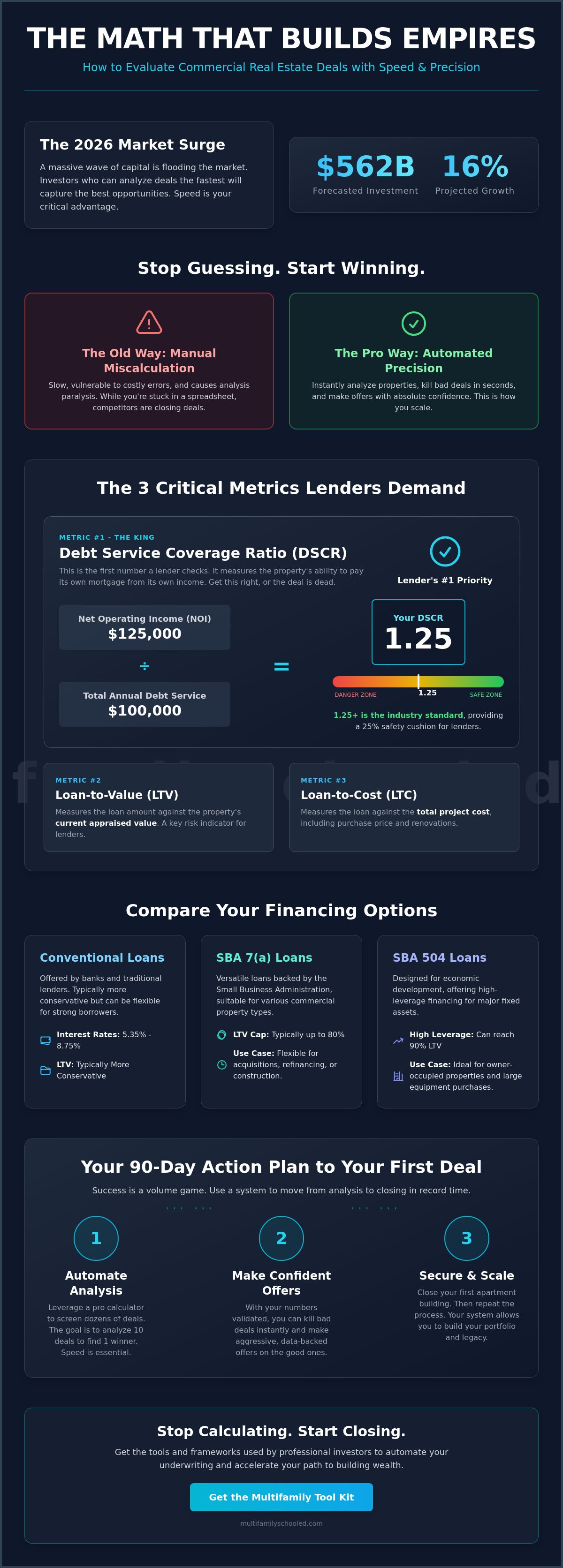
The Debt Service Coverage Ratio is the king of commercial lending. It's the first number a lender looks at to determine risk. The formula is simple: Net Operating Income (NOI) divided by Total Debt Service. If your NOI is $125,000 and your annual debt is $100,000, your DSCR is 1.25. This 1.25 benchmark is the industry safety standard. It provides a 25% cushion for the lender against vacancy or expense spikes. DSCR is the primary measure of a property’s ability to pay its own debt. If your calculator shows a 1.10, you're in the danger zone. Lenders won't touch it. You must find ways to increase income or lower the loan amount to hit that 1.25 target.
In 2026, you also need to track the difference between Loan-to-Value (LTV) and Loan-to-Cost (LTC). LTV measures the loan against the current appraisal. LTC measures it against the total project cost, including renovations. High-leverage options like SBA 504 loans can reach 90% LTV, while SBA 7(a) loans typically cap at 80% LTV. Conventional banks often stay more conservative. Your calculator must account for these limits to ensure you have enough capital to close the deal without a last-minute cash shortfall.
Understanding Amortization vs. Loan Term
New investors often confuse the loan term with the amortization schedule. A commercial loan might have a 25-year or 30-year amortization, but the actual term is often only 5 or 10 years. This creates a mismatch. Your monthly payments are calculated as if you have 25 years to pay, but the full balance is due much sooner. This leads to the balloon payment reality. When the clock runs out, you must either sell the property or refinance the remaining balance. Use your commercial real estate financing calculator to plan for this event years in advance. If you want to master these calculations before your next offer, consider joining our mentorship program to see how we analyze deals in real-time. Don't let a balloon payment catch you off guard. Build your exit strategy into your math from day one.
Comparing Commercial Loan Types and Their Impact on Math
Every loan type is a different variable in your wealth equation. You cannot simply plug a random interest rate into your commercial real estate financing calculator and hope for the best. The structure of your debt determines your monthly cash flow, your tax liability, and your ultimate return on investment. In the 2026 market, conventional bank rates fluctuate between 5.35% and 8.75%. Choosing the wrong product can turn a winning apartment building into a financial anchor. You must understand how these tools function before you start running the numbers.
Conventional vs. Agency Financing
Conventional loans from local or regional banks are the most common path for new investors. These lenders offer flexibility and personal relationships, but they often require recourse debt. This means you are personally liable if the deal goes south. Agency loans from Fannie Mae or Freddie Mac offer the holy grail: non-recourse debt and lower interest rates. As of June 2026, multifamily agency rates for deals over $6 million start around 5.54%. However, the bars for entry are high. They demand experienced teams and pristine properties. When using your commercial real estate financing calculator, always input conventional terms first. It is your most realistic baseline. If the deal still works at 7.5% with a local bank, it will be a home run if you later qualify for agency debt.
The Role of Bridge Loans in Value-Add Deals
Bridge loans are the high-octane fuel of the multifamily world. They are designed for "value-add" properties that need significant renovation before they qualify for long-term debt. You might accept a higher interest rate, sometimes ranging from 5.75% to 12.75%, for a short period. Why? Because these loans provide the capital to transform a distressed asset. The math here is different. You aren't calculating for 30 years; you're calculating for an exit.
Your calculator must stress-test your exit strategy. You need to know exactly what happens if interest rates rise before you finish your renovations. If you plan to refinance into a conventional loan in 24 months, run your numbers at a 1% higher rate than today's market. This cushion protects your capital. Speed is essential here. If you want to see how we model these high-speed transitions, check out the Real Estate Radar software to track market shifts in real-time. Don't let the short-term cost of a bridge loan scare you away from a massive payday. Just make sure your math accounts for the move to permanent financing. Action without a plan is just a gamble. Action with a calculator is a business.
How to Interpret Your Calculator Results to Greenlight a Deal
Data is just noise without a framework. A commercial real estate financing calculator gives you the raw output, but you must provide the judgment. Don't be a spectator to your own wealth. You need to transform those digits into a decisive action plan. If the numbers don't scream "profit," you must have the courage to kill the deal and move to the next one. Use this four-step process to evaluate every opportunity that crosses your desk.
- Step 1: Check the Cash-on-Cash Return. This is your annual pre-tax cash flow divided by your total initial investment. If this number doesn't beat your personal goal, the deal is dead.
- Step 2: Verify the DSCR. As established, lenders demand a 1.25 minimum. If your calculator shows anything less, the bank won't fund it. You're wasting your time.
- Step 3: Analyze "Breakeven Occupancy." This percentage tells you how low your occupancy can drop before you stop covering expenses and debt. A resilient deal can survive at 70% or 75% occupancy. If your breakeven is 90%, you have zero margin for error.
- Step 4: Compare the Results. Never look at a deal in a vacuum. Compare it against every other property in your pipeline to ensure you're deploying capital into the highest-performing asset.
The "Go/No-Go" Framework
Identify your red flags immediately. Negative cash flow or a DSCR below 1.20 are instant "No-Go" signals. However, these numbers are also your best negotiation weapons. If the math doesn't work at the current asking price, don't just walk away. Show the seller your commercial real estate financing calculator results. Tell them exactly how much the price must drop to make the deal bankable. Use the math to strip the emotion out of the room. When you lead with data, you lead with authority.
Stress Testing Your Deal
Your deal must survive the real world, not just a perfect spreadsheet. What happens if interest rates rise by 1% before you close? If you are modeling a 6% rate today, run the numbers at 7% to see if the cash flow holds up. What happens if vacancy increases to 10% during a local market shift? If the deal still produces a profit in these "worst-case" scenarios, you've found a winner. Speed is your edge, but precision is your shield. To get the exact tools we use for these high-level stress tests, download the Multifamily Tool Kit and start analyzing like a pro. Stop guessing and start closing with absolute certainty.
Stop Calculating and Start Closing: Your 90-Day Action Plan
Math is the foundation of every great real estate empire, but action is its architect. You've learned how to wield a commercial real estate financing calculator like a weapon. You've mastered the DSCR and stress-tested your assumptions. Now, you must cross the bridge from theory to reality. Knowledge without execution is just a hobby. In a 2026 market where property sales are forecasted to increase by 16%, hesitation is your biggest expense. You need a system that moves you from a spreadsheet to a signed contract in record time.
The transition to ownership requires a shift in focus. You stop looking for reasons to say "no" and start looking for the path to "yes." This doesn't mean ignoring the data. It means using the data to drive your offers. We've built an ecosystem designed to handle the heavy lifting so you can focus on the win. Stop over-analyzing and start following a proven 90-day roadmap to your first apartment building.
Leveraging Real Estate Radar for Deal Sourcing
Manual deal finding is a relic of the past. You don't have time to hunt through outdated listings or wait for a broker to call you back. You need an engine that feeds your commercial real estate financing calculator with high-quality opportunities every single day. That engine is Real Estate Radar AI. This software uses advanced algorithms to find off-market deals before your competitors even know they exist. There is a powerful synergy between AI sourcing and financial calculation. The AI identifies the potential, and your calculator confirms the profit. This combination allows you to analyze 10 times more deals with half the effort. It is the only way to scale in today's high-speed environment.
The Mentorship Advantage
The smartest investors never calculate alone. They surround themselves with mentors who have already closed the deals they're currently analyzing. Why spend years making expensive mistakes when you can follow a blueprint that works? Our Mentorship Program is specifically designed to help you find and close a deal in just 90 days. We provide the tools, the community, and the tactical guidance to navigate complex commercial structures.
- Days 1-30: Set up your sourcing engine and master your underwriting tools.
- Days 31-60: Analyze 10 deals a week and submit your first three offers based on the math.
- Days 61-90: Refine your negotiations and move your best deal into contract.
This is your invitation to join a movement of high-achievers who are seizing their financial freedom. Don't let another quarter pass you by while you stay stuck in "analysis mode." Claim your spot in our ecosystem today. The numbers are clear. The path is set. Now, it's time to close.
Build Your Empire With Mathematical Certainty
You now hold the blueprint to dominate the numbers. Mastering a commercial real estate financing calculator is your first step toward true economic empowerment. You know that a 1.25 DSCR is the line between a green light and a disaster. You understand how 2026 interest rate shifts impact your cash flow. But calculations alone won't build your legacy. You need a proven system to turn those spreadsheets into tangible assets that provide long-term independence and wealth.
Stop analyzing from the sidelines. It's time to join an ecosystem built for your success. Led by multi-generational investor Justin Brennan, our program provides the strategic tools you need to win. We give you immediate access to our proprietary Real Estate Radar AI to source the deals you've learned to calculate. We are so confident in this system that we offer a 90-day deal guarantee. Success is attainable for anyone who follows this prescribed method.
Join the Mentorship: Find Your First Deal in 90 Days and start your journey today. Your future self is waiting for you to take decisive action. Seize the opportunity and build your wealth now.
Frequently Asked Questions
What is a good DSCR for a commercial real estate loan?
A Debt Service Coverage Ratio of 1.25 is the standard benchmark for most commercial lenders. This figure proves that your property generates 25% more income than is required to cover the debt service. Aim for a 1.30 or higher to project maximum strength and secure more favorable terms during the underwriting process.
How much down payment is required for a multifamily property?
Most conventional multifamily deals require a down payment of 20% to 25%. If you are pursuing an owner-occupied deal, programs like the SBA 504 loan can allow for a down payment as low as 10%. Always verify your liquid capital against the current 2026 LTV limits before submitting your Letter of Intent.
Can I use a commercial financing calculator for SBA loans?
You can and should use a commercial real estate financing calculator to model SBA loans, provided you include their specific fees. SBA 7(a) loans carry guarantee fees ranging from 2% to 3.5% depending on the loan size. With rates currently between 5.75% and 8.75%, these fees significantly impact your total capital requirement.
What is the difference between an amortization period and a loan term?
The amortization period is the timeframe used to calculate your monthly payment, while the loan term is the actual duration of the loan. Most commercial mortgages use a 25 or 30-year amortization to keep payments manageable. However, the loan term is often only 5 or 10 years, at which point the remaining balance is due as a balloon payment.
How do interest rates in 2026 affect my commercial mortgage payments?
Interest rates are the primary driver of your debt service and overall deal viability. As of June 2026, conventional rates range from 5.35% to 8.75%, which is higher than previous cycles. Even a small increase in your rate reduces your DSCR and can turn a cash-flowing asset into a liability if your math isn't precise.
What are the typical closing costs for a commercial real estate deal?
Expect closing costs to range between 2% and 5% of the total loan amount. This includes lender origination fees, which typically sit between 0.5% and 1.5%, along with appraisals and legal fees. You must budget for these costs upfront to ensure you have enough cash to close the deal without delay.
Do I need a commercial loan calculator for a 4-unit property?
You don't need a commercial calculator for a 4-unit property because it falls under residential lending guidelines. A commercial real estate financing calculator becomes essential once you hit 5 units or more. At this threshold, lenders stop looking at your personal income and start evaluating the property's ability to generate profit.
Is it better to get a fixed or variable rate commercial loan?
Fixed-rate loans are the superior choice for investors seeking long-term stability and predictable cash flow. Variable rates may offer a lower entry point, but they expose your portfolio to the risk of rising payments. In a market where the Federal Reserve holds rates steady near 3.75%, locking in a fixed rate protects your ROI from future volatility.



