

Master Lease Option Multifamily: The Ultimate Guide to Creative Acquisition in 2026
What if you could control a 50-unit apartment complex tomorrow without begging a bank for a loan or scraping together a massive down payment? Most investors think they're locked out of the 2026 market because commercial mortgage rates can climb as high as 12.75%. They're wrong. You don't need millions in the bank to dominate this industry. By mastering the master lease option multifamily strategy, you bypass the banking bottleneck and start collecting cash flow immediately. It's time to stop waiting for permission to build your legacy.
It's frustrating to watch great deals slip away while you struggle to qualify for traditional commercial loans. You want the financial freedom that comes with large assets, but the entry barriers feel impossible. This guide changes everything. You'll learn the exact blueprint to control high-value properties with little money down and use current 2026 tax benefits like the OBBBA to maximize your returns. We're diving into the systematic 90-day bridge to ownership so you can stop dreaming and start closing.
Key Takeaways
- Control large apartment assets and pocket the cash flow without the 20% down payment required by traditional banks.
- Discover how to close deals in as little as 30 days, bypassing the long bank approval cycles that kill most opportunities.
- Master the master lease option multifamily framework to secure the right to buy at today’s price while benefiting from tomorrow’s appreciation.
- Use proprietary technology like Real Estate Radar AI to pinpoint "tired landlords" and out-of-state owners ready for creative exits.
- Follow a proven 90-day blueprint to find, analyze, and close your first multifamily deal with total confidence and zero guesswork.
What is a Master Lease Option (MLO) for Multifamily Properties?
Stop waiting for a bank's permission to build your empire. A master lease option multifamily agreement is your shortcut to controlling massive apartment buildings without the traditional 20% down payment. Think of it as a strategic bridge to ownership. You take the keys, you manage the property, and you keep the profit while the owner stays on the deed for now. It's the ultimate low-money-down vehicle for a 2026 market where commercial mortgage rates can climb as high as 8.80% for conventional loans. You bypass the red tape and start building equity on day one.
To understand the legal foundation of this strategy, it helps to review the basics of What is a Lease Option? in a general real estate context. In the multifamily world, this strategy grants you "equitable title." This means that while you don't hold the deed yet, you have a financial interest in the property's future value. You aren't just a property manager. You are the master operator. You control the cash flow, the renovations, and the tenant base today while locking in your purchase price for tomorrow.
To better understand this concept, watch this helpful video:
The Two-Contract Structure
Keep your paperwork clean and your legal standing strong. A successful master lease option multifamily deal relies on two distinct documents. The Master Lease Agreement (MLA) gives you the right to occupy and manage the entire building. The Option Agreement locks in your "Strike Price." This is the fixed price you'll pay to buy the building in three, five, or seven years. Keeping these documents separate provides a tactical advantage. If one agreement is challenged, the other remains a shield for your investment. Use the Multifamily Tool Kit to ensure your documents are prepared for 2026 compliance standards.
Who Benefits from an MLO?
This strategy is a lifesaver for investors who have the drive to find deals but lack the "capital flow" for massive down payments. It also rescues "tired landlords" who are exhausted by management but want to avoid a massive tax hit from an immediate sale. If a property is currently un-financeable due to high vacancy or physical distress, an MLO allows you to stabilize the asset before you ever approach a lender. Use Real Estate Radar AI to identify these distressed assets and out-of-state owners before your competition even knows they're for sale.
The Mechanics: How a Master Lease Option Actually Works
Execution is everything. In a master lease option multifamily deal, you step into the shoes of the owner without actually being on the deed. You take full control of the property's operations and its Net Operating Income (NOI). The flow of funds is simple but powerful. Residents pay their rent directly to you as the master tenant. You then pay a pre-negotiated monthly fee to the owner. Everything left over is yours to keep. This isn't a management fee; it's your profit from operating a high-performance asset. This isn't just a theory for small-time players. You can see how this works in practice by looking at this real-world MLO example involving a 31-unit property where the master tenant took over full operational responsibility.
You also take on the burden of taxes, insurance, and maintenance. This is often a triple-net style setup that gives the owner total peace of mind. They stop getting calls about leaky toilets and late payments. In exchange, you get the right to improve the asset and reap the rewards. It's a fair trade that unlocks massive wealth for those who know how to manage effectively. If you want to see how these numbers look on a real deal, our Mentorship Program provides the exact frameworks to analyze these spreads with total precision.
Cash Flow Dynamics
The "Spread" is your primary engine for wealth. To calculate it, you subtract your operating expenses and your master lease payment from the total monthly rent collected. Net Operating Income is the total revenue produced by the property after deducting all operating expenses but before paying any mortgage or master lease fees. Handling Capital Expenditures (CapEx) requires a strategic approach. You typically negotiate who pays for "roof and structure" while you handle interior upgrades. Every dollar you spend on a new kitchen or better flooring directly increases the NOI. Because your purchase price is locked in, every cent of that increased value belongs to you, not the seller.
The Exit Strategy
Your ultimate goal is the exit. Most investors use the lease term to force appreciation. By renovating units and cutting waste, you drive up the property value. When your option term ends, you refinance into permanent debt using the new equity you created. You could also assign the contract to another buyer for a massive assignment fee if you prefer quick cash over a long-term hold. If the property doesn't perform or the market shifts, you can simply choose not to exercise the option. You walk away with your credit intact, having only lost your initial option fee. It's the ultimate "heads I win, tails I don't lose much" scenario.
Master Lease Option vs. Traditional Financing: Which Wins in 2026?
Speed is the new currency in real estate. Traditional bank loans are a slow, grinding process that can drag on for 90 days or more. In the fast-paced 2026 market, that delay is a deal-killer. A master lease option multifamily agreement can be executed in as little as 30 days. You don't need a perfect credit score or a 700 FICO to win here. MLOs are essentially "credit-blind." You're negotiating with a person, not a faceless institution with a rigid checklist. This flexibility allows you to craft terms that work for both parties, turning a "no" from a bank into a "yes" from a seller.
The risk profile is also vastly different. In a traditional purchase, you're putting 20% to 30% down. That’s a massive amount of non-refundable capital at risk. With an MLO, your "skin in the game" is the option fee. This fee is often as low as 5% to 10% of the option price. On a million-dollar property, you might secure control for just $25,000. If the market shifts or the deal goes south, your loss is capped at that fee. Your personal credit remains untouched. You keep your liquidity and your sanity while controlling a multi-million dollar asset.
When Traditional Debt Fails
Banks are terrified of risk. If a property has occupancy below 85%, most lenders won't even look at the file. They also demand "seasoning," requiring you to own or manage a property for 12 to 24 months before they’ll consider a refinance. A master lease option multifamily deal bypasses these hurdles. You use the lease period to stabilize the property and build that necessary seasoning. Think of the MLO as your bridge to a permanent Fannie Mae or Freddie Mac loan. You fix the building first, then you bring in the bank once the asset is a "sure thing."
The Cost of Creative Control
Creative control isn't free, but it's worth every penny. You might agree to a slightly higher strike price or a monthly payment that matches a bank's interest rate to secure the deal. With commercial mortgage rates currently ranging between 5.14% and 12.75% as of July 2026, the MLO often ends up being the more affordable path. You aren't paying points, appraisal fees, or massive legal retainers to a lender. You're investing that money directly into the property to force appreciation. Stop asking for a loan and start taking control. Our Mentorship Program shows you exactly how to win these negotiations every time.
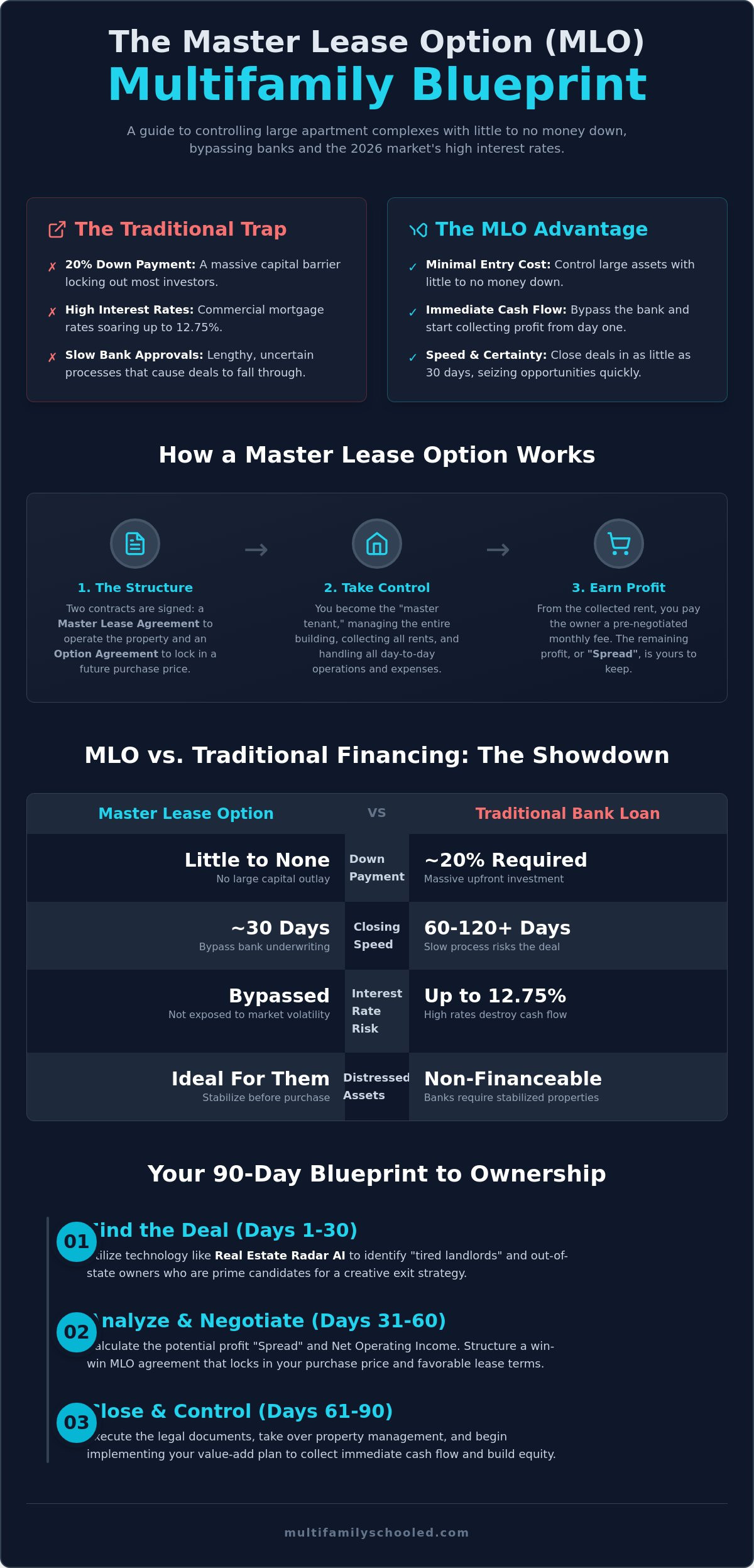
Finding and Negotiating MLO Deals: A 90-Day Blueprint
Success in this business isn't about luck. It's about a systematic approach to finding motivated sellers. Tired landlords are the lifeblood of the master lease option multifamily world. These owners are finished with the headaches of property management. They want out, but they don't want the immediate tax hit of a lump-sum sale. You are the solution to their problem. Use Real Estate Radar AI to identify distressed assets before your competitors even wake up. This software lets you filter for high-vacancy properties and out-of-state owners who haven't seen their buildings in years.
Your first contact must frame the MLO as a rescue mission. You aren't just a buyer; you're a problem solver. Focus on the seller's pain. Are they tired of "tenants, toilets, and trash"? Offer them a guaranteed monthly check and a management-free lifestyle. This is how you win the negotiation before it even starts. You're providing a path to freedom for them while building your own empire.
Leveraging Deal-Finding Software
A 90-day system requires relentless daily action. You need to generate leads every single morning. Focus on "Zombie" properties. These are buildings that are half-empty and deteriorating. Banks won't touch them, but they are perfect for a creative acquisition. Use direct mail and cold calling to reach these owners directly. Your goal is to find the one owner out of a hundred who is ready to walk away. Consistency is the only thing that separates the masters from the amateurs in this competitive 2026 market.
Closing the Seller
Expect the "Why don't you just buy it?" objection. It's a standard question. Your answer is simple: an installment-style sale provides massive tax advantages. Remind them that under the One Big Beautiful Bill Act (OBBBA), they can strategically manage their rental income through an LLC. This structure allows them to keep more of their money while you take over the daily grind. By deferring the sale, they avoid a massive capital gains tax bill today while receiving a steady income stream from you.
When you present your offer, look like a pro. Use the Multifamily Tool Kit to provide clean, authoritative documents. Negotiate the "Big Three" with total confidence. You need a Strike Price that reflects today's value, a Monthly Lease that ensures positive cash flow, and an Option Term long enough to stabilize the asset. Usually, three to five years is the sweet spot. If you want the exact scripts and strategies to close your first deal within 90 days, apply for our Mentorship Program today and start your journey to financial independence.
Mastering Creative Financing Through Multifamily Mentorship
Execution is the graveyard of good intentions. 95% of solo investors fail to close their first master lease option multifamily deal. They get stuck in "analysis paralysis" or trip over legal landmines that a seasoned pro would spot in seconds. A bad default clause or a poorly defined performance standard can strip you of your option rights and your profit. You don't have to guess. You don't have to wonder if your contract is solid. Stop waiting for "enough money" to start your journey. The capital you need is already out there; you just need the system to capture it.
A proven system turns a daunting professional process into a series of simple, achievable steps. We focus on a high-speed framework: Find, Analyze, and Close in 90 days. This isn't just about reading a book or watching a video. It's about having a mentor who has been in the trenches and knows how to navigate the 2026 market. You need someone to look over your shoulder when you're presenting an offer to a tired landlord. You need the confidence that comes from a multi-generational heritage of real estate success.
The Multifamily Schooled Advantage
Success requires more than just theory. You need direct access to the Mentorship Program for deal-specific guidance that keeps your momentum high. We move you from "Theory" to "Closing" with live workshop support and proprietary tools designed for immediate results. Our 90-day results guarantee removes the risk of starting by providing a clear, systematic timeline for your first acquisition. You aren't just buying a course. You're joining an ecosystem designed to ensure you cross the finish line.
Your Next Step to Financial Freedom
Don't let another year pass while you sit on the sidelines waiting for a 20% down payment. The 2026 market is moving fast, and the window for creative acquisition is wide open. Join the movement of investors who are taking control of their future and building legacy wealth through strategic assets. You have the ambition; we have the blueprint. It's time to stop dreaming and start operating. Start your 90-day journey to multifamily ownership here!
Take Control of Your Multifamily Future Today
The 2026 market belongs to the bold. You've seen how the master lease option multifamily strategy turns traditional barriers into stepping stones for wealth. You can control large-scale assets, bypass high interest rates, and build equity without a massive down payment. But knowledge without action is just a dream. You need a proven system to find, analyze, and close these deals before your competition catches on.
Led by Justin Brennan, a multi-generational industry expert, our program gives you the tools to win. You'll get proprietary Real Estate Radar AI software to pinpoint distressed sellers instantly. We're so confident in our process that we guarantee you'll find a deal in 90 days or we'll provide one for you. Stop waiting for the "perfect time" and start building your legacy now. Apply for the 90-Day Multifamily Mentorship Program and take your seat at the table. Your financial freedom is just one deal away.
Frequently Asked Questions
Is a Master Lease Option legal in all 50 states?
Yes, the strategy is legal across the country, but you must follow local regulations. For example, California Assembly Bill 1482 now applies rent control provisions to lease-option contracts as of 2026. This means monthly payments exceeding 110% of fair market rent can trigger specific tenant protection statutes. Always consult with a specialized attorney in your target market to ensure your contract is bulletproof and compliant with current local laws.
How much money do I typically need for a Master Lease Option fee?
You can often secure a deal with as little as 5% to 10% of the option price. On a million-dollar asset, research shows you might control the property for an option fee as low as $25,000. This is a massive advantage over the 20% to 30% down payments banks demand in 2026. It allows you to keep your liquidity for renovations and property improvements that drive value.
What happens if the property value goes down during the option period?
You simply choose not to exercise your option. This is the ultimate safety net of the master lease option multifamily strategy. You walk away with your credit intact and your other assets protected. Your only loss is the initial option fee you paid at the start. It's a calculated risk that prevents you from being trapped in a declining asset while the seller keeps the title.
Can I use a Master Lease Option for a small apartment building (5-20 units)?
Small apartment buildings are the perfect playground for this strategy. Owners of 5-20 unit properties often manage them personally and are the most likely to suffer from management fatigue. These tired landlords are frequently looking for an exit that doesn't involve a complex bank appraisal or 90-day waiting period. You can step in, solve their headache, and take control in as little as 30 days.
Who is responsible for repairs during a Master Lease agreement?
You are typically responsible for all day-to-day repairs and maintenance as the master tenant. This responsibility is exactly what the seller wants to get rid of. However, you should negotiate structural items like roofs or foundations to remain the owner's burden. Clearly defining these roles in your agreement prevents expensive surprises during your lease term and keeps your cash flow predictable.
How do I explain an MLO to a skeptical real estate broker?
Frame it as a performance-based acquisition for a property that won't qualify for traditional financing today. Brokers want their commission and a closed deal. Explain that the seller gets a guaranteed monthly check and a future exit while the broker gets paid for bringing a creative solution to a hard-to-sell asset. Use professional documents to show you're a serious operator with a systematic plan.
Can I refinance an MLO into a traditional commercial loan later?
Refinancing is the standard exit strategy once you have stabilized the asset and forced appreciation. By increasing the Net Operating Income (NOI), you create the equity needed to qualify for a traditional commercial loan. Most investors use the lease term to season the property for 12 to 24 months. This makes you an ideal candidate for lenders who want to see a track record of successful management.
What is the difference between an MLO and Seller Financing?
The main difference is who holds the title during the term. In seller financing, the deed transfers to you immediately and you sign a promissory note. In a master lease option multifamily deal, the seller keeps the title until you exercise your option and pay the strike price. This keeps the transaction cleaner for the seller and allows you to control the building without the immediate burden of a mortgage.



