

Investing in Real Estate With Friends and Family Agreement: The 2026 Guide
What if the key to your first apartment complex is sitting at your dinner table right now? Most investors never tap into their inner circle because they fear a messy legal dispute or a ruined holiday dinner. You've likely considered the idea, but the absence of a professional investing in real estate with friends and family agreement keeps you on the sidelines. You're right to be cautious. Trust is the foundation of any relationship. However, in the high-stakes world of 2026 multifamily assets, trust requires a proven system. You need a structure that protects your capital and your peace of mind while you hunt for your first deal in the next 90 days.
Stop guessing and start scaling. This guide provides the exact roadmap to professionalize your partnership. You'll learn how to split profits fairly, define management roles, and choose the right legal structure to handle 2026 tax standards. We're moving beyond handshake deals to create a bulletproof framework. By the end of this article, you'll have the confidence to pitch a deal to your inner circle and the tools to protect those relationships for the long haul. Your path to multi-generational wealth starts with a professional plan. Let's build your legacy.
Key Takeaways
- Unlock larger, safer multifamily deals by pooling capital and leveraging diverse skill sets within your trusted inner circle.
- Master the essential clauses for a professional investing in real estate with friends and family agreement to ensure legal clarity and protect your personal relationships.
- Choose the right legal structure by understanding why an LLC is the 2026 gold standard for protecting partners from personal liability.
- Establish bulletproof exit triggers and quarterly communication rhythms to keep your syndicate aligned and prevent future disputes.
- Take the 90-day challenge to transition from theoretical talk to closing your first high-quality apartment deal together.
Co-Investing in Multifamily: Your Fastest Path to Wealth
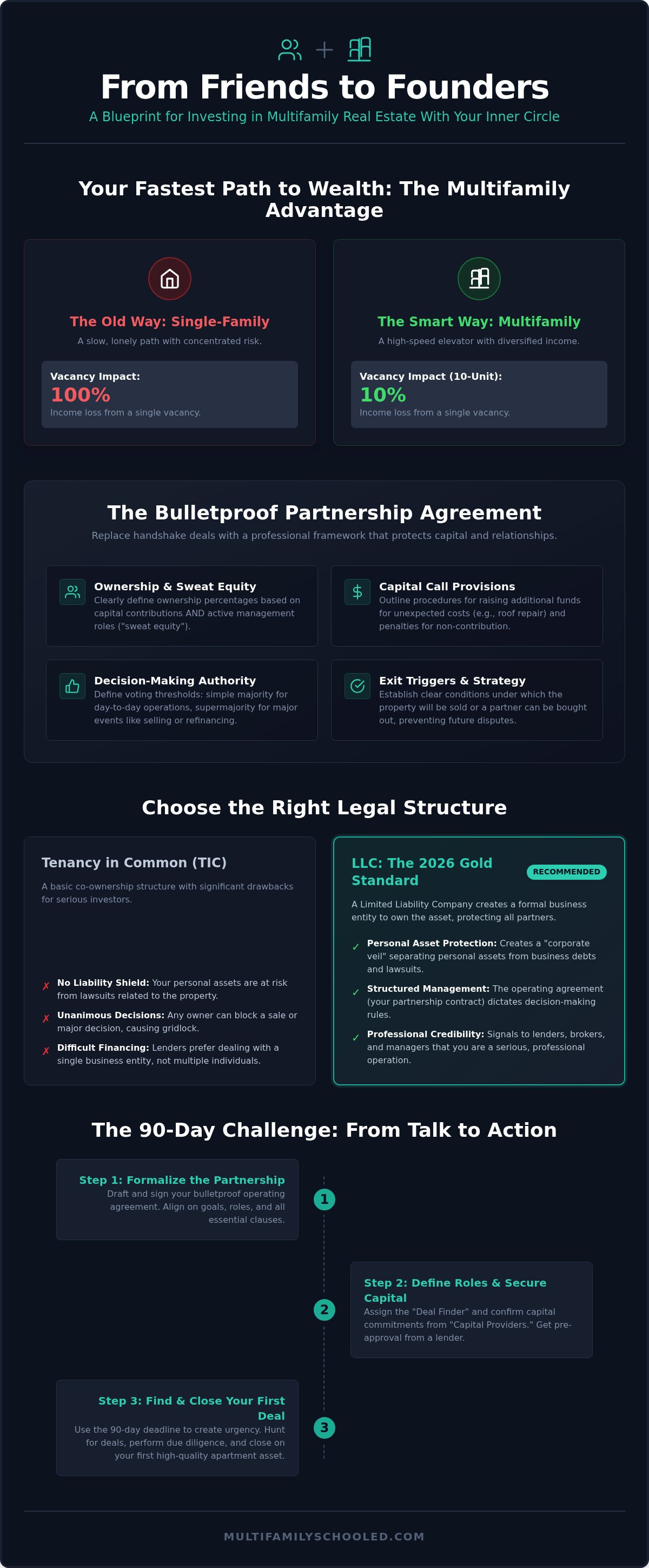
Stop thinking about "buying a house" and start thinking about "owning the block." Single-family investing is a slow, lonely grind. Multifamily investing with a team is a high-speed elevator to financial independence. When you pool your resources, you aren't just increasing your budget; you're decreasing your risk. A single vacancy in a one-bedroom house is a 100% loss of income. A single vacancy in a 10-unit building is barely a dent in your monthly cash flow. This is the math of the wealthy, and it's time you used it to your advantage.
Your inner circle is your greatest untapped asset. You don't need five experts to close a deal. You need one "Deal Finder" who masters the search and four "Capital Providers" who fuel the engine. This division of labor allows everyone to play to their strengths. While one partner uses proprietary deal finding software to locate off-market gems, the others focus on securing the funding. This isn't just a hobby. It's a strategic alliance designed to build a legacy that lasts for generations.
The Multifamily Advantage for Groups
Scale changes everything. Property managers often ignore a single house, but they'll compete to manage a 20-unit complex. This brings professional oversight to your investment, freeing you from the "toilet and tenant" headaches. Lenders also prefer larger assets. They view a commercial apartment building as a business with its own income stream, making it easier for a group to secure substantial financing than for an individual to buy a condo. To protect everyone, you must research the right legal structures for co-ownership before you sign the first contract. This ensures that every "door" you add to your portfolio strengthens your collective shield against liability.
Transitioning from Social Connection to Business Partnership
The biggest threat to your family legacy isn't a market crash. It's a handshake deal. You must transition from "friends having a beer" to "partners building a business." This requires a formal investing in real estate with friends and family agreement that outlines exactly who does what. Do you want cash flow now or appreciation later? You need to align on these goals today. Set a 90-day deadline to find and close your first deal. This creates the urgency needed to move past the "talking" phase. A professional agreement replaces anxiety with strategic confidence. It allows you to focus on the prize: creating multi-generational wealth through collective action.
The Essential Clauses for a Bulletproof Friends and Family Agreement
A handshake is a gesture of trust, but a contract is a gesture of respect. When you move from social connection to a business partnership, your investing in real estate with friends and family agreement serves as the ultimate shield for your capital and your relationships. Don't leave your financial future to memory or "good intentions." You need a professional framework that anticipates every possible friction point before it happens. This document is the difference between a successful syndicate and a legal nightmare.
Ownership percentages are rarely a simple 50/50 split. You must calculate value based on both capital and sweat equity. If one partner brings the cash while another uses our multifamily tool kit to find and manage the deal, their ownership should reflect that effort. Equity is the currency of your partnership; spend it wisely. Clearly define what happens when the property needs an unexpected $50,000 roof repair. Capital call provisions must be non-negotiable. They outline exactly how much each partner must contribute and the penalties for failing to meet the call. This ensures the asset remains protected regardless of an individual's temporary cash flow issues.
Decision-making authority is where most family deals fail. You cannot require unanimity for every minor repair. Establish a system where day-to-day operations require a simple majority, while major events like selling the asset or taking on new debt require a higher threshold. This keeps the business moving at the speed of the market.
Financial Contributions and Profit Distribution
The math must be transparent. Define exactly how the initial down payment and closing costs are split among the group. You need to establish a "waterfall" structure for distributions. Who gets paid first? Typically, capital providers receive their preferred return before the deal finder takes their share of the profits. You must also account for ongoing expenses and 2026 property tax liabilities to ensure the entity remains solvent through every season of the investment cycle.
Management Roles and Responsibilities
Stop the "who is doing what" guessing game. Decide immediately if you will use professional management or if a partner will lead operations. Set a strict spending limit, such as $2,500, for the managing partner. Anything above that requires a group vote. Professionalize the hustle by compensating the partner who found the deal. This "acquisition fee" rewards the effort required to secure a high-quality asset in a competitive market. A Buy-Sell Clause acts as the ultimate partnership insurance by providing a clear, pre-negotiated exit path if a partner needs to leave the deal due to death, divorce, or a change in personal strategy.
Choosing the Right Legal Structure: LLC vs. Tenancy in Common
Selecting your legal entity isn't just paperwork; it's your first line of defense. In 2026, the Limited Liability Company (LLC) remains the gold standard for multifamily syndication. It provides a clean, professional wrapper for your investing in real estate with friends and family agreement. While some beginners look at Tenancy in Common (TIC) because it seems simpler, they often overlook the massive personal liability. In a TIC, your personal assets are exposed to every slip-and-fall lawsuit or creditor claim involving the property. Don't build your wealth on a foundation of sand.
The tax benefits of an LLC are equally powerful. As a pass-through entity, it allows profits and losses to flow directly to your individual tax returns. You can leverage 2026 capital gains rates, which currently range from 0% to 20% for long-term holdings, while utilizing depreciation to offset your income. Current regulations heavily favor structured entities for commercial assets. Lenders almost exclusively require an LLC for apartment building loans because it professionalizes the management and isolates the risk from your personal life.
Asset Protection and Liability
Protect your personal bank account. An LLC creates a "corporate veil" between your family's savings and the property's liabilities. To maintain this shield, you must treat the entity with respect. Don't co-mingle funds. Keep separate bank accounts. With national average LLC filing fees sitting at approximately $132 in 2026, the cost of protection is negligible compared to the risk of a total personal loss. This structure ensures that a legal dispute at the property level doesn't become a financial disaster at your dinner table. It keeps your business and your personal legacy separate.
Flexibility and Future Growth
Your partnership will evolve. An LLC makes it easy to add or remove partners as your portfolio grows. It also prepares your group for a 1031 exchange. This allows you to defer taxes when you eventually trade up to a larger complex. Use the Multifamily Tool Kit to organize your partnership documents and ensure your operating agreement is bulletproof from day one. This isn't just about one deal. It's about building a scalable system that works for your entire inner circle. Professionalize your structure today to win tomorrow.
Managing the 'People Problem': Communication and Exit Strategies
Relationships are the fuel for your portfolio, but friction is the fire that can burn it down. Most investors wait for a crisis to discuss an exit. That's a recipe for disaster. Your investing in real estate with friends and family agreement must include a "Pre-Nup" for the property from day one. You need to establish clear exit triggers. Life happens. Partners get divorced, face medical emergencies, or simply change their financial goals. Without a pre-negotiated roadmap, these personal shifts can force an unnecessary sale of a high-performing asset.
Professionalize your communication with quarterly partner meetings. These aren't social hangouts. They are strategic sessions to keep everyone aligned on the 90-day plan. If a partner wants out early, don't panic and sell the building. Use a "Right of First Refusal" clause. This allows the remaining partners to buy out the departing member's interest at a fair market value. It keeps the asset under your control while providing the liquidity your partner needs. This is how you protect the building and the bond simultaneously.
Conflict Resolution Framework
Stop disputes before they reach a courtroom. Litigation is a black hole for your profits. Mandate mediation in your agreement to resolve deadlocks. You must also define "Default" with absolute clarity. If a partner stops paying their share of the property taxes or mortgage, the group needs the power to dilute their equity or remove them. For extreme deadlocks, use a "Shotgun Clause." One partner offers a price to buy the other out. The second partner must either accept the offer or buy the first partner at that exact same price. It's the ultimate deterrent against irrational behavior.
Transparency and Reporting
Visibility kills suspicion. Use Real Estate Radar to provide your partners with real-time, data-driven updates. When everyone can see the numbers, trust grows. Deliver monthly financial statements that break down every dollar of cash flow and expense. This is especially vital for "Passive" partners. Set their expectations early. Define exactly what they will receive and when they will receive it. This prevents micromanagement and allows the "Deal Finder" to focus on scaling the portfolio. Professional reporting turns a group of relatives into a sophisticated investment syndicate.
Ready to turn your inner circle into a powerhouse investment team? Join our Mentorship Program to get the exact frameworks we use to close deals in 90 days.
Scale Your Portfolio Together: Join the Multifamily Schooled Mentorship
A bulletproof contract is a shield, but a high-quality deal is your sword. You can have the most sophisticated investing in real estate with friends and family agreement in the world, but it's worthless if you don't have a profitable asset to put it on. Most family groups fail because they spend months arguing over clauses and zero hours analyzing real deals. They get stuck in "analysis paralysis" while professional syndicators scoop up the best opportunities. It's time to stop talking and start closing. You need a system that transitions your partnership from a social concept to a cash-flowing reality in exactly 90 days.
Professional mentorship is the missing piece of the puzzle. It prevents the rookie mistakes that kill family legacies, such as overpaying for a property or missing critical deferred maintenance during due diligence. In the 2026 market, where buyer selectivity is at an all-time high, you cannot afford to guess. You need access to the off-market deal flow that solo investors never see. By professionalizing your approach, you provide your partners with the ultimate security: the knowledge that an expert has vetted every move you make.
Professionalize Your Partnership
Move from "amateur" to "pro" by joining our Mentorship Program. This isn't just about learning; it's about execution. You get a second set of expert eyes on your family's first big deal to ensure the numbers actually work. We provide the proven systems that make your partners feel secure in their investment. When you show up with a professional framework and a vetted deal, you aren't just asking for money. You are offering an exclusive opportunity for economic empowerment. Use our authority to build your credibility.
Your 90-Day Roadmap to a Closed Deal
Speed is a competitive advantage. Our system is designed to take your group from a standing start to a closed deal on a fixed timeline. Follow this roadmap to maintain momentum and keep your partners engaged:
- Weeks 1-4: Alignment and Entity Setup. Finalize your investing in real estate with friends and family agreement and file your LLC. Use this time to define your buying criteria and secure your initial funding commitments.
- Weeks 5-8: Aggressive Deal Finding and Analysis. Leverage our proprietary software to find off-market apartment buildings. Run the numbers daily and submit offers on assets that meet your group's specific cash-flow goals.
- Weeks 9-12: Due Diligence and Closing. Execute your inspections, finalize the financing, and move through the legal hurdles with your syndicate. This is where your professional structure pays off as you cross the finish line together.
The 2026 recovery is happening now. Don't let this window of opportunity close while you're still sitting on the sidelines. Build your legacy, protect your relationships, and secure your financial future by taking decisive action today. Your first 10-unit deal is closer than you think.
Build Your Family Legacy Today
The window for 2026 multifamily opportunities is open right now. You have the roadmap. You know how to choose an LLC to shield your assets from liability. You understand why a professional investing in real estate with friends and family agreement is the only way to protect your relationships while you scale. Don't let another month pass in "talk" mode. Your inner circle is ready for a leader. They are waiting for a partner who provides the system to turn collective capital into a multi-generational empire. This is your moment to step up.
Stop guessing and start winning. Our Mentorship Program is led by multi-generational real estate experts who have mastered every market cycle. We give you the unfair advantage of our proprietary Deal Finding Software to locate off-market gems. We are so confident in our framework that we promise you'll find a deal in 90 days or we'll provide one for you. Move from amateur to authority and show your partners what's possible. Secure your family's financial future—Join the 90-Day Mentorship today! Your future starts with the action you take right now.
Frequently Asked Questions
Can we invest in real estate with friends without an LLC?
You can, but you shouldn't. Investing without an LLC exposes your personal assets to every lawsuit and creditor claim involving the property. A Tenancy in Common structure lacks the "corporate veil" protection that keeps your personal bank account safe. Professionalize your deal by forming an entity that isolates risk. This ensures a property-level disaster doesn't wipe out your family's savings or your personal credit score.
What is the best way to split ownership in a family real estate deal?
Calculate ownership based on the total value provided, not just the cash. Capital is vital, but the "Deal Finder" who manages the 90-day search and handles due diligence deserves equity for their hustle. Your investing in real estate with friends and family agreement should reflect these varied contributions clearly. Avoid the "equal split" trap if the work isn't equal. Reward the specific performance that drives the deal forward.
What happens if one partner wants to sell the property but the others don't?
Execute the pre-negotiated Buy-Sell clause established in your operating agreement. This allows the remaining partners to purchase the departing member's interest at a fair market price without forcing a sale of the entire building. Use a Right of First Refusal to keep the asset under your group's control. This strategy protects your long-term wealth goals while providing a clean exit for the partner who needs liquidity today.
How do we handle a partner who can't meet a capital call?
Use equity dilution to protect the asset's solvency. If a partner fails to contribute their share for a major repair, the other partners cover the gap and increase their ownership percentage accordingly. Your agreement must make this process automatic and non-negotiable. You can also structure the missing funds as a high-interest loan from the group to the defaulting partner. This ensures the property remains funded without punishing the partners who are paying.
Is it better to invest with friends as a 50/50 split?
Rarely is a 50/50 split the most effective path for a serious partnership. One partner almost always carries more of the operational load or provides the bulk of the initial capital. Misaligned equity leads to resentment and stalled portfolio growth. Structure your deal to reward the specific roles and risks each person takes. Accurate splits based on real contribution create a more sustainable business environment for your inner circle.
What are the biggest risks of investing with family?
The primary risk is the "social trap" where familiarity replaces formal business structure. Emotional disputes over money can destroy both your holiday dinners and your investment portfolio simultaneously. Without a professional investing in real estate with friends and family agreement, you risk legal deadlocks and permanent personal fallout. Treat the partnership as a high-stakes business from day one to shield your relationships from the inevitable pressures of the market.
How do we decide who manages the property day-to-day?
Assign the role to the partner with the most operational expertise or hire a professional management firm. If a partner manages the asset, compensate them with a specific management fee. This professionalizes the role and prevents "volunteer burnout" that often occurs in casual deals. Set a clear spending limit for the manager to ensure the group retains control over major financial decisions while the property runs efficiently every day.
Do we need a lawyer to draft a real estate partnership agreement?
You absolutely need a legal professional to finalize your document. While you should use our frameworks to build the initial structure and align your partners, a lawyer ensures your agreement complies with 2026 state-specific laws. Think of this as an investment in your protection, not a cost. A few hundred dollars spent today saves you thousands in potential litigation tomorrow. Don't gamble your family's future on a generic template.



