

How to Vet a Multifamily Property Management Company
What if the company with the biggest portfolio isn’t the right fit for your property? A polished pitch and impressive reputation don’t show how a team handles leasing, maintenance, reporting, or day-to-day decisions. Learning how to vet a multifamily property management company means looking past sales claims and examining the operating systems behind them.
It’s reasonable to question whether professional management will justify its fees for your asset, or whether self-management would stretch your time and skills too thin. Hiring a manager shouldn’t mean giving up visibility or control. The right approach depends on your property, priorities, and capacity as an owner.
This guide gives you a practical framework to compare self-management with professional management, assess candidates using consistent criteria, and separate proven processes from promises. You’ll learn what evidence to request, which performance measures to review, and how to clarify fees, responsibilities, reporting, and accountability before signing. Make the decision based on how the property will be operated, not just who makes the strongest first impression.
Key Takeaways
- Weigh the time, expertise, resident communication, and oversight each approach demands before deciding whether to manage the property yourself or delegate.
- To learn how to vet a multifamily property management company, compare its experience with properties and challenges similar to yours, including the proposed account team’s track record.
- Give every candidate the same vacancy, repair, and reporting scenarios to see how its systems work in practice.
- Compare reporting, maintenance, leasing, and fees with a consistent scorecard, then verify claims through references.
- Before signing, put the scope, approval authority, communication expectations, responsibilities, and termination terms in writing.
DIY management or a professional company: which fits your multifamily property?
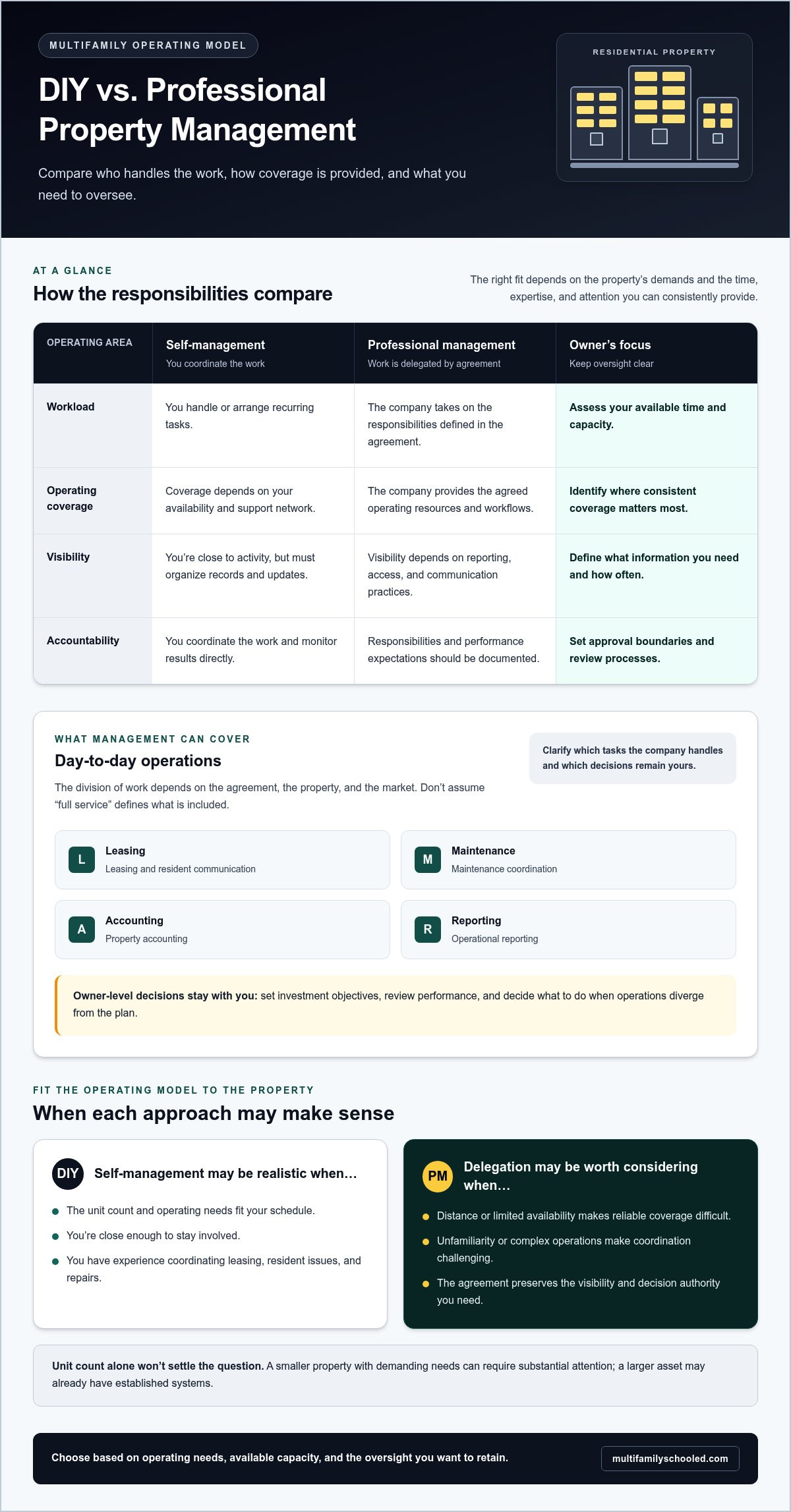
Start by deciding how involved you want to be in daily operations. Self-management keeps tasks and decisions close to you. Hiring a professional company delegates the responsibilities defined in your agreement, but you still own the investment and need a reliable way to oversee performance. Neither approach is automatically better. The fit depends on the property’s demands and the time, expertise, and attention you can consistently provide.
What does multifamily property management cover?
Multifamily management can include leasing and resident communication, maintenance coordination, property accounting, and operational reporting. These recurring activities support the property’s day-to-day operations. As the owner, you remain responsible for investment-level choices such as setting objectives, reviewing performance, and deciding what to do when operations diverge from the plan. For a general overview of property management, see how the field encompasses different roles and responsibilities.
The division of work depends on the agreement, property, and market. One company may coordinate repairs, while another agreement may set out a different process. Don’t assume a label like “full service” tells you what’s included. Get specific about which tasks the company handles, which decisions remain yours, and how you’ll receive updates.
| Area | Self-management | Professional management | Owner’s focus |
|---|---|---|---|
| Workload | You handle or arrange recurring tasks. | The company takes on the responsibilities defined in the agreement. | Assess your available time and capacity. |
| Operating coverage | Coverage depends on your availability and support network. | The company provides the agreed operating resources and workflows. | Identify where consistent coverage matters most. |
| Visibility | You’re close to activity, but must organize records and updates. | Visibility depends on reporting, access, and communication practices. | Define what information you need and how often. |
| Accountability | You coordinate the work and monitor results directly. | Responsibilities and performance expectations should be documented. | Set approval boundaries and review processes. |
When is DIY management realistic, and when is delegation worth considering?
Self-management may be realistic when the unit count and operating needs fit your schedule, you’re close enough to stay involved, and you have the experience to coordinate leasing, resident issues, and repairs. Delegation may be worth considering when distance, limited availability, unfamiliarity, or complex operations make reliable coverage difficult to maintain. Unit count alone won’t settle the question: a smaller property with demanding needs can require substantial attention, while a larger asset may already have established systems.
Before comparing candidates, write down the outcomes you need. Decide, for example, how often you need reporting, which decisions you want to approve, and which tasks you’re prepared to own. This baseline helps you judge whether delegation fills a real capacity gap or simply adds another layer between you and the property.
Professional management may suit an owner when recurring operating needs exceed the owner’s available time, proximity, or expertise, provided the agreement preserves the visibility and decision authority the owner needs. Use that as a starting point for how to vet a multifamily property management company, rather than assuming a larger firm or a hands-on approach is the right answer.
How to vet a multifamily property management company’s experience and fit
A company’s size or brand recognition won’t tell you whether its team can handle your property’s specific operating demands. To learn how to vet a multifamily property management company, match its evidence to your asset: property type, unit count, location, occupancy, resident needs, and current challenges. A firm experienced with stabilized apartments may have different strengths from one used to repositioning a property or coordinating extensive repairs.
Does the proposed team match your property and market?
Find out who would manage your account, what each person would handle, and which comparable properties they’ve worked with. Ask for examples of how the team handled needs like yours, not just assets with similar branding. If local leasing knowledge matters, ask how the team has approached leasing in that market. For staffing and vendor coordination, ask who did the work, how responsibilities were divided, and how owners were kept informed.
Distinguish company-wide credentials from the experience of the people assigned to your property. A firm may oversee a broad portfolio, but the relevant question is whether your proposed account team has the capacity and practical experience your asset requires. Ask who provides coverage when the primary contact is unavailable and how a change in assigned staff would be communicated.
How can you validate credentials and references?
Licensing and credential requirements vary by jurisdiction and role. Identify the rules that apply where the property operates, then verify relevant licenses and available disciplinary information through official public resources. Don’t assume a credential required in one location applies everywhere. If your property participates in a housing program, ask about directly relevant experience. HUD’s Office of Multifamily Housing (HUD) provides information on federal multifamily housing programs.
Request references from owners of properties with similar operating needs, and ask whether each reference can speak to the proposed team and service scope. Keep questions concrete: How promptly did the team follow through? Were reports clear? Did the owner know when an issue needed a decision? Did the company’s actual responsibilities match the agreement? A reference based only on the firm’s overall reputation may not tell you how your account would be handled.
Before shortlisting, gather evidence of comparable property experience, the proposed team’s roles, local operating examples, verified credentials, and owner references tied to similar service needs. Keep the materials together so you can compare candidates on evidence rather than impressions. Stronger evaluation starts with knowing what your asset needs and what proof would demonstrate a fit.
- Property examples that match your unit count, occupancy, and operating challenges
- Names and responsibilities of the people proposed for your account
- Examples of local leasing and vendor coordination
- Official credential checks relevant to the property’s jurisdiction
- References who can discuss the assigned team and agreed service scope
Build that decision-making discipline into your broader ownership plan. Multifamily investing mentorship can help investors strengthen their understanding of ownership decisions beyond daily operations.
Test reporting, maintenance, leasing, and fees with real scenarios
Move beyond a service list. Give every finalist the same practical situations and ask them to show, step by step, what their team would do and what you would see as the owner. This makes it easier to compare actual workflows instead of confident descriptions. For information about property management resources and certifications, the Institute of Real Estate Management (IREM) is another reference point as you assess professional practices and qualifications.
Can the company show how leasing and maintenance decisions happen?
Start with a vacancy scenario. Ask how the team handles an inquiry, schedules a tour, tracks an application, communicates a decision, and updates you on leasing progress. Clarify how renewals are initiated and how vacancy status appears in owner updates. Look for named responsibilities, clear handoffs, and records you can review. “Strong leasing” is a broad claim; ask who follows through and how you’ll know what’s happening.
Then trace a repair from start to finish. For example, a resident reports a leak. Ask how the request is logged, how urgency is assessed, who contacts or selects a vendor, when owner approval is required, how completion is documented, and where the expense appears. Confirm how emergency responsibilities, approval limits, and vendor oversight are defined in the proposed scope. You should understand what happens when a repair exceeds an approval threshold or takes longer than expected.
Are reporting and fees transparent enough to support oversight?
Request a redacted sample report and review it as if you were making an ownership decision. Can you distinguish rent collected from outstanding balances? Are expenses connected to budget categories? Do variances and operational updates explain what changed and what action is needed? Ask how often reports arrive, how owners access supporting records, and how the team flags exceptions such as missing invoices or unexpected expenses.
Compare each candidate’s fee schedule with its written service scope. Match every charge to the work it covers, note exclusions and possible additional charges, and identify when your approval is required. Don’t assume a fee label means the same thing across proposals. Ask how financial questions, disputed charges, and corrections are recorded and resolved. Keep the answers in writing so you can compare like with like.
- Ask how often financial and operating reports are delivered.
- Confirm which records you can access and how supporting documents are organized.
- Identify who can authorize work and where approval limits apply.
- Match proposed charges to included services, exclusions, and approval steps.
A sample report and a demonstrated workflow are stronger evidence than general promises because they show what information reaches you, who acts, and how decisions are documented. During each demonstration, take notes using the same criteria. That gives you a practical basis for how to vet a multifamily property management company while preserving your ability to stay informed without managing every task yourself.
Use a consistent interview, reference, and scorecard process
A repeatable process keeps a persuasive presentation from outweighing practical evidence. Set your criteria before interviews, give each finalist the same questions and scenarios, and record what’s verified, what’s a sales claim, and what remains unanswered. This makes how to vet a multifamily property management company a comparison you can explain and defend.
- Define your needs. List the property’s operating priorities, owner approval preferences, reporting needs, and communication expectations.
- Build a shortlist. Advance candidates whose relevant property experience and proposed team appear aligned with those needs.
- Request evidence. Ask for comparable property examples, team roles, sample reporting, references, and a written service scope.
- Run the same scenarios. Ask every finalist to walk through a vacancy, resident concern, maintenance issue, and financial variance.
- Check references. Speak with comparable owners about responsiveness, reporting accuracy, consistency, and issue resolution.
- Score and resolve gaps. Rate each candidate against agreed criteria, then get answers to open questions in writing before choosing.
What should owners ask in a management-company interview?
Ask who would manage the account, how the team provides coverage, how often you’ll communicate, and how an issue is escalated. Request a walkthrough of a vacancy, resident concern, maintenance problem, and unexpected financial variance. Then ask how the company would shape an initial operating plan around your property’s needs. Look for clear ownership of each step, not just a polished summary of services.
How should references and candidate scores be compared?
Use a scorecard with criteria chosen before the interviews. Weight asset fit, team capability, reporting, operating workflows, communication, and contract clarity according to your priorities. For example, if close financial oversight is central, give reporting and access to records more weight. Apply the same scale to every finalist and note the evidence behind each rating.
Ask references about specific experiences: whether reports arrived consistently, questions received clear answers, and issues were followed through to resolution. Separate what a reference confirms from your impression of the interview. A confident answer isn’t proof by itself. Mark each score as supported by documents, confirmed by a reference, based on a demonstration, or still unverified.
- Verified evidence: Written scope, sample reports, scenario walkthroughs, or reference feedback.
- Sales claims: Statements about service quality or results without supporting examples.
- Open items: Questions about responsibilities, approvals, communication, or contract terms that still need written answers.
Don’t let a high overall score hide a critical gap. Resolve unanswered items in the written scope before selection, especially if they affect decision authority, reporting, or who handles a key operating task. Investors building a stronger ownership decision process can explore multifamily investing mentorship as an educational resource.
Make the decision, set expectations, and plan the management transition
Choose the candidate whose demonstrated systems, assigned team, and proposed scope fit your property. A large portfolio can signal experience, but it doesn’t prove that the people and processes assigned to your asset match its needs. Your work on how to vet a multifamily property management company should lead to a clear decision, written expectations, and an orderly handover.
What should the management agreement and transition plan make clear?
Before signing, compare the agreement with the proposal and your interview notes. Confirm that services, exclusions, reporting cadence, approval authority, communication channels, and fees match what you discussed. Define who handles each recurring task and how you’ll raise a service concern. Review termination provisions so responsibilities and notice requirements are clear if the relationship ends.
Put transition responsibilities in writing, too. Identify who will transfer records, coordinate resident communications, share vendor details, and track open work orders. Agree on how financial information and unresolved issues will be handed over, and set a review cadence to catch gaps early.
- Property and resident records, including who transfers and receives them
- Open maintenance requests, pending work, and assigned follow-up owners
- Vendor contacts, current arrangements, and relevant service information
- Resident notices, communication timing, and the person responsible for sending them
- Financial records, outstanding items, and a process for resolving discrepancies
Give every open item a named owner and a due point, with the schedule set by the agreement and property needs. For example, a repair already in progress should have a clear status, vendor contact, next action, and person responsible for updating the owner. Set a regular check-in to review unresolved issues, reporting, and exceptions that need escalation.
How can investors strengthen their broader multifamily decision-making?
Management oversight is one part of ownership, not a substitute for it. Decide how the property’s operating plan supports your broader investment goals, what information you need to assess performance, and which choices remain yours. That clarity helps you stay accountable for outcomes while delegating agreed day-to-day work.
Multifamily Schooled provides investor education, mentorship, workshops, and tools for owners building their understanding of multifamily investing. These resources can support informed ownership decisions.
Ready to strengthen your investing knowledge? Explore multifamily investing education resources and keep building the skills to make deliberate property decisions.
Build confidence in your next ownership decision
The way you operate a property can shape how effectively it supports your broader investment goals. Treat this decision as part of your ownership strategy: ask for evidence, make expectations explicit, and choose an approach that lets you stay informed while the property’s needs are handled. The framework for how to vet a multifamily property management company can also strengthen how you evaluate future operating decisions.
Multifamily Schooled brings an investor perspective to that learning process. Justin Brennan is a third-generation multifamily investor active in real estate since 2006. The company owns 1,200+ units and $200 M+ in multifamily properties across 5 states, and has helped 1,000+ students build their multifamily investing knowledge.
Ready to keep developing your investor judgment? Explore multifamily investing education and take your next step with greater clarity. Your operating approach should fit your property, your priorities, and the kind of ownership you’re working toward.
Frequently Asked Questions
Is hiring a multifamily property management company worth it?
It can be worth it when the value of delegated operating work justifies the fee and oversight the arrangement requires. Compare your actual workload with the time you want to spend on investing, and consider whether missed follow-ups or inconsistent administration could affect your plans. Track the hours and recurring tasks you handle over a typical month, then decide whether hiring support would free capacity you can put to better use.
Can a property management company guarantee that every apartment will stay occupied?
No company can reliably promise that every apartment will remain occupied at all times. Residents move, leases end, and demand can shift. A manager can describe its leasing approach and report on vacancies, but those activities don’t eliminate turnover or guarantee a result. Treat an occupancy guarantee cautiously: read the exact contract language, identify any conditions or exclusions, and understand what remedy, if any, the agreement provides.
What should a multifamily property management contract specify?
A contract should spell out the working relationship: services included, excluded tasks, fees and additional charges, agreement term, renewal process, and termination provisions. It should also explain how the manager handles owner funds and records, communicates performance, and obtains authorization for decisions outside its authority. Compare the final document with the proposal and any written commitments. If a promise matters to you, make sure the agreement captures it clearly.
How do I check whether a property management company is licensed?
Start with the jurisdiction where the property is located, because licensing rules and responsible agencies can differ. Use the official government licensing database or regulator’s public records to search the company and relevant individuals by their legal names. Confirm the credential type and current status, then review any disciplinary information the agency makes available. Check which role the credential covers; a company license and an individual’s license may not be interchangeable.
How can I tell whether a management company’s references are relevant to my property?
Look for references whose properties resemble yours in unit count, location, occupancy conditions, resident profile, or operating needs. Ask whether the person speaking worked directly with the proposed account team and received the service scope you’re considering. A reference from a different type of asset can still offer useful context, but it may not establish fit. Ask for a concrete example of a challenge similar to one your property faces.
What should owners prepare before changing multifamily property managers?
Prepare a handover file with current leases, a rent roll, resident contact and notice information, financial records, vendor details, access credentials, and a list of open work orders. Note pending payments, unresolved resident concerns, and work already approved. Set a clear cutoff for accounting and responsibility, and assign someone to track each transfer. A shared checklist helps prevent essential information from getting lost during the changeover.
What is the difference between property management and asset management?
Property management focuses on ongoing operations, such as leasing, resident communication, and maintenance coordination. Asset management focuses on the owner’s investment objectives and the property’s performance against its business plan, including reviewing results and considering strategic changes. The roles can overlap, especially for smaller ownership teams. Clarify who makes each decision so operational updates inform investment oversight without blurring accountability.



