

How to Underwrite Property Management in Multifamily: The 2026 Investor’s Guide
Your "rule of thumb" management fee is the fastest way to kill your 2026 deal before it even starts. Many investors fall into the trap of overestimating their Net Operating Income because they rely on generic industry averages instead of hard data. Learning how to underwrite property management in multifamily is the single most important skill you need to master this year. It is the difference between owning a high-performing asset and a financial anchor.
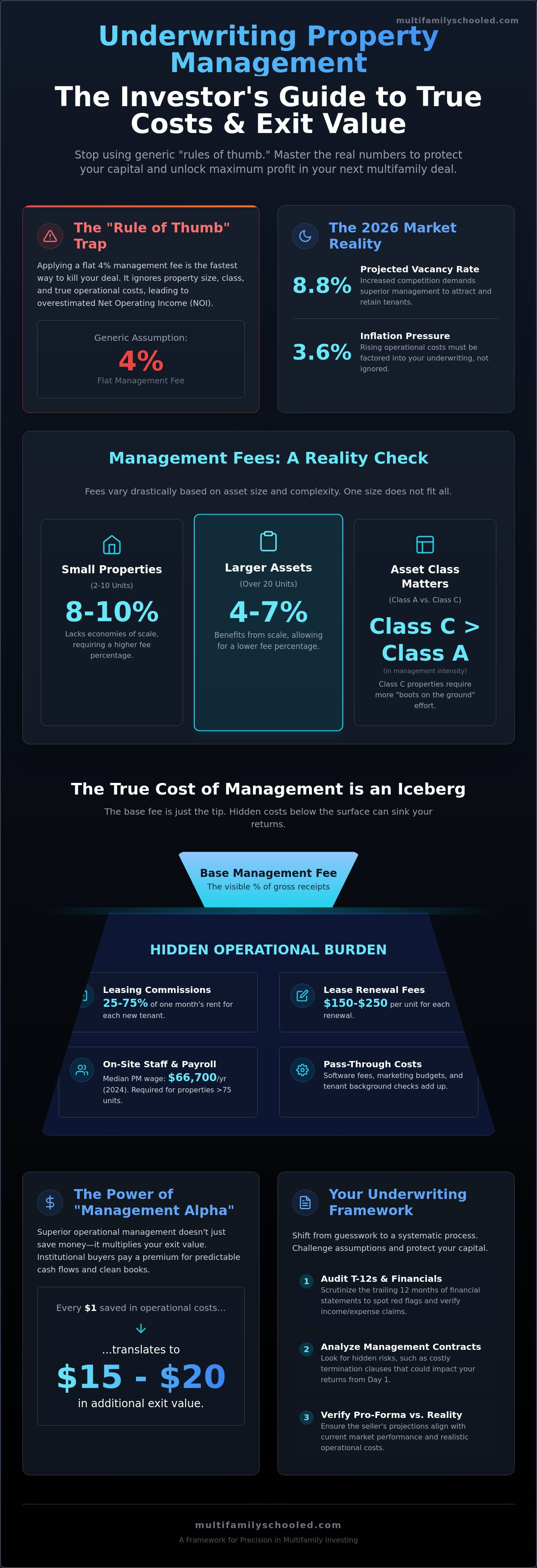
You likely feel the pressure of rising vacancy rates, which are projected to hit 8.8 percent by the end of 2026. You are right to worry about hidden fees and inflated pro-forma claims that do not account for 3.6 percent inflation. We are going to fix that right now. This guide gives you a foolproof framework for underwriting management costs with absolute precision. You will gain the confidence to challenge any seller's operational assumptions and protect your exit value. Follow this system to build a clear path to finding and closing your next deal in just 90 days.
Key Takeaways
- Master how to underwrite property management in multifamily by looking beyond base fees to uncover the true operational impact on your NOI.
- Identify the gap between base management fees and the total operational burden to protect your building's exit value.
- Audit property T-12s to spot red flags and verify that a manager's pro-forma claims match current 2026 market performance.
- Underwrite the financial risks within management contracts, including termination clauses that could cost you on Day 1.
- Shift from guesswork to a systematic framework that allows you to challenge seller assumptions and close your next deal in 90 days.
Why Property Management is the 'Make or Break' Variable in Your Deal
Stop treating property management like a static line item on a spreadsheet. It is the primary engine of your Net Operating Income. If you want to master how to underwrite property management in multifamily, you must shift your perspective. Underwriting is not just about vetting costs; it is about auditing operational efficiency. A poorly managed asset in a prime location will still fail. Conversely, superior operations create "Management Alpha," which is the extra value you squeeze out of a property through elite execution. This is the difference between a mediocre return and a life-changing exit.
You must understand the property management fundamentals that dictate how an asset breathes. Quality management ensures your property remains competitive as national vacancy rates are projected to hit 8.8 percent by the end of 2026. Without a strategic manager, your expenses will spiral, and your tenant base will erode. Master this process now to protect your capital and secure your financial future.
To better understand this concept, watch this helpful video:
Moving Beyond the 4% 'Rule of Thumb'
Applying a flat 4 percent management fee to every deal is a recipe for disaster. This "rule of thumb" ignores the reality of 2026 economics. Small multifamily properties, typically 2 to 10 units, often require fees between 8 and 10 percent because they lack economies of scale. Larger assets over 20 units might see fees drop to the 4 to 7 percent range. You also have to consider asset class. A Class C property requires much higher management intensity and "boots on the ground" compared to a stabilized Class A luxury building. Don't let a generic percentage blind you to the actual labor required to run your deal.
How Management Quality Impacts Your Exit Valuation
Efficiency is your greatest multiplier. In the current market, every dollar you save through better management translates to 15 to 20 dollars in additional value at exit. This is why learning how to underwrite property management in multifamily is so lucrative. Institutional buyers don't just buy buildings; they buy predictable cash flows. They pay a premium for "clean" books and professional reporting. If your management records are a mess, you'll scare away the big players and settle for a lower price. Professional operations also help you secure the best financing, especially when lenders are looking for a minimum Debt Service Coverage Ratio of 1.25x.
Calculating the True 'Total Cost of Management'
Mastering how to underwrite property management in multifamily means looking past the headline number. The base fee is a distraction. You need to calculate the all-in management burden to protect your capital. Professional investors often start with a standardized HUD underwriting template to ensure no expense is left behind. But even the best templates require you to input real-world data. You aren't just paying for a service; you're funding an entire operational ecosystem. This includes software pass-throughs, marketing budgets, and background check fees. If you miss these, your NOI projections are pure fiction. Stop guessing and start calculating the total cost of ownership.
Decoding the Fee Structure: Beyond the Base Percentage
Leasing commissions are a major variable in your 2026 projections. Expect to pay between 25 and 75 percent of one month's rent for every new tenant acquisition. Lease renewal fees typically range from 150 to 250 dollars per unit. These aren't just "junk" fees; they are the cost of performance. However, you must identify administrative costs that should have been covered by the base percentage. Every dollar that leaks out of your deal through unvetted fees is a dollar that isn't building your wealth. Learning how to underwrite property management in multifamily is the only way to spot these hidden drains before they kill your returns.
Accounting for On-Site Staff and Payroll Burdens
Payroll is your heaviest lift. For properties over 75 units, a full-time manager is standard. Smaller assets might utilize a roving manager to save costs. The median annual wage for property managers hit 66,700 dollars in 2024. You must factor in a 20 to 30 percent "burden" for taxes, health insurance, and workers' comp. Don't forget the "free" manager unit. While it doesn't show up on a typical expense line, it reduces your Gross Potential Rent. It increases your economic vacancy. This is a real cost that must be accounted for in your initial analysis. You can master these complex calculations quickly with our multifamily tool kit.
Your underwriting must also account for technology pass-throughs. Many modern managers charge for proprietary software or third-party portals. These fees can range from 1 to 5 dollars per unit per month. While seemingly small, they impact your bottom line across a 100-unit portfolio. Secure your future by auditing these costs during your 90-day deal sprint. Accurate payroll and fee projections are the foundation of a successful apartment investment.
Auditing Management Performance During Due Diligence
The T-12 is the medical record of your property. Trust nothing the seller tells you until you verify it against the actual ledger. If you want to know how to underwrite property management in multifamily with precision, you must look for the stories hidden in the numbers. High tenant turnover is a glaring red flag. It often points to poor maintenance or a toxic onsite culture. You are looking for operational friction that you can solve to unlock value. Don't just accept the "Actuals" as the ceiling. Compare them against market benchmarks to find your "Management Alpha."
Use Real Estate Radar AI to benchmark your neighborhood performance instantly. If the property next door is achieving higher rents with lower marketing spend, you've found an opportunity. Success in 2026 requires this level of granular data. You aren't just buying a building; you're buying a business. Audit the "Other Income" line items with extreme care. Is the current manager actually collecting late fees? Are they maximizing the Ratio Utility Billing System (RUBS)? If these lines are thin, you have a clear path to increasing your NOI on Day 1.
Analyzing T-12 Reports for Operational Inefficiency
Spiky maintenance costs are a warning sign. They indicate a "fix it when it breaks" mentality rather than a proactive preventative care plan. This neglect leads to massive capital expenditures down the road. You should also run the "Marketing vs. Occupancy" test. If the manager is overspending on digital ads while vacancy rates climb toward the 2026 national average of 8.8 percent, their strategy is failing. Watch out for "ghost" tenants or uncollected bad debt hidden in the rent roll. These are operational leaks that destroy your valuation.
Benchmarking Rents and RUBS (Ratio Utility Billing System)
Identify your "Loss to Lease" immediately. This is the gap between your current rents and what the market actually supports. Management is responsible for capturing this spread. Underwrite the potential for a utility bill-back system if one isn't already in place. Many older properties leave thousands of dollars on the table by paying for tenant water and gas. Compare the management's pro-forma claims to actual neighborhood data. If their projections don't align with the 3.6 percent inflation forecast for 2026, their assumptions are dangerous. Master these numbers during your 90-day due diligence window to ensure you never overpay for a deal.
The Management Contract: Hidden Underwriting Risks
The management agreement is more than a legal safety net; it's a financial blueprint. If you fail to read the fine print, you're leaving your NOI to chance. Learning how to underwrite property management in multifamily requires a deep dive into these specific contracts. You need to know exactly what happens if the manager fails to perform. Most rookie investors ignore the termination clause. If you plan to fire the manager on Day 1, you might owe three months of fees as a penalty. That is a direct hit to your acquisition budget. Calculate that cost before you close.
Watch out for the "Capital Expenditure Management Fee." Some managers charge an extra 5 to 10 percent on top of every renovation project they oversee. This can turn a profitable value-add play into a budget nightmare. You must also check for exclusivity clauses. Some contracts prevent you from hiring a different manager for nearby properties. This limits your flexibility. It can even lower your building's value when you try to sell to a buyer who wants their own team in place. Don't sign until you calculate the true cost of these restrictions.
Performance Penalties and Incentives
Align your manager's goals with your 90-day success plan. Structure "bonus" payments that only trigger when they hit specific NOI targets. Don't just hand out money for high occupancy; pay for profit. You should also include "clawback" provisions. If the manager fails to collect rent or ignores preventative maintenance, they should lose a portion of their fee. This creates the accountability you need to win. It ensures your manager is a partner in your wealth creation, not just a service provider.
Insurance and Indemnification Costs
Who carries the burden for professional liability? In 2026, insurance costs are a massive variable. National annual multifamily property insurance costs per unit hit 777 dollars in 2024. You must know if you are paying for the manager's mistakes. Underwrite the risk of manager-led litigation. It's a real threat to your operational durability. Check our Multifamily Tool Kit for contract templates that protect your interests. Using a proven framework is the only way to ensure your contract doesn't become a liability.
Ready to stop guessing and start closing? Join our Mentorship Program to get the exact frameworks we use to vet management contracts and secure your financial future.
Master the Numbers and Close Your First Deal in 90 Days
Stop leaving your financial future to chance. The multifamily market in 2026 is a return to fundamentals, where disciplined underwriting separates the winners from the spectators. You've learned the risks of "rule of thumb" fees. You've seen the hidden traps in management contracts. Now, you must integrate these lessons into a repeatable system. Mastering how to underwrite property management in multifamily is not just a technical skill; it is your ticket to closing a deal in the next 90 days. You don't have time for guesswork when interest rates are hovering between 5.5 and 7.25 percent. You need precision.
Our 3-Day Live Workshop is designed to take you from uncertainty to total authority. We don't just talk about theory. We dive into real-world deals and stress-test every operational assumption. You will learn to challenge sellers and spot the "Management Alpha" that others miss. This is where you gain the confidence to execute with speed. Mentorship is the shortcut that prevents rookie mistakes. Don't let a miscalculated payroll burden or a missed utility bill-back system kill your first deal. Learn from those who have already paved the way.
The 90-Day Roadmap to Multifamily Success
You don't need a finance degree to build wealth in this industry. You need a roadmap. We provide the frameworks that allow you to find, underwrite, and close your first deal in record time. Our community of high-level investors provides the ultimate vetting ground for third-party management companies. You get access to the collective intelligence of people who are already doing the work and winning. When you follow our prescribed system, you eliminate the fear of the unknown. You move from analysis paralysis to decisive action.
- Find a deal in 90 days or we provide one for you.
- Master the numbers using our proprietary Deal Finding Software.
- Leverage our multi-generational heritage to avoid common pitfalls.
Your Next Step Toward Financial Freedom
The market doesn't wait for the "perfect" time. It only waits for the prepared investor. Every day you spend guessing is a day you aren't building equity. Take the leap and join the Mentorship Program today. This is your chance to secure a life-transforming asset using a proven blueprint. If you're looking for the exact tools we use to analyze deals, download our free resources at the Multifamily Schooled Store. The assets you buy today are the freedom you enjoy tomorrow. Start now. Your future self will thank you for the action you take today.
Take Command of Your Wealth and Close Your Next Deal
You now hold the blueprint to dominate the 2026 multifamily market. You understand that property management isn't just a static line item; it's the primary engine of your asset's value. By mastering how to underwrite property management in multifamily, you've moved past the "rule of thumb" traps that sink most rookie investors. You know how to audit the T-12 for red flags, decode complex fee structures, and align management incentives with your profit goals.
Now is the time to turn this knowledge into a closed deal. Stop analyzing from the sidelines and start building your legacy. Leverage Justin Brennan's multi-generational expertise and our proprietary Deal Finding Software (Real Estate Radar AI) to identify high-potential assets instantly. We are so confident in our system that we offer a 90-day deal guarantee. We help you find, underwrite, and close your deal or we provide one for you.
Secure Your Spot in Our Next Mentorship Intake – Find a Deal in 90 Days. Your journey to financial independence starts with a single, decisive step. Take it now. The assets you buy today are the freedom you enjoy tomorrow.
Frequently Asked Questions
What is a typical property management fee for multifamily in 2026?
The average management fee for multifamily properties ranges from 4 percent to 12 percent of collected monthly rent. For larger assets with over 20 units, fees typically sit between 4 percent and 7 percent. Smaller properties with 2 to 10 units usually range from 8 percent to 10 percent. Don't let a "rule of thumb" percentage blind you to the actual labor required to run your specific deal.
Should I include leasing fees in my underwriting model?
Yes, you must include leasing fees to protect your Net Operating Income. Budget between 25 percent and 75 percent of one month's rent for every new tenant placement. You should also account for lease renewal fees, which typically range from 150 to 250 dollars. Neglecting these "hidden" costs will lead to overestimating your NOI and destroying your building's exit value during your 90 day sprint.
How do I underwrite property management for a smaller 5-10 unit property?
Expect to pay a higher percentage, typically 8 percent to 10 percent, because these assets lack the economies of scale found in larger buildings. You are often paying for a "roving manager" or a boutique firm rather than on-site staff. When learning how to underwrite property management in multifamily for small assets, focus on the flat minimum fees that managers often charge to cover their operational overhead.
What is a 'payroll burden' and how do I calculate it for an apartment building?
Payroll burden is the total cost of an employee beyond their base salary, including taxes, benefits, and insurance. The median annual wage for property managers reached 66,700 dollars in 2024. You must add a 20 percent to 30 percent multiplier to the base salary to find the "burdened" cost. This ensures your underwriting reflects the true expense of the staff required to maintain your asset's performance.
Can I manage the property myself to save on underwriting costs?
You can self manage to boost immediate cash flow, but your underwriting model must still include professional management fees. Lenders will apply a market management fee, usually 4 percent to 7 percent, when calculating your Debt Service Coverage Ratio. Even if you do the work yourself, accounting for professional management ensures your asset remains attractive to institutional buyers who want a turnkey operational framework at exit.
What are the biggest red flags in a multifamily property management contract?
The most dangerous red flags are high termination fees and "CapEx management fees" that take a percentage of your renovation budget. A manager who profits from every repair project has a conflict of interest that can inflate your expenses. Mastering how to underwrite property management in multifamily means ensuring your contract includes performance incentives tied to NOI targets. This alignment is the only way to guarantee your manager acts as a true partner.
How does professional management impact my ability to get a loan?
Professional management is a critical factor for lenders, especially for Fannie Mae and Freddie Mac programs. Lenders require a minimum Debt Service Coverage Ratio of 1.25x, and they trust professional managers to hit those targets. Having an elite management team in place can help you secure better interest rates, which currently range from 5.50 percent to 7.25 percent. Quality operations make your deal bankable and secure your financial future.



