

How to Underwrite a Multifamily Property: The 90-Day Deal-Closer Guide
Most investors don't lose money because they bought the wrong building. They lose it because they used the wrong math. If you're tired of staring at complex spreadsheets and feeling the sting of analysis paralysis, you aren't alone. It is easy to feel overwhelmed by shifting market cap rates and the fear of missing a hidden expense in a T12. You want a clear path to financial independence, not a math project that leads nowhere.
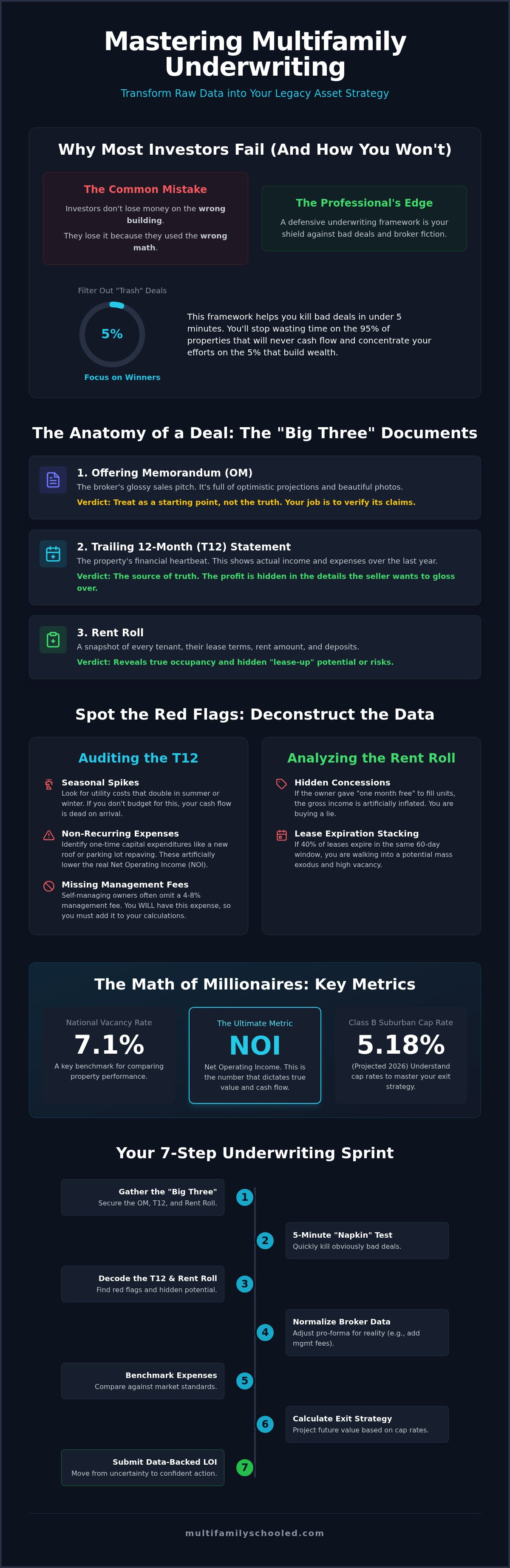
In this guide, you will master how to underwrite a multifamily property using the exact framework professional investors use to strip away risk. We're moving past the guesswork. With national vacancy rates hitting 7.1 percent and Class B suburban cap rates hovering around 5.18 percent in 2026, precision is your only protection. You will learn to filter out "trash" deals in under five minutes so you can focus on the five percent that actually cash flow.
This is your repeatable 90-day blueprint for success. We are going to cover everything from analyzing operating expenses to calculating your exit strategy with total certainty. This article provides the tools you need to move from uncertainty to action. By the time you finish reading, you will have the confidence to submit an LOI and the system to build a lasting legacy. Let's get to work.
Key Takeaways
- Transform your approach from a "money pit" gamble to a legacy asset strategy using a professional defensive underwriting framework.
- Decode the T12 and Rent Roll to expose hidden expenses and identify massive lease-up potential before you ever sign an LOI.
- Master the 7-step sprint for how to underwrite a multifamily property to normalize broker data and benchmark expenses with surgical precision.
- Dominate the math of millionaires by prioritizing Net Operating Income (NOI) and understanding how cap rates dictate your ultimate exit strategy.
- Accelerate your path to closing by using proprietary AI tools and expert mentorship to filter out bad deals in under five minutes.
What is Multifamily Underwriting and Why It Dictates Your Wealth
Underwriting is the heartbeat of your real estate career. It is the difference between retiring early on a legacy asset and losing your shirt on a money pit. At its core, What is Underwriting? In the multifamily space, it is the systematic process of verifying every cent of income and every dollar of expense to determine a property's true value and risk. It is not just math. It is your financial survival strategy.
You must follow the "Garbage In, Garbage Out" rule. Your financial model is only as good as the data you feed it. If you blindly accept a broker's numbers, you are gambling with your future. Pro investors don't trust; they verify. They shift from "looking at properties" to "underwriting deals" as a daily professional habit. This shift in mindset transforms you from an observer into a transaction-ready closer who understands how to underwrite a multifamily property with surgical precision.
The Defensive Power of the Underwrite
Brokers are paid to sell dreams. Their pro-formas are often works of fiction designed to make a mediocre building look like a gold mine. Your underwriting process acts as a filter that strips away the fluff and reveals the raw potential of an asset. The Underwriting Shield is the investor's primary risk-management tool. It protects you from pro-forma lies and helps you identify red flags, such as suspicious utility spikes or inconsistent occupancy, before you ever spend a dime on inspections.
Speed as a Competitive Advantage
In the 2026 market, the first investor to submit a credible, data-backed LOI usually wins. You cannot afford to spend three days debating a single deal. You need to move fast. Use the 5-minute "napkin" test to kill bad deals instantly. If the numbers don't work on the back of an envelope, they won't work in a complex spreadsheet. Mastering how to underwrite a multifamily property allows you to ignore the noise and focus on the profit. Stop being a student and start being a closer. By using the Multifamily Tool Kit, you can normalize data quickly and move with the speed the market demands. Seize the opportunity before someone else does.
The Anatomy of a Deal: Gathering the Big Three Documents
You cannot close a high-cash-flow deal without the right weapons. In the world of apartment investing, those weapons are raw data. To master how to underwrite a multifamily property, you must secure the "Big Three" documents before you even think about making an offer. The Offering Memorandum (OM) is the broker’s sales pitch. It is usually beautiful, glossy, and full of optimistic projections. Treat it as a starting point, not the truth. To find the reality, you must demand the Trailing 12-Month Statement (T12) and the Rent Roll.
If a broker hands you a polished OM but stalls on the raw data, push back immediately. Ask for "un-audited" financials or direct QuickBooks exports. Sellers often try to hide operational messes within the marketing materials. Real closers know that the profit is hidden in the details the seller wants to gloss over. Don't be afraid to be the "difficult" buyer who asks for the truth. It is your capital on the line.
Deconstructing the T12 Statement
The T12 is the heartbeat of the property's history. You need to look for seasonal spikes that can kill your margins. If utility costs double in July and you didn't account for that surge, your cash flow is dead on arrival. Identify non-recurring expenses like a one-time roof repair or parking lot repaving. These are capital expenditures, not operating expenses, and they shouldn't be in your long-term model. Watch out for "management fee" gaps. If the owner is managing the property personally, they are likely omitting a 4 to 8 percent expense that you will definitely have to pay. For a second pair of eyes on these tricky numbers, our Mentorship Program provides the expert guidance you need to spot these traps.
Auditing the Rent Roll for Truth
The Rent Roll is a snapshot of your future occupancy and "lease-up" potential. You must audit it for hidden concessions. If the owner gave away "one month free" to fill units, the gross income is artificially inflated. You are buying a lie. Check the lease expiration dates carefully. If 40 percent of the building has leases ending in the same sixty-day window, you are walking into a mass exodus. Verify the Unit Mix against market demand. If the market is starving for two-bedroom units but you are buying a building full of studios, you will struggle to raise rents. Mastering this audit is a non-negotiable step in how to underwrite a multifamily property with total confidence.
The Math of Millionaires: 4 Key Metrics You Must Master
You have the documents. Now you need the math. Professionals don't guess. They calculate. Understanding how to underwrite a multifamily property requires mastering four specific metrics. These numbers decide if you retire in five years or work for fifty. If you want to build a legacy, you must speak the language of the bank and the market with total clarity.
NOI: The Number That Never Lies
Net Operating Income (NOI) is the king of commercial real estate. The formula is simple: Effective Gross Income minus Operating Expenses. Unlike residential real estate, which relies on "comps," multifamily value is driven by the income the asset produces. If you increase the NOI, you increase your wealth. It is that straightforward.
Normalizing NOI for your "Year 1" projection is critical. You must account for the 2026 national vacancy rate of 7.1 percent and rising operating expenses, which climbed 32 percent over the five years leading up to August 2026. Don't use the seller's numbers. Use the reality of the market. A sanitized T12 from a broker won't account for the $700 to $800 per door insurance costs typical for Class B properties today.
Cap Rates vs. Cash-on-Cash
The Capitalization Rate (Cap Rate) helps you understand market value versus property performance. The relationship between NOI and Cap Rate is the "Value Formula." Avoid the "Market Cap" trap. A low cap rate, like the 4.70 percent seen in Class A metros in August 2026, isn't always bad if there is massive rent growth potential. It simply means the market perceives the asset as lower risk.
However, Cash-on-Cash (CoC) is the most important metric for investors seeking immediate financial freedom. It measures the actual cash your cash earns after you pay the mortgage. While Cap Rate tells you what the market thinks a building is worth, CoC tells you if you can afford to quit your day job. You need both to win, but you eat the cash flow, not the cap rate.
Finally, you must master the Debt Service Coverage Ratio (DSCR). This is what your lender cares about most. With multifamily mortgage rates ranging from 5.35 percent to 12.75 percent in late 2026, lenders need to know the property can cover its debt service comfortably. A DSCR of 1.25 is often the minimum requirement. If the property doesn't hit this benchmark, your deal is dead before it starts. Master these numbers to ensure your first deal is a home run.
The 7-Step Underwriting Sprint: From Pro Forma to LOI
Underwriting is not a static math problem. It is a high-speed acquisition sprint. You need to move from the broker's pro forma to a firm Letter of Intent (LOI) with speed and total confidence. This is how you win in a competitive 2026 market. You must follow a systematic process to strip away the seller's optimism and find the raw profit potential. Mastering how to underwrite a multifamily property means moving through these steps with surgical precision.
- Step 1: Data Entry & Normalization: Strip the broker's "pro forma" of its fluff. Input the raw T12 data and normalize it to reflect reality, not a sales pitch.
- Step 2: Expense Benchmarking: Compare the property's performance against market averages. If the owner claims $300 per door for insurance, but the 2026 average is $600 to $800, your model is already broken.
- Step 3: Revenue Projections: Identify the "Value-Add." Calculate your potential rent bumps based on actual market deliveries and current 7.1 percent vacancy trends.
- Step 4: Debt Structuring: Model your loan terms carefully. With interest rates ranging from 5.35 percent to 12.75 percent as of late 2026, your leverage must be conservative to maintain a healthy DSCR.
- Step 5: Capital Expenditure (CapEx) Planning: Budget for the "Big Fix." Roofs, HVACs, and parking lots aren't operating expenses; they are your capital budget.
Benchmarking Your Expenses
Property taxes are a silent deal killer. They almost always reset higher after a sale. Don't assume the current owner's tax bill will be yours. You must also calculate the "Price Per Door" for maintenance and unit turns based on current labor costs. Use the Multifamily Tool Kit to keep these benchmarks organized and ensure you aren't missing a single line item. This organization is the difference between a winning bid and a catastrophic mistake.
Modeling the Exit Strategy
Most investors fail because they don't plan the exit during the underwrite. You must model both "5-Year Hold" and "10-Year Hold" scenarios to see how time impacts your returns. Always assume exit cap rates will expand. If you buy at a 5.2 percent cap, model your exit at 5.7 percent. This conservative approach ensures your Multiple on Invested Capital (MOIC) remains strong even if the market shifts. Ready to stop guessing and start closing? Join our Mentorship Program and let Justin Brennan review your first deal before you submit that LOI.
Stop Guessing: Scaling with AI and Expert Mentorship
Manual spreadsheets are the slow lane of real estate in 2026. If you are still hand-typing data from a coffee-stained T12 into a clunky Excel file, you have already lost the deal. The market moves at the speed of light. Knowing how to underwrite a multifamily property is only the first step; doing it at scale is how you build a dynasty. You need to move from a student mindset to a professional acquisition machine. This requires the right technology and the right guidance.
Stop guessing and start using data as a weapon. While others are stuck in analysis paralysis, you can use Real Estate Radar AI to automate the heavy lifting. This proprietary software allows you to scan thousands of deals and identify the top five percent that actually meet your criteria. It is about efficiency, accuracy, and the power to strike when the numbers are right.
The Power of AI Underwriting
AI isn't just a buzzword; it is your competitive edge. In 2026, smart investors use AI to scan market comps in seconds and verify if rent growth projections are grounded in reality. With national vacancy rates at 7.1 percent, you cannot afford a single decimal point of error. AI tools automate data extraction from complex PDFs and T12s, stripping away the risk of human error in your financial formulas. This allows you to focus on the strategy while the software handles the math. You get more deals analyzed in less time, giving you a massive advantage over the competition.
Your Path to a 90-Day Closing
Technology is powerful, but it doesn't replace the need for a "second set of eyes." Every new investor should have an expert review their first ten underwrites. This is where the Multifamily Schooled Mentorship becomes your ultimate safety net. Lead mentor Justin Brennan provides the strategic framework you need to turn a "maybe" underwrite into a "yes" offer. This isn't just about learning; it's about doing. Our system is designed to take you from your first underwrite to a closed deal in just 90 days.
The gap between where you are and where you want to be is bridged by action. You have the blueprint. You have the metrics. Now, you need the confidence to pull the trigger. Stop analyzing from the sidelines. Use the tools, trust the mentorship, and start acquiring. Your legacy doesn't build itself. Secure your future by mastering how to underwrite a multifamily property and closing your first deal this quarter. Let's get to work.
Take Command of Your Financial Future
Mastering how to underwrite a multifamily property is the single most important skill you will ever develop. It transforms you from a spectator into a high-stakes closer. You now have the blueprint to audit a Rent Roll, normalize a T12, and benchmark expenses with surgical precision. Don't let another high-cash-flow deal slip away because of analysis paralysis or fear. The data is your shield; the system is your path to freedom.
You don't have to walk this path alone. Leverage the multi-generational expertise of Justin Brennan and the power of our proprietary Real Estate Radar AI software. We are so confident in our system that we guarantee you will find a deal in 90 days or we will provide one for you. This is your moment to seize economic empowerment and build a legacy that lasts for generations.
Take the 5-Day Multifamily Challenge and Master Deal Analysis!
The market is moving fast. Your new life is waiting on the other side of your next underwrite. Get started today and claim the independence you deserve.
Frequently Asked Questions
What is the most important metric in multifamily underwriting?
Net Operating Income (NOI) is the absolute king of metrics because it directly dictates the property's value in commercial real estate. While other numbers matter, increasing NOI is the fastest way to build wealth. You should also prioritize Cash-on-Cash return to ensure the deal supports your lifestyle. If the NOI doesn't grow, your legacy doesn't grow. Master this calculation to move from a student to a professional closer who understands real value.
How long should it take to underwrite a multifamily property?
You should be able to kill a bad deal in under five minutes using a basic "napkin test." A full, deep-dive analysis shouldn't take more than a few hours if you have organized data and professional templates. Speed is your competitive advantage in the 2026 market. Use tools like the Multifamily Tool Kit to automate the process. Don't waste days on a single deal when the market is moving this fast. Start closing today.
What is a 'good' cap rate for an apartment building in 2026?
A "good" cap rate depends on the asset class and location, but in 2026, average rates range from 4.5 percent to 8 percent. For example, suburban Class B properties averaged around 5.18 percent in August 2026. Don't just chase a high cap rate; look for "value-add" potential where you can force appreciation. A lower cap rate in a high-growth market often represents a safer, more stable legacy asset for your long-term portfolio.
Can I underwrite a property without a T12 or Rent Roll?
You cannot accurately learn how to underwrite a multifamily property without these core documents. Attempting to run numbers without a T12 or Rent Roll is gambling, not investing. The T12 shows the actual historical heartbeat of the property, while the Rent Roll reveals current occupancy truth. If a broker won't provide them, walk away. Professional investors never risk their capital on "pro-forma" dreams without seeing the raw financial proof first. Demand the truth.
What is the difference between a Pro Forma and a T12?
The Trailing 12-Month Statement (T12) is the historical truth of what the property actually earned and spent. In contrast, a Pro Forma is a projection of what the property could do in the future. Brokers use pro-formas to sell you a dream. You must use the T12 to ground your analysis in reality. Successful investors underwrite based on the T12 while using the Pro Forma only as a guide for potential rent growth.
How do I account for property tax increases after the sale?
You must assume property taxes will reset to the new purchase price immediately after closing. Don't rely on the seller's historical tax bill, as it is often based on an outdated valuation. Contact the local assessor or use market benchmarks to estimate the post-sale jump. Accounting for this increase is a critical step in how to underwrite a multifamily property without leaving a massive hole in your projected cash flow. Protect your margins.
Do I need a professional accountant to underwrite my first deal?
You don't need a CPA to run your initial numbers, but you do need a proven system and a "second set of eyes." Most successful investors use proprietary software and mentorship to verify their math. Our Mentorship Program provides the safety net you need for your first ten deals. Focus on mastering the framework yourself so you can make fast, authoritative decisions. An accountant helps with taxes; a professional mentor helps you close.
What is a 'Value-Add' strategy in multifamily underwriting?
A value-add strategy involves buying an underperforming property and forcing appreciation through physical renovations or operational improvements. You might upgrade interiors to increase rents or fix "management gaps" to lower expenses. The goal is to drive up the Net Operating Income (NOI). This is the primary engine for wealth creation in multifamily. It allows you to transform a tired building into a high-performing, high-cash-flow asset in a very short timeframe.



