

How to Underwrite a Multifamily Property: The 2026 Master Guide
Stop wasting 15 hours on a single spreadsheet only to watch a pro snap up the deal before you even hit save. Most aspiring investors lose their first 3 deals to analysis paralysis or the terrifying fear of missing a hidden $25,000 plumbing expense. You know that mastering how to underwrite a multifamily property is the only bridge between your current 9 to 5 and true financial freedom. It's frustrating to feel uncertain about market-standard cap rates while others are building massive wealth right in front of you.
It's time to stop guessing and start executing. This 2026 Master Guide delivers the exact, repeatable system you need to analyze apartment deals with 100% confidence. You'll learn to filter out the noise in under 5 minutes and identify profitable opportunities with surgical precision. We're diving into the Fast 5 Method and the specific data points that separate the winners from the dreamers. Take control of your future today and learn to underwrite like a pro. Your journey to mastery starts right now.
Key Takeaways
- Master a scalable 5-step framework designed to analyze any apartment deal with maximum speed and total confidence.
- Discover exactly how to underwrite a multifamily property by verifying real data and avoiding the "Seller Math" that destroys returns.
- Learn to separate the "truth" from the "dream" by identifying hidden costs and aggressive fluff in seller pro formas.
- Deploy the 1-Minute Green Light Strategy to triage deals instantly and focus your time only on the winners.
- Unlock your path to financial freedom by turning complex spreadsheets into a simple, repeatable system for building wealth.
What is Multifamily Underwriting and Why Does Speed Matter?
Underwriting is your crystal ball. It is the process of verifying every scrap of financial data to predict exactly how an asset will perform over the next five to ten years. In 2026, the real estate market moves at light speed. If you don't know how to underwrite a multifamily property with precision, you're just gambling with millions of dollars. Mastery of this skill turns a risky bet into a predictable wealth machine. It is the heartbeat of every successful real estate empire.
Amateurs get emotional. They fall in love with a lobby, a neighborhood, or a "feeling." They take three weeks to look at a T-12 and a rent roll. Pros use a system. They are fast, data-driven, and ruthless. They kill bad deals in minutes so they can focus on the 1% of opportunities that build a legacy. Underwriting is the foundation of institutional real estate. If you want to own your first apartment building in 90 days, you must start by mastering the math.
To see a professional breakdown of this process in action, watch this video:
The Purpose of Underwriting in 2026
In 2026, you must underwrite for three specific outcomes. First is risk mitigation. You're hunting for red flags before you sign the contract. If the utility bill is 22% higher than the market average, you've found a leak or a management failure. Second is value creation. Learning how to underwrite a multifamily property helps you find "forced appreciation" upside that others miss. Third is lender confidence. Banks won't touch your deal if your numbers are shaky. Your underwriting must be bulletproof to secure 75% LTV debt in today's environment.
Overcoming Analysis Paralysis
Most people fail because they over-analyze. 99% of investors never close a deal because they treat every lead like a deep-dive project. You don't have time for that. Use the "Fast 5 Method" to screen deals in under 60 seconds. If a deal doesn't pass the high-level sniff test, move on to the next one immediately. Speed is your competitive advantage. By using tools like Real Estate Radar AI, you can pull market data and rent comps 10 times faster than the competition. Stop guessing and start scaling. The math doesn't lie; it only reveals the truth about your future wealth.
The 5-Step Framework to Underwrite Any Apartment Deal
Don't let the complex spreadsheets fool you. The logic behind a winning deal is actually very simple. You're just solving a puzzle to find the truth hidden in the numbers. This framework works whether you're looking at a small 5-unit property or a massive 500-unit complex. It's the exact same process every single time. Consistency is your best friend when learning how to underwrite a multifamily property. To stay organized and move fast, you need a Multifamily Tool Kit. This is how you stop guessing and start building real wealth. Mastering the math is your direct ticket to financial freedom.
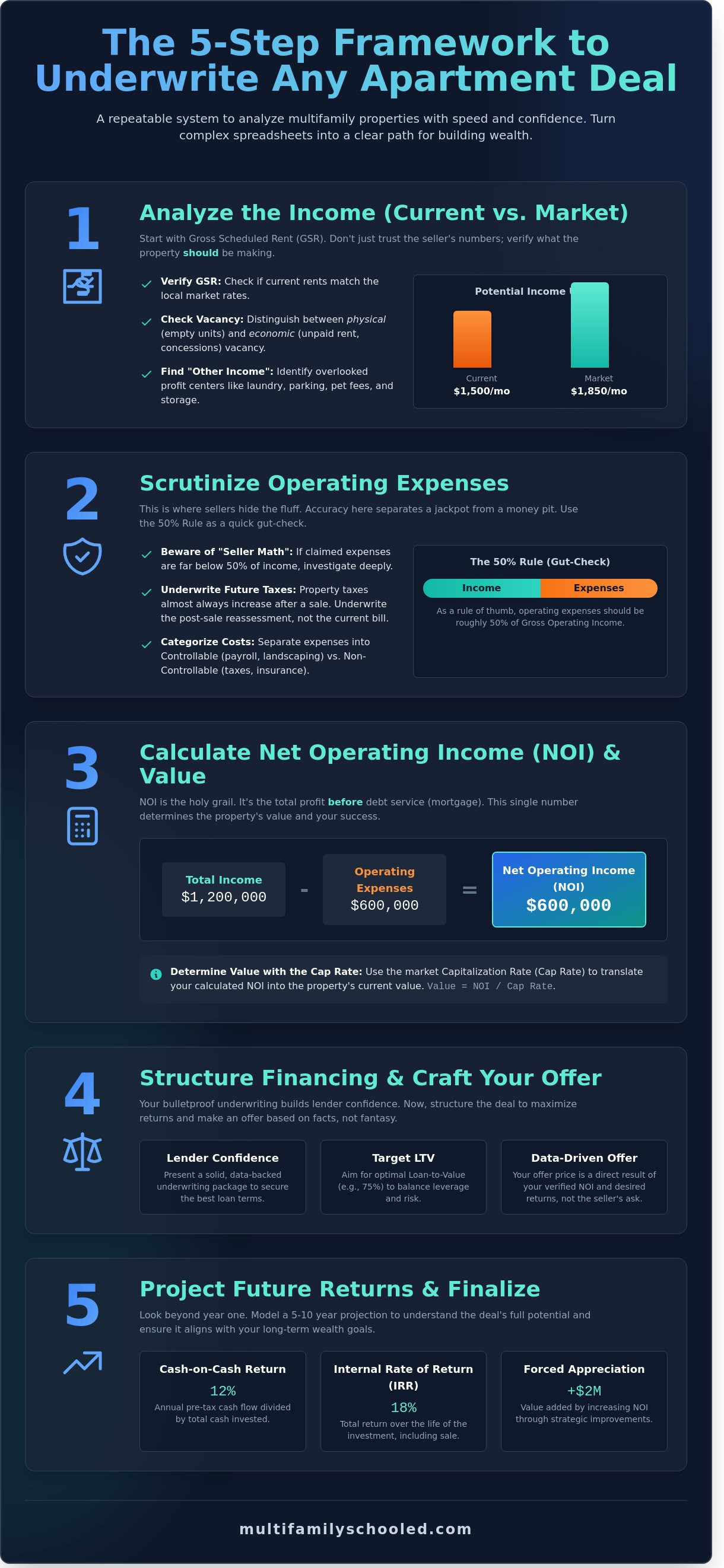
Step 1: Analyze the Income (Current vs. Market)
Start with Gross Scheduled Rent. This is the total potential income if every unit was occupied at current market rates. Don't just look at what the owner is collecting today. Look at what the property should be making. You also need to distinguish between physical and economic vacancy. A building can be 100% full but still lose money if tenants aren't paying or you're giving away too many concessions. Don't forget other income streams. Laundry, parking, and pet fees are often overlooked profit centers that add massive value to your bottom line. Every extra dollar in income increases your property value exponentially.
Step 2: Scrutinize Operating Expenses
Beginners should use the 50% Rule as a quick gut-check. If the seller claims expenses are only 25% of the income, they're likely hiding something. You must look for common underwriting mistakes like underestimating the future tax bill. Property taxes will almost always go up after you buy. Underwrite the post-sale reassessment, not the current bill. Separate your expenses into controllable and non-controllable categories. You can manage landscaping costs or payroll, but you can't control the city's tax rate or global insurance premiums. Accuracy here is the difference between a jackpot and a money pit.
Step 3: Calculate Net Operating Income (NOI) and Value
NOI is the holy grail of multifamily investing. It's the money left over after all operating expenses are paid but before you pay the mortgage. This number determines your success. You also need to master the Cap Rate. This is the market multiplier that converts income into a purchase price. When you know how to underwrite a multifamily property, you use this formula for every deal: Value = NOI / Cap Rate. This simple calculation tells you exactly what a property is worth today and what it will be worth after you improve it. If you want to scale your portfolio fast, you need a proven system to find and close these deals.
T12 vs. Pro Forma: Identifying Seller Fluff and Hidden Costs
The Trailing 12 Months (T12) report is the only truth you have. It represents the actual history of the asset over the last 365 days. The Pro Forma is a dream. It is a marketing brochure designed to make you overpay for a future that might not exist. Most sellers use "Seller Math" to inflate their numbers. They project aggressive rent hikes and conveniently ignore the reality of rising operating costs. You need to be a detective. Don't just study the numbers. Investigate them. To master how to underwrite a multifamily property, you must separate fact from fiction immediately.
Apply the 90-Day Rule to every deal. Compare the most recent three months of income against the full year. If income suddenly spiked 12% in the last 90 days, the seller is likely "window dressing" the property. They might be stuffing the building with low-quality tenants or offering massive concessions that don't show up on the T12. This is a trap. Real wealth is built on sustainable cash flow, not temporary spikes created to juice a sale price. Take control of your financial future by demanding the bank statements to back up every penny claimed.
Common Red Flags in Seller Financials
- Disguised CapEx: Look for major repair costs hidden in the "maintenance" line item. Sellers do this to keep these costs "above the line" and artificially lower the Net Operating Income. If a $15,000 boiler replacement is listed as a minor repair, your valuation is wrong.
- Unrealistic Vacancy: A 0% vacancy rate is a red flag. It usually means the rents are 20% below market value or the seller is hiding "economic vacancy" like uncollected rent. In a standard 2026 submarket, you should model at least a 5% to 8% vacancy loss.
- Utility Discrepancies: Compare the owner's ledger to actual utility provider bills. If the numbers don't match within 3%, the seller is likely omitting sewage, water, or trash fees.
Building Your Pro Forma Reality
Your Year 1 projections must be based on real-world data. Get three written quotes from local property management firms. If the broker says management is 4%, but local pros quote 7% to 9%, use the higher number. This is how you protect your capital. Always include a Capital Reserve. Set aside $350 to $500 per unit annually for major systems like HVAC and plumbing. This keeps your investment safe when things break in 2027 or 2028.
Be conservative with rent growth. The 2026 market demands discipline. Stick to a 2.5% to 3% annual growth rate. If the deal doesn't work at 3% growth, it's a gamble, not an investment. Use the Multifamily Tool Kit to run these numbers against real-world benchmarks. Stop guessing. When you learn how to underwrite a multifamily property with this level of detail, you win. Unlock your financial freedom today by refusing to buy into the seller's fluff.
The "Green Light" Strategy: Triaging Deals in 60 Seconds
Time is your only non-renewable resource. Most amateur investors drown in spreadsheets for days only to realize a deal was dead on arrival. You don't have that luxury. To build real wealth, you must master the 1-Minute Green Light Deal Analyzer. This isn't about being sloppy; it's about being surgical. If the deal doesn't pass the initial smell test in 60 seconds, kill it and move to the next one. Stop wasting hours on junk that will never close.
Professional investors use a triage system to filter 95% of the noise. You need to know exactly what an "Instant No" looks like so you can focus your energy on the "Deep Dive" opportunities. For example, if the property is in a high-crime area with a rating over 50 per 1,000 residents, or if the occupancy is stuck below 70% without a clear reason, it's usually a pass. Use professional analyzer tools to automate this process and keep your pipeline moving at light speed.
The Three Pillars of a Green Light Deal
Pillar 1: Cash-on-Cash Return. Does it pay you today? If the day-one cash-on-cash return is below 7%, you're speculating on appreciation. We don't speculate; we invest. Look for properties that put money in your pocket the moment you close the escrow.
Pillar 2: Debt Service Coverage Ratio (DSCR). Is the loan safe? Lenders typically demand a minimum DSCR of 1.25. If your initial triage shows a 1.10, the bank won't touch it, and neither should you. A safe loan is the foundation of your financial freedom.
Pillar 3: Value-Add Potential. Can you force the appreciation? Look for a 15% to 20% rent upside. If the current owner hasn't raised rents since 2022, you've found a goldmine. This is how you "unlock" massive equity in a short window.
Moving from Triage to Offer
Speed beats "perfect" math every single time. Once you understand how to underwrite a multifamily property at a high level, you'll realize that the first 60 seconds tell you 80% of what you need to know. Don't wait for a 40-page report to pick up the phone. Call the broker the moment the green light flashes.
The Letter of Intent (LOI) is your best friend. It isn't a final contract; it's a tool for further discovery. It forces the seller to show their hand and provide the "real" financial records. Knowing how to underwrite a multifamily property effectively means moving fast enough to beat the competition to the table. Get your offer in, start your due diligence, and refine the numbers later.
Stop overthinking and start acting. Grab the Multifamily Tool Kit and start analyzing deals like a pro today!
Master the Math: Join the Multifamily Schooled Mentorship
Mastery is not a gift; it is a skill earned through relentless repetition and expert guidance. You can study every guide on how to underwrite a multifamily property, but the true test happens when you are staring at a real deal with millions of dollars on the line. Theory is safe, but action builds wealth. Our Mentorship Program serves as your ultimate shortcut to the closing table, stripping away the guesswork and replacing it with a proven system. We are so confident in our process that we offer a 90-day guarantee: we help you find a deal or we find one for you. Stop dreaming about "one day" and start owning your future today.
Why a Mentor is Better Than a Spreadsheet
A spreadsheet is a static tool, but the market is a living beast. A cell in Excel won't tell you if a broker's pro-forma is inflated or if a 1980s roof is about to cost you your entire maintenance budget. Justin Brennan brings 3 generations of hands-on street smarts and investment experience to your corner. This isn't just about book smarts; it's about real-world survival and success. When you join the mentorship, you get real-time deal feedback. You get an expert to check your math and verify your assumptions before you sign a personal guarantee. You also gain instant access to a VIP community of active 2026 investors who are closing deals in the current economy. They share data, vendors, and strategies that keep you ahead of the curve.
Your Next Steps to Financial Freedom
Execution is the only thing that separates a student from an owner. You have the framework for how to underwrite a multifamily property, but now you need the momentum. Follow these steps to transition from education to acquisition:
- Download the Resources: Grab our free eBook and Opt-in resources to secure the same tools our lead investors use every day.
- Attend the Live Workshop: Register for the next 3-Day Live Workshop. We spend 72 hours underwriting real deals live, so you can see exactly how the pros find the "green lights."
- Take the Challenge: Commit to the 5-Day Challenge to jumpstart your journey. It is designed to force action and build the habits required for high-level investing.
Financial freedom is a choice you make today. The math is simple, the system is proven, and the support is ready. Stop watching from the sidelines. Join the movement and start building your legacy now.
Stop Analyzing and Start Owning Today
Mastering how to underwrite a multifamily property isn't just about spreadsheets; it's about speed and tactical certainty. You now have the 5-step framework to identify real value and the 60-second triage skills to filter out the noise. You've learned to spot seller fluff in a T12 and project costs like a pro. These aren't just tips; they're the keys to your financial freedom. Don't let another 90 days slip away while you stay stuck in analysis paralysis. The market waits for no one, and the best deals go to those who move with purpose.
You deserve a mentor with 3rd generation hands-on street smarts. Join a community featured on major real estate platforms and use a system designed for immediate results. We're so confident in our methods that we offer a proven 90-day deal guarantee. Stop guessing and start executing with a team that has already paved the way. Your future as an apartment owner is waiting for you to take the lead right now.
Apply for the Multifamily Mentorship & Own Apartments in 90 Days
Success is a choice you make today. You have the tools and the roadmap, so let's get out there and close your first deal together!
Frequently Asked Questions
How long should it take to underwrite a multifamily property?
You should complete your initial "Green Light" underwriting in under 10 minutes to see if the deal has legs. Master investors use a proven system to filter 95 percent of deals within minutes, saving deep dives for the top 5 percent of opportunities. A full, detailed analysis for a formal offer typically requires 2 to 4 hours of focused work. Speed is your competitive advantage in the 2026 market. Take action now and stop wasting hours on dead deals.
What is a good DSCR for a multifamily loan in 2026?
A Debt Service Coverage Ratio (DSCR) of 1.25 or higher is the gold standard for most agency lenders in 2026. This means your Net Operating Income must be 25 percent higher than your annual debt payments. Lenders require this buffer to protect against market volatility. If your DSCR drops below 1.20, you risk losing your financing or facing much higher interest rates. Aim for 1.30 to secure the best terms and unlock maximum leverage.
Do I need expensive software to underwrite apartment deals?
You don't need $5,000 software packages to learn how to underwrite a multifamily property like a pro. A robust, custom Excel model or a streamlined "1-Minute Green Light" analyzer is often more effective than complex, bloated programs. Focus on mastering the underlying math rather than buying flashy tools. Our students use a proven, systematic spreadsheet to analyze 20 unit deals with total precision. Start with a reliable tool and upgrade only when your portfolio scales.
What is the difference between Cap Rate and Cash-on-Cash Return?
Cap rate measures a property's unleveraged yield based on its current value, while Cash-on-Cash (CoC) return measures the actual profit on the specific dollars you invested. Think of Cap Rate as the market's temperature and CoC as your personal bank account's growth rate. If you buy a $1,000,000 building at a 6 percent Cap Rate, it earns $60,000 annually. If your $250,000 down payment generates $25,000 in distributions, your CoC return is 10 percent. Both metrics are vital for your success.
How do I underwrite a property with high vacancy?
Underwrite properties with vacancy rates above 15 percent by creating a bridge budget that accounts for 12 to 18 months of negative or low cash flow. You must calculate the exact cost of lease-up commissions and tenant improvements needed to reach 90 percent occupancy. Don't assume the building will fill up overnight. Use a stabilized pro forma to see the future value, but base your purchase price on the current distressed reality. This is how you unlock massive equity gains.
Can I underwrite a deal without seeing the actual leases?
You can perform your initial 1-Minute analysis using a rent roll, but you must never close a deal without auditing every single lease. Use the T-12 (trailing 12-month) statement to verify actual income collected versus what the rent roll claims. In 2026, smart investors find a 5 percent to 8 percent discrepancy between pro forma rents and reality during the due diligence phase. Trust the data, but verify the documents. Your financial freedom depends on accurate numbers.
What is the most common mistake in multifamily underwriting?
The most common mistake is underestimating annual operating expenses, particularly property taxes and insurance which can jump 20 percent or more after a sale. Many beginners use a flat 35 percent expense ratio, but seasoned pros know that older Class C assets often require 45 percent to 50 percent of gross income for proper management. Learning how to underwrite a multifamily property correctly means researching the specific tax millage rates for 2026. Don't guess your expenses; use real quotes to protect your wealth.



