

How to Talk to Investors About Multifamily Risk
Downside scenarios don’t automatically make a multifamily deal unattractive. Vague reassurance can make it harder to trust. If you’re wondering how to talk to potential investors about risk, start with the facts: explain what could go wrong, how it could affect the investment, and what steps may help manage the exposure.
It’s reasonable to worry that discussing vacancies, slower rent growth, rising expenses, or refinancing challenges will weaken investor interest. But leaving those risks out won’t make them disappear. A clear, balanced explanation shows that you’ve tested the investment thesis, understand its assumptions, and aren’t promising certainty where none exists.
This article will help you organize material risks, compare relevant assumptions and downside scenarios, and describe mitigations without overstating what they can do. You’ll also learn how to connect each risk to the business plan and explain contingencies in plain language. The goal isn’t to overwhelm investors with every possible problem or talk them into a deal. It’s to give them a realistic basis for evaluating the opportunity, asking informed questions, and setting expectations from the start.
Key Takeaways
- Learn how to talk to potential investors about risk by explaining uncertainty, possible impact, planned responses, and what exposure remains.
- Group material risks into practical categories, then connect each one to its cause, potential effect, and response plan.
- Compare base, downside, and upside cases to show how changes in rent growth, vacancy, expenses, or financing terms may affect the investment.
- Use a consistent conversation sequence, from the investment thesis and evidence to mitigations, remaining exposure, and investor questions.
- Keep assumptions, diligence sources, risk updates, and investor questions organized so follow-up stays consistent and material changes can be shared through appropriate channels.
Discussing Multifamily Risk Without Losing Trust
Investor questions about risk are normal. They’re central to an informed decision, especially when a multifamily investment depends on property operations, market conditions, financing, and execution. The goal isn’t to make uncertainty disappear. It’s to explain what could happen, how it may affect the investment, what actions could help, and what exposure would remain.
Separate risks tied to the specific deal from broader market uncertainty. Deferred maintenance or current occupancy is property-specific. Changes in interest rates or local rental demand can affect a wider group of properties. Be clear about what your diligence confirms, what your analysis estimates, and what you can’t know in advance. Risk management begins with identifying and assessing potential threats, then considering how to address them, as outlined in Risk management.
What potential investors need to hear first
Start with the investment thesis and business plan. Explain why the property may fit the strategy, how the plan is expected to work, and which assumptions support that view. Then distinguish verified information from estimates and unresolved questions. For example, describe rent growth as an assumption in the model, not an assured outcome. Projections help investors evaluate a plan; they aren’t promises or guarantees.
Why honest risk disclosure can strengthen a conversation
Specific examples help investors see how the analysis connects to the plan. If the plan relies on improving occupancy, explain how slower leasing could affect income and which operational steps are intended to respond. Those steps may reduce exposure, but they can’t eliminate uncertainty. Name both the mitigation and its limits instead of suggesting every risk is fully controlled.
Risk disclosure is a clear discussion of uncertainty, its possible impact, the response plan, and the exposure that remains. This keeps the conversation focused on the deal instead of broad reassurances. It also gives investors room to ask informed questions and decide whether the assumptions and remaining risks fit their expectations.
Build a Multifamily Investor Risk Framework Before the Conversation
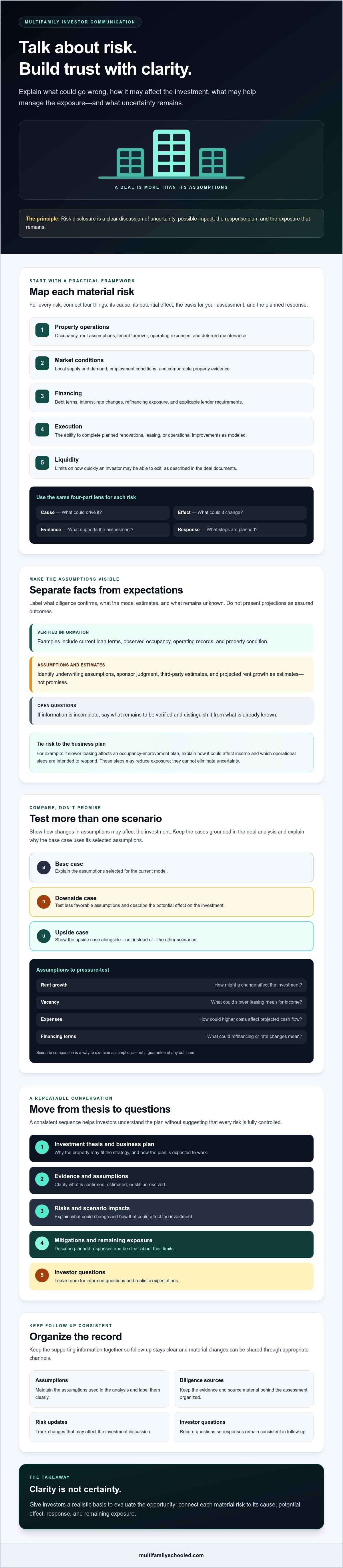
Prepare a deal-specific framework before meeting with investors. A useful starting point is a shared understanding of what investment risk is: the possibility that an investment’s actual outcome may differ from expectations. For a multifamily deal, sort material risks into five areas:
- Property operations: occupancy, rent assumptions, tenant turnover, operating expenses, and deferred maintenance.
- Market conditions: local supply and demand, employment conditions, and comparable-property evidence.
- Financing: debt terms, interest-rate changes, refinancing exposure, and applicable lender requirements.
- Execution: the ability to complete planned renovations, leasing, or operational improvements as modeled.
- Liquidity: limits on how quickly an investor may be able to exit, as described in the deal documents.
For each material risk, record its cause, potential effect on the investment, the basis for your assessment, and the planned response. Separate documented facts, such as current loan terms or observed occupancy, from underwriting assumptions, sponsor judgment, and third-party estimates. Label each clearly. This makes it easier to explain which statements rest on evidence and which depend on expectations.
Which multifamily risks should sponsors assess?
Review operating records and property condition alongside the assumptions in your model. Check whether rent projections are supported by comparable properties and whether expense estimates account for known needs. For market risks, identify the sources behind local supply, demand, and employment assessments. For financing, distinguish confirmed loan terms from assumptions about future rates or refinancing. If information is incomplete, say so and explain what remains to be verified.
How to connect risk to deal analysis
Use a deal-analysis worksheet to connect each risk to the current model. For example, show how lower occupancy could reduce rental income or how higher expenses could narrow projected cash flow. State why the base case uses its selected assumptions, then test reasonable downside scenarios rather than presenting only an optimistic outcome. Check each figure against the latest available diligence before sharing it. This preparation makes how to talk to potential investors about risk a repeatable analytical process, not an improvised pitch.
For continued learning, explore Multifamily Schooled’s multifamily investing toolkit as one educational resource for strengthening your deal-analysis approach.
Compare Risk Scenarios and Explain the Numbers
A scenario table makes assumptions easier to examine. Compare a base case, a downside case, and an upside case using the same categories. Fill each with figures from the current underwriting model and identify the source, such as property records, comparable-property data, lender terms, or a clearly labeled estimate. The example below shows what to compare, not projected results for a specific property.
| Assumption | Base case | Downside case | Upside case |
|---|---|---|---|
| Rent growth | Underwritten pace | Slower growth, supported by a stated stress assumption | Stronger growth, supported by relevant evidence |
| Vacancy | Expected operating level | Higher vacancy or slower lease-up | Lower vacancy or faster lease-up |
| Operating expenses | Current estimate | Higher costs for identified expense categories | Lower costs only where the basis is clear |
| Financing | Modeled loan terms | Less favorable terms or refinancing conditions | More favorable terms, if supported |
Then show how each changed input affects projected cash flow and the business plan. Avoid presenting a single output as certain. State that projections are estimates, name their sources, explain data limitations, and remind investors that actual results can differ. Don’t assign probabilities unless you have a defensible basis for them. A precise-looking number isn’t useful if its supporting evidence is uncertain.
How to present a downside scenario responsibly
Choose stress assumptions that fit the property and explain why they matter. For example, slower leasing may be relevant if nearby properties compete for the same renters. Test one change at a time to show its effect, then consider how combined pressures could affect the plan. Identify which operating or financing assumptions have the greatest effect on projected cash flow. Discuss possible responses, but make clear that adjusting expenses or leasing plans may not fully offset the impact.
How to discuss mitigation without implying a guarantee
Pair each response with the risk it addresses. State who would lead the action, what they would do, and when progress would be reviewed. For example, a sponsor might compare leasing results with the underwriting assumptions and consider operational changes if performance falls short. Explain what exposure remains after that response. This is how to talk to potential investors about risk with clarity: describe the plan, its limits, and the uncertainty that no mitigation can remove.
Use a Clear Step-by-Step Structure for Investor Risk Conversations
A consistent sequence keeps the conversation focused and gives investors room to assess the deal. Move through these points:
- Investment thesis: Explain the property strategy and how the business plan is intended to work.
- Material risks: Identify the deal-specific uncertainties that could challenge the plan.
- Evidence: Show the relevant diligence, data, or assumptions behind your assessment.
- Mitigations: Describe the planned response and who is responsible for it.
- Residual exposure: State what could still happen despite those steps.
- Investor questions: Pause, invite questions, and ask what would be useful to clarify.
Use plain language. Define terms such as occupancy or refinancing if they’re unfamiliar, and don’t bury a direct answer in technical detail. A useful check-in is, “Would it help to go deeper on the assumption or the possible impact?” After the meeting, record questions, promised follow-ups, and the materials shared so you can respond consistently.
What to say when an investor raises a risk
Acknowledge the concern first. Then connect the evidence, assumption, and response without dismissing the possibility of a worse outcome. For example: “You’re right to ask about slower leasing. Our plan assumes the property reaches the occupancy level shown here. If leasing takes longer, projected income may be lower. We’re monitoring leasing against the plan and will review operating options if results fall short, though that may not fully offset the impact.” Avoid suggesting that past performance predicts future results.
How to handle unknowns and difficult questions
If you don’t know, say so. Don’t improvise a confident-sounding figure. Explain what would help answer the question, who will verify it, and when you expect to follow up. For example: “I don’t have a confirmed answer yet. I’ll check the current lender terms and follow up by the date we agree on.” If timing isn’t certain, don’t promise a deadline you can’t meet. Keep the investor updated if verification takes longer.
For more context on preparing for capital conversations, review these real estate deal capital-raising resources. To build your investor communication skills through further study, explore the multifamily investor mentorship program.
Turn Investor Risk Questions into a Consistent Follow-Up Process
A clear investor conversation shouldn’t depend on someone remembering which assumptions were shared or how a question was answered. Keep a version-controlled record of underwriting assumptions, diligence sources, risk updates, investor questions, and materials distributed. When an assumption changes, record what changed, why it changed, and which investor materials need review.
Consistency matters across presentations, written disclosures, and follow-up conversations. If a projection or risk description is updated in one place, check the other materials for outdated figures or conflicting language. Share material changes promptly through appropriate channels and follow processes reviewed by qualified counsel. Legal and financial professionals can also help assess materials and obligations that depend on the deal and jurisdiction.
Create a repeatable risk communication checklist
Before sharing materials or following up, use a practical review. Confirm that each material risk has supporting evidence, a clear explanation of its possible impact, and a realistic response. Check that projections and scenario assumptions match across documents. Track unresolved questions with an assigned owner and a response date agreed with the investor. If the date changes, update the record and communicate the revised expectation.
- Are sources and assumptions current and identified?
- Do the written materials and conversation use consistent figures?
- Are responses to investor questions documented, including any remaining unknowns?
- Have relevant materials been reviewed through counsel-approved processes?
Build your investor communication skills over time
Investor questions can show where an explanation needs more context. Use that feedback to clarify assumptions, improve supporting materials, or explain a risk more plainly. Don’t use it to hide uncomfortable information or remove a material downside from the discussion. A record of recurring questions can help you prepare clearer answers for future conversations while preserving the distinction between what is known and what remains uncertain.
Learning how to talk to potential investors about risk takes practice alongside sound multifamily analysis. Structured education or mentorship can help you develop both skills, though it can’t guarantee investment results or investor commitments. If you want to build your knowledge through guided learning, explore Multifamily Schooled’s mentorship program.
Make Clear Risk Conversations Part of Your Investor Approach
Trust grows when investors can see how a deal’s assumptions connect to its potential outcomes. Organize risks by category, support your assessment with relevant evidence, and compare scenarios to show how changing key inputs may affect the plan. Then explain what you’re doing to manage each risk and what uncertainty remains.
A consistent conversation matters beyond the first meeting. Track investor questions, keep figures aligned across materials, and follow through when an answer needs more verification. This gives you a practical, repeatable way to learn how to talk to potential investors about risk without minimizing uncertainty or overwhelming them with jargon.
Keep strengthening your analysis and communication skills. Multifamily Schooled offers education for novice and experienced multifamily investors through mentorship, live workshops, online challenges, and deal-finding software. These learning options can help you build knowledge, but they don’t guarantee investment results or investor commitments.
Explore Multifamily Schooled’s investor education resources and take your next step with greater clarity and confidence.
Frequently Asked Questions
How do you explain investment risk to a potential investor?
Explain what could happen, how it might affect the investment, and what steps may help manage the exposure. To learn how to talk to potential investors about risk, connect each concern to the deal’s assumptions and evidence. For example, describe how slower leasing could affect projected income, then explain the planned response and its limits. Label projections as estimates, not promises, and leave room for investor questions.
Should you tell investors about every risk?
Focus on material risks, meaning those that could meaningfully affect the business plan or an investor’s evaluation of the opportunity. Organize them by areas such as property operations, market conditions, financing, execution, and liquidity. Don’t bury important concerns in a long list of remote possibilities. Also, don’t omit information because it may make the deal sound less attractive. Ask qualified legal counsel to review disclosure materials and applicable obligations.
How can you discuss risk without scaring investors away?
Be direct, measured, and specific. Explain the risk in plain language, show the assumption or evidence behind your assessment, and describe the response being considered. Then acknowledge what could remain outside your control. For instance, a leasing plan may address slower occupancy, but it can’t ensure that projected rents or timing will be achieved. Clear context helps investors evaluate the opportunity without mistaking confidence for certainty.
What risks should multifamily real estate investors consider?
Assess property-level factors such as occupancy, rent assumptions, tenant turnover, operating expenses, and deferred maintenance. Review financing terms, interest-rate exposure, and potential refinancing challenges. Consider local supply, rental demand, employment conditions, and comparable-property evidence. Also examine execution risks, including whether the business plan’s improvements can be completed as assumed, and liquidity limits described in the offering materials. Which risks matter most depends on the property and investment strategy.
What should you do if you do not know the answer to an investor’s risk question?
Say plainly that you don’t know yet. Don’t guess or offer an unsupported figure to sound prepared. Explain what information could answer the question, who will verify it, and when you expect to follow up. If you can’t provide a firm date, say so and keep the investor informed if the timing changes. Record the question and response plan so the follow-up is accurate and consistent.
Can a sponsor promise investors that a multifamily deal is low risk?
A sponsor shouldn’t present an investment as risk-free or promise a particular outcome. Multifamily properties remain exposed to changing operations, market conditions, financing, and execution, even when the business plan includes ways to manage those risks. Describe the specific factors that may make the deal more or less exposed, explain the assumptions behind that view, and state what uncertainty remains. Have qualified legal and financial professionals review relevant materials.



