

How to Structure Your First Multifamily Deal: The 2026 Investor Blueprint
Stop letting analysis paralysis keep you on the sidelines while elite investors secure 5.6% cap rates in today's shifting market. Your lack of personal capital isn't the reason you haven't closed a deal. It's your lack of a repeatable system. You've likely spent months worrying about how to protect investor money or how to split profits without losing your shirt. It's a common fear that keeps most people stuck in the research phase forever.
This is your 2026 blueprint to mastering how to structure your first multifamily deal with the exact frameworks used by industry leaders. We're handing you the tools to organize debt, equity, and partnerships for maximum profit in just 90 days. You don't need to guess about GP/LP splits or equity waterfalls anymore. We are breaking down the repeatable partnership models you need to sign your first Letter of Intent with absolute confidence. Get ready to turn your investment goals into a tangible, income-producing reality today.
Key Takeaways
- Shift your mindset from buying physical buildings to managing a strategic capital stack that dictates your long-term independence.
- Learn how to structure your first multifamily deal by prioritizing senior debt to create a rock-solid foundation for every acquisition.
- Define clear GP and LP roles to attract passive investors and build a repeatable partnership model that scales your portfolio fast.
- Leverage advanced deal-finding software to identify off-market opportunities and move from analysis to a signed LOI in record time.
- Follow a systematic 90-day blueprint that combines expert mentorship with proprietary tools to secure your path to professional mastery.
Why Deal Structure Is the Bridge to Financial Freedom
Deal structure is the invisible DNA of every successful acquisition. It dictates your risk, your reward, and exactly how you will exit the property for a massive payday. Most beginners fail because they treat a property like a physical object. They focus on the roof and the paint. Elite investors focus on the capital stack. This shift in perspective is the only way to master how to structure your first multifamily deal without risking your own life savings.
Understanding the fundamentals of real estate investing is just the starting point. To reach true financial freedom, you must move beyond the basics of valuation and property management. You need to learn how to move the pieces of the financial puzzle to create a win-win for everyone involved. To better understand this concept, watch this helpful video:
In the 2026 market, precision is your only protection. With national apartment vacancy rates hitting 8.6% in the first quarter, you can't afford a sloppy arrangement. You are no longer just buying a building. You are managing a complex layer of senior debt and private equity. This mastery allows you to control millions in assets while keeping your personal capital safe. Beginners struggle because they can't explain the why to their partners. When you can articulate the flow of money, you become the authority in the room.
Overcoming Analysis Paralysis
The math behind a deal is often simpler than the gurus make it sound. Use proven frameworks to stay focused on the big three: cash flow, long-term appreciation, and debt paydown. Deal structure is the formal arrangement of capital and responsibility between you and your partners. Don't get lost in the weeds. If the structure protects the principal and ensures a return, the deal works. Mastery comes from repetition, not just reading.
The Power of the 90-Day Mindset
Speed is your greatest competitive advantage. The current market moves fast, and hesitation is a deal-killer. A structured system removes the guesswork, allowing you to move from curious to closer in three months. Use tools like Real Estate Radar to find off-market opportunities before they hit the open market. A repeatable structural blueprint is the key to signing your first LOI with total confidence. Stop overthinking and start executing.
The Anatomy of a Deal: Debt vs. Equity
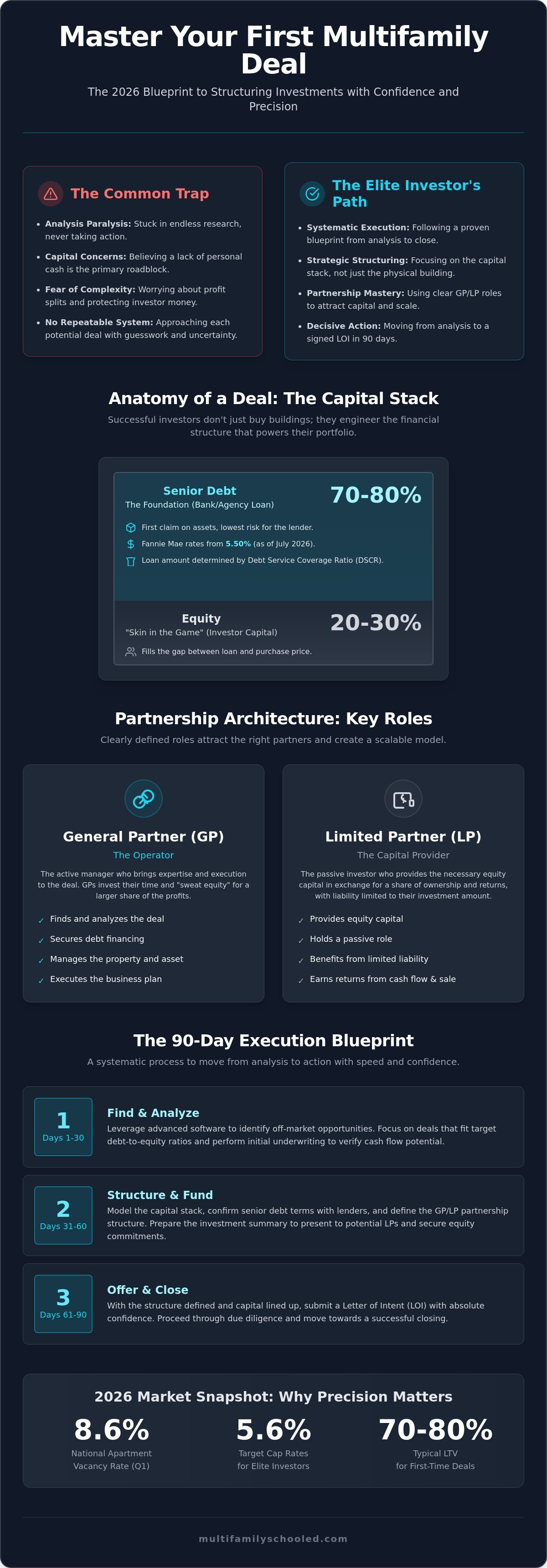
Every multifamily deal has a skeleton. We call it the capital stack. It is the hierarchy of who provides the money, who takes the most risk, and who gets paid first. At the very top sits senior debt. This is usually a bank or an agency lender. In July 2026, Fannie Mae multifamily rates start as low as 5.50%, making them your most important partner. They provide the bulk of the capital, but they also have the first claim on the property if things go south. Below debt sits your equity. This is the "skin in the game" required to close the gap between your loan amount and the purchase price.
Successful investors don't guess at these numbers. They use precision tools to find the right balance. You can use Real Estate Radar to identify off-market properties that specifically fit your target debt-to-equity ratios. Mastering how to structure your first multifamily deal requires you to see these layers clearly before you ever make an offer. If the stack is top-heavy with expensive debt, the deal will crumble. If it's balanced, it becomes a wealth-generating machine.
Understanding Loan-to-Value (LTV)
For most first-time deals, 70-80% LTV is the sweet spot. It provides enough leverage to boost returns without overextending your risk. With the national apartment vacancy rate rising to 8.6% in early 2026, lenders are scrutinizing your ability to pay. They look closely at your Debt Service Coverage Ratio. The Debt Service Coverage Ratio (DSCR) dictates your maximum loan amount by measuring whether the property's net income can reliably cover its annual debt payments. If your DSCR is too low, the bank will pull back, forcing you to find more equity.
Sourcing the Equity Gap
Don't panic if you don't have a 20-30% down payment sitting in your bank account. Most elite investors don't use their own cash for the entire equity portion. They understand GP and LP roles, allowing them to bring in passive partners to fund the gap. You can also look at mezzanine debt or "gap funding" for larger acquisitions. If you want to learn how to pitch these structures to partners, our Mentorship Program provides the exact scripts and frameworks we use to raise capital. Always calculate your required equity using professional software before you ever pick up the phone to call a broker.
Creative Financing Options
In a high-rate environment, traditional bank loans aren't your only path. Seller financing is making a massive comeback in 2026. This is where the owner acts as the bank, allowing you to pay them back over time. You might also consider a master lease option. This allows you to gain control of the property and its cash flow without taking the title immediately. These creative structures are often the secret to how to structure your first multifamily deal when the 10-Year Treasury is sitting at 4.49% and traditional debt feels tight. Be aggressive and look for owners ready to exit.
Partnership Architecture: GP and LP Roles
You aren't just buying a building. You are building a high-performance team. The General Partner (GP) is the active engine of the investment. They find the deal, negotiate the debt, and manage the property's daily operations. The Limited Partner (LP) is the fuel. These are passive investors who provide the capital required to close the equity gap. They have limited liability and no management role. This distinction is the core of how to structure your first multifamily deal because it separates the work from the wealth.
In the 2026 market, the industry benchmark for equity splits usually lands at 70/30 or 80/20 in favor of the LP. This might seem lopsided, but remember that the LP provides the lion's share of the cash. Your value as a GP comes from your "sweat equity." If you have no personal capital to contribute, don't let that stop you. You are the deal-maker. Without your expertise and effort, the investor's capital sits idle. Being the architect of the deal is the most valuable role in the entire capital stack.
The Equity Waterfall Explained
The waterfall is the mechanism that dictates exactly when and how people get paid. Most structures begin with a preferred return, typically ranging from 6% to 8%. This means the LPs receive all available cash flow until they hit that percentage. Once the "pref" is met, the GP earns their "promote." This is a higher percentage of the remaining profits that rewards the GP for hitting performance milestones. Visualizing this flow of cash from the tenant’s rent check to the GP’s pocket is essential for explaining your vision to potential partners.
Protecting All Parties
Your Operating Agreement is the "marriage contract" of your multifamily deal. It must be rock-solid. You need clear clauses covering buy-sell agreements, voting rights, and specific exit triggers. If the market shifts or a partner wants out early, the Operating Agreement tells you exactly what to do. Never sign a partnership deal without a second pair of eyes. This is why a mentor is critical. They have seen where these agreements fail and can help you avoid expensive legal traps. If you want a proven framework to follow, our Mentorship Program provides the exact legal templates you need to protect your interests and your investors. Move fast, but move with a plan.
The 90-Day Execution Blueprint
Success in the 2026 multifamily market isn't about luck. It's about speed and a systematic approach. You have 90 days to go from a dreamer to a deal-maker. This is the exact roadmap for how to structure your first multifamily deal with professional precision. Don't wait for the perfect moment. Create it by following these five critical steps.
- Step 1: Define your buy box. Use Real Estate Radar to hunt for off-market gems that others miss. Focus on markets with constrained supply to maximize your rent growth potential.
- Step 2: Submit your Letter of Intent. Your offer must be pre-vetted with a clear structural plan. This shows the seller you aren't just kicking tires.
- Step 3: Secure commitments. During due diligence, lock in your senior debt and private equity partners. With Fannie Mae rates starting at 5.50% in July 2026, you must act while the window is open.
- Step 4: Legal formation. Set up your LLC and finalize that operating agreement we discussed. This document is the bedrock of your partnership.
- Step 5: Close. Transition from the architect of the deal to the leader of the asset.
Drafting the Perfect LOI
Your Letter of Intent is your first impression. Sellers don't just want the highest price. They want "certainty of close." Show them you are a structured investor by including clear terms on due diligence periods and financing contingencies. If your LOI looks professional, you win the deal before the bidding war even starts. Price is often secondary to the confidence you project through your terms. To get it right the first time, download our Multifamily Tool Kit for ready-to-use templates that command respect from brokers and sellers alike.
Managing the Due Diligence Clock
Once your LOI is signed, the clock starts. You usually have a 30-day window to verify everything. This means physical inspections, lease audits, and a deep dive into the financials. If an inspection reveals a $50,000 roof issue, don't walk away. Pivot your structure. Negotiate a seller credit or adjust the equity split to cover the cost. Use this time to confirm the 8.6% national vacancy rate won't sink your specific submarket projections. Speed is vital, but accuracy is your shield. To master this critical phase, sign up for our 5 Day Multifamily Challenge and get our full due diligence checklist. You can't afford to miss a single detail when investor money is on the line. Stop guessing and start closing deals with a proven system.
Master the Game with the Multifamily Schooled Mentorship
You have the blueprint. You have the 90-day timeline. Now you need the execution. Even with the best data, the final hurdle is often the fear of making a mistake when investor capital is on the line. A mentor is your secret weapon. They provide the bridge between knowing how to structure your first multifamily deal and actually signing the closing documents. Don't gamble with your future. Follow a path that has already been paved by those who have closed hundreds of millions in transactions.
The Multifamily Schooled promise is simple and bold. We help you find a deal in 90 days or we provide one for you. This isn't just an educational course. It is a high-speed results engine. You gain immediate access to a community of high-level investors who are actively partnering on deals right now. Stop guessing. Stop piecing together fragmented advice from random forums. Start following a systematic, proven path to acquisition that values your time and protects your reputation.
Direct Access to Justin Brennan
Success leaves clues. When you join our ecosystem, you get direct access to Justin Brennan. Benefit from multi-generational real estate expertise and a track record of success that spans decades. One of the greatest risks for a new investor is a poorly drafted operating agreement or a flawed capital stack. Our experts review your deals before you sign the paperwork. This safety net ensures your first deal is a win. Learn more about our Mentorship Program and secure your spot in our next intake today.
The Complete Ecosystem for Success
Piecing together your strategy from free YouTube videos is a recipe for delay. The 2026 market moves too fast for trial and error. We provide a complete ecosystem for success. This includes everything from proprietary deal-finding software to live workshops that sharpen your negotiation skills. This "all-in-one" authority model is designed for speed. It removes the friction from how to structure your first multifamily deal by providing every resource in one place. Check out the full suite of resources at our Online Store. Your journey to financial independence requires the right tools. We provide the hammer, the nails, and the blueprint. You just need to show up and build. Seize this opportunity now.
Take Command of Your Financial Future
The 2026 market doesn't wait for the hesitant. You now have the blueprint for how to structure your first multifamily deal with absolute precision. By mastering the capital stack and defining clear partnership roles, you've moved past the analysis paralysis that stops most investors. You understand that senior debt is your foundation. Your value as a deal-maker is the most powerful asset you possess. It's time to stop watching from the sidelines and start building your legacy.
Don't let this knowledge sit idle. Our Mentorship Program provides a proven system for apartment building acquisition that removes every ounce of guesswork. You'll gain exclusive access to our Real Estate Radar AI software to find off-market gems instantly. We're so confident in our process that we promise you'll find a deal in 90 days or we'll provide one for you. This is your moment to transition from a student to a successful owner. Apply for the 90-Day Mentorship and Close Your First Deal now. Your new life as a multifamily mogul begins today.
Frequently Asked Questions
How much money do I need for my first multifamily deal?
You typically need 20% to 30% of the purchase price for a down payment plus an additional 2% to 5% for closing costs and reserves. In a market like Atlanta, where the average price per unit is $174,500 as of early 2026, a small apartment building requires a significant capital stack. However, your personal contribution depends on your ability to raise equity. By mastering how to structure your first multifamily deal, you can leverage outside partners to cover the majority of these costs.
Can I structure a deal with zero of my own money?
You can absolutely close a deal with zero of your own money by acting as the General Partner. Your value is in finding the opportunity, securing the debt, and managing the asset. You bring in Limited Partners to provide the cash while you provide the "sweat equity" and expertise. This is a standard practice for elite investors who want to scale their portfolios quickly without hitting a personal capital ceiling. Your role as the deal-maker is the most valuable part of the equation.
What is a standard GP/LP split in multifamily syndication?
The industry benchmark for a standard multifamily syndication is typically a 70/30 or 80/20 split in favor of the Limited Partners. This ensures the passive investors, who provide the majority of the capital, are compensated for their risk. As the General Partner, your 20% to 30% "promote" is earned by hitting performance milestones. This structure aligns everyone’s interests and keeps the focus on maximizing the property’s net operating income. It’s a win-win for the active manager and the passive investor.
How do I find investors to fund the equity gap?
Start with your existing network of high-net-worth individuals, including doctors, attorneys, and business owners. You aren't asking for a favor; you are offering them a high-yield opportunity backed by a tangible asset. Use social media and local real estate meetups to build your authority as a deal-maker. When you show a pre-vetted deal with a solid capital stack, investors will compete to fund your equity gap. Professionalism and a clear track record are your best tools for attraction.
What happens if the deal doesn't hit its cash flow projections?
If a deal misses its projections, you must immediately audit your property management and expenses. This is why maintaining a healthy capital reserve is a non-negotiable part of your initial deal structure. You might need to defer your GP fees or adjust the waterfall to ensure your LPs still receive their preferred return. Transparency with your partners is vital during a market rebalancing to maintain trust and protect your reputation. A good manager shines when the market gets tough.
Do I need an LLC to structure my first multifamily deal?
You should always use a dedicated LLC for every multifamily acquisition to protect your personal assets. An LLC provides a clear legal framework for your operating agreement and defines the roles of all partners. It is the primary vehicle for holding title and securing senior debt from lenders like Fannie Mae or Freddie Mac. Never risk your personal financial health by closing a commercial deal in your own name. It is a fundamental step in learning how to structure your first multifamily deal safely.
How long does it typically take to close a multifamily deal?
A standard multifamily deal typically takes 60 to 90 days to close from the moment your Letter of Intent is accepted. You generally spend the first 30 days in the due diligence phase, conducting physical inspections and lease audits. The remaining time is focused on finalizing the loan and securing equity commitments. Moving faster than the market average requires a repeatable system and a pre-vetted team of experts ready to execute. Speed is your advantage in a competitive market.
What is the difference between a 2-unit and a 50-unit deal structure?
The primary difference is the transition from residential to commercial financing. A 2-unit deal is usually structured with a personal mortgage based on your individual credit and income. A 50-unit deal is a business acquisition where the lender focuses on the property's income and your experience as a manager. Commercial deals require a more complex capital stack, involving multiple partners and sophisticated equity waterfall structures to manage the higher stakes. Big deals require big systems.



