

How to Structure a Real Estate Syndication Deal: The Ultimate 2026 Guide
Your deal structure isn't just a legal chore. It's the most powerful marketing tool you own. In a market where global transaction volumes have surged to $936 billion, the difference between a funded deal and a failed pitch is the framework you build. You must master how to structure a real estate syndication deal to command respect from high-net-worth investors and protect your hard-earned equity. Stop guessing. Start closing.
It's normal to feel overwhelmed by shifting SEC regulations or the fear of giving away too much of the pie. You want to be a leader, not just a middleman. This guide provides the ultimate blueprint for 2026. You'll learn to navigate GP/LP splits, justify acquisition fees, and stay ahead of the SEC's increased focus on fee allocations. We're moving past the confusion. We're diving into the exact legal and financial systems that top syndicators use to close massive multifamily assets and secure investor capital. It's time to follow a proven system and claim your place in the market. Success is attainable if you follow the right framework. Let's build your empire.
Key Takeaways
- Establish a rock-solid foundation by using an LLC to define clear roles between General Partners and Limited Partners.
- Master the financial "Waterfall" to understand how to structure a real estate syndication deal that balances investor returns with your own equity promote.
- Navigate SEC Regulation D with confidence to ensure your capital raises are compliant, professional, and attractive to high-net-worth investors.
- Learn how to justify and calculate sponsor fees, from acquisition to asset management, so you get paid for the value you create.
- Deploy a systematic 90-day blueprint to move from initial deal structuring to closing your first massive multifamily asset.
The Blueprint: Understanding the Legal Entity and Partnership Roles
Real estate syndication is your gateway to massive multifamily assets. It is the strategic pooling of capital and expertise to acquire properties that would be impossible to buy alone. Think of it as a powerhouse partnership. You provide the vision and the hustle; your investors provide the fuel. This is the ultimate vehicle for real estate investing at scale. If you want to dominate the market, you must master how to structure a real estate syndication deal with surgical precision. It starts with your legal foundation.
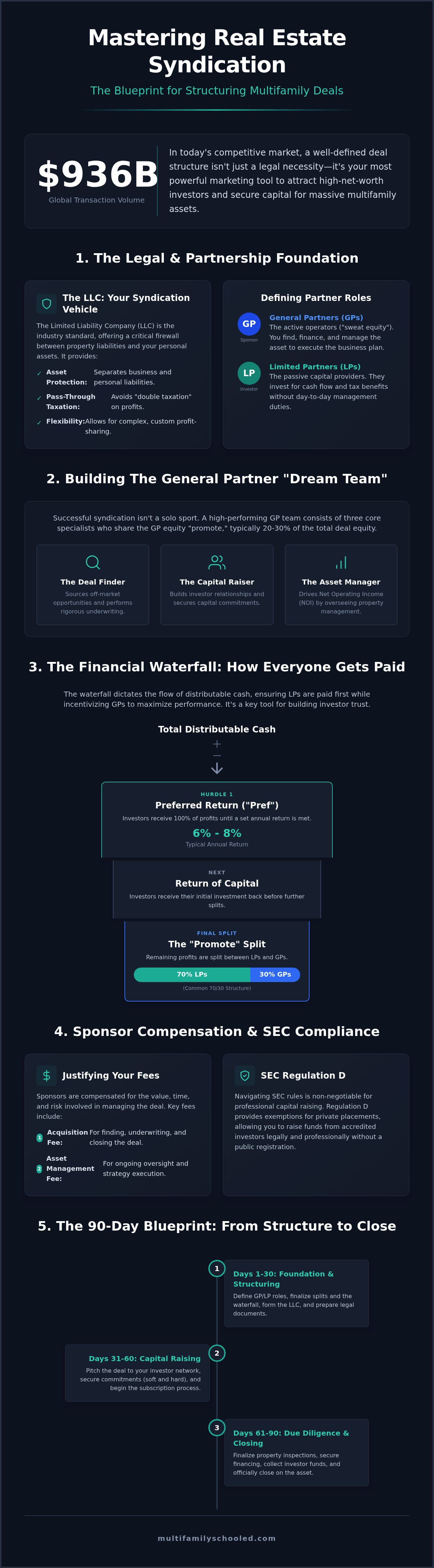
The Limited Liability Company (LLC) is the primary vehicle for modern multifamily deals. It’s built for protection and speed. In a standard syndication, you’ll see two distinct groups within this entity. The General Partners (GPs) are the active players. You are the "sweat equity." You find the deal, secure the debt, and execute the business plan. The Limited Partners (LPs) are the passive capital providers. They want the tax benefits and the cash flow without the 2:00 AM maintenance calls. This clear division of labor is what makes syndication so powerful.
LLC vs. Limited Partnership: Which Wins in 2026?
Why do top syndicators choose the LLC over a traditional Limited Partnership? Flexibility is the answer. LLCs allow for complex profit-sharing arrangements that aren't possible in other structures. You get pass-through tax benefits, meaning profits and losses flow directly to partners' tax returns. This avoids the "double taxation" trap that kills corporate deals. For the sponsor, the asset protection is non-negotiable. It creates a legal firewall between the property’s liabilities and your personal wealth. In 2026, the LLC remains the undisputed champion for asset protection and operational ease.
The General Partner (GP) Hierarchy
Don't try to be a lone wolf. Successful syndication requires a high-performing team. Within the GP group, roles are often specialized to maximize efficiency. You need three core pillars to succeed:
- The Deal Finder: The expert who sources off-market gems and handles the heavy lifting of underwriting.
- The Capital Raiser: The communicator who builds relationships and secures investor commitments.
- The Asset Manager: The strategist who oversees property management and drives the Net Operating Income (NOI).
Deciding how to structure a real estate syndication deal means knowing how to split the GP "pie." Typically, the GP team keeps 20% to 30% of the total equity as a "promote" for their work. To ensure your partnership is bulletproof, use the professional templates in the Multifamily Tool Kit. Don't waste time guessing on your operating agreement. Use a proven framework that investors already trust and respect.
The waterfall is where your deal comes to life. It is the mathematical engine that drives investor confidence and rewards your hustle. Mastering how to structure a real estate syndication deal requires you to visualize money flowing through a series of buckets. Each bucket must be filled before the next one receives a drop. This hierarchy ensures that your Limited Partners feel secure while you remain motivated to crush your performance targets.
Standard multifamily deals in 2026 typically follow a 70/30 or 80/20 split. In a 70/30 structure, your investors receive 70% of the cash flow and profits, while you, the Sponsor, retain 30% as a "promote." This promote is your reward for finding, financing, and managing the asset. It is the "sweat equity" that turns a stagnant building into a cash-flowing machine. To avoid expensive errors in these calculations, many new syndicators join a mentorship program to refine their models before pitching to big capital.
The Preferred Return: Protecting Investor Capital
The "Pref" is the first hurdle in your waterfall. It is a dedicated percentage of profit that goes entirely to your investors before you take a cent of the promote. In the current 2026 market, preferred returns usually range from 6% to 8% annually. This isn't just a financial calculation; it's a trust-building tool. It proves to your LPs that their capital is the priority. When you put their returns first, you eliminate the skepticism that often kills deals with first-time investors.
Straight Splits vs. Tiered Waterfalls
Deciding how to structure a real estate syndication deal often comes down to choosing between simplicity and performance-based incentives. A straight split is easy to explain. You agree on a percentage, and you stick to it for the life of the deal. However, if you want to scale, consider a tiered waterfall based on IRR hurdles. For example, you might move from a 70/30 split to a 50/50 split once the deal achieves a 15% Internal Rate of Return. This structure rewards you for exceptional management. It aligns your interests perfectly with the LPs. They want higher returns; you want a bigger piece of the upside.
Don't forget the "Catch-up" clause. This allows the Sponsor to receive a concentrated burst of profit after the LPs hit their preferred return but before the main split begins. It "catches you up" so your total profit share matches your agreed-upon promote percentage. This ensures your compensation is fair relative to the massive value you provide. Alignment of interest is your strongest closing tool. Show your investors that you are in the trenches with them, and the capital will follow.
SEC Compliance: Navigating Regulation D for Syndicators
Compliance is not a hurdle. It is your shield. When you learn how to structure a real estate syndication deal, you are entering the world of securities. Under the Howey Test, a syndication is a security because investors are putting up money in a common enterprise with the expectation of profit through your sole efforts. Don't gamble with the SEC. Mastery of Regulation D is what separates professional syndicators from those who lose it all to legal fees and fines. This framework is your best friend. It allows you to raise unlimited capital without the crushing burden of a full IPO registration.
Transparency is your ultimate currency. You must commit to absolute clarity in every investor communication. Avoid the "Grey Zone" of illegal public solicitation. If you aren't certain about your compliance, you're putting your entire 90-day deal at risk. Use the templates in the Multifamily Tool Kit to ensure your Private Placement Memorandum (PPM) meets the highest standards of disclosure and professionalism.
506(B) vs. 506(c): The Marketing Dilemma
Your capital raising strategy dictates your legal path. Rule 506(b) is the "Friends and Family" route. It prohibits public advertising. You must have a pre-existing, substantive relationship with every investor before you pitch the deal. Conversely, Rule 506(c) is the "Public" route. It allows you to shout your deal from the rooftops and use social media to attract capital. However, it comes with a trade-off. Every single investor must be accredited, and you are legally required to verify their status. Choose 506(b) if you have a deep personal network. Choose 506(c) if you want to scale fast through digital marketing.
Accredited vs. Sophisticated Investors
Knowing who can legally invest is critical. In 2026, an accredited investor must have an annual income exceeding $200,000 (or $300,000 jointly) for the last two years. Alternatively, they must have a net worth over $1 million, excluding their primary residence. Approximately 24.3 million U.S. households now meet these criteria. If you use Rule 506(b), you can include up to 35 "sophisticated" investors. These are individuals who aren't accredited but have enough financial knowledge to evaluate the risks. In a 506(c) offering, the "sophisticated" loophole does not exist. Verification is your responsibility. You must take reasonable steps, such as reviewing tax returns or obtaining third-party letters, to prove your investors are qualified. Build your empire on a foundation of compliance, and the capital will flow with confidence.
Sponsor Compensation: Fees and the Equity 'Promote'
You are the architect of the deal. You found the off-market asset, secured the debt, and built the professional team. When you decide how to structure a real estate syndication deal, your compensation must reflect the massive value you bring. Investors aren't just paying for a building. They are paying for your vision and your execution. Stop feeling guilty about fees. Start seeing them as the fuel for your operational excellence. You are providing the opportunity; you deserve to be rewarded for it.
Standard Fee Structures in 2026
Professional syndicators use a standardized fee schedule to keep the business moving and the deals profitable. In 2026, the acquisition fee typically ranges from 1% to 3% of the property's purchase price. This is paid at closing. It compensates you for the months of underwriting, site visits, and negotiations required to win the asset. Next is the asset management fee, generally 1% to 2% of the gross rental income annually. This fee ensures you stay relentlessly focused on driving performance and managing the property manager. Finally, plan for the exit. Disposition fees usually fall between 1% and 2% of the gross sale price, rewarding you for a successful full-cycle investment.
The Promote: Your Path to Wealth
The "Promote" is where you build true, multi-generational wealth. Also known as carried interest, this is your equity stake in the profits above and beyond any capital you personally invested. It is the ultimate incentive. When your investors win big, you win bigger. In a standard multifamily deal, the promote triggers after the Limited Partners have received their preferred return. This structure ensures your interests are perfectly aligned with your capital providers. If you want to learn the exact scripts to justify these fees to high-level investors, join our Mentorship Program today. Mastery of these numbers gives you the confidence to lead.
How you structure a real estate syndication deal determines your long-term reputation in the market. A fair promote keeps you motivated during the intense years of a value-add project. It transforms you from a mere manager into a true partner. By the time you reach the disposition phase, that 20% or 30% promote can result in a life-changing payday. This is the reward for your courage and your systematic approach. Own your value. Scale your vision. Success is a choice, and it starts with a professional compensation plan.
From Structure to Scale: Closing Your Deal in 90 Days
Knowledge without execution is just a hobby. You now have the blueprint for the legal and financial frameworks of a winning syndication. However, the most sophisticated structure in the world is worthless without a property to back it up. Don't get stuck in analysis paralysis. Many beginners spend months obsessing over GP/LP splits before they've even toured a building. That is a rookie mistake. In the world of high-stakes multifamily, structure follows the deal. You must find the asset first, then tailor the framework to meet the specific needs of that property and its investors.
Understanding how to structure a real estate syndication deal becomes much easier when you have a live opportunity on your desk. While you are hunting for properties, you must simultaneously build your investor list. Don't wait for a signed Letter of Intent (LOI) to start networking. Start the conversation now. Tell your potential LPs about the frameworks you are building. Show them the systematic approach you are taking. When the right deal lands, you want your capital ready to move within days, not weeks.
Finding the Deal First
Building a structure without a property is like designing a cage for a bird you haven't caught. Every asset has unique characteristics that might require a specific waterfall or a different fee structure. To find these opportunities before your competitors do, you need the right technology. Use Real Estate Radar to identify off-market multifamily gems and motivated sellers who are ready to exit. The 90-day deal finding mindset is a commitment to aggressive, systematic outreach that prioritizes closing over theoretical perfection. Stop searching and start finding.
Accelerate with the Mentorship Program
Your first syndication is the most important deal of your career. It sets the tone for your reputation and your future wealth. Why risk it on a "rookie" mistake? A bad split or a missing compliance check can cost you hundreds of thousands of dollars in the long run. Expert guidance isn't an expense; it's an investment in your speed and safety. Join the Multifamily Schooled Mentorship to secure your first deal with total confidence. We provide the tools, the templates, and the tactical advice you need to win. The market does not wait for the hesitant. Take action now and close your first massive deal in the next 90 days.
Claim Your Future: Build Your Apartment Empire Today
You've now mastered the frameworks used by the industry's elite. You know how to design waterfalls that protect investors and create promotes that build your legacy. Mastering how to structure a real estate syndication deal is the difference between a side hustle and a multi-generational empire. You have the legal blueprint and the financial roadmap. Now, you need the speed to execute. Stop waiting for the perfect moment; create it instead.
Our system is designed for results. You get immediate access to our proprietary Real Estate Radar software to find off-market gems and a proven system for apartment investing mastery. We are so confident in our methods that we guarantee you'll find a deal in 90 days or we provide one. Don't let hesitation steal your prosperity. You've got the tools; now take the lead. Your economic empowerment is waiting for you to claim it.
Ready to close your first deal? Join our Mentorship Program and find your building in 90 days!
Frequently Asked Questions
What is the most common real estate syndication structure for beginners?
The most effective structure for beginners is a Limited Liability Company (LLC) using a 70/30 or 80/20 profit split. In this model, Limited Partners provide the capital while you, as the General Partner, manage the asset. It is the industry standard because it provides clear legal protection and a framework that investors already trust. Learning how to structure a real estate syndication deal this way ensures you stay compliant while protecting your equity.
Can I structure a syndication deal with no money down as the sponsor?
Yes, you can structure a deal with no personal capital, but it requires significant "sweat equity." Sponsors often earn their stake by finding the deal, securing the debt, and managing the asset. However, most sophisticated investors want to see skin in the game. If you don't have the cash, you can partner with a co-sponsor who provides the liquidity. This keeps the deal attractive and proves there is real alignment of interest.
How much should a sponsor invest in their own syndication deal?
Sponsors typically invest between 1% and 5% of the total equity required for the deal. This investment signals to your Limited Partners that you are financially committed to the project’s success. While some deals are funded entirely by outside capital, contributing your own funds builds massive trust. It proves you believe in your underwriting and are willing to share the risk alongside your passive investors to secure the capital you need.
What is the difference between a real estate fund and a syndication?
A syndication is a one-off deal focused on a single, specific property that investors can evaluate before committing capital. In contrast, a real estate fund is often a "blind pool" where you raise money to purchase multiple properties over time. Syndications are generally better for those starting out because they are easier to explain. They allow you to focus your marketing on one tangible asset rather than a broad, complex strategy.
How do I pay myself as the general partner in a syndication?
You pay yourself through a combination of upfront fees and long-term equity. The most common payments include a 1% to 3% acquisition fee at closing and a 1% to 2% asset management fee based on gross revenue. The real wealth, however, comes from the "promote." This is your share of the profits after investors hit their preferred return. It rewards your hustle and ensures you get paid for delivering tangible results for your partners.
Is it legal to advertise my real estate syndication deal on social media?
It is legal only if you use the SEC Rule 506(c) exemption. This rule allows for general solicitation, meaning you can post on social media or run ads to find investors. However, you must take reasonable steps to verify that every investor is accredited. If you use Rule 506(b), public advertising is strictly prohibited. You must have a pre-existing relationship with your investors before discussing any specific deal details or offering documents.
What happens if a syndication deal doesn't meet its preferred return?
If a deal fails to meet its preferred return, the Limited Partners receive all available cash flow until that threshold is met. As the sponsor, you will not receive your "promote" or performance-based profits until the investors are made whole. This structure protects the LPs and keeps you relentlessly motivated to turn the property around. It is a powerful tool that ensures you only win when your investors win first.
How long does a typical real estate syndication deal last?
Most multifamily syndication deals have a target hold period of 3 to 7 years. This timeline provides enough room to execute a value-add business plan, increase the Net Operating Income, and wait for a favorable market cycle to sell. While some sponsors look for shorter exits, a five-year horizon is the industry standard. It balances the need for investor liquidity with the time required to maximize the asset's total value and long-term stability.



