

How to Read a Commercial Real Estate Offering Memorandum: The Investor’s 2026 Blueprint
Your next multimillion-dollar deal isn't hidden in that 80-page glossy PDF; it's buried under the broker's pro-forma dreams. Most investors waste hours staring at pretty pictures and estimated returns that never materialize. You know the feeling of opening a massive document and wondering if you're about to step into a financial trap. It's frustrating to see market forecasts predicting a 27 percent surge in mortgage originations while you're still struggling to tell if a specific deal is actually worth your time.
You need a way to cut through the noise fast. This blueprint teaches you exactly how to read a commercial real estate offering memorandum so you can stop playing guessing games. We'll give you a repeatable 10-minute system to filter deals and the confidence to spot red flags before spending a dime on due diligence. You're going to master the art of separating actuals from projections and start closing profitable multifamily deals with total certainty.
We're diving into the exact metrics that matter in 2026, from the 4.2 percent 10-year Treasury average to specific vacancy trends in high-quality assets. Get ready to turn information overload into your greatest competitive advantage.
Key Takeaways
- Treat the OM as a property resume and learn to ignore the "fluff" so you can focus on the real numbers that drive profit.
- Execute a 5-minute filter by skipping the photos and targeting the investment highlights to find immediate deal-breakers.
- Master how to read a commercial real estate offering memorandum by uncovering the truth between the Rent Roll and the T12 financial statements.
- Identify red flags like unrealistic expense ratios and deferred maintenance traps that brokers hope you'll overlook.
- Transition from reading to closing by applying the "back of the napkin" test to ensure every deal hits your minimum cash-on-cash returns.
What is a Commercial Real Estate Offering Memorandum (OM)?
Think of the Offering Memorandum (OM) as the property's professional resume. It's a polished, high-impact document crafted by brokers to highlight the best possible version of a commercial asset. An Offering Memorandum is a comprehensive marketing package that outlines the investment thesis and financial projections of a commercial asset. In many cases, these documents serve as a legal framework for a private placement, providing potential investors with the data they need to make an initial decision. Its primary purpose isn't to give you a neutral audit; it's to attract interest and solicit non-binding offers.
Don't confuse the OM with the "Teaser." A teaser is a one or two page flyer designed to grab your attention with a few highlights. The OM is the deep dive that follows. However, it's still not the full story. The ground truth lives in the "Due Diligence Vault," where the real receipts, like bank statements and actual invoices, are kept. Mastering how to read a commercial real estate offering memorandum is the first step toward filtering out the noise and focusing on the assets that actually build wealth.
To better understand this concept, watch this helpful video:
The Broker’s Sales Pitch vs. Your Reality
Brokers are masters of persuasion. They lead with "Hero Shots" and glossy photography because they want to cloud your judgment with emotion. You see a beautiful sunset over a pool; they see a way to distract you from cracks in the pavement. You must distinguish between the "As-Is" state of the property and the broker's "Stabilized" vision. One is the current reality. The other is a dream that requires your capital and sweat to achieve. Treat every broker assumption as a hypothesis to be tested. If they project rent growth, verify it against the 2.5 percent inflation forecast for 2026. Don't take their word for it.
Why Speed of Analysis Dictates Your 2026 Success
Success in 2026 belongs to the decisive. In a competitive market where commercial mortgage originations are expected to hit $805 billion, the fastest investors win. You don't have days to ponder a deal. You have minutes. Learning how to read a commercial real estate offering memorandum with surgical precision allows you to filter through the noise in under ten minutes. Use the Multifamily Tool Kit to automate your initial scan and crunch the numbers instantly. Your goal isn't to find reasons to buy on the first read. Your goal is to find the one "deal-breaker" that lets you move on to the next opportunity. Stop wasting time on bad deals and start focusing on the winners.
The 5-Minute Filter: Identifying Deal-Breakers Fast
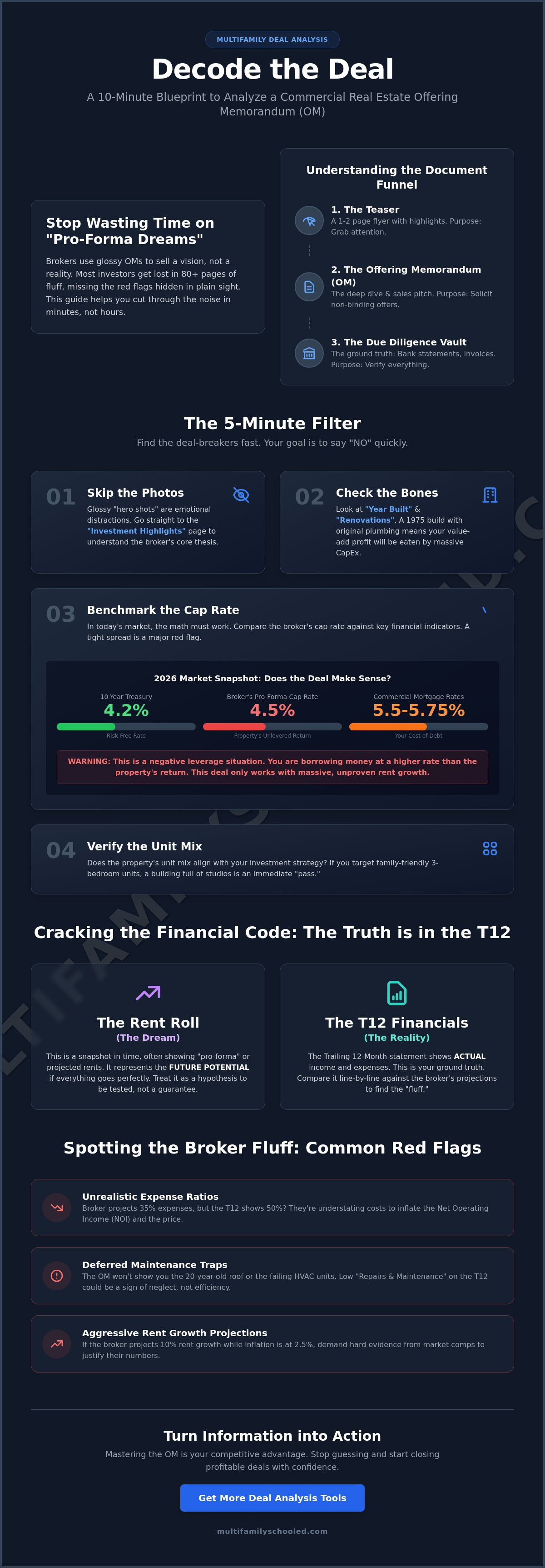
Stop wasting your most valuable asset: time. You don't need to read every page of an 80-page document to know if a deal is worth your capital. Most investors get trapped in "analysis paralysis" because they treat every page with equal importance. Your goal is to find a reason to say "no" as fast as possible. This is the core of how to read a commercial real estate offering memorandum like a pro. Follow this high-speed sequence to filter out the noise and find the gold.
- Step 1: Skip the photos. The glossy "hero shots" of the pool and clubhouse don't pay the mortgage. Go straight to the "Investment Highlights" page to see the broker's core thesis.
- Step 2: Check the bones. Look at the "Year Built" and "Renovations" sections. If you're looking at a 1975 build with original plumbing, your "value-add" profit will quickly vanish into massive CapEx bills.
- Step 3: Benchmark the Cap Rate. In 2026, the 10-year Treasury yield is averaging 4.2 percent. If the broker is pitching a 4.5 percent cap rate while commercial mortgage rates sit between 5.5 and 5.75 percent, the math simply doesn't work without massive rent growth.
- Step 4: Verify the unit mix. Ensure the bedroom counts align with your specific criteria. If your strategy focuses on family-friendly three-bedroom units, a building full of studios is an instant pass.
- Step 5: Check the occupancy trend. Look for the last 12 months of data. A sudden spike in occupancy right before the sale often indicates the owner is "stuffing" the building with low-quality tenants to juice the numbers.
Scanning the Executive Summary for Red Flags
Watch for "Value-Add" claims that lack supporting market data. If a broker claims you can raise rents by $300 but doesn't provide a comps page showing nearby properties achieving those numbers, it's just a guess. Be wary of pro-forma expense numbers. If the expense ratio is under 35 percent for an older building, the broker is likely hiding true property management costs. Identify if the seller is a "motivated closer" or just someone testing the market to see if they can get an unrealistic price.
Location and Demographics: Beyond the Pretty Maps
Don't trust the broker's custom-drawn map. Use Real Estate Radar to verify crime rates and school scores independently. Look closely at "Major Employer" claims. With a national office vacancy rate of 17.6 percent in 2026, that "anchor" office tenant nearby might be downsizing or planning an exit. Check for "Path of Progress" indicators like new retail developments or infrastructure projects that actually drive long-term value. If you want to master this process and start closing deals with confidence, consider joining our Mentorship Program to learn the exact systems we use every day.
Cracking the Financial Code: Rent Rolls and T12s
Numbers are the heartbeat of any deal. While the broker's narrative paints a picture of effortless wealth, the financial documents tell the real story. The Rent Roll is a snapshot in time; the T12 (Trailing 12 Months) is the movie. You cannot master how to read a commercial real estate offering memorandum without learning to cross-reference these two documents. One shows you where the property stands today. The other shows you the momentum, or lack thereof, over the last year.
The T12 reveals the true seasonal volatility of a property’s operating expenses. Look closely for "Ghost Tenants." These are units that appear as occupied on the Rent Roll but show zero dollars in collected rent on the T12. Brokers often use "concession masking" to hide these vacancies. They might give a tenant two months of free rent to keep the building "full" for the sale. If you don't catch this, you'll inherit a building with a collapsing income stream the moment those concessions end. Be aggressive in your scrutiny. Your profit depends on it.
The Rent Roll: Detecting Turnover Cliffs
Analyze the lease expiration dates immediately. If 40 percent of the leases expire in the next 90 days, you are facing a turnover cliff. This is a massive risk to your cash flow. Calculate the "Month-to-Month" (MTM) concentration. High MTM numbers mean tenants can leave at any time without penalty. Watch out for "Lease-Up Scams" where a seller signs over-market leases with questionable tenants just to juice the numbers before hitting the market. Finally, verify the security deposits. Ensure they are held in a separate account and not being used to patch over operating deficits. If the seller can't account for every dollar, walk away.
T12 vs. Pro-Forma: Why Brokers Love the Future
The "Broker Pro-Forma" is a work of fiction. Your underwriting must be the reality. Brokers almost always understate two critical items: property taxes and insurance. In 2026, many jurisdictions are aggressively reassessing values upon sale. Your tax bill will not be what the current owner pays; it will reset based on your purchase price. Normalize the T12 data by stripping out one-time "non-recurring" owner expenses. If the owner paid for a personal vehicle or a family vacation out of the property's maintenance fund, add that back to the Net Operating Income. Use our Multifamily Tool Kit to run these scenarios against current 5.50 percent mortgage rates. Don't buy a dream. Buy a proven income stream.
Spotting the "Broker Fluff": What They Aren’t Telling You
The broker's job is to sell the property at the highest price possible. Your job is to find the truth. When you're learning how to read a commercial real estate offering memorandum, you must develop a healthy skepticism. If a deal looks too perfect, it probably is. Brokers often omit the "ugly" parts of a deal to keep the momentum moving toward a letter of intent. They want you to see the potential while they hide the pitfalls.
One of the most common traps is the 20 year old roof. The OM will brag about "modern interiors" or "fresh paint," but it will conveniently ignore the aging infrastructure. Deferred maintenance is a silent profit killer. If you don't budget for a full roof replacement or HVAC overhaul, your projected returns will evaporate in the first year. Always assume there is a massive repair bill waiting just beneath the surface of those glossy photos. You aren't just buying units; you're buying a physical structure with a ticking clock on its components.
Watch the expense ratios closely. If a broker presents an expense ratio under 35 percent for an older building, they are hiding costs. It is simply not possible to operate a Class B or C asset that efficiently in 2026. They also love to "lowball" management fees. Most OMs assume a 3 percent fee, but professional property management actually costs between 4 and 7 percent. This 1 to 4 percent discrepancy might seem small, but it can swing your valuation by hundreds of thousands of dollars when you capitalize that missing expense.
Real estate taxes are the ultimate hidden killer. In 2026, tax jurisdictions are aggressively reassessing properties upon sale. The current owner's tax bill is irrelevant to you. You must calculate your taxes based on the new purchase price. If you want to avoid these common pitfalls and master the art of underwriting, join our Mentorship Program today and learn the systems used by top tier investors.
Hidden Capital Expenditures (CapEx)
Brokers love the term "Recent Renovations." Often, this is just code for "we fixed the things that were breaking." These aren't value add upgrades; they're basic maintenance. Look for mentions of plumbing and electrical systems. If they aren't mentioned, assume they are original and failing. You must also budget for "Lease Up" costs. The OM assumes high occupancy from day one, but the reality involves advertising, commissions, and tenant concessions that eat into your initial cash flow. Don't let a lack of transparency in the OM derail your first year of ownership.
The "Other Income" Trick
Scrutinize the "Other Income" section with a magnifying glass. Many owners claim high Utility Reimbursements (RUBS), but they aren't actually collecting them from tenants. Check the T12 to see if that money is actually hitting the bank account. Be wary of high application or late fees. This often signals a low quality tenant base that will cause headaches down the road. Finally, verify if "Pet Rent" or "Storage Income" is actually sustainable. If every other building in the submarket offers free storage, your "extra income" will disappear the moment a competitor drops their price. Verify every dollar before you sign the contract.
From OM to Offer: Taking Decisive Action
Stop reading and start winning. You have learned how to read a commercial real estate offering memorandum to spot the lies. Now it is time to use that knowledge to secure assets. Never use the broker’s spreadsheet. It is designed to make you overpay. Build your own model. This is where the real work happens. If a deal doesn’t pass the "Back of the Napkin" test for your minimum Cash-on-Cash return, throw it away immediately. Your time is too valuable to spend on mediocre math.
Draft your Letter of Intent (LOI) based on your real underwriting. If the broker’s pro-forma was a fantasy, your offer must be the reality. Don't be afraid to submit an offer that reflects the actual deferred maintenance and tax resets we discussed earlier. High-energy investors don't wait for permission; they dictate the terms. You are building a portfolio for long term independence, not helping a broker hit their sales quota. Take the lead and make the market come to you.
Calculating Your Own Metrics Independently
Adjust your Cap Rate expectations for the 2026 environment. With mortgage rates hovering between 5.50 and 5.75 percent, you cannot accept a 4 percent cap. You need a spread to ensure safety. Set your "Walk-Away Price" before you ever pick up the phone to talk to the broker. This prevents emotion from clouding your judgment during negotiations. Conservative underwriting isn't being scared; it's being strategic in a market where the 10-year Treasury yield is averaging 4.2 percent. Protect your downside to ensure your upside is guaranteed.
Building Your 90-Day Deal Pipeline
Success is a numbers game. You need to read at least 10 OMs a week to find the one deal that actually makes sense. This volume builds your "market intuition" and helps you spot trends before they become common knowledge. When you pass on a deal, tell the broker exactly why. Tell them your underwriting showed a tax reset they missed or that the expense ratio was unrealistic for 2026. This level of professionalism makes brokers take you seriously. They will start sending you "Off-Market" deals before the glossy PDFs are even created.
Ready to go from reader to owner? Apply for our Mentorship Program today. Join a community that holds you accountable to a 90-day deal-finding timeline and provides the proprietary blueprint for multi-generational wealth. Stop guessing and start closing.
STOP ANALYZING AND START CLOSING
You now possess the blueprint to dismantle any broker sales pitch. You've mastered the 5-minute filter and learned to spot the hidden "ghost tenants" that drain your profits. Now that you know how to read a commercial real estate offering memorandum with surgical precision, you have a massive competitive advantage over the thousands of investors still stuck in "analysis paralysis." The difference between a dreamer and a closer is the speed of execution. Don't let another profitable deal slip through your fingers because you were too slow to act.
Don't navigate this volatile 2026 market alone. Access the tools and the network used by the pros. Master the 90-Day Deal System: Join the Multifamily Mentorship. Led by multi-generational investor Justin Brennan, you'll gain immediate access to our proprietary Deal Finding Software. We are so confident in our system that we guarantee results; find a deal in 90 days or we will provide one for you.
Your future of economic empowerment is waiting. Take the first step toward long-term independence today and turn your new knowledge into tangible assets. The best deals of 2026 are already out there; go find them.
Frequently Asked Questions
What is the most important section of an offering memorandum?
The financial section containing the Rent Roll and Trailing 12-Month (T12) statement is the most critical part of any OM. While the executive summary provides the hook, these raw data points reveal the property's actual performance history. You must look past the glossy photos and prioritize the numbers that dictate your cash flow and debt service coverage. This is where you find the truth behind the broker's pitch.
Should I trust the pro-forma numbers in a commercial real estate OM?
Never trust a broker's pro-forma numbers without independent verification. Pro-formas are aspirational "best-case scenarios" designed to maximize the seller's exit price. You must build your own underwriting model to account for the 2026 reality of 5.50 percent mortgage rates and realistic expense ratios. Use the pro-forma only as a starting point for your own skeptical analysis of the deal's potential.
What is a "turnover cliff" and how do I find it in the rent roll?
A turnover cliff occurs when a large percentage of leases expire within a short window, threatening your immediate occupancy and cash flow. You find this by reviewing the lease expiration column in the Rent Roll. If 30 percent or more of the units expire in the same quarter, you face massive turnover costs and a potential income gap. Spot these clusters early to negotiate a lower price.
Why do brokers omit certain expenses from the offering memorandum?
Brokers omit expenses like realistic management fees and capital reserves to artificially inflate the Net Operating Income (NOI). A higher NOI leads to a higher valuation based on market cap rates. They often assume a 3 percent management fee when professional firms actually charge 4 to 7 percent. Always add these missing costs back into your model to see the property's true investment value.
How long should it take to analyze an offering memorandum?
You should complete your initial scan of an offering memorandum in under 10 minutes. Use a systematic filter to check the year built, unit mix, and current occupancy before diving into the weeds. If the deal doesn't pass your "back of the napkin" test for cash-on-cash returns, move on immediately. Speed is your greatest weapon in a competitive 2026 multifamily market.
What is the difference between a sales teaser and an offering memorandum?
A sales teaser is a one-page "hook" designed to generate interest, while an OM is a detailed marketing package. The teaser gives you basic stats like unit count and location. The OM provides the deeper dive into demographics, financials, and market comps. Learning how to read a commercial real estate offering memorandum is what separates serious buyers from casual lookers who never close.
Can I use the OM as a legal document if the numbers are wrong?
No, you cannot rely on the OM as a legally binding document because it almost always contains "non-reliance" disclaimers. Brokers include these clauses to protect themselves from liability regarding mathematical errors or omitted facts. It's your responsibility to verify every claim during the due diligence period. Use the OM for your initial offer, but let your own independent audit drive the final contract.
How do I verify the market rents mentioned in the OM?
Verify market rents by pulling independent comps from third-party databases or your own deal-finding software. Don't rely on the "Rent Comps" page in the OM; brokers often select only the highest-performing assets in the area. Call local property managers and ask about current concessions and effective rents. This ground-level data ensures your "value-add" projections are rooted in the 2026 economic reality.



