

How to Protect Your Apartment Building Investment from Risk in 2026
One predatory lawsuit or a single overlooked structural defect can wipe out a decade of equity in less than ninety days. Does your current portfolio structure actually stand up to the pressure of a shifting 2026 market? You've worked hard to build your assets, but the fear of losing them to a tenant dispute or hidden defect is real. Mastering how to protect your apartment building investment from risk is no longer optional; it's the foundation of your long-term independence. You need a system that turns your vulnerability into a fortress.
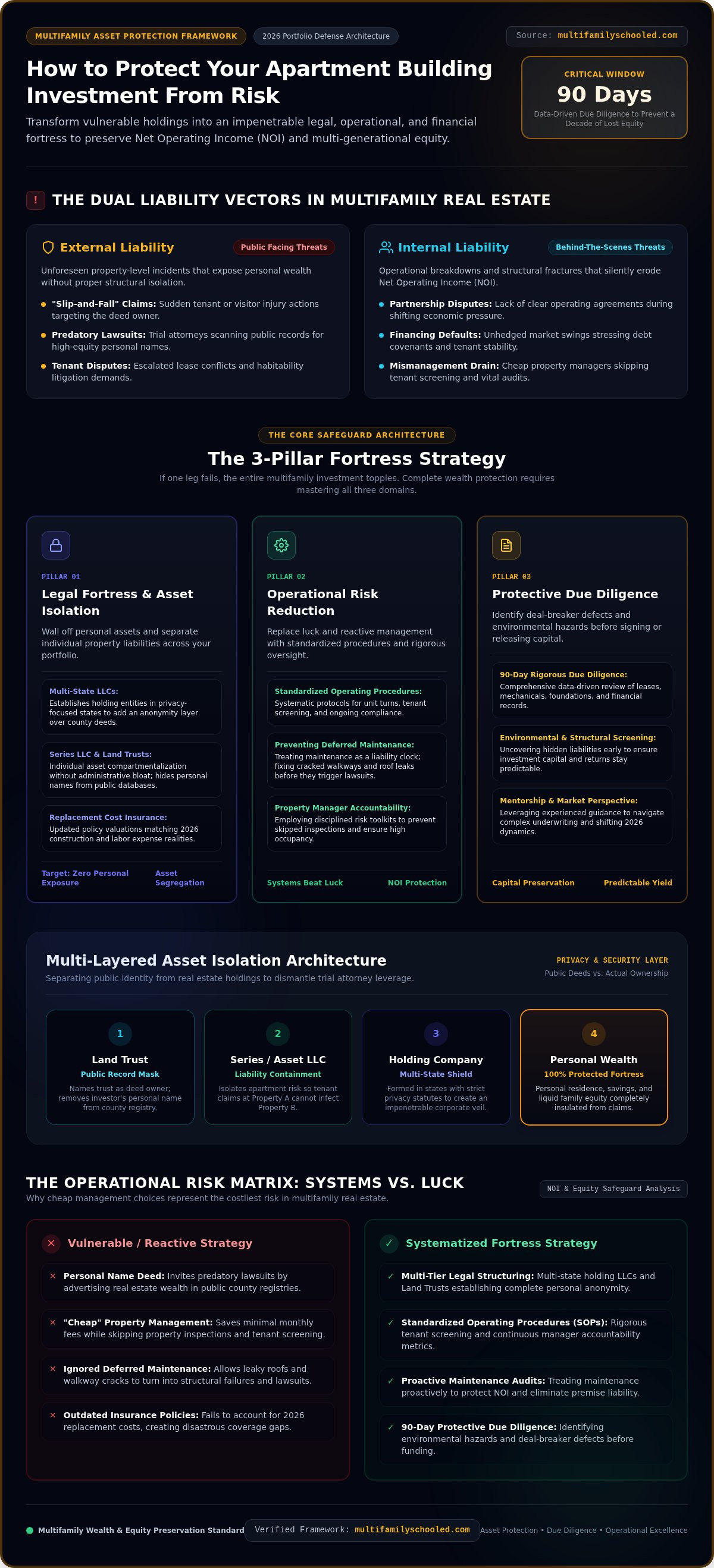
This article provides the exact roadmap you need to achieve total confidence in your holdings. We'll break down the three-pillar strategy of legal, operational, and financial protection to safeguard your multifamily assets against lawsuits, market shifts, and mismanagement. You'll gain a clear system for operational risk reduction and a blueprint for legal shielding. Stop guessing and start following a proven framework to make your investment "lawsuit-proof" starting right now. The path to a secure, prosperous future is waiting for you.
Key Takeaways
- Construct a legal fortress using multi-state LLCs and trusts to shield your personal wealth from predatory lawsuits and public exposure.
- Master how to protect your apartment building investment from risk by replacing hope with a rigorous, data-driven 90-day due diligence system.
- Eliminate management chaos through standardized operating procedures and elite tenant screening systems that stop operational fires before they start.
- Identify hidden "deal breaker" defects and environmental hazards before you commit, ensuring your capital remains safe and your returns stay predictable.
- Leverage professional mentorship to gain the high-level perspective needed to spot market shifts and navigate complex structures with total confidence.
Understanding the Multi-Layered Risks of Apartment Investing
Multifamily real estate is the greatest wealth-building vehicle on the planet, but it isn't a "set it and forget it" asset. In 2026, the landscape has shifted. Market volatility and changing tenant expectations mean you must be proactive. Learning how to protect your apartment building investment from risk is the difference between a thriving portfolio and a financial nightmare. You're building a legacy; don't let it crumble because you ignored the warning signs.
Multifamily risk is the potential for unforeseen events to erode your Net Operating Income (NOI) or equity. While this asset class is historically stable, "low risk" never means "no risk." To succeed, you must master the three-legged stool of protection: legal structures, operational systems, and financial due diligence. If one leg fails, your entire investment topples. You need a comprehensive strategy to identify these threats before they manifest in your bank account. Always consult with qualified legal and tax professionals to ensure your specific plan is airtight.
External vs. Internal Liability
Liability comes from two directions. External liability includes the classic "slip-and-fall" lawsuits or tenant claims that can arise at any moment. You should work with experts to establish a limited liability company (LLC) or similar structure to wall off your personal assets from these claims. Internal liability is often more dangerous. This involves partnership disputes or financing defaults that happen behind the scenes. In 2026, economic shifts can stress tenant stability, making these internal pressures even more intense. You need clear contracts and transparent communication to keep your internal operations secure.
The High Cost of Mismanagement
Operational risk is often a silent killer. Deferred maintenance isn't just a repair bill; it's a hidden liability clock. Every day you ignore a leaky roof or a cracked walkway, you increase the chance of a catastrophic failure or a massive lawsuit. High vacancy rates in premium markets are another major threat to your NOI. Don't fall into the trap of choosing "cheap" property management. Saving a few dollars on monthly fees often leads to the riskiest choice: a manager who skips inspections or fails to screen tenants properly. Use tools like the Multifamily Tool Kit to standardize your risk analysis and keep your managers accountable. Systems beat luck every single time.
Building Your Legal Fortress: LLCs, Trusts, and Insurance
Owning an apartment building in your personal name is a "Day 1" mistake that invites financial disaster. It's a neon sign for predatory lawyers looking for an easy target. If a tenant slips or a pipe bursts, your personal savings, home, and future are all on the line. You must separate your identity from your assets immediately. Building a legal fortress is the foundational step in learning how to protect your apartment building investment from risk. While these strategies are powerful, you should always consult with qualified legal and tax professionals to tailor them to your specific portfolio.
Start by moving your property into a Limited Liability Company (LLC). This structure creates a crucial barrier between the asset's liabilities and your personal wealth. You can review the IRS guidelines on LLC formation and taxation to understand how these entities impact your tax filing and bottom line. For advanced protection, many elite investors utilize multi-state LLC structures to add an "anonymity layer." By using a holding company in a state with strong privacy laws, you make it significantly harder for public record searches to link you directly to the deed.
The LLC vs. Land Trust Debate
LLCs excel at asset isolation. They keep a problem at one property from infecting the rest of your portfolio. If you plan on scaling quickly, consider a "Series LLC" to wall off each building individually without the administrative burden of dozens of separate filings. Land Trusts offer a different advantage: privacy. By naming a trust as the owner, your name disappears from the county's public records. This makes you a much harder target for frivolous lawsuits. Combining these tools creates a multi-layered shield that most trial lawyers won't even try to penetrate.
Maximizing Insurance Coverage
Insurance is your first line of defense, but it's never the only one. In 2026, you must review your "Replacement Cost" values with extreme scrutiny. Construction and labor costs have shifted, and an outdated policy will leave you with a massive capital gap if disaster strikes. Ensure your coverage includes General Liability, Rent Loss insurance to protect your NOI during major repairs, and Professional Liability. Naming your legal entities as "Additionally Insured" is a non-negotiable step to ensure your fortress stands firm in court. If you want to see how these legal layers fit into a larger growth strategy, our Mentorship Program provides the expert guidance needed to build a resilient, high-performing portfolio.
Operational Risk Management: Why Systems Beat Luck
Luck is not a strategy. Amateurs rely on hope; professionals rely on systems. In the fast-moving 2026 market, you can't afford to leave your assets to chance. Mastering how to protect your apartment building investment from risk requires turning your property into a high-performance machine. While your legal structure provides the shell, your operations provide the substance. You must bridge the gap between LLC formation and tax treatment and the daily reality of managing people and physical assets. Systems don't sleep, and they don't make emotional mistakes.
Start with your data. You need to know exactly what you're walking into before you sign the deed. Use proprietary tools like RealEstateRadar.ai to pull market-level risk data and filter out high-risk properties. Once you own the asset, your primary defense is elite tenant screening. A bad tenant is a ticking time bomb for a predatory lawsuit. Implement a rigorous, non-negotiable screening process that looks beyond credit scores to criminal history and past evictions. This is the most effective way to stop problems before they enter your building.
Standardizing Maintenance and Safety
Physical risk is often hidden in plain sight. You must conduct regular property audits to identify "attractive nuisances" like unsecured pools or broken stairs. Focus your energy on the "Big Three" of physical risk: fire safety, lighting, and security. If your hallways are dark or your smoke detectors are outdated, you're inviting a claim. Implement a 24/7 incident reporting system so tenants can flag issues immediately. Document every repair, every inspection, and every tenant interaction. This paper trail is your ultimate defense in a courtroom. If it isn't documented, it didn't happen.
Professional Property Management Selection
Your property manager is the steward of your wealth. Don't hire based on the lowest fee; hire based on the best systems. Vet your managers by asking if they use modern risk-tracking software and real-time reporting. You need to see key performance indicators (KPIs) like work order completion times and delinquency rates. These numbers signal rising risk long before they hit your bank statement. Adopt an "audit the auditor" approach to your monthly financial reporting. Review the ledger for anomalies and ensure your manager is following your Standard Operating Procedures (SOPs) to the letter. This level of oversight ensures your investment remains a fortress of stability.
Protective Due Diligence: Reducing Risk Before the Purchase
Success in multifamily real estate is won or lost before you ever take the keys. You make your money on the buy, but you keep it through due diligence. If you're wondering how to protect your apartment building investment from risk, the answer lies in a clinical, emotionless vetting process. Amateurs fall in love with the "potential" of a building; professionals fall in love with the data. You need a rigorous 90-day system to strip away the seller's marketing fluff and reveal the true health of the asset. This is your window to walk away before a bad deal becomes a permanent anchor on your portfolio.
Financial due diligence is where you spot "cooked books" and hidden expenses. Sellers often normalize one-time costs or "forget" to include realistic repair budgets in their pro formas. You must verify every line item against bank statements and tax returns. To ensure your analysis is standardized and bulletproof, use the Multifamily Tool Kit to run your numbers with professional precision. Don't take the broker's word for it; verify the math yourself.
The Phase I Environmental Site Assessment
Environmental hazards can bankrupt an investor in a single transaction. Lenders require a Phase I Environmental Site Assessment for a reason, and you should too. This report identifies historical risks like nearby dry cleaners or former gas stations that may have leaked toxins into the soil. In older multifamily assets, you must also account for lead, asbestos, and mold. These aren't just maintenance issues; they are massive liability risks that can lead to predatory lawsuits and government fines. Identifying these early allows you to negotiate the price down or demand remediation before closing.
Lease File Audits and Estoppel Certificates
The rent roll is the heartbeat of your investment. You must conduct a physical audit of every lease file to verify tenant income and security deposits. Look for "unwritten" agreements where the seller promised a tenant free rent or special privileges that aren't in the contract. Estoppel Certificates are your most powerful tool here. These documents, signed by the tenants, confirm the current lease terms and prevent post-closing surprises. If a tenant claims they are owed a month of free rent after you close, the Estoppel Certificate is your shield. For high-speed vetting of market-level risks, leverage the data inside RealEstateRadar.ai to ensure the neighborhood supports your investment goals.
Scaling Safely with Multifamily Mentorship
Isolation is the silent killer of investment portfolios. When you're alone, your blind spots are your biggest liabilities. A mentor acts as a high-speed radar, spotting "deal breakers" that would bankrupt an amateur before they even sign the contract. This is the ultimate way to master how to protect your apartment building investment from risk. You gain immediate access to a battle-tested network of risk-aware attorneys and CPAs who specialize in multifamily assets. Don't gamble with your family's future by guessing. Join our Mentorship Program to find and secure low-risk deals and step into a system designed for your absolute success.
The 2026 market is fast and unforgiving. You need an expert who has already navigated these waters to guide your hand. A mentor doesn't just provide advice; they provide a shield. They've seen the market cycles, the predatory lawsuits, and the management failures that sink most new investors. By leveraging their experience, you collapse the time it takes to achieve independence while significantly lowering your exposure. You aren't just buying a building; you're securing your freedom with a proven guardian by your side.
The Power of a Proven Framework
Success is a repeatable process, not a stroke of luck. You must avoid the expensive mistakes that derail first-time owners before they lose their capital. By using the Multifamily Tool Kit, you implement a standardized analysis that leaves no room for emotional bias or "hope" in your numbers. Peer review within a mentorship group acts as your final safety net. When dozens of experienced eyes look at your deal, hidden risks have nowhere to hide. This collective intelligence is your greatest asset in a volatile economy. Standardized systems beat guesswork every single time.
Taking Action with Confidence
Stop letting "analysis paralysis" steal your time and your potential. Knowledge without action is just a hobby; knowledge with a system is a business. You need to move toward calculated risk-taking with total certainty. Our 90-day roadmap provides the exact steps to find, vet, and close your first protected apartment deal. We don't just teach theory. We provide the tools for a guaranteed path to economic empowerment, backed by a multi-generational industry heritage. Your life-transforming journey starts the moment you decide to follow a proven blueprint. The market waits for no one. Explore our store for resources to start your journey and claim your place in the multifamily movement today.
Take Command of Your Financial Future
You now have the blueprint to shield your assets from the volatility of 2026. By implementing a multi-layered legal structure, standardizing your operations, and executing clinical due diligence, you've mastered how to protect your apartment building investment from risk. Don't let hesitation be the reason you miss out on this life-transforming journey. You need a system that replaces guesswork with guaranteed results. It's time to move from analysis to action and build a legacy that lasts.
Led by multi-generational real estate expert Justin Brennan, our program provides the tools for a certain path to success. You'll gain immediate access to our proprietary Deal Finding Software to filter out high-risk properties before they reach your desk. We're so confident in this framework that we offer a performance guarantee: find a deal in 90 days or we provide one for you. Secure Your Future: Apply for Our 90-Day Mentorship Program. Your path to long-term independence is open. Take the first step with total confidence today.
Frequently Asked Questions
Is an LLC enough to protect my apartment building investment from risk?
No. An LLC is a legal shell, not a complete strategy. You must combine it with robust insurance and professional operational systems. An LLC alone won't stop a market crash or mismanagement. It's just one pillar of our three-pillar strategy. Always consult with legal professionals to ensure your specific structure is airtight. Learning how to protect your apartment building investment from risk requires a holistic ecosystem that goes far beyond simple entity formation.
What is the most common risk that multifamily investors overlook?
Operational risk and deferred maintenance are the silent killers. Many investors focus so hard on the legal structure that they ignore the "hidden liability" clock of a failing roof or poor tenant screening. These issues can lead to predatory lawsuits or massive capital calls that erase your equity. Using a standardized system like our Multifamily Tool Kit helps you identify these gaps and physical hazards before they become expensive disasters for your portfolio.
How much insurance coverage do I actually need for a 20-unit building?
You need enough to cover the full replacement cost of the building plus a significant umbrella policy. In 2026, rising construction costs mean you must review your "Replacement Cost" values annually. Don't just settle for the lender's minimum requirements. You should also carry rent loss insurance to protect your NOI during major repairs. Work with a commercial broker who understands the specific risks of your local market and asset class to avoid gaps.
Can I use a Land Trust instead of an LLC for privacy?
You can use a Land Trust, but it serves a different purpose than an LLC. A Land Trust provides privacy by keeping your name off public records, while an LLC provides the actual asset isolation and liability protection. Many elite investors use both: the Land Trust holds the title for anonymity, and the LLC is the beneficiary to handle the legal defense. This multi-layered approach is a key part of our mentorship training for scaling safely.
What happens if a tenant sues me personally instead of my company?
This is where trial lawyers try to "pierce the corporate veil." If you haven't maintained separate bank accounts or followed corporate formalities, they can go after your personal assets. This is why mastering how to protect your apartment building investment from risk is about more than just filing paperwork. You must run your investment like a professional business with clear boundaries and documented systems to ensure your personal wealth remains untouchable and your legacy stays secure.
How does due diligence differ between a 4-unit and a 50-unit building?
Scale changes the complexity, not the necessity. A 50-unit building requires a more intensive audit of lease files, estoppel certificates, and historical maintenance logs. You'll likely need a Phase I Environmental Site Assessment and a more thorough physical inspection of mechanical systems. Our 90-day system and Deal Finding Software are designed to handle this complexity, ensuring you don't miss "deal breakers" regardless of the property size or the current market conditions.
What are the environmental risks I should look for in older properties?
Lead paint, asbestos, and mold are the primary physical hazards in older assets. You must also check for historical soil contamination from nearby dry cleaners or gas stations. These risks can bankrupt an investor through remediation costs and government fines. Identifying these early allows you to negotiate price reductions or walk away from the deal. We teach you how to spot these red flags during the initial deal-finding phase to keep your capital safe.
Do I need a separate LLC for every apartment building I own?
It depends on the value of the assets and your risk tolerance. Many investors use a "Series LLC" or separate LLCs to wall off each property, preventing a problem at one building from infecting the rest of the portfolio. This isolation is a core strategy for scaling safely and protecting your long-term independence. While it adds some administrative work, the protection it offers for your assets is worth the effort. Consult with your legal team today.



