

How to Invest in Real Estate Out of State: The 2026 Multifamily Blueprint
Distance is not a barrier; it's a filter that forces you to rely on hard data over emotion. You likely feel trapped by sky-high prices in your own backyard or the measly 2% yields found in expensive coastal markets. It's natural to fear the unknown when you're looking at property a thousand miles away. You worry about lacking a trusted local team or getting blindsided by complex new regulations like California's AB 628 or Florida's latest flood disclosures. Learning how to invest in real estate out of state doesn't have to be a gamble. It's about shifting your mindset from local landlord to strategic asset manager.
Stop letting geography dictate your net worth. You can master a system that finds, analyzes, and closes high-performing multifamily deals without ever leaving your home. We're handing you the 2026 blueprint to build a rock-solid local team and navigate state-specific laws with total confidence. This guide provides a repeatable framework for remote market selection and a clear execution plan. You'll gain the tools to identify cash-flowing opportunities in the South or Southeast and the momentum to close your first deal within the next 90 days. Success is a system. It's time to start yours.
Key Takeaways
- Escape the "home field advantage" trap by using a data-driven strategy that prioritizes high-yield returns over geographic proximity.
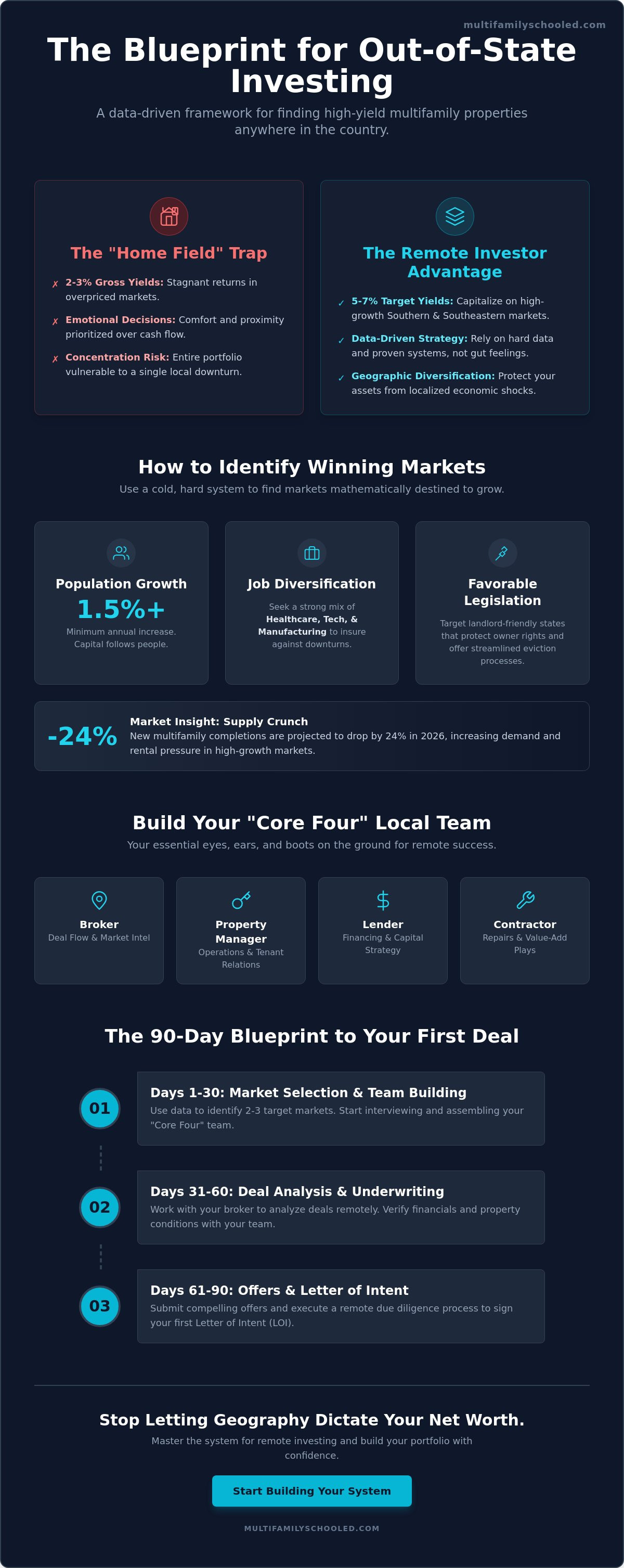
- Identify winning markets by targeting specific metrics, including a minimum 1.5% annual population growth and robust job diversification.
- Build your "Core Four" local team—Broker, Property Manager, Lender, and Contractor—to serve as your essential eyes and ears on the ground.
- Master how to invest in real estate out of state by executing a remote due diligence process that verifies financial red flags and physical property conditions.
- Follow a proven 90-day blueprint to accelerate your progress from initial market research to your first signed Letter of Intent.
Why Your Local Market is Likely Holding You Back
Stop waiting for your local market to "cool down" or hand you a miracle deal. It isn't going to happen. If you live in a high-cost coastal city, you're likely staring at 2-3% gross rental yields while your capital stagnates. The "Home Field Advantage" is a psychological trap. It leads to emotional, low-yield investing that prioritizes comfort over cash flow. You must learn how to invest in real estate out of state to break free from these geographic chains and secure your financial future.
Mastering basic real estate investing principles requires looking beyond your own zip code. In 2026, capital is rapidly fleeing primary coastal hubs due to restrictive regulations and compressed margins. Sophisticated investors are chasing the 5-7% yields found in emerging Southern and Southeastern markets. Geographic diversification isn't just about higher returns; it's your ultimate asset protection. It shields your entire portfolio from a single local economic downturn or a sudden shift in municipal laws that could wipe out your profits.
To better understand the power of remote investing, watch this helpful video:
The Myth of the "Local Expert"
Being able to drive by your property provides a false sense of security. It's an illusion. Physical proximity doesn't stop a pipe from bursting or a tenant from skipping rent. Professional investors rely on scalable systems, not a Saturday afternoon drive-by, to ensure asset performance. You must shift your mindset from a "property owner" to a "portfolio strategist" immediately. Use high-leverage tools like Real Estate Radar AI to analyze the data that your eyes can't see from the street. Proximity is a crutch; data is a superpower.
Comparing Yields Across State Lines
The math is simple and brutal. Staying local in an overpriced market carries a massive opportunity cost. In early 2026, the national rental vacancy rate sat at a healthy 7.3%, but growth isn't even across the board. You're trading thousands of dollars in potential monthly income for the convenience of being close to the asset. The yield gap is the difference between local comfort and remote cash flow. When you calculate the real ROI of remote expansion, the "safety" of your backyard looks like a financial liability. Don't let your zip code cap your wealth. Seize the higher yields waiting in growth-ready markets today.
The Data-Driven Framework for Picking Winning Markets
Stop guessing where the next boom will happen. You don't need a "gut feeling" to succeed. You need a cold, hard system. Understanding how to invest in real estate out of state begins with identifying markets that are mathematically destined to grow. In 2026, the national rental vacancy rate sits at 7.3%. While this is healthy, you aren't looking for average results. You want markets where demand outstrips supply so aggressively that your cash flow is guaranteed by the data. High-performance technology now allows you to unlock remote real estate investing at a level once reserved for institutional players.
Your first benchmark is population growth. Target markets with a minimum 1.5% annual increase. If people aren't moving there, your capital shouldn't either. Next, examine job diversification. Avoid "one-company towns" at all costs. If that single employer shuts down, your building goes dark. You want a mix of healthcare, tech, and manufacturing. This diversity acts as an insurance policy for your occupancy rates. With new multifamily completions expected to drop by 24% in 2026, finding these high-demand pockets is your ticket to rapid equity growth.
Legislation is your next filter. Focus on landlord-friendly states that protect your rights as an owner. Texas, for example, streamlined its eviction process with SB 38 on January 1, 2026. Florida now requires a clear 30-day notice for month-to-month terminations, providing much-needed stability. Compare this to the restrictive environment in California, where new laws mandate landlords to maintain specific appliances. You want to invest where the law is on your side. If you want to master these metrics quickly, check out the resources available at Multifamily University.
Top 3 Metrics for Remote Multifamily Success
- Job Growth vs. National Average: Look for cities outperforming the national trend by at least 1%. These are the economic hubs of the future.
- Median Household Income Trends: Ensure incomes are rising. Your tenant base must be able to absorb the modest 1.2% rent growth forecasted for 2026.
- The Path of Progress: Track new infrastructure projects and commercial development permits. Follow the government's money to find the next "hot" neighborhood.
Tools for Virtual Market Analysis
Ditch the spreadsheets and use real-time data. You can now scrape rental rates and vacancy stats in seconds. Use Real Estate Radar to identify off-market opportunities before they hit the general public. Build a "Market Scorecard" to objectively compare three potential cities side-by-side. This removes the emotion from the decision. When the data says "buy," you move with total confidence. Information without a system is just noise. Use these tools to turn that noise into a profitable portfolio.
Building Your "Boots on the Ground" Support System
Building a world-class team is the only way to scale your portfolio. Your team serves as your eyes and ears on the ground. Without them, you aren't investing; you're gambling with your hard-earned capital. To master how to invest in real estate out of state, you must assemble the "Core Four": a Broker, a Property Manager, a Lender, and a Contractor. These professionals turn a distant building into a high-performing asset. Don't settle for the first person who answers the phone. Conduct "virtual coffee" interviews via video call to gauge their responsiveness and local reputation. You need people who are as hungry for your success as you are.
Financing is the fuel for your growth. When you are financing real estate investments, your lender must understand the specific nuances of out-of-state multifamily debt. They are your gatekeepers for capital and your first line of defense against bad deals. Align your incentives from day one. Structure your agreements so your team wins when you win. This might mean performance-based bonuses for your property manager or exclusive listing rights for your broker on the exit. When everyone's interests are perfectly aligned, the system runs itself with minimal interference from you.
Finding the Right Multifamily Broker
Stop calling residential agents who "also do apartments" on the side. You need a dedicated commercial specialist who lives and breathes multifamily data every single day. A true specialist knows the specific sub-market cap rates and knows exactly which streets to avoid. To get on a broker’s "First Call" list for lucrative pocket listings, you must prove you are a closer. Ask them about recent transactions and their take on local rent growth trends for 2026. If they can't speak fluently about local supply and demand, keep looking. Your broker should be your primary deal funnel.
Property Management: The Remote Investor’s Lifeline
Your property manager is your most critical hire. There is a massive difference between simple "rent collection" and true asset management. You need a partner who proactively looks for ways to increase your Net Operating Income (NOI) through efficiency and value-add strategies. Track key performance indicators (KPIs) every month, such as economic occupancy and maintenance turnaround times. Use the Multifamily Tool Kit to standardize your reporting and keep your team accountable. This ensures you have a clear bird's-eye view of your investment from 1,000 miles away. Consistency is the only path to remote mastery.
Remote Due Diligence: Analyzing Deals from 1,000 Miles Away
Distance should never be an excuse for sloppy analysis. In fact, remote investing forces you to be more disciplined than the local buyer who relies on "gut feelings" or a quick drive-by. To master how to invest in real estate out of state, you must follow a rigid, five-step due diligence process that eliminates guesswork. You're not just buying bricks and mortar; you're buying a cash-flow engine. If that engine has a hidden leak, you need to find it before you sign the closing documents. Your goal is to move from a signed Letter of Intent (LOI) to a closed deal with absolute certainty.
Step one is desktop underwriting. You must verify the Trailing 12-month (T-12) financial statement and the current Rent Roll for red flags. Look for "other income" that seems suspiciously high or utility expenses that don't match the occupancy levels. Step two involves the virtual tour. Demand high-definition video walkthroughs of every unit, the roof, and the common areas. Step three requires third-party reports. Hire local structural engineers and environmental specialists to conduct audits. Step four is the lease audit. Randomly call tenants to verify their contract terms against the reported income. Finally, step five is your final pro-forma. You must adjust your numbers based on local property tax reassessments, which often trigger immediately after a sale in 2026.
Mastering the Numbers: NOI and Cap Rates
Net Operating Income (NOI) is the only number that truly matters in the multifamily world. It's the income left after all operating expenses are paid but before debt service. Professional investors live and die by this metric. You must also calculate a realistic exit cap rate for your five-year plan. Don't assume the market will stay hot forever. A 1% increase in your property's NOI can add tens of thousands of dollars to the building's valuation when calculated against a market cap rate. If you want to master these calculations and ensure your underwriting is bulletproof, grab the Multifamily Tool Kit today.
The "Secret Shopper" Strategy
Data on a screen only tells half the story. You need to verify the rental market by calling competing apartment buildings in the area. Act like a prospective tenant. Ask about their move-in specials, pet fees, and recent vacancies. This tells you the real-world demand that a spreadsheet might hide. Use local social media groups to understand tenant sentiment and see what people are saying about the neighborhood. Always cross-reference your assumptions with updated crime maps and school ratings. This validates whether your "B-class" property is actually in a "B-class" area. Knowing how to invest in real estate out of state means doing the deep work that others are too lazy to finish.
Master the Out-of-State Game: Find Your First Deal in 90 Days
Information without execution is just a hobby. You can read every book and listen to every podcast, but until you submit a Letter of Intent (LOI), you're just a spectator. Most people spend years "learning" how to invest in real estate out of state without ever actually buying a single door. This ends today. You need a hard deadline. A 90-day window creates the healthy pressure required to push past the fear of the unknown. It turns a vague wish into a concrete mission that yields tangible assets.
Analysis paralysis is the silent killer of wealth. It's easy to get overwhelmed by the nuances of 2026 market conditions, such as the 6.5% interest rates or the slowing national rent growth. Professional investors don't wait for the "perfect" market; they find the perfect deal within the current environment. The most successful remote investors aren't necessarily smarter than you. They simply follow a repeatable system and have the courage to act when the data says "go." Stop overthinking and start executing.
Your 90-Day Multifamily Roadmap
- Weeks 1-3: Market Selection and Initial Team Outreach. Use your data filters to pick one target market and start interviewing your "Core Four" local professionals.
- Weeks 4-7: Deal Flow Generation and Daily Underwriting. Review at least five deals a week. This high-volume approach sharpens your "deal eyes" and helps you spot red flags instantly.
- Weeks 8-12: Submitting Offers and Securing Financing. Move from analysis to action by submitting competitive LOIs and finalizing your debt partners.
Get the Blueprint for Success
Mentorship is the ultimate shortcut to financial freedom. It is the difference between guessing and knowing. Why spend years making expensive mistakes in a distant market when you can follow a path already paved by experts? The Mentorship Program provides the exact ecosystem you need to scale with speed and precision. This isn't just about theory; it's about a proven system designed for remote mastery. We provide the tools, the network, and the accountability to ensure you don't just learn, but you actually close.
Stop being a student and start being an owner. You have the data. You have the framework. Now, you need the guidance to bring it all together. Ready to scale? Join our Mentorship Program and close your first deal in 90 days.
Seize Your Multifamily Future Today
You now have the blueprint. You understand that distance is an advantage when you rely on data over emotion. By mastering how to invest in real estate out of state, you've moved past the limitations of your local zip code. You know how to filter markets with 1.5% population growth, build a "Core Four" team, and execute remote due diligence with surgical precision. The only thing left is to take action. Information without execution is just a hobby; it's time to become an owner.
Don't let another 90 days pass while you sit on the sidelines. Our Mentorship Program is led by Justin Brennan, a multi-generational real estate expert who has turned this process into a science. We provide you with proprietary Deal Finding Software to uncover off-market gems instantly. We are so confident in this system that we guarantee you'll find a deal in 90 days, or we will find one for you. This is your moment to build a legacy and secure long-term independence.
Apply for the 90-Day Mentorship Program
The life you want is just one deal away. Let's go get it.
Frequently Asked Questions
Is it safe to buy a property without seeing it in person?
It's completely safe if you rely on a proven system of third-party verification. Professional investors use high-definition video walkthroughs and structural audits to see what the naked eye misses during a quick visit. You aren't buying a home to live in; you're buying a cash-flow engine. Trust the data and your local team to act as your eyes on the ground. This disciplined approach often leads to better results than emotional, in-person buying.
How do I handle property taxes when investing in another state?
You must account for local tax reassessments that often trigger immediately after a sale. Property tax rates vary wildly; New Jersey has high average rates around 2.23%, while Hawaii sits at a low 0.27%. Always consult with a local tax professional in your target market to ensure your pro-forma reflects the actual post-closing tax liability. This prevents your cash flow from being wiped out by a surprise bill from the county assessor.
What is the best state for multifamily real estate investing in 2026?
Texas and Florida remain top contenders in 2026 due to their lack of state income tax and favorable landlord-tenant laws. Texas recently streamlined evictions with SB 38, making it a defensive powerhouse for owners. Look for mid-sized cities in these states where rental yields average 5-7%. These markets significantly outperform the 2-3% yields found in expensive coastal hubs where regulations are increasingly restrictive.
How much money do I need to start investing in out-of-state apartments?
You typically need a 20% to 25% down payment for a multifamily commercial loan. While the specific dollar amount depends on the market, you must also set aside reserves for closing costs and immediate capital improvements. Learning how to invest in real estate out of state often involves leveraging partnerships or syndications. This allows you to take down larger buildings and achieve better economies of scale with less personal capital upfront.
Can I use a local bank for a loan on an out-of-state property?
You can, but using a lender local to the property is the superior strategy. Local banks understand the specific sub-market dynamics and are more comfortable with the collateral. They often provide better terms because they have a vested interest in the regional economy. A local lender's knowledge of specific neighborhood trends can be the difference between a rejected application and a funded deal for your remote asset.
How do I find a reliable property manager from a distance?
Start by asking your commercial broker for referrals to "asset managers" who specialize in multifamily properties. Conduct rigorous video interviews and ask for references from other out-of-state owners. A reliable manager should provide monthly KPI reports and have a clear system for handling maintenance. They are your most critical hire. Don't stop until you find a partner who is proactive about increasing your Net Operating Income.
What are the biggest risks of remote real estate investing?
The primary risks include shifting local regulations and a lack of oversight on your local team. Recent law changes in California show how quickly the landscape can change for landlords who aren't paying attention. You mitigate these risks by diversifying across multiple states and maintaining a strict reporting schedule. Systems replace the need for physical presence. If you follow the data, the distance becomes a filter for better decision-making.
How does out-of-state investing differ for multifamily vs. single-family?
Multifamily investing offers better economies of scale and more professionalized management than single-family rentals. In a multifamily building, one vacancy doesn't stop the cash flow, whereas a single-family vacancy means zero income. Multifamily assets are valued based on Net Operating Income, giving you more control over equity growth. It is a more scalable and efficient way to master how to invest in real estate out of state while building long-term wealth.