

How to Invest in Real Estate Out of State: The 2026 Multifamily Blueprint
Stop looking for deals in your own backyard. Your local market is likely overpriced, low-yield, and holding your portfolio back. Learning how to invest in real estate out of state is the only way to secure the massive returns you deserve in 2026. You need to go where the numbers make sense, not just where you can drive.
You know the local numbers don't work, but the fear of remote contractors or bad managers keeps you stuck in analysis paralysis. It's a common hurdle that kills most dreams before they start. I'll show you the exact systems and frameworks required to acquire high-performing apartment buildings in any market without ever leaving your couch.
This guide delivers a predictable system for remote acquisition and professional market selection. You'll learn how to leverage the permanent 100% bonus depreciation from the OBBBA and navigate the new FinCEN reporting requirements with total confidence. Read on for a clear, high-speed path to closing your first out-of-state deal in under 90 days.
Key Takeaways
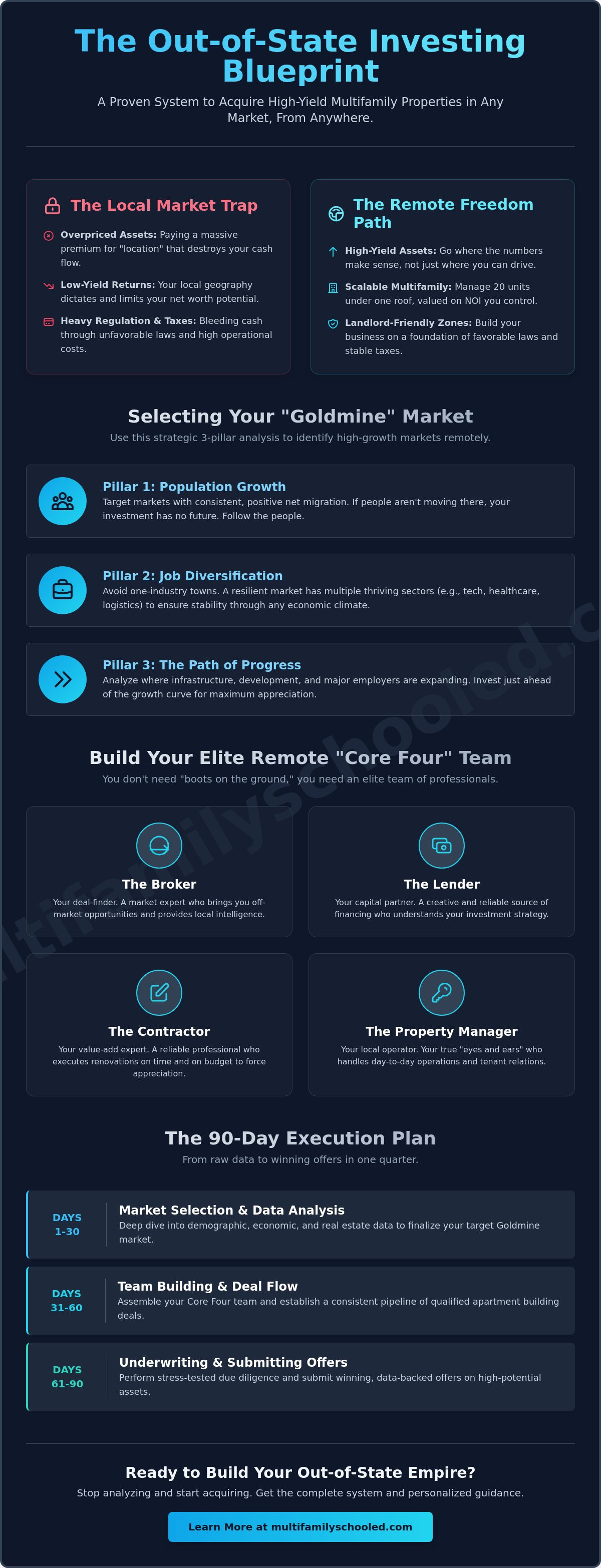
- Escape the local market trap and discover how to invest in real estate out of state to secure high-yield multifamily assets in landlord-friendly zones.
- Identify high-growth "Goldmine" markets using a strategic 3-pillar analysis of population growth, job diversification, and the path of progress.
- Build an elite remote "Core Four" team of brokers, lenders, contractors, and managers to act as your eyes and ears on the ground.
- Master virtual due diligence and stress-tested underwriting frameworks to ensure your investment remains profitable in any economic climate.
- Commit to a proven 90-day execution plan that takes you from raw data analysis to submitting winning offers on apartment buildings.
Why Out-of-State Multifamily Investing is Your Fastest Path to Freedom
Stop letting your geography dictate your net worth. Most investors fail because they buy only where they live. That's a hobby, not a business. Mastering how to invest in real estate out of state means moving your capital to high-yield, landlord-friendly markets where your money actually works. You're building an empire, not just collecting a few rent checks. High entry costs in your local zip code are a barrier you must break through to achieve true economic independence.
If you live in a high-cost coastal city, the entry costs are astronomical. You pay a massive premium for "location" while your cash flow bleeds out through high taxes and heavy regulation. This is the Local Market Trap. It's a prison of low ROI that keeps you chained to a 9-to-5. Break free by becoming market agnostic. Follow the data. Follow the jobs. Follow the yield. Whether the building is ten miles or ten thousand miles away doesn't matter if the spreadsheet says "yes."
To visualize the exact process of scaling your portfolio beyond your own backyard, watch this breakdown:
Why hunt for 20 separate houses? That's 20 roofs, 20 driveways, and 20 different headaches. Multifamily is the ultimate scalability hack. Managing 20 units under one roof is simpler, cheaper, and more efficient. It's the core of a professional real estate investing strategy. You buy the building, you install the system, and you move on to the next deal. This is how you build a legacy at speed.
The Multifamily Advantage for Remote Owners
Multifamily properties over 5 units unlock professional property management. The income pays for the manager, so you don't have to deal with tenants. You get your time back immediately. These buildings are valued on Net Operating Income (NOI), not emotional neighborhood comps. You control the value. If you increase the rent or lower expenses, the building's value jumps. This creates a massive margin of safety that single-family rentals simply cannot match.
Overcoming the 'Boots on the Ground' Anxiety
Forget the "boots on the ground" myth. You don't need to swing a hammer to succeed. You need to lead an elite team. In 2026, technology has erased the distance. High-def video walkthroughs, remote sensors, and cloud-based reporting give you more transparency than a local owner who "stops by" once a month. Learning how to invest in real estate out of state is about mastering systems, not frequent flyer miles. Stop being an operator. Become a business owner. Our Mentorship Program provides the exact blueprints to make this transition seamless.
Selecting Your Goldmine: How to Identify High-Growth Markets Remotely
Stop guessing. Start winning. Finding the right market is the first step in mastering how to invest in real estate out of state. You need a repeatable system to filter through the noise of 3,000+ counties. Focus on the 3-pillar analysis: population growth, job diversification, and the path of progress. If people aren't moving there, walk away. You want markets where diverse industries thrive. This is the only way to ensure your remote portfolio remains profitable year after year. Speed and data are your greatest weapons.
Landlord-friendly laws are your non-negotiable foundation. You cannot build a scalable business in a state that treats you like a criminal. Many investors wonder if Buying Out-Of-State Real Estate is actually worth the effort. It is, provided you target regions with favorable eviction laws and stable property tax environments. Look for the "Tertiary Market" secret. These are smaller cities within 60 miles of major metros. They offer higher yields and lower competition while benefiting from the overflow of the primary hub. It's the ultimate path to finding hidden gems.
Critical Metrics for 2026 Real Estate Markets
Numbers don't lie. Track the median household income against average rent ratios. You want a market where residents can actually afford your rent increases. Watch for major employer relocations and infrastructure projects. If a tech giant or a massive distribution center breaks ground, you buy nearby. Analyze "Days on Market" for multifamily assets. If buildings sell in under 30 days, the demand is high. If they sit for 90, you have leverage. Use these data points to build your shortlist of target zip codes. This precision eliminates guesswork.
Leveraging AI and Data Tools
Speed wins in 2026. You cannot manually search every listing. Use Real Estate Radar to spot off-market opportunities before they hit the MLS. This software allows you to filter 3,000+ counties into your top 3 target zones in minutes. Automate your lead flow. Set up "Market Alerts" that ping your phone the second a deal fits your criteria. Beat local investors to the punch by being faster and more data-driven. This is how you automate your success. Want to see our full market selection framework? Grab our Multifamily Tool Kit to start your search today.
Building Your Elite Remote Team: The Scalable Support System
You cannot do this alone. Your success in multifamily depends entirely on the quality of the people you hire. To master how to invest in real estate out of state, you must assemble the "Core Four": your Broker, Property Manager, Lender, and Contractor. These individuals are your eyes, ears, and hands on the ground. Without an elite team, you are just a tourist with a mortgage. Stop being a spectator and start acting like a CEO. Your job is to lead, not to swing a hammer or answer tenant calls.
Many beginners ask, Is Buying Out-Of-State Real Estate Worth It? The answer is a resounding yes, but only if you build a "Referral Loop." High-level professionals only work with other high-level professionals. Find one top-tier broker and ask for their best property manager. Ask that manager for their most reliable contractor. This loop eliminates guesswork and builds your support system in days, not months. Turn local brokers into your personal deal-scouts by proving you are ready to close. Speed and reliability are the only currencies that matter in this game.
Vetting Your Property Management Partner
Your Property Manager is your most critical hire because they protect your Net Operating Income (NOI). Don't settle for a generalist who mostly handles single-family rentals. You need a specialist who understands the complexity of 5+ unit buildings. Ask them about their current occupancy rates and their specific experience with multifamily assets. In May 2026, management fees for larger properties typically range from 4% to 7% of collected rent. Watch out for maintenance markups, which often hover around 10%. You want a partner who views your building as a high-performance business, not just a list of repairs.
Lenders and Legal: Securing the Deal
Local portfolio lenders are your secret weapon. They understand the specific market dynamics better than national banks and keep loans on their own books. This gives you the flexibility you need to scale. You also need a local real estate attorney to handle state-specific contracts. For example, the FinCEN rule that took effect on March 1, 2026, now requires reporting for all-cash purchases made through LLCs. Your attorney ensures you stay compliant with these federal transparency laws. Present yourself as a serious investor from the first phone call. Have your proof of funds ready and speak the language of cap rates. If you need help refining your pitch to local pros, our Mentorship Program provides the exact scripts you need to win.
Mastering Remote Due Diligence and Underwriting
Stop wasting your money on plane tickets. You don't need to physically walk through a building to own it. In 2026, learning how to invest in real estate out of state is about mastering the data, not the travel. If you're still flying across the country to "kick the tires," you're an amateur. Professionals use systems to verify reality from their couch. Use high-definition video walkthroughs and specialized third-party inspectors to be your eyes. This isn't just about seeing the property; it's about verifying the numbers that drive your wealth.
Desktop due diligence starts with the Rent Roll and the T-12 statement. These documents tell the story of the building's past year. Don't take the seller's word for it. Cross-reference their claims with bank statements and utility bills. Use the "Secret Shopper" technique to verify local market rents. Call three competing buildings in the same zip code. Pretend to be a prospective tenant. Ask about their current vacancies and move-in specials. This real-world data beats any generic market report. It gives you the leverage to spot "Value-Add" opportunities that locals often overlook because they're too close to the project.
The Multifamily Underwriting Framework
Your underwriting must be bulletproof. As of May 30, 2026, the national average 30-year fixed mortgage rate for investment properties is approximately 6.63%. Stress-test your deal by assuming a 1% to 2% increase in vacancy. If the numbers still work, you have a deal. Calculate your Cap Rate and Cash-on-Cash returns using current 10-year Treasury Note data, which dropped to 4.44% in late May. Net Operating Income (NOI) is the heartbeat of your investment, representing the total income generated after all operating expenses are paid but before debt service and taxes. Master this one metric to control your financial destiny.
The Third-Party Inspection Protocol
Hire specialized commercial inspectors, not residential generalists. You need a pro who understands flat roofs, boilers, and fire suppression systems. Use your "Boots on the Ground" team to verify the neighborhood vibe. Have your property manager visit at 10:00 PM on a Tuesday. Is the parking lot full? Is it quiet? This qualitative data is just as important as the physical structure. Use the inspection report to negotiate credits or price drops. If the inspector finds $50,000 in deferred maintenance, that's $50,000 off the purchase price. This is how you win. Ready to master the math behind the deals? Download our Multifamily Tool Kit and start underwriting like a pro today.
The 90-Day Execution Plan: From Analysis to Acquisition
Stop waiting for the "perfect" moment. It doesn't exist. In the competitive 2026 market, speed is your greatest asset. Your ability to execute defines your success. This is the exact blueprint for how to invest in real estate out of state in just one quarter. You have 90 days to change your financial trajectory. Don't waste them.
- Days 1-30: Focus on market selection and core team recruitment. Use the 3-pillar analysis to lock in your target zip codes. Recruit your "Core Four" and verify their track records immediately.
- Days 31-60: Transition to high-volume deal analysis. This is a numbers game. Analyze at least 10 deals a week and submit offers on anything that hits your yield targets. Do not get emotionally attached to the brick and mortar.
- Days 61-90: Trigger your remote due diligence protocol once an offer is accepted. Finalize your financing with your local portfolio lender and close the deal.
Scaling with Mentorship and Systems
Going it alone is the most expensive mistake you can make. You'll pay a "Beginner Tax" in the form of missed repairs, bad managers, or overpaying for assets. A mentor allows you to skip the line. You get the proprietary software and the accountability to move faster than the competition. Accelerate your journey and avoid costly out-of-state errors by joining the Multifamily Schooled Mentorship. Stop guessing and start following a proven path to your first deal.
The Finish Line: Closing and Beyond
Closing the deal is just the beginning of your journey as a business owner. Hand the keys to your property management partner immediately and step into your role as the strategist. Set up your "Owner Dashboard" to track your performance metrics every month. Stay in the loop without being in the weeds. Once your systems are running smoothly, don't stop. Rinse and repeat. Most successful investors are ready to buy their second building just 6 months after the first. This is how you build true, multi-generational wealth at speed.
Launch Your Multifamily Empire from Anywhere
You now have the complete blueprint. You understand that the local market trap is a choice, not a life sentence. By focusing on high-growth goldmines and building a scalable "Core Four" team, you've already bypassed 90% of your competition. Mastering how to invest in real estate out of state is the definitive path to asset accumulation in 2026. You don't need to be a local expert. You need to be a system builder. Your geography no longer limits your financial potential.
Stop letting analysis paralysis steal your future. It's time to trade guesswork for a proven framework. Get exclusive access to our proprietary AI deal-finding software and learn directly from multi-generational real estate experts who have closed thousands of units. We are so confident in our system that we guarantee you'll find a deal within 90 days or we will provide one for you. Your freedom is waiting on the other side of this decision.
Secure Your First Apartment Deal in 90 Days; Join Our Mentorship Today!
The opportunity is here. The tools are ready. The only thing missing is your decision to start. Take the leap and build your legacy today. You are closer than you think.
Frequently Asked Questions
Is it safe to invest in real estate in a state I've never visited?
Yes, it is safe if you follow a standardized system for virtual due diligence. High-definition video walkthroughs and specialized third-party commercial inspectors replace the need for your physical presence. You are building a business, not buying a personal home. Trust the data and your elite remote team to protect your capital while you focus on the numbers.
How much money do I need to start investing in out-of-state multifamily properties?
You typically need a minimum down payment of 15% to 20% for investment property loans, though many lenders require 25% for 2 to 4 unit properties. Factor in closing costs, which generally range from 2% to 5% of the loan amount. Understanding how to invest in real estate out of state requires accurate budgeting for these entry costs before you submit your first offer.
What are the best states for real estate investing in 2026?
Target states with high population growth, job diversification, and landlord-friendly laws. As of 2026, approximately 36 states have laws restricting foreign ownership, so focus on domestic growth hubs in the Southeast and Midwest. Look for regions where the "One Big Beautiful Bill Act" tax incentives provide the highest impact on your bottom line. Focus on markets where multifamily management fees stay in the 4% to 7% range.
How do I find a reliable property manager from 1,000 miles away?
Use the "Referral Loop" by asking your local broker for their top management recommendation. Vet them with specific questions about their current occupancy rates and multifamily experience. You need a specialist who understands the complexity of 5+ unit buildings rather than a generalist who focuses on single-family rentals. A great manager is the most important member of your remote team.
What is the biggest risk of out-of-state investing and how do I avoid it?
The biggest risk is a breakdown in your local support system, specifically poor property management. Avoid this by shifting from an "owner-operator" to a "business-owner" mindset. Implement standardized systems and regular reporting intervals to maintain oversight from a distance. Your success depends on the quality of your team and the consistency of your data-driven frameworks.
Can I use a local bank for a loan on an out-of-state property?
You should prioritize local portfolio lenders in the state where the property is located. These banks understand the specific market dynamics and are often more flexible than national institutions. They keep loans on their own books, which makes it easier to scale your portfolio as you grow. Present yourself as a serious investor with a clear business plan to win their trust.
How do I handle taxes when I own property in multiple states?
You must account for state-specific laws and the new OBBBA tax changes effective in 2026. This includes permanent 100% bonus depreciation for qualifying properties and an increased SALT deduction cap of $40,000. Hire a CPA who specializes in multi-state real estate to ensure you maximize your deductions and stay compliant with various state tax codes and reporting requirements.
What is the difference between active out-of-state investing and syndication?
Active out-of-state investing gives you total control over the asset, the team, and the returns. You own the building and make the final strategic decisions. Syndication is a passive role where you provide capital to a deal sponsor who manages everything. If you want to build a scalable empire and maximize your long-term independence, active investing is the superior path for economic empowerment.