

How to Find Private Money Lenders for Real Estate: The 2026 Power Guide
Your bank account balance is the least important factor in closing your next multifamily deal. Stop waiting for your savings to grow while the market moves without you. Most investors stay small because they don't know how to find private money lenders for real estate or they fear sounding unprofessional to high-net-worth individuals. You want to scale, but the confusion between hard money and private capital keeps you stuck. It's a common roadblock, but it's one you can dismantle today.
This guide is your blueprint to master the exact system for locating, pitching, and securing private capital. You'll gain the confidence to speak the language of wealth and the tools to present deals that demand a "yes." We'll break down the 2026 landscape, including how to handle the latest FinCEN reporting rules that took effect this March. You're going to get a predictable framework for finding lenders, a professional pitch deck template, and the strategic edge needed to close deals without using a dime of your own cash. Let's build your empire.
Key Takeaways
- Stop letting tightening bank regulations stall your growth by leveraging the speed and flexibility of individual capital.
- Use the "3 Circles" system to learn exactly how to find private money lenders for real estate by tapping into your current network and high-value referrals.
- Build a "Yes-Proof" pitch deck focusing on the four essential pillars of Deal, Market, Team, and Exit to win over high-net-worth partners.
- Stay compliant with the latest 2026 legal standards by mastering the structural differences between 506(b) and 506(c) private placements.
- Transition from chasing individual deals to building a scalable funding machine using a 90-day deal-finding sprint and systematic investor database.
Why Private Money is Your Secret Weapon for Scaling in 2026
Private money is your ticket to the big leagues. It isn't a faceless institution or a high-interest hard money shop. It's capital from individual investors, wealthy professionals, or retirees looking for better returns than a savings account. In the current market, these individuals are your most powerful allies. They provide the flexibility that traditional banks simply cannot match. While banks are drowning in red tape and tightening their lending criteria, private lenders move with speed and precision. They care about the deal and your track record, not just a credit score or a 50-page tax return.
Mastering how to find private money lenders for real estate gives you a massive competitive edge. Institutional buyers are slow. They have committees and layers of bureaucracy. With private capital, you can close in days. This speed allows you to beat out all-cash offers from massive corporations because you bring the certainty of a relationship to the table. You aren't just buying a property; you're building "Relationship Alpha." This is a network of trust that funds your first deal, your tenth deal, and every multifamily asset in between. It's the ultimate shortcut to long-term wealth.
To better understand this concept, watch this helpful video:
Private Money vs. Hard Money: The Critical Distinction
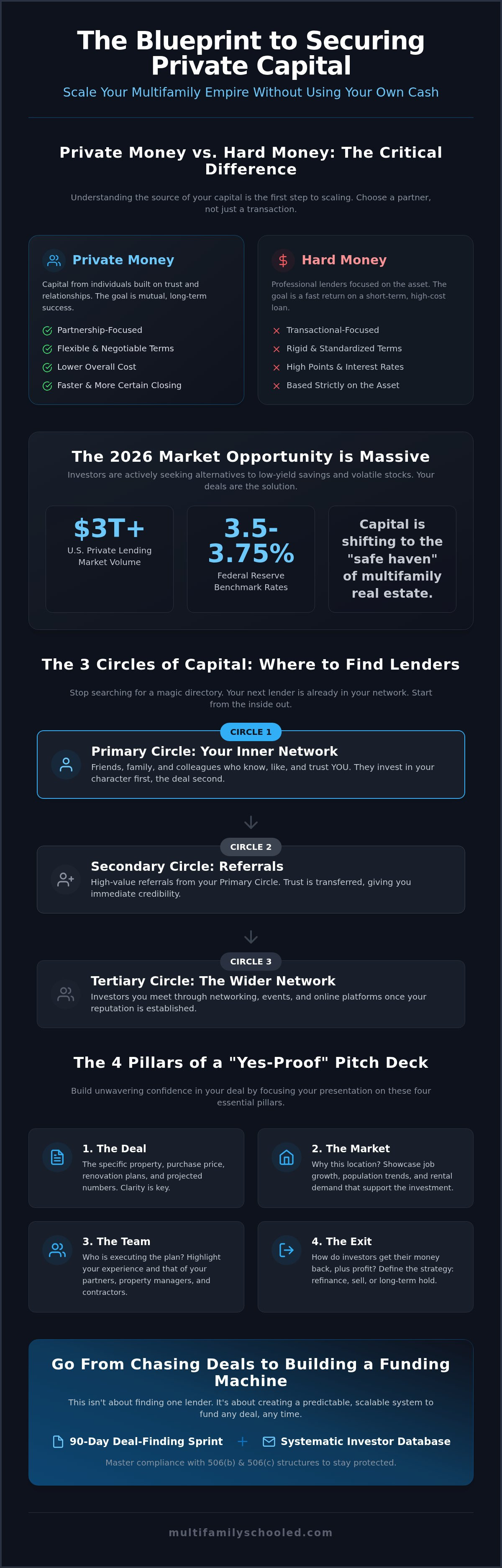
Don't confuse these two. Hard money lenders are professionals who lend based strictly on the asset. They charge high points and even higher interest. Private money is different. It's built on a foundation of Private Money Investing where the lender is often a peer or a mentor. Private money is usually cheaper over the long run because the terms are negotiable. Hard money lenders want their capital back with a fee. Private lenders want to see you succeed so they can keep their money working in your next deal. It's a partnership, not just a transaction.
The 2026 Economic Landscape for Real Estate Capital
The 2026 market is ripe with opportunity. With the Federal Reserve holding benchmark rates between 3.50% and 3.75% as of June, investors are hungry for higher yields. Traditional savings aren't cutting it. This has pushed the U.S. private lending market to an outstanding volume of over $3 trillion. There is massive "dry powder" sitting in individual retirement accounts and personal portfolios. People are fleeing the volatility of the stock market and looking for the "safe haven" of multifamily real estate. Even with the new FinCEN reporting rules that took effect on March 1, 2026, the demand for privately financed deals is skyrocketing. If you want to tap into this, the Mentorship Program is your fastest path to establishing the credibility these lenders require. Stop guessing and start using a proven system to capture this capital.
The 3 Circles of Capital: Where to Locate High-Net-Worth Lenders
Your network is your net worth. It's a cliché because it's true. When you are learning how to find private money lenders for real estate, you must stop looking for a magic directory. Instead, start looking at your existing connections. Capital raising is a game of proximity. The closer you are to the source of trust, the faster you close the deal. We categorize these sources into three distinct circles of capital. Master the first, and the others will follow as your reputation grows.
The Primary Circle consists of people who already know, like, and trust your character. These are friends, family members, and former colleagues. They aren't investing in the deal as much as they are investing in you. You don't need a decade of experience to tap into this circle. You need integrity. Before you pitch, review this Guide To Private Lending to understand the mindset of an individual investor. This knowledge ensures you don't sound like an amateur when talking to your uncle or your old boss.
The Secondary Circle is where your growth accelerates. These are referrals. When a Primary Circle investor sees your professional approach, they naturally mention it to their peers. This bridge of trust is the most efficient way to scale. Finally, you reach the Tertiary Circle. These are strangers. This is the "Big League" where you find high-net-worth individuals through strategic networking and digital presence. Moving from the first circle to the third is a systematic journey of building authority. If you want to jumpstart this journey, our Online Challenge provides the exact roadmap to build your investor-ready persona.
Networking Strategies for the Tertiary Circle
Success in the Tertiary Circle requires a purpose-driven approach. Don't just "attend" local REIA meetings. Show up as the person with the deal flow. Use LinkedIn to share "Authority Content" that highlights your market knowledge. This attracts passive investors who are tired of low-yield stocks. To identify these power players, use Real Estate Radar. This software allows you to identify potential partners by seeing who is already active in specific multifamily markets. Data-driven outreach beats cold calling every single time.
Digital Communities and 2026 Crowdfunding Trends
The 2026 landscape has shifted toward specialized digital forums. High-net-worth individuals now frequent private digital communities to find silent partners. However, you must vet these potential lenders carefully. Scams are prevalent in unregulated spaces. Always use professional member directories like the American Association of Private Lenders (AAPL) for verification only. Never assume a digital profile is legitimate without seeing proof of funds. In this high-speed market, how to find private money lenders for real estate involves as much defense as it does offense. Protect your reputation by only partnering with verified, sophisticated investors.
Crafting the 'Yes-Proof' Pitch: How to Present Your Real Estate Deal
Stop asking for money. Start offering an opportunity. Amateur investors often fail because they approach lenders with a "please help me" attitude. The pros use the 'Deal First' mentality. You must secure a high-quality asset before you even think about a pitch. When you lead with a tangible deal, you transform from a solicitor into a deal provider. This shift is the secret to how to find private money lenders for real estate who actually want to fund your projects. They aren't looking for a person to help; they're looking for a place to grow their wealth safely.
Your presentation must rest on four unshakable pillars: the Deal, the Market, the Team, and the Exit. If one is weak, the whole pitch collapses. You need to quantify the "why" using clear, professional metrics. Explain the Return on Investment (ROI) without the fluff. Show a conservative Loan to Value (LTV) and a robust Debt Service Coverage Ratio (DSCR) to prove the property can handle its debt. We call this the 'Justin Brennan Method.' It focuses on the multi-generational security of multifamily assets. You aren't just selling a building. You're selling a legacy of stable cash flow that survives market cycles.
The Anatomy of a High-Impact Pitch Deck
Your pitch deck is your first impression. It needs to be visual, professional, and data-heavy. In 2026, lenders expect high-definition photography and clear floor plans. Every slide must serve a purpose. Start with an executive summary and end with a specific "Ask" that outlines exactly how much capital is needed and what the lender gets in return. You need a 'Unique Deal Point' that grabs attention instantly. For example: "This asset is 20% under-market in a submarket with 12% annual job growth." Be specific. Be bold. Move with the confidence of someone who has already won.
Handling Objections Like a Pro
Expect resistance. It's a sign of a sophisticated investor. When they ask, "What if the market crashes?" you answer with data-backed resilience. Show them that even with 2026's average 30-year fixed-rate mortgage at 6.55%, your multifamily deal remains profitable due to high rental demand. If you're worried about your own track record, use the 'No-Experience' pivot. See how our Mentorship Program gives you instant credibility. You aren't doing this alone. You're bringing the weight of an expert team and a proven system to the table. That's how you turn a "maybe" into a "yes."
Legal and Structural Essentials for Private Money Partnerships
Speed is nothing without safety. You've learned the systems for how to find private money lenders for real estate, but your empire will crumble if your legal foundation is weak. Do not hire a general "real estate lawyer" to structure your capital partnerships. You need an SEC attorney. This is a specialized field where the wrong paperwork can lead to heavy fines or worse. Your legal team is responsible for drafting the documents that protect your reputation and your lender's capital. This isn't just about compliance; it's about projecting the professional authority that high-net-worth individuals demand.
The core of your strategy involves Regulation D exemptions. Most investors use 506(b) or 506(c) offerings. If you use 506(b), you can raise unlimited capital from people with whom you have a "pre-existing substantive relationship." You cannot advertise. If you want to blast your deal on social media, you must use 506(c), which allows for general solicitation but requires you to verify that every investor is accredited. This distinction is critical. Mastering these rules allows you to move with confidence while others are paralyzed by the fear of regulatory scrutiny in the 2026 market.
Structuring the payout is where you win the lender's heart. Most private money partnerships use a combination of preferred returns and equity splits. A common structure is an 8% preferred return followed by a 70/30 equity split in favor of the investors. Alternatively, for shorter-term projects, you might offer a straight interest-only promissory note. Whatever you choose, ensure it is clearly defined in your Operating Agreement. This document is the ultimate rulebook for the partnership, detailing exactly how decisions are made and how the "exit" will be executed. To get the exact templates and frameworks used by the pros, download our Multifamily Tool Kit today.
Compliance and SEC Regulations in 2026
The definition of an "Accredited Investor" is your primary filter. Generally, this means an individual with a net worth over $1 million (excluding their primary residence) or an annual income exceeding $200,000. You must also avoid "Broker-Dealer" traps. Never pay a "finder's fee" to anyone who isn't a licensed broker. It's illegal and can void your entire offering. Instead, rely on your Private Placement Memorandum (PPM). This massive disclosure document is your liability shield, detailing every possible risk to the lender so they can make an informed, sophisticated decision.
Choosing the Right Legal Structure
Your deal size dictates your structure. For your first small apartment building, a Joint Venture (JV) is often the simplest path. It allows for active participation from all partners and avoids some of the complexities of a formal syndication. As you scale, however, multifamily syndication becomes the ultimate vehicle. It allows you to pool capital from dozens of private lenders into a single, powerful entity. Whether you use Promissory Notes for debt or Equity Partnerships for ownership, choose the structure that aligns with your 90-day closing goal. Move fast, but move legally.
Stop Searching, Start Closing: Building Your Private Money Machine
Stop chasing. Start attracting. You've mastered the pitch and cleared the legal hurdles. Now, you must build a system that works while you sleep. The most successful investors don't treat capital raising as a one-time event. They build a machine. Learning how to find private money lenders for real estate is only the first step; creating a predictable funnel for long-term funding is how you achieve true economic independence. It's time to move from a transactional mindset to a transformational one.
The "90-Day Sprint" is your new reality. This framework aligns your deal-finding efforts with your capital-raising activities. You shouldn't wait for a deal to start talking to investors. Instead, use an "Investor Database" or CRM strategy to manage your relationships. This allows you to build a "Soft Circle" of interest. A soft circle consists of lenders who have already committed to a specific dollar amount before you even sign a contract. When you have $2 million in soft commitments, you can hunt for deals with the confidence of an institutional buyer. You aren't just looking for properties; you're fulfilling a promise to your partners.
Automating Your Deal Flow to Attract Capital
Consistency is the ultimate magnet for wealth. When you use the Multifamily Tool Kit, you analyze deals faster than your competition. This speed is vital. High-net-worth individuals want to back winners who have a constant stream of opportunities. Consistent deal-flow creates a "Fear of Missing Out" (FOMO) among your lenders. They see you closing. They see your "Success Cycle" in action. You close one deal, document the win, and use that momentum to fund the next ten. This isn't guesswork. It's a proprietary methodology designed for rapid scaling.
Your Next Steps to Financial Freedom
The market won't wait for you. The 2026 real estate landscape is moving fast, and those who hesitate will be left behind. You have the blueprint. Now, you need the execution. Mentorship is the absolute fastest way to bypass years of "trial and error" in capital raising. Don't spend a decade trying to figure out what we can teach you in a week. Take the 5 Day Multifamily Challenge to master the A-Z of apartment investing and start your journey toward asset accumulation. Join a movement of successful investors who don't wait for banks to give them permission. Your future is waiting. Secure it now.
Build Your Empire With Private Capital Today
The gap between where you are and where you want to be is filled with private capital. You've learned that success isn't about your own bank balance. It's about your ability to build a "Yes-Proof" pitch and navigate the 2026 legal landscape with precision. By mastering how to find private money lenders for real estate, you've unlocked the ability to scale without limits. You now have the blueprint to move from the primary circle of trust to a global network of high-net-worth partners. Stop letting bank regulations dictate your growth.
The 90 day clock is ticking. You can spend years trying to figure this out alone, or you can leverage a proven system. Get direct coaching from Justin Brennan and gain immediate access to our proprietary Real Estate Radar software to find deals faster than the competition. We don't just teach theory; we provide the tools for a guaranteed path to success. Secure Your First Deal in 90 Days. Apply for Our Mentorship Program Now. Your seat at the table is ready. Claim it and start building your multifamily empire today.
Frequently Asked Questions
Is it legal to find private money lenders for real estate online?
Yes, finding lenders online is legal as long as you comply with SEC Regulation D. If you plan to advertise your deal on social media or digital forums, you must use a 506(c) offering and only accept accredited investors. For those learning how to find private money lenders for real estate through digital communities, remember that the new FinCEN reporting rule effective March 1, 2026, requires specific reporting for privately financed transfers involving LLCs. Always verify your lender's identity to stay compliant with these updated anti-money laundering regulations.
What is the typical interest rate for a private money lender in 2026?
Interest rates for private money typically range between 8% and 12% depending on the relationship and the deal's risk profile. In the second quarter of 2026, the average interest rate for private money loans in Maryland was 9.96%, down from 11.19% in the first quarter. While conventional 30-year fixed rates are hovering around 6.55%, private capital remains a premium service because of its speed and flexibility. You're paying for the ability to close deals that banks won't touch.
Do I need a license to raise private money for real estate deals?
You do not need a license to borrow private money for your own real estate projects. However, you cannot act as a middleman who connects lenders to other investors for a fee without a broker-dealer license. As long as you are the principal in the deal, you are simply seeking a partner or a lender. Focus on mastering the legal structure of your partnership rather than worrying about licensing, as the SEC exemptions cover most individual capital raising efforts.
How do I find private lenders if I have no track record or experience?
Start with your "primary circle" of friends and family who already trust your character. If your personal network is limited, the most effective way to gain instant credibility is to leverage the track record of a mentor or a high-energy coaching program. Lenders want to see a professional system, not just a person. By presenting a deal backed by a proven methodology and professional software, you shift the focus from your lack of experience to the strength of the asset and the team supporting you.
What is the difference between a private money lender and a hard money lender?
The primary difference is the source of the capital and the criteria for the loan. Hard money lenders are professional companies that lend based strictly on the asset's value and often charge 1 to 4 origination points. Private money lenders are individuals, such as doctors or retirees, who lend based on a personal relationship and trust. Private money is generally more flexible and can be significantly cheaper over the long term because you are negotiating terms directly with the source of the cash.
How much equity should I give a private money lender in a multifamily deal?
Equity splits vary, but a standard structure often involves a 70/30 or 80/20 split in favor of the investors after they receive a preferred return. This preferred return is typically around 8%. In this "waterfall" structure, the investors get paid their fixed return first, and then the remaining cash flow is split. This aligns your interests with the lender's success. It ensures they are taken care of before you take your share of the profits as the deal sponsor.
Can I use private money for the down payment on an apartment building?
Yes, using private money for a down payment is a fundamental strategy for scaling quickly. This allows you to secure a conventional or bridge loan for 75% to 80% of the purchase price while using private capital to cover the remaining 20% to 25%. This "gap funding" is how to find private money lenders for real estate that allow you to close large multifamily assets with zero of your own cash out of pocket. It's the ultimate tool for economic empowerment.
What documents do I need to show a private money lender?
You must provide a professional pitch deck, a Private Placement Memorandum (PPM), and an Operating Agreement. Your pitch deck should clearly outline the four pillars: the Deal, the Market, the Team, and the Exit strategy. Sophisticated lenders in 2026 also expect to see a detailed Debt Service Coverage Ratio (DSCR) analysis to ensure the property can handle the debt. Providing these documents upfront proves that you are a strategic investor who prioritizes the safety of their capital.



