

How to Find Multifamily Deals: The 2026 Blueprint for Apartment Investors
Stop acting like a scavenger. Real apartment investing isn't a treasure hunt; it's a high-speed manufacturing process. You're likely exhausted by overpriced on-market inventory and the soul-crushing competition for mediocre deals. It's frustrating to watch others scale their portfolios while you're stuck in analysis paralysis caused by bad data and gatekeeping brokers. You deserve a system that works as hard as you do.
I know exactly how that feels. You want a repeatable pipeline that delivers off-market owners directly to your desk. This guide is your 2026 blueprint for economic empowerment. You'll master the exact systems used by professional investors to learn how to find multifamily deals that your competition doesn't even know exist. We're moving past the "hope and pray" method and into a world of predictable asset accumulation.
We will break down how to build an automated sourcing engine from scratch. You'll learn to leverage the 2026 HUD mortgage limits and the permanent 100% bonus depreciation to maximize your returns. We'll show you how to analyze any apartment complex in minutes, not hours. Get ready to turn your investment goals into a systematic reality. This is your time to dominate the market.
Key Takeaways
- Stop wasting time on public portals and learn why information asymmetry is your greatest competitive advantage in the 2026 market.
- Discover exactly how to find multifamily deals by mastering the two core pillars of professional sourcing: elite broker relationships and aggressive direct-to-owner outreach.
- Compare the real costs of acquisition to see why off-market negotiations beat bidding wars every single time.
- Follow a proven 90-day roadmap that takes you from market selection to a high-volume outreach blitz of 50+ owners per week.
- Leverage proprietary deal-finding systems and professional mentorship to eliminate analysis paralysis and guarantee your results.
Beyond LoopNet: Why Traditional Deal Sourcing is Failing in 2026
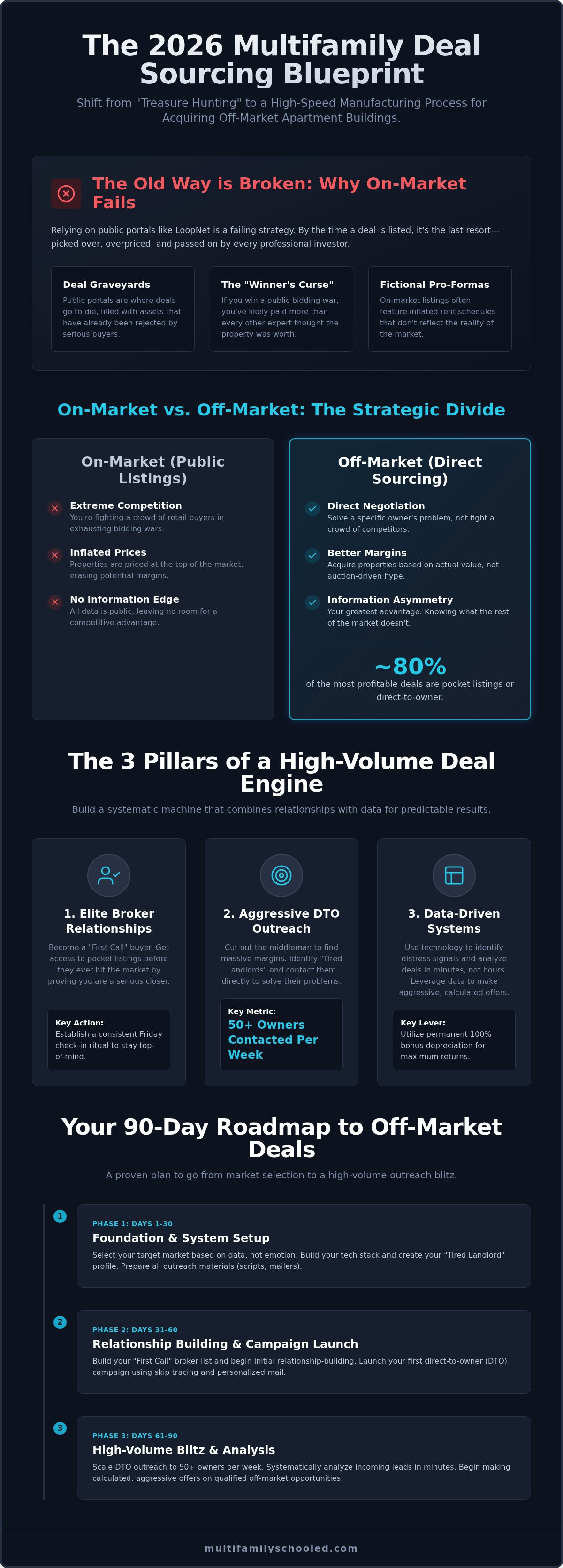
LoopNet is where deals go to die. If you're still refreshing public portals hoping to strike gold, you're fighting for scraps in a deal graveyard. These platforms are designed for retail buyers, not for serious investors looking for high-margin assets. By the time an apartment building hits a public website, every professional in the market has already passed on it. It's picked over, overpriced, and likely carries a "pro-forma" rent schedule that's pure fiction. Stop acting like a scavenger and start acting like an owner.
The Problem with On-Market Listings
Brokers use public portals as a last resort. They only list a property on LoopNet when their private list of "First Call" buyers says no. This creates the "Winner’s Curse." If you win a bidding war on a public portal, you probably paid more than every other expert thought the building was worth. With the national vacancy rate projected to hit 8.8% by the end of 2026, you can't afford to overpay based on inflated broker numbers. Use these portals for data points and market research, but don't expect them to provide your next acquisition. They're tools for observation, not for execution.
Understanding the Off-Market Advantage
Before you dive into the mechanics of Multifamily residential housing acquisitions, you must realize that the best opportunities never reach the public eye. Information asymmetry is your secret weapon. This is the gap between what the owner knows and what the market sees. About 80% of the most profitable deals are "pocket listings" or direct-to-owner negotiations. You're looking for the tired landlord who hasn't raised rents in five years or the owner who is intimidated by the new regulatory requirements of the 21st Century ROAD to Housing Act. When you negotiate directly, you aren't fighting a crowd. You're solving a specific person's problem.
If you want to know how to find multifamily deals that actually cash flow, you have to stop hunting and start manufacturing. In 2026, data-first investors are crushing relationship-only investors. They use sophisticated systems like Real Estate Radar to identify distress signals before a broker is even called. They leverage the permanent 100% bonus depreciation from the OBBBA to make aggressive, yet calculated, offers. Mastering how to find multifamily deals requires a systematic approach that treats sourcing like an assembly line. You need a pipeline that delivers consistent leads so you can analyze deals in minutes and move with total confidence. The days of the "lucky find" are over. It's time to build your engine.
The 3 Pillars of a High-Volume Multifamily Deal Engine
A high-volume deal engine isn't a luxury. It's your lifeline. If you want to master how to find multifamily deals, you can't rely on luck. You need a systematic approach that fires on all cylinders. In the 2026 market, where the national average asking rent sits at $1,769, the competition for yield is fierce. You must build a machine that combines human relationships with cold, hard data. This is how you move from being a spectator to a powerhouse investor.
Mastering Broker Relationships
Brokers are the lifeblood of commercial real estate. To get on the "First Call" list, you must prove you are a real buyer. Don't just ask for deals; provide clarity. Use specific tips to help you navigate the broker landscape, such as defining your exact strike zone and showing proof of funds early. Establish a Friday afternoon check-in ritual. Consistency earns respect. When a broker knows you are a closer, you get the pocket listings before they ever hit the public market. It's about being the first name they think of when a seller wants a quiet exit.
Direct-to-Owner (DTO) Strategies
Cutting out the middleman is where the massive margins live. You need to identify the "Tired Landlord" profile. These are owners with properties showing visible deferred maintenance or those struggling with the 2.3% increase in FHA mortgage limits. Use skip tracing technology to find the actual decision-maker's mobile number. In 2026, cold calling combined with highly personalized direct mail yields the highest ROI. It's about pure volume. You should be contacting at least 50 owners per week to see real results. This direct line allows you to solve the owner's problem without a bidding war.
The final pillar is digital sourcing. You must use AI to predict seller intent. Proprietary tools like Real Estate Radar allow you to see distress signals before they become public knowledge. This data-first approach gives you the "unfair advantage" needed to hit your 90-day deal goal. When you combine broker trust, owner outreach, and predictive data, you create an unstoppable force. This synergy is the key to mastering how to find multifamily deals in any economic climate. If you're ready to stop guessing and start closing, consider joining a professional mentorship program to accelerate your journey to economic independence.
On-Market vs. Off-Market: A Strategic Comparison for 2026
Deciding your acquisition strategy is a high-stakes choice between speed and margin. You must decide if you're going to pay with your capital or your sweat equity. In 2026, with 10-year Agency loan rates hovering around 5.85%, your entry price dictates your survival. On-market deals offer convenience but come with a "transparency tax" where every competitor sees the same numbers. Off-market deals require more legwork but offer the only path to double-digit cap rates in a stabilizing market. Understanding these trade-offs is essential for mastering how to find multifamily deals that actually build multi-generational wealth.
Analyze your current constraints before you dive in. If you have more money than time, on-market is your lane. If you're building from scratch and need to maximize every dollar, off-market is your only option. With national vacancy rates projected to hit 8.8% by the end of 2026, you cannot afford to overpay. Your acquisition cost isn't just the purchase price. It's the broker fees, the marketing spend, and the time you spend in the trenches. Choose the path that leads to a closed deal, not just a full spreadsheet.
When to Buy On-Market
On-market isn't always a mistake. It's the right move when you're facing a 1031 exchange deadline or when you spot a "Mismanaged Listing." Look for properties on Zillow or Crexi with terrible photos, incomplete financials, or "all-caps" descriptions that scare away institutional buyers. These are your opportunities. Use on-market data to verify your pricing. If you know the average price per unit in Atlanta is $174,500, you can spot a mispriced asset in seconds. Speed is the advantage here. You pay a broker fee, but you close fast and move on to the next unit.
The Mechanics of an Off-Market Close
Off-market closes are a different beast entirely. You are the face of the deal. You must build direct trust with owners who are often wary of "we buy houses" types. Structure a "Win-Win" by offering flexible closing dates or taking the property "as-is" to solve their deferred maintenance headaches. Many owners are intimidated by the new regulatory requirements of the 21st Century ROAD to Housing Act. Show them how you are the solution to their problem. Identifying these targets is a science, not a guess. High-performance tools like Real Estate Radar are critical here. They help you pinpoint owners likely to sell before they even realize it themselves. This is the ultimate way to learn how to find multifamily deals with zero competition and maximum upside. Your time is your most valuable asset. Spend it where the profit is highest.
Your 90-Day Roadmap to Securing an Apartment Building
Most "gurus" tell you it takes a year or more to close your first complex. They're wrong. If you follow a proven, systematic process, you can go from zero to a signed contract in exactly 90 days. This isn't a suggestion; it's a directive. Success in 2026 requires speed, precision, and an aggressive mindset. You need to understand how to find multifamily deals by outworking and out-thinking the competition. Stop waiting for the "perfect time" and start manufacturing your own opportunities through high-volume action.
Phase 1: Building the Foundation
Spend your first 30 days aggregating data and selecting your "Goldilocks Zone." This is a market that isn't too hot to enter but isn't suffering from the projected 8.8% national vacancy rate. Look for Gateway markets or low-cost Midwest hubs where rent gains are concentrating. Set up your CRM immediately. You cannot manage a high-volume pipeline with sticky notes. Define your "Ideal Deal Criteria" in one sentence to avoid distraction. For example: "I am targeting 20 to 60 unit B-class assets in submarkets with positive job growth and a 15% value-add upside."
Phase 2: Execution and Underwriting
Days 31 through 60 are for the "Outreach Blitz." You must contact 50 owners every single week. This is where most investors fail because they get tired of hearing "no." You need to embrace the "Rule of 100": analyze 100 deals to offer on 10 and close on 1. To do this at scale, you can't waste hours on a single spreadsheet. Use the Multifamily Tool Kit for rapid analysis that takes minutes, not hours. This proprietary system allows you to filter out the noise and focus only on high-margin opportunities that meet your strike zone.
The home stretch, from Day 61 to 90, is for the kill. Send out Letters of Intent (LOIs) aggressively. Every rejection is just a "not yet" that goes into your follow-up sequence. Most deals are closed on the fifth to seventh touchpoint. This is the secret to how to find multifamily deals while others are still stuck in analysis paralysis. Maintain a relentless "Multifamily Mindset" and stay the course. If you want a guaranteed path to success and a deal in your hands within 90 days, join our Mentorship Program today and let us provide the blueprint for your economic independence.
Scaling Your Deal Flow with Multifamily Schooled Systems
You have the blueprint. Now you need the engine. Knowledge without execution is just a hobby; in the 2026 market, hobbies are expensive. The gap between the elite investor and the dreamer is the system they use to stay consistent. Mastering how to find multifamily deals is about moving from manual labor to automated mastery. You need an unfair advantage to win when bank rates are sitting at 6.25% and competition is fierce. It's time to stop hunting and start presiding over a deal-finding empire.
The Power of the 90-Day Guarantee
Fear kills more deals than bad math ever will. Our Multifamily Schooled Mentorship removes that fear by providing a 90-day deal guarantee. You aren't just buying a course; you're gaining an expert partner to review your underwriting before you put your capital at risk. This safety net prevents the "Winner's Curse" and ensures your first acquisition is a home run. You gain immediate access to our "Inner Circle" of deal flow and professional credibility. This is how you close a 50-unit building with the confidence of a seasoned pro. We provide the tools, the data, and the accountability to ensure you don't fail.
Automating Your Pipeline with Technology
You can't scale if you're stuck skip tracing phone numbers manually every Saturday morning. In 2026, data is the new gold, and speed is the new currency. Use AI-driven tools like Real Estate Radar to filter for high-intent sellers automatically. This software identifies distress signals, such as owners struggling with the 2026 FHA mortgage limit increases, before they ever call a broker. You can manage a massive portfolio of leads without hiring a single staff member. This is the ultimate evolution of how to find multifamily deals. Technology does the boring work so you can focus on closing.
Stop being a student and start being an owner. Your journey to economic empowerment depends on the systems you implement today. You have the 2026 market data. You have the roadmap. Now you need the professional framework to cross the finish line. Don't let another 90 days pass you by while you're still sitting on the sidelines. Join our next Online Challenge or apply for the Mentorship Program right now. The market is moving fast, and the best deals are being claimed by those who act with urgency. Secure your future today.
Build Your Apartment Empire in 90 Days
The 2026 real estate market doesn't wait for the hesitant or the unprepared. You now have the blueprint to move beyond the "LoopNet Trap" and start manufacturing your own opportunities. Real success comes from treating your pipeline like a high-speed engine, fueled by elite broker relations and aggressive direct-to-owner outreach. Mastering how to find multifamily deals is no longer about luck; it's about using the right systems to create predictable results. You've seen the roadmap. You've seen the technology. Now it's time to execute.
Stop letting analysis paralysis steal your future. Join hundreds of successful Multifamily Schooled graduates who have already achieved economic empowerment through our proven frameworks. We provide the proprietary software and the expert guidance you need to dominate your market. Apply for our 90-Day Mentorship Program and find your first deal guaranteed! We promise you'll find a deal in 90 days or we'll provide one for you. This is your moment to transition from a student to a powerful owner. Take command of your legacy today.
Frequently Asked Questions
How do I find multifamily deals with no money down?
You don't need your own cash if you have a great deal and a proven system. Use creative structures like seller financing or master lease options to control the asset without a traditional bank down payment. You can also bring in equity partners who provide the capital while you provide the deal and the management expertise. This is how savvy investors scale their portfolios rapidly without hitting a personal capital ceiling.
What is the best software for finding off-market apartment buildings?
Real Estate Radar is the gold standard for identifying off-market opportunities before they hit the public eye. This proprietary software allows you to filter for specific distress signals like high vacancy or long-term ownership. By leveraging data-driven insights, you can learn how to find multifamily deals with high-intent sellers who are ready to exit. Don't waste time on generic lists; use technology that predicts seller behavior.
How do I talk to multifamily brokers if I am a beginner?
Act like a professional by leading with your "Ideal Deal Criteria" and your ability to close. Brokers don't care if it's your first deal as long as you have a strong team or a mentor backing you. Show them you've done your homework on the local submarket and have your financing pre-vetted. Consistency is key; keep up your Friday afternoon check-ins to stay at the top of their mind.
Is it better to find deals locally or out-of-state?
Follow the numbers, not your backyard. In 2026, many investors are looking at low-cost Midwest markets or stable Gateway cities where rent growth is more concentrated. While local deals allow for easier site visits, out-of-state investing is often necessary to find the yields you need. Use a systematic approach to market selection so you can invest with confidence in any region that meets your financial goals.
What criteria should I use to filter multifamily deals in 2026?
Look for properties where the cap rate exceeds current mortgage rates, which for Agency loans are around 5.85% as of August 2026. Focus on B and C-class assets with a clear value-add component, such as significant deferred maintenance or under-market rents. Target buildings with 20 to 60 units to avoid the heavy competition from institutional REITs while maintaining enough scale for professional third-party management.
How many deals do I need to analyze before making an offer?
You should analyze approximately 100 deals for every one that you actually close. This "Rule of 100" ensures you have a deep understanding of market pricing and can spot a true outlier instantly. Using a high-speed underwriting system allows you to filter through the noise in minutes. High-volume analysis is the only way to build a predictable deal-finding machine that delivers consistent results.
Can I find multifamily deals on the MLS?
While you can find small residential multifamily properties on the MLS, it's rarely the best place for commercial-scale apartment buildings. Most listings on public portals are already picked over by retail buyers who are willing to accept lower returns. If you want to master how to find multifamily deals with high margins, you must focus on off-market strategies and direct broker relationships. Public listings should be your data source, not your primary acquisition channel.
What is a "tired landlord" and how do I find them?
A "tired landlord" is typically a mom-and-pop owner who has held the property for over 10 years and is exhausted by management or maintenance. You can identify them by looking for signs of physical neglect or properties with outdated "For Rent" signs. Use skip tracing to find their direct contact information and offer a "Win-Win" solution that relieves them of their management headaches. These owners are often the most motivated to sell off-market.



