

How to Finance Multifamily Properties: A Deal-First Guide
The lowest-rate loan isn’t automatically the right financing for a multifamily deal. The right fit depends on the property’s income, your investment plan, and your financial and operating capacity as a borrower. If you’re figuring out how to finance multifamily properties, those factors can make the options feel confusing, especially when cash, experience, or qualification requirements seem like hurdles.
A promising property still needs financing that fits its numbers and your goals. Start with the deal, not a generic list of loans. When you understand what lenders may assess and what each financing route is designed to support, you can build a clearer plan and identify questions to resolve early.
This guide compares the main financing routes and their trade-offs, explains what property and borrower information to organize before lender conversations, and outlines how to shape a realistic plan around your strategy. You’ll learn how to connect a property’s financials with financing requirements, spot potential gaps, and prepare for informed next steps.
Key Takeaways
- Learn how to finance multifamily properties by matching the financing route to the property’s stage and your investment plan.
- Compare conventional, agency, government-backed, bridge, construction, and seller-financing options by their uses and trade-offs.
- Understand how lenders assess the deal and borrower, including how property income relates to debt obligations through DSCR.
- Follow a practical workflow to screen a deal, model assumptions, shortlist financing routes, and prepare documents for lender discussions.
- Turn your analysis into a written financing plan, then verify current program rules with qualified lending and legal professionals.
How multifamily property financing starts with the deal
The first financing decision isn’t choosing a loan. It’s getting clear on the property and your plan for it. A lender or investor will view a stabilized apartment building differently from a vacant property that needs major work because the risks, timing, and likely sources of repayment differ. Start with the deal’s facts, then compare financing routes that could fit.
Multifamily financing is the capital plan for acquiring or improving a property, using debt, equity, or both. A loan is one part of that plan. The full plan may also account for sponsor or investor equity and how funds will cover the purchase, improvements, and other project needs. Loan approval doesn’t automatically mean every part of the project is funded, so map the full cost and each planned source of capital.
What lenders and investors mean by multifamily financing
Financing needs depend on the project. An acquisition requires funds to buy a property. A rehabilitation plan may need capital for repairs and improvements, while a development plan addresses building new housing. Refinancing replaces or restructures existing debt. These are different objectives, so the property’s current status and intended use help narrow the options.
The term “multifamily” can also be applied differently across programs and markets. For a general introduction to the building type, see Multifamily residential property. Don’t assume one program’s unit-count definition or eligibility rules apply everywhere. This guide uses U.S.-oriented examples because the financing examples focus on the U.S.; requirements can vary by program and location.
Start with the property and your investment plan
Before comparing ways to finance multifamily properties, build a short profile of the deal. Record the unit count, occupancy, physical condition, and location. Then state what you plan to do with the asset: acquire and operate it as-is, complete renovations, develop new housing, or refinance a property you already own.
Consider a hypothetical 12-unit building with several vacant apartments and repairs to address. Its current income may not show the full potential or cost of the proposed investment. Separate existing performance from assumptions about renovation, leasing, and future operations. A fully occupied building in sound condition may call for a different plan focused on acquiring and operating a stable asset. These examples don’t determine eligibility; they show why property facts should come before loan comparisons.
Write down the intended ownership structure and operating approach, too. Clarify who will own the property, who will oversee the business plan, and whether the strategy depends on immediate improvements or ongoing operations. This gives you a practical starting point for comparing routes and helps reveal missing information before assumptions about the property become assumptions about financing.
Compare multifamily financing routes by deal fit
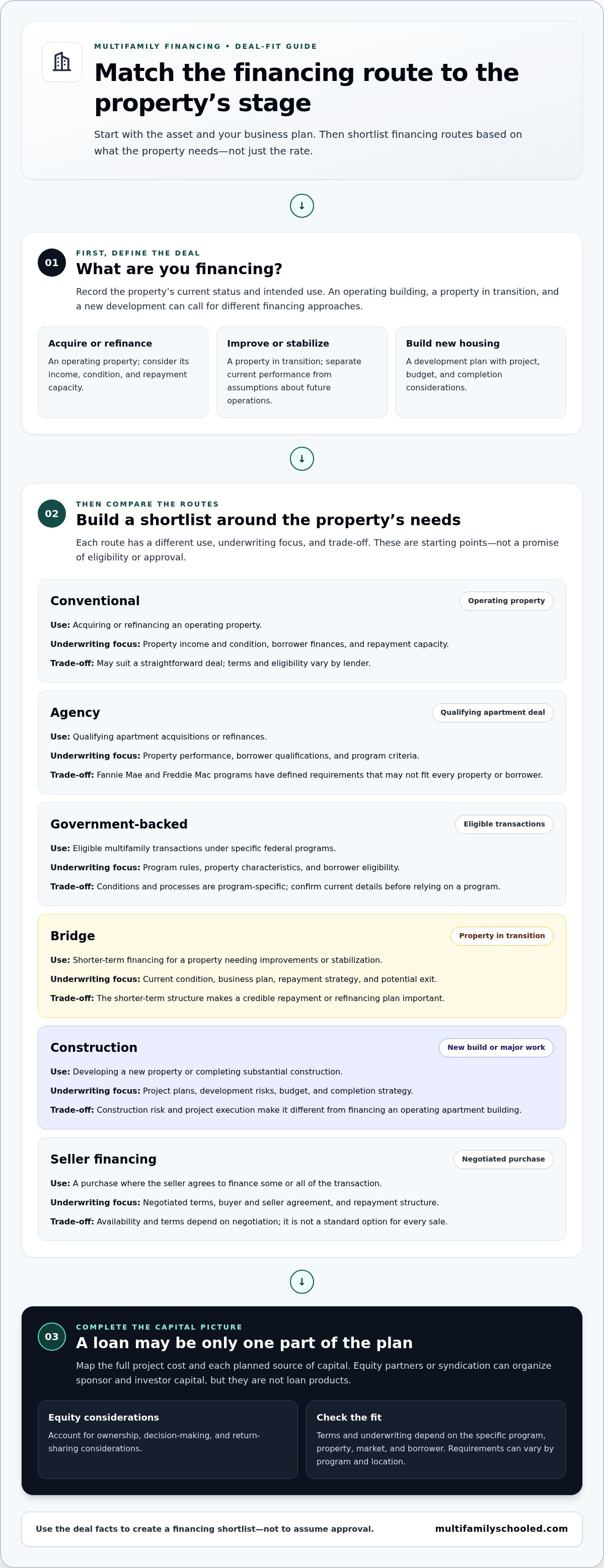
Financing options are easier to compare when you consider the property’s stage and business plan. A stabilized building, a property needing major renovations, and a ground-up development have different financing needs. Use the categories below to create a shortlist, not to assume a program will approve a particular deal.
Match financing categories to the property’s stage
This comparison is a starting point. Actual underwriting and terms depend on the specific loan program, property, market, and borrower. Treat equity partners and syndication separately: they’re ways to organize investment capital, not loan products.
| Financing route | Property stage and typical use | Underwriting focus | Trade-offs to consider |
|---|---|---|---|
| Conventional | Acquiring or refinancing an operating property | Property income, condition, borrower finances, and repayment capacity | May suit a straightforward deal, but terms and eligibility vary by lender. |
| Agency | Qualifying apartment acquisitions or refinances | Property performance, borrower qualifications, and program criteria | Fannie Mae and Freddie Mac programs have defined requirements that may not fit every property or borrower. |
| Government-backed | Eligible multifamily transactions under specific federal programs | Program rules, property characteristics, and borrower eligibility | Can involve program-specific conditions and processes. Confirm current details before relying on a program. |
| Bridge | Shorter-term financing for a property in transition, such as one needing improvements or stabilization | Current condition, business plan, repayment strategy, and potential exit | Its shorter-term structure makes a credible plan for repayment or refinancing important. |
| Construction | Developing a new property or completing substantial construction | Project plans, development risks, budget, and completion strategy | Construction risk and project execution make it different from financing an operating apartment building. |
| Seller financing | A purchase where the seller agrees to finance some or all of the transaction | Negotiated terms, buyer and seller agreement, and repayment structure | Availability and terms depend on negotiation; it isn’t a standard option for every sale. |
Equity partners or syndication may complement a loan by organizing capital from sponsors and investors. They also introduce ownership, decision-making, and return-sharing considerations. Don’t compare them as if they were another mortgage type.
Compare agency and government-backed options carefully
In the U.S., agency financing may involve Fannie Mae or Freddie Mac, while HUD and FHA are relevant to certain government-backed multifamily programs. HUD’s HUD Multifamily Housing Programs page is a starting point for understanding its programs. The program name alone doesn’t establish fit: current rules, property details, and borrower eligibility matter. Verify program-specific requirements and terms with qualified professionals before building them into your plan.
To make a practical shortlist, identify the property’s stage first, then set aside routes that don’t match its intended use. Compare the remaining options by underwriting focus, timing, repayment plan, and conditions. If you’re building your investor knowledge alongside deal analysis, explore the multifamily investing learning resources. This deal-first approach to how to finance multifamily properties helps you ask focused questions before preparing an application.
What multifamily lenders evaluate, and how to address the cash objection
Concerned that you don’t have enough personal cash to pursue a multifamily deal? Cash matters, but it isn’t the only part of a financing plan. Depending on the lender and route, the review may also consider the property’s income, your financial capacity, available liquidity, experience, and the project’s funding structure. Equity partners may be one possible source of capital, but their involvement doesn’t guarantee loan approval or replace lender requirements.
Lenders assess both the borrower’s capacity to meet obligations and the property’s ability to support the proposed debt. That’s why understanding how to finance multifamily properties means preparing for questions about both sides of the transaction, not focusing only on the cash you can contribute.
How property income and debt coverage shape review
A lender may review net operating income, or NOI: the property’s income after operating expenses, before debt payments and income taxes. NOI helps describe the asset’s operating performance, but it doesn’t promise that the property will produce the same results in the future.
Debt service coverage ratio (DSCR) compares a property’s net operating income with its debt obligations. It helps show how the property’s income relates to scheduled debt payments. There isn’t one universal threshold that applies to every lender or financing route, so don’t treat a general benchmark as an approval rule.
Look closely at the assumptions behind the income. Vacancy, rent collections, operating expenses, and planned repairs can all affect the figures used in underwriting. For example, projected income based on full occupancy may look stronger than current income from a building with vacant units. Keep current performance separate from projections, and be ready to explain the basis for your assumptions.
What the sponsor may need to prepare
Requirements vary by lender, route, and transaction. Organize core information early so you can respond clearly when requests arrive. A lender may ask for materials such as:
- Personal or business financial statements and records supporting liquidity.
- An experience summary describing relevant ownership or operating history.
- Entity details, including information about the proposed ownership structure.
- Source-of-funds records that explain where planned contributions will come from.
- Property materials such as rent rolls, operating statements, leases, and condition information.
Credit history, guarantees, liquidity, and prior experience may also be considered, but their role differs by program and lender. Fannie Mae’s multifamily resources describe its financing platform and loan offerings, but the criteria still need to be assessed against the particular transaction. Reviewing Fannie Mae Multifamily Financing can help you understand that agency context.
Multifamily investor mentorship can help you build deal-finding and preparation skills as you organize your analysis. Financing decisions remain subject to lender review and the specifics of your transaction.
Moving from Multifamily Deal to Financing Application
A clear process turns deal analysis into focused lender conversations. Keep each step grounded in the property’s evidence, and don’t treat an early expression of interest as a financing commitment. Screen the deal, model the assumptions, shortlist financing routes, prepare supporting documents, then approach lenders with a defined plan.
- Screen the deal. Confirm that the property and intended strategy warrant further review. Identify key gaps, such as incomplete operating records or unclear repair needs.
- Model assumptions. Organize current income and expenses separately from estimates for vacancy, improvements, or future operations. Test how changes could affect the financing picture.
- Shortlist routes. Compare options that could fit the property’s stage and business plan. Note the repayment approach, expected timing, and any major conditions to investigate.
- Prepare documents. Assemble property records, borrower information, ownership details, and a concise summary of the transaction.
- Approach lenders. Share a consistent deal snapshot, record questions and requests, and track next steps without assuming preliminary feedback is final.
Build a lender-ready deal snapshot
Make the opportunity easy to understand. Summarize purchase assumptions, current operations, the improvement plan, and your intended hold strategy. Label each figure as verified, estimated, or projected, and note its source or basis. That distinction helps a reviewer see what the property is doing now and what your plan expects it to do.
Use the same core model to compare financing scenarios. Change one assumption at a time, such as renovation timing or occupancy, so you can see what drives differences between options. A model is a decision tool, not a promise of returns.
Prepare for lender conversations and diligence
Keep property records, borrower materials, entity and ownership information, and other supporting documents organized in one place. As conversations progress, track lender questions, requested materials, decision milestones, and unresolved diligence. A simple record helps prevent conflicting versions of the deal from circulating.
Before moving forward, understand any financing contingencies and how the proposed schedule relates to the transaction timeline. Clarify which third-party reports may be required, who must arrange them, and when their results are needed. Requirements and timing vary, so allow room for diligence rather than assuming every step will happen on your preferred schedule.
Preliminary discussions and indicative terms are useful for exploring fit, but they aren’t final approval or committed terms. Underwriting, property review, and required documentation can change the outcome. As you learn how to finance multifamily properties, keep a record of what remains conditional and wait for formal documentation before relying on specific terms.
Build deal-finding and preparation skills through Multifamily Schooled’s investor mentorship as you develop a disciplined process for evaluating opportunities.
Build your multifamily financing plan with informed next steps
Turn your research into a written plan before making financing decisions. A clear plan connects the property’s stage to potential capital sources, the questions you still need answered, and the next action for each open issue. That structure helps you move from learning how to finance multifamily properties to evaluating a specific opportunity with care.
Keep the plan focused and practical. For each financing route you’re considering, record why it might fit, what information supports that view, and what could make it unsuitable. A useful plan might include:
- Deal stage: acquisition, rehabilitation, development, or refinancing.
- Potential capital sources: financing routes under consideration and any planned equity contributions.
- Open lender questions: eligibility, underwriting, documentation, timing, and conditions.
- Next actions: records to obtain, assumptions to revisit, or qualified professionals to consult.
Organized preparation makes it easier to keep deal facts and financing questions together. The multifamily investor toolkit can support a structured approach to evaluating and preparing for a deal. Use it as an educational resource, not as a substitute for lender review or transaction-specific advice.
Choose the next learning step that fits your stage
Your next learning need depends on where you are. If you’re still identifying opportunities, focus on deal-finding fundamentals. If you’ve found a property, build your acquisition knowledge by evaluating the deal, reviewing its assumptions, and preparing focused questions. Structured education can help you develop those skills, but it can’t determine a lender’s decision or supply capital.
For guided learning as you build investor knowledge, explore multifamily investing mentorship. Treat education as preparation for your own decisions, not as a promise of financing or investment outcomes.
Keep financing decisions grounded in verified information
Before acting, recheck the program’s current eligibility rules, underwriting standards, and documentation requirements. Qualified lending and legal professionals can help you understand how those details apply to your transaction. Requirements can differ by program, property, borrower, and market, so don’t rely on a general guide as a final answer.
Maintain clear boundaries between verified property data, projected performance, lender terms, and investor assumptions. Update the plan when new information arrives, and mark which terms remain preliminary or conditional. This keeps optimism connected to evidence and gives you a stronger basis for each decision.
Ready to strengthen your deal-finding and acquisition knowledge? Explore Multifamily Schooled’s educational resources and choose a learning step that fits your investing stage.
Turn Your Next Deal Into a Clearer Plan
Your next step isn’t to chase every financing option. It’s to build the judgment to recognize a workable opportunity, ask sharper questions, and prepare with purpose. Learning how to finance multifamily properties is an ongoing process, and each deal can help you strengthen your approach.
Multifamily Schooled supports investor education through workshops, online challenges, deal-finding software, and mentorship. The Mentorship Program is designed to help investors find a deal within 90 days or provide one. These resources support learning and preparation; they aren’t lending or investment capital, and they don’t guarantee financing or returns.
Build your skills and put them to work on your next opportunity. Explore Multifamily Schooled’s investor education resources and choose a learning step that fits where you are now.
Frequently Asked Questions
How much money do you need to finance a multifamily property?
There’s no single amount because required funds depend on the property, financing route, and transaction costs. Plan beyond the down payment: you may also need funds for closing expenses, inspections, immediate repairs, and operating reserves. For example, a building with deferred maintenance may require more cash available after closing than a property in ready-to-operate condition. Build a project-specific budget and verify lender requirements before making an offer.
Can you finance a multifamily property with no money down?
It may be possible to invest without contributing all the capital personally, but a deal still needs funding. A seller-financed arrangement or equity partners may contribute capital, subject to negotiated terms and lender requirements. These structures don’t guarantee approval or eliminate the need for funds to cover the purchase and project needs. Map every source and use of capital, and clarify ownership, repayment, and decision-making before committing.
Can you use a residential loan to buy a four-unit multifamily property?
Yes, certain residential loan programs can apply to a four-unit property, depending on occupancy and borrower eligibility. For example, FHA guidance describes qualifying two-to-four-unit purchases with owner occupancy, requiring the buyer to live in one unit for at least a year. A property bought solely as an investment may not fit that path. Confirm current program rules before structuring your offer around residential financing.
What credit score do you need for a multifamily property loan?
There isn’t one credit score that applies to every multifamily loan. The lender and financing program set their own criteria and may weigh credit alongside income, liquidity, experience, and the property’s financial performance. For example, FHA guidance lists a 580 minimum for certain qualifying two-to-four-unit purchases. That figure isn’t a universal standard for apartment financing, so identify the program before relying on a score threshold.
Can you finance renovations when buying an apartment building?
Yes, some financing plans can account for renovation work, but the right structure depends on the property and scope. A buyer planning cosmetic updates may need a different approach from one undertaking extensive repairs or redevelopment. Prepare a detailed work scope, cost estimates, and a realistic timeline, then determine how proposed improvements relate to loan proceeds and disbursement conditions. Don’t assume a standard purchase loan automatically covers renovation expenses.
What happens if a multifamily property does not qualify for the loan you wanted?
First, identify what prevented the property or borrower from meeting the program’s criteria. The issue might involve condition, income documentation, occupancy, or a program-specific rule. Depending on the deal, you could revise the plan, explore another financing route, negotiate changes to the purchase, or decide not to proceed. Review any contract deadlines and financing protections with qualified professionals before changing course.
Is seller financing a good way to finance a multifamily property?
Seller financing can be useful if both parties agree on workable terms, but it isn’t automatically a better or simpler option than a loan. Clarify the payment schedule, interest, repayment date, default consequences, and how the arrangement interacts with existing debt or liens. Have qualified legal professionals review the documents before signing. Compare the full obligations with your operating plan, especially if a large payment could come due before you’re ready.



