

How to Evaluate a Commercial Real Estate Deal: The 2026 Investor’s Guide
Most investors spend 40 hours a week drowning in spreadsheets only to watch the best deals get snatched up by someone else. You're likely exhausted by information overload and terrified that a single mistake in your NOI or Cap Rate calculations will ruin your portfolio. It's a common trap that keeps 95% of aspiring owners stuck on the sidelines for years. You don't need more data. You need a system that works at the speed of the 2026 market.
You're ready for a breakthrough. We're going to show you exactly how to evaluate a commercial real estate deal using our proprietary "Green Light" process. This is the same systematic approach we've used to help 1,200+ students filter multifamily properties in minutes and secure their first assets. No more analysis paralysis or second-guessing your math. You'll gain the total confidence required to make competitive offers that actually get accepted by sellers.
This guide provides the blueprint to master deal flow and unlock your path to financial freedom in the next 90 days. We'll walk through the essential metrics and the rapid-fire vetting tools you need to build a massive wealth-generating engine today.
Key Takeaways
- Master the 1-minute "Green Light" process to filter properties at lightning speed and secure a massive competitive advantage in the 2026 market.
- Discover how to evaluate a commercial real estate deal using the "Big Four" metrics to ensure every investment delivers maximum profit and stability.
- Learn why the 3-mile radius rule is critical for demographic analysis and how to avoid the trap of buying a "great deal" in a failing market.
- Protect your capital with a 5-step evaluation framework that uses T-12 reviews and rent roll audits to verify actual income before you offer.
- Unlock the proven system to own apartments in 90 days and replace years of risky trial and error with expert mentorship and street-smart strategies.
The 1-Minute Green Light: Why Evaluation is Your Wealth Shield
Evaluation is your systematic risk-mitigation process. It's the armor that protects your capital from bad debt and poor locations. In the fast-paced 2026 market, speed is your ultimate competitive advantage. If you can't decide on a property within 60 seconds of seeing the basic financials, you've already lost the deal to a more prepared investor. Learning how to evaluate a commercial real estate deal with lightning precision allows you to strike while others are still opening their spreadsheets.
To see how professional investors filter opportunities in record time, watch this helpful video:
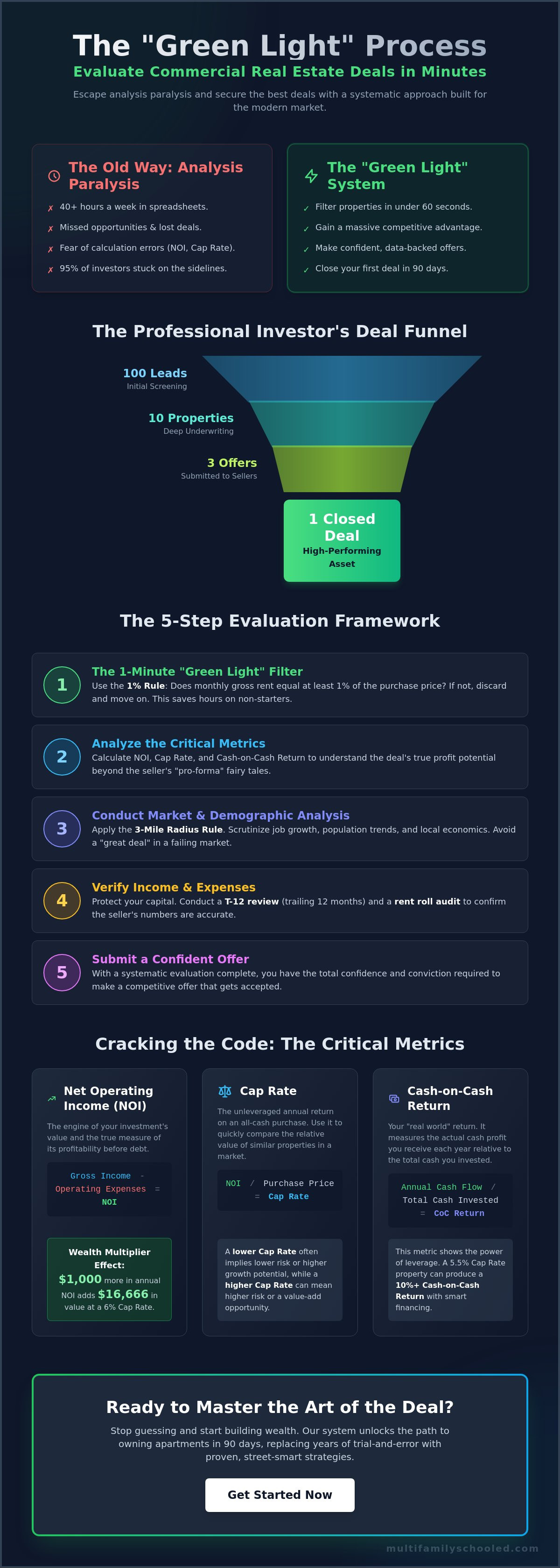
Success in this industry requires a shift from "Book Smarts" to "Street Smarts." Theory tells you what a Cap Rate is; execution tells you if the seller's reported expenses are realistic for the current year. You must treat your investing like a high-volume machine. Professional wealth builders use a deal funnel to filter through the noise. Typically, you'll need to screen 100 leads to find 10 worth deep underwriting. From those 10, you might submit 3 offers to close just 1 high-performing deal.
The High Cost of Analysis Paralysis
Waiting for perfect data leads to missed opportunities and empty portfolios. Markets move, interest rates shift, and sellers get impatient. You don't need 100 percent certainty to make a move; you need a system that gives you the confidence to act on a 70 percent probability of success. Evaluation isn't just about math. It's about building the conviction to pull the trigger. Deal flow is the lifeblood of wealth.
Evaluation vs. Appraisal: Knowing the Difference
Never confuse an appraisal with an evaluation. An appraisal is a backwards-looking document created for the bank's protection. It utilizes standard Real estate appraisal methods like sales comparisons or replacement costs to justify a loan amount. Your evaluation is forward-looking and focused entirely on your profit. You must set your own "buy criteria" before you ever look at a listing. Don't let a bank's conservative estimate dictate your vision. Use the ready-made templates in the Multifamily Tool Kit to set your own benchmarks. This allows you to master how to evaluate a commercial real estate deal based on your specific financial goals, ensuring every move you make is calculated for maximum return.
Cracking the Code: The 4 Critical Metrics for Every Deal
Stop gambling with your capital. Knowing how to evaluate a commercial real estate deal requires looking past the glossy brochures. Sellers lie. Marketing packages often contain "pro-forma" numbers that are nothing more than fairy tales designed to inflate the price. If you rely on a single metric, you are inviting disaster. Real investors use the "Big Four" to expose the truth behind the numbers. Before you dive deep, use the 1% rule as a 60-second filter. If the monthly gross rent doesn't reach at least 1% of the purchase price, the deal likely won't cash flow in 2026. Toss it and move to the next one.
Net Operating Income (NOI): The Engine of Value
NOI is the heartbeat of your investment. Use the formula: Gross Income - Operating Expenses = NOI. Operating expenses include property taxes, insurance, utilities, and management fees. They do not include your mortgage or big renovation costs. Mastering Calculating Net Operating Income allows you to see the actual profit potential. Every dollar you save on expenses or add in rent creates massive equity. In a market with a 6% cap rate, increasing your annual NOI by just $1,000 adds $16,666 in property value. That is how you build wealth fast.
Cap Rates and Cash-on-Cash Return
Cap rate represents the unleveraged yield of the asset. It shows what the property returns if you pay 100% cash. Cash-on-Cash (CoC) return is different. It measures the actual cash hitting your bank account after the lender takes their cut. Leverage is your secret weapon here. A property with a 5.5% cap rate can produce a 12% CoC return if you structure the debt correctly. Cap rates tell you about the market; Cash-on-Cash tells you about your pocket. Always prioritize the cash that stays with you.
Debt Service Coverage Ratio (DSCR)
The bank is your most demanding partner. They use DSCR to decide if your deal is safe. This ratio compares your NOI to your annual debt payments. Most commercial lenders in 2026 require a minimum DSCR of 1.25. If your NOI is $125,000, your maximum annual mortgage payment cannot exceed $100,000. Use this threshold to determine your maximum allowable offer. If the numbers don't hit 1.25, the bank won't fund you, and the deal is dead. You can automate these vital checks with the Multifamily Tool Kit to ensure you never overpay.
Master these four metrics to gain total control over your financial future. When you understand how to evaluate a commercial real estate deal with surgical precision, you stop being a spectator and start being an owner. Don't let a seller's "projected" numbers distract you from the hard data. Run the math. Verify the expenses. Secure your freedom.
Beyond the Spreadsheet: Analyzing Market and Property History
Numbers on a screen can lie. A high cap rate looks amazing in a spreadsheet, but it means nothing if the asset sits in a dying zip code. A "great deal" in a "bad market" is a fast track to a financial nightmare. You must master how to evaluate a commercial real estate deal by looking at the dirt, the neighbors, and the future of the neighborhood. Stop falling in love with the pro-forma and start looking at the reality of the street.
Macro Trends: Is the Market Moving with You?
Real estate is a game of location and timing. Use the 3-mile radius rule for every multifamily asset you analyze. If the population within that circle hasn't grown by at least 1.2% annually over the last three years, your exit strategy is in trouble. Look for the "path of progress." Check for new infrastructure projects or major employer relocations scheduled for 2026. You want to buy where the jobs are moving, not where they used to be.
Watch out for the "regulatory trap." In 2026, several states are pushing for aggressive rent control and unfriendly tax changes. A single legislative vote can wipe out your projected upside overnight. Don't guess on these numbers. Use Real Estate Radar to pull instant neighborhood data and stay ahead of local trends. This tool gives you the "street smarts" you need to verify if a market is actually growing or just riding a temporary bubble.
Micro Analysis: The Property’s Secret Story
The property has a story to tell, and it's usually hidden in the paperwork. Audit the rent roll with extreme prejudice. Look for "stacked" lease expirations. If 35% of your tenants have leases ending in the same 60-day window, you face a massive vacancy risk in your first year. Check for consistency in payments. A "full" building is worthless if 15% of the tenants are 30 days late every month.
- Hunt for Deferred Maintenance: Walk the property and look for the "red flags" numbers can't capture. A $60,000 roof replacement or a failing HVAC system will kill your cash flow instantly.
- Secret Shop the Management: Call the leasing office as a prospective tenant. If they don't answer within 3 hours, the current management is failing. This is a massive opportunity for you to add value by installing a better system.
- Investigate the Seller’s "Why": Ask why they are exiting now. Are they dodging a massive 2027 balloon payment? Is a new 300-unit complex breaking ground next door that will crush their occupancy?
Understanding how to evaluate a commercial real estate deal requires you to be a detective. You are looking for the truth behind the marketing brochure. When you combine hard data with physical due diligence, you unlock the power to buy with absolute confidence. This is how you build true wealth and achieve financial freedom in the 2026 market.
The 5-Step Evaluation Framework: From Lead to Offer
Stop guessing and start winning. Real estate mastery requires a proven system, not a gut feeling. If you want to unlock massive wealth in 2026, you must master how to evaluate a commercial real estate deal with surgical precision. This 5-step framework moves you from a raw lead to a winning offer in record time.
- Step 1: The T-12 Review. Analyze the last 12 months of actual income and expenses. This document is your baseline for reality.
- Step 2: The Rent Roll Audit. Verify every tenant. Ensure the security deposits match the leases and the bank statements to confirm who is actually paying.
- Step 3: Market Comps. Compare your asset to at least three similar properties sold within a 3-mile radius over the last 180 days.
- Step 4: The Expense Stress Test. Pad your budget for 2026 inflation. Account for a 12% jump in utility costs and a 15% rise in property insurance premiums.
- Step 5: The Exit Strategy. Calculate your Internal Rate of Return (IRR) based on a 5-year hold period. You need to know your profit before you buy.
Performing Due Diligence Without the Stress
Organization is your best weapon against overwhelm. Create a rigid Due Diligence Checklist that covers everything from HVAC ages to roof warranties. Never skip the physical walkthrough. You must touch every unit before your earnest money goes hard to avoid hidden $50,000 surprises. The T-12 is the only truth in real estate because it records what actually happened, not what the broker hopes will happen in the future.
Stress Testing Your Assumptions
Success depends on your ability to survive the worst-case scenario. What happens if vacancy hits 15% next year? If your Debt Service Coverage Ratio (DSCR) remains above 1.25 under that pressure, you have a resilient asset. Model for interest rate hikes of at least 75 basis points to stay safe in a volatile 2026 market. Find your break-even point by totaling your operating expenses and debt service, then dividing by your gross potential rent. Knowing this number gives you the confidence to close. It's the key to understanding how to evaluate a commercial real estate deal while protecting your capital.
Ready to analyze deals like a pro? Download the Multifamily Tool Kit and start your journey to financial freedom today.
Master the Art of the Deal with Multifamily Schooled
You've spent hours learning the mechanics of the market. You understand the math and the metrics. But the truth is, knowledge without execution is just a hobby. Justin Brennan created Multifamily Schooled to turn your knowledge into keys. He brings three generations of "street smarts" to the table. This isn't academic fluff; it's a battle-tested blueprint designed for speed and scale. You don't have years to spend on expensive mistakes. You need a system that works now.
The Multifamily Schooled Mentorship Advantage
Experience is the most expensive teacher. Why pay for it with your own mistakes? Our mentorship replaces decades of struggle with a clear path to ownership. We focus on the "90 Days to a Deal" promise. It's a commitment to your results. We offer a guarantee that stands alone in this industry: we help you find a deal or we give you one. This removes the "what if" from your investment strategy. You'll enter an elite circle of VIP investors who share resources, contacts, and insights daily. This isn't about watching videos in a vacuum. It's about having a 3rd Generation Investor review your numbers and guide your negotiations. You'll stop wondering how to evaluate a commercial real estate deal and start closing them with total confidence. Transform from a student into a powerful owner of multifamily assets today.
Leveraging Technology for Instant Analysis
The 2026 market moves at the speed of light. Manual spreadsheets are a relic of the past. Our "1-Minute Green Light Deal Analyzer" is a total game changer. It saves you 10 or more hours per week by automating the heavy lifting of financial modeling. You'll know within 60 seconds if a property hits your specific ROI targets or if it's a waste of time. When you integrate Real Estate Radar into your daily workflow, you find off-market opportunities before the competition even knows they exist. This software provides the deep data you need to move with absolute certainty. Stop guessing and start analyzing with surgical precision. The difference between a "pass" and a "buy" has never been clearer. Learn how to evaluate a commercial real estate deal like a pro while cutting your work time in half. Take the first step toward your new life of financial freedom.
- Identify high-yield properties in under 60 seconds.
- Access 3rd generation investment strategies.
- Join a community of active apartment owners.
Stop Analyzing and Start Owning
Stop sitting on the sidelines while 2026 passes you by. You've now seen how the 1-Minute Green Light filter saves hours of wasted effort and why the 4 critical metrics are the only numbers that truly matter. Mastering how to evaluate a commercial real estate deal isn't about being a math genius; it's about following a 5-step framework that turns raw data into a wealth shield. You don't need to guess when you can leverage Justin Brennan's 3rd generation street smarts to protect your capital. Our proven Fast 5 evaluation system removes the friction that stops most investors before they even begin. It's time to trade your spreadsheets for real assets and secure your financial future. We are so confident in this process that we offer a 90-Day "Find a Deal" Guarantee. If you don't find a deal in 90 days, we'll find one for you. Your path to passive income is ready and waiting for you to step up. Unlock Your Financial Freedom: Join Our 90-Day Mentorship Today. You've got the tools; now take the lead and build your legacy.
Frequently Asked Questions
How do I determine the value of a commercial property?
You determine value by dividing the property's Net Operating Income (NOI) by the current market capitalization rate. For example, a property generating $250,000 in annual NOI in a market with a 5% cap rate has a value of $5,000,000. This formula is the foundation of how to evaluate a commercial real estate deal because it treats the asset as a business focused on cash flow.
What is a "good" cap rate for a multifamily deal in 2026?
A target cap rate between 5.75% and 6.25% is considered strong for Class B multifamily assets in 2026. While rates fluctuate based on Federal Reserve policy, these figures provide a healthy spread over current 10 year Treasury yields. Focus on markets with population growth exceeding 1.5% annually to ensure your exit cap rate stays compressed and your property value remains protected.
How much money do I need to start evaluating commercial deals?
Evaluating deals costs nothing but your time when you use a proven system. You don't need a down payment just to run the numbers and send out Letters of Intent. Most lenders require a 25% down payment for a final purchase, but you can bridge this gap using private money partners or syndication models. Start analyzing ten deals a day right now to build your "street smarts" without spending a dime.
Can I evaluate a commercial deal without a professional appraisal?
You must evaluate the deal yourself using the trailing 12 month financial statements before you ever pay for an appraisal. Professional appraisals cost between $3,500 and $6,000 and are typically the final step for bank financing. Use a 1-Minute Green Light Deal Analyzer to see if the math works first. If your internal numbers don't show a 12% or higher internal rate of return, don't waste money on the professional report.
What are the biggest red flags in a commercial real estate deal?
The biggest red flag is an expense ratio below 35% on an older property. Sellers often hide maintenance costs or use "pro forma" taxes that don't account for the reassessment after the sale. If the physical occupancy is 95% but the economic occupancy is below 80%, the landlord is likely "buying" tenants with heavy concessions. This hidden loss of income will crush your returns after you take over.
How do I calculate Net Operating Income (NOI) correctly?
Subtract all necessary operating expenses from your total income, but exclude your mortgage and any capital improvements. If a building brings in $400,000 and costs $180,000 to maintain, your NOI is $220,000. Mastering this calculation is the most vital skill when learning how to evaluate a commercial real estate deal. It tells you exactly how much cash the asset produces regardless of how it's financed.
Is multifamily real estate safer than single-family investing?
Multifamily is significantly safer because it eliminates the "all or nothing" vacancy risk found in single family homes. When a single family tenant leaves, your income drops by 100% immediately. In a 50 unit apartment building, one vacancy only reduces your gross income by 2%. This scale allows you to absorb market shifts and maintain debt coverage even during economic downturns like the 2023 cooling period.
What is the best software for evaluating commercial real estate deals?
The 1-Minute Green Light Deal Analyzer is the best tool for rapid screening of potential investments. It allows you to filter out bad deals in seconds so you can focus on the winners. For deep due diligence, use a robust Excel based underwriting model that tracks 5 year and 10 year projections. Speed is your competitive advantage in the 2026 market, so don't get bogged down in slow, manual calculations.



