

How to Create a Real Estate Investor Pitch Deck That Closes Deals in 2026
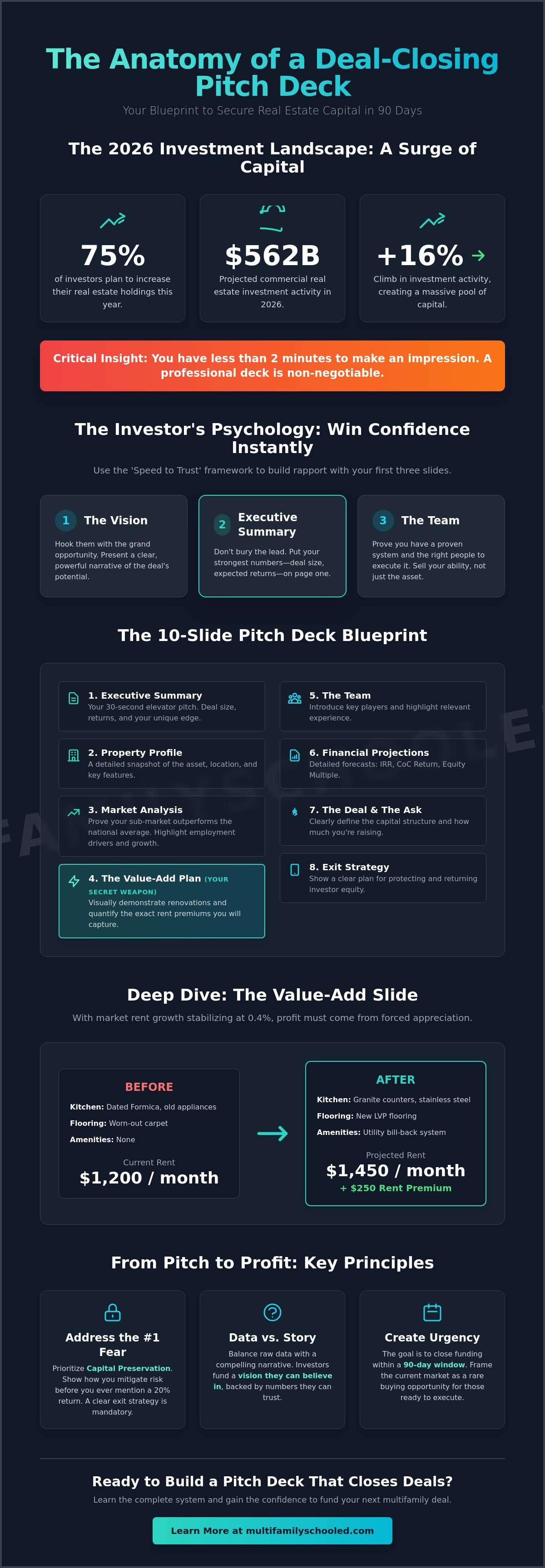
Did you know that 75% of investors are planning to increase their real estate holdings this year? Commercial real estate investment activity is set to climb by 16% in 2026, hitting a massive $562 billion. There's a mountain of capital waiting for the right deal, but most investors will decide whether to fund yours in under two minutes. If you're worried about looking like an amateur or struggling to explain complex data, you aren't alone. It's a common hurdle that stops many talented people from ever closing their first big deal.
You likely already know that a solid property isn't enough on its own. You need a narrative that proves you have a proven system for speed and safety. Learning how to create a real estate investor pitch deck is the bridge between a good idea and a funded project. This isn't just about design. It's about mastering the art of the multifamily pitch to secure capital within a tight 90-day window.
This article provides the exact blueprint for building a high-impact deck that commands investor confidence. We'll break down how to simplify your data into a story that closes deals, even if you lack a long track record. Let's turn your next apartment deal into a reality.
Key Takeaways
- Learn to use the 'Speed to Trust' framework to build rapport with investors in just three slides.
- Discover how to create a real estate investor pitch deck using the 10 essential slides that prove your ability to execute a winning system.
- Master the balance between raw data and compelling storytelling to sell a vision that secures capital for your next apartment deal.
- Identify the best interactive software and templates for 2026 to build professional presentations in record time.
- Gain the tactical skills to handle high-pressure Q&A sessions like a seasoned pro and close funding within a 90-day window.
The Psychology of the Pitch: Why Investors Say Yes
Investors don't give you money because they love the bricks and mortar of an apartment complex. They give you money because they trust your system. When you're learning how to create a real estate investor pitch deck, you must realize that your deck is a visual representation of a comprehensive business plan designed to generate wealth. If your deck looks like a disorganized mess, investors assume your management will be a mess, too. You aren't just selling a deal; you're selling your ability to execute a proven methodology.
You have exactly three seconds to hook an investor. This is the 3-second rule. Every slide must communicate one clear, powerful opportunity instantly. Use the Speed to Trust framework by focusing your first three slides on your vision, your executive summary, and your team's ability to execute. This builds immediate rapport. It proves you aren't an amateur guessing at numbers, but a professional with a roadmap for success.
To better understand this concept, watch this helpful video:
Multifamily remains the ultimate recession-proof pitch in 2026. While U.S. GDP growth is forecasted to slow to 2.0%, the demand for housing is constant. People always need a place to live. By showing a systematic approach to acquiring these assets, you position yourself as a leader in a market expected to see a 16% increase in investment activity this year. Mastering how to create a real estate investor pitch deck allows you to tap into this massive $562 billion pool of capital.
Solving the Investor's Greatest Fear
Investors are terrified of losing their principal. Address capital preservation before you ever mention a 20% return. Show them how you use forced appreciation to create value regardless of market swings. You aren't just asking for money. You're solving their lazy cash problem by putting their capital into a high-performing asset. Explain your exit strategy clearly. A controlled exit proves you've considered the risks and have a plan to protect their equity at every stage.
The 'Why Now' Factor in 2026
2026 is a year of recovery and adaptation. Inflation is expected to average 2.5%, making hard assets like real estate a vital hedge against rising costs. There's a massive supply-demand gap in apartment housing that creates a narrow window of opportunity. Use this market volatility to your advantage. Frame the current landscape as a rare buying opportunity for those who move fast. Don't wait for the market to get perfect. Perfection is expensive. Execution is where the profit lives. Create urgency by showing that the best deals are being snatched up by those with a clear, professional system.
The 10 Essential Slides for a Multifamily Pitch Deck
Mastering how to create a real estate investor pitch deck requires more than just filling out a template. You need a narrative that transforms a property into a profit engine. Your deck should follow a logical flow that answers every investor question before they even ask it. Start with an Executive Summary that acts as your 30-second elevator pitch. It must define the deal size, the expected return, and why you are the right person to lead it. Don't bury the lead. Put your strongest numbers on page one.
Follow this with a Property Profile and a deep Market Analysis. In 2026, investors are looking for stability. With multifamily vacancy rates sitting at 8.5% as of April 2026, you must prove why your specific sub-market will outperform the national average. Highlight local employment drivers and transit-oriented zoning changes that support long-term demand. This level of detail mirrors the standards seen in a professional real estate development challenge, where precision separates winners from the rest of the pack.
The 'Value-Add' Slide: Your Secret Weapon
Show, don't just tell. Use conceptual before-and-after visuals for your planned renovations. If you're upgrading kitchens or flooring, quantify the exact rent premiums you expect to capture. In 2026, rent growth has stabilized around 0.4%, so your profit must come from operational efficiencies. Detail your plan for utility bill-back systems or tech-driven property management. This proves you aren't just buying a building; you're optimizing a business.
The Capital Stack and Investor Returns
Transparency builds trust instantly. Your deck must include a clear Sources and Uses table that accounts for every dollar. Define your capital stack by showing the split between senior debt and investor equity. Explain your waterfall structure clearly. Whether it's a 7% preferred return or a specific equity split after a hurdle, investors need to know exactly when and how they get paid. This clarity eliminates the "amateur" label and positions you as a sophisticated operator.
When you understand how to create a real estate investor pitch deck that speaks the language of high-net-worth individuals, the funding follows. If you want to refine these skills with a proven system, consider joining our mentorship program to see how the pros structure their biggest wins. Execution is everything. Build your deck with the 10 essential slides and start closing deals in record time.
Data vs. Story: Avoiding the 'Boring Deck' Trap
Data validates the deal. Story sells the vision. Don't make the mistake of drowning your audience in endless spreadsheets. If you want to know how to create a real estate investor pitch deck that actually moves the needle, you must master the narrative. Investors care about the 5.63% starting rates for multifamily loans, but they care more about who is steering the ship. They're looking for a leader, not just a bookkeeper. Your job is to transform raw numbers into a compelling journey toward profit.
Think of your pitch as a Hero's Journey. The property is the hero. It's currently struggling with high vacancy or poor management. You are the guide. You have the map to lead it to a profitable exit. If you're a new investor, borrow credibility by leaning on "The System." Point to the frameworks and mentors that back your strategy. This shifts the focus from your personal track record to the proven methodology you're executing. It proves you have a systematic approach to wealth creation.
Simplify your financial slides using the Rule of Three. Focus on Net Operating Income (NOI), Yield, and your Exit Strategy. Total commercial real estate investment activity is expected to hit $562 billion in 2026. You don't need to explain every dollar of that. You just need to show how your specific deal captures a piece of that momentum. Keep it punchy. Keep it fast. If you clutter the page with every line item from your pro forma, you'll lose their attention before you reach the final slide.
Leveraging Third-Party Credibility
Stop making assumptions. Start providing proof. Include direct quotes from local brokers to validate your projected rent premiums. Showcase your "Power Team." This includes your property managers, attorneys, and mentors. Mention your use of professional Deal Finding Software to ensure every data point is accurate. When you show that your deal is backed by industry experts and high-end tech, you eliminate the fear of the unknown. It shows you've done the heavy lifting before asking for a single dollar.
Visualizing the Win
Make the deal feel tangible. Use professional photography or high-end renders to show the "after" state of the property. Charts should follow a five-second rule. If an investor can't grasp the growth trend in five seconds, it's too complex. Delete it. Write a single, declarative sentence for your exit strategy. "We will sell to an institutional buyer in 60 months after achieving a 20% NOI increase." Clarity creates confidence. Confidence closes deals. Mastery of how to create a real estate investor pitch deck is about removing friction from the decision-making process.
Building Your Deck in Record Time: Tools and Templates
Speed is your greatest weapon in 2026. If you take three weeks to build a presentation, the deal will be gone. The secret to mastering how to create a real estate investor pitch deck is starting with a Deal Memo. Don't open PowerPoint yet. Write a two-page executive summary that outlines the purchase price, the renovation budget, and the projected NOI. A Deal Memo acts as your north star. By writing this out first, you identify the holes in your strategy before they become visible to an investor. Once your logic is bulletproof, you can move into high-impact visual design.
Static PDFs are becoming obsolete. In 2026, sophisticated investors want interactive Offering Memorandums that allow them to toggle between different financial scenarios. You need tools that do the heavy lifting for you. Automate your market research by using the Multifamily Tool Kit. This system allows you to plug in property data and generate professional-grade insights in minutes. It's about working smarter, not harder. When you understand how to create a real estate investor pitch deck using modern automation, you free up your time to find more deals.
Accept the 48-hour challenge. When a surprise meeting pops up, you shouldn't panic. You should have a draft deck ready to go at all times. Use a modular system where you can swap out property-specific slides while keeping your team and market thesis slides constant. This allows you to pivot instantly when a new opportunity strikes. In a market where commercial real estate investment activity is expected to hit $562 billion this year, being the first to the table is a massive advantage.
Automation and AI in Pitching
AI has changed the game for 2026. Use it to summarize complex demographic shifts or local transit-oriented zoning changes. Don't waste hours manually searching for comparable sales. Leverage Real Estate Radar to pull real-time data and current SOFR rates, which sit at 3.65% as of June 12, 2026. This ensures your financial tables are accurate and update automatically. Precision is the foundation of trust. If your data is stale, your deal is dead.
The Final Polish Checklist
One math error can kill a million-dollar deal. Conduct a ruthless audit of every slide. Check your debt assumptions against the current market. As of June 2026, conventional commercial mortgage rates for stabilized properties are in the 5.43% to 8.75% range. If your deck shows outdated rates, you've already lost your audience. Ensure your brand colors and fonts are consistent throughout the presentation. Finally, test your deck on someone who isn't an investor. If they can't explain the deal back to you in sixty seconds, your story is too complicated. Simplify until the win is obvious.
Stop guessing and start closing. Get the tools the pros use to dominate the market. Get the Multifamily Tool Kit now and build your next deck in record time.
Beyond the Deck: Closing the Deal with Multifamily Schooled
A deck is just a tool. It's a high-impact visual aid, but it doesn't sign the contract for you. Wealth is built through execution. You've learned how to create a real estate investor pitch deck that captures attention; now you must learn how to close the deal. The real work starts when the slides stop. Investors aren't just looking at your IRR or cap rate. They're looking at you. They want to see if you can handle the pressure when the numbers get questioned. Your presence in the room is what transforms a presentation into a partnership.
The Q&A session is where most deals live or die. Seasoned pros don't get defensive. They provide data-backed answers with total confidence. If an investor asks about the 8.5% multifamily vacancy rate reported in April 2026, you should already have a sub-market strategy ready. You don't guess. You lead. This level of preparation is what separates a student from a master. It's the difference between a "maybe" and a wire transfer. The market doesn't wait for the hesitant. Commercial real estate investment activity is expected to climb by 16% this year, and that capital is looking for a home right now.
Having a mentor behind you is the ultimate edge. It's like having the answer key to a test. When you're backed by a team with a track record of success, your confidence skyrockets. Investors feel that energy. They see a professional who has a system for safety and a roadmap for growth. This is how you secure capital for your next apartment deal without the anxiety of not having a long personal history in the game. Mastery of how to create a real estate investor pitch deck is just the beginning of your journey toward economic empowerment.
The Power of the 90-Day Guarantee
Stop guessing. Start doing. Our system is designed for speed and results. We don't just teach theory; we give you the blueprint for action. Our Mentorship Program helps you build a deck that actually works in the real world. You get the support you need to answer the toughest investor questions. We provide the strategic advantage you need to win. Imagine walking into a meeting knowing an expert has already vetted your deal. That is how you secure funding within a tight 90-day window.
Ready to Level Up?
It's time to stop being a spectator. Join the movement of investors who are taking control of their financial futures. Attend our next Live Workshop to master the A-Z of apartment investing. This is a high-energy experience designed to transform your mindset and your bank account. You can also access our full library of resources at the Multifamily Store. Don't just build a deck. Build a legacy. The 2026 market is moving fast. Don't get left behind.
Take Command of Your Financial Future
The roadmap is in your hands. You've learned how to bridge the gap between complex data and a compelling story. You know the exact ten slides that transform a property into a profit engine. Most importantly, you understand that investors fund systems, not just buildings. Mastering how to create a real estate investor pitch deck is the final hurdle between you and the life-changing capital you need for your next apartment deal.
Don't wait for the perfect moment. The 2026 market is moving fast, and the winners are those who execute with speed. We've built an entire ecosystem to ensure your success. From our proprietary deal-finding software to a proven system for raising private capital, we provide every tool necessary to build your legacy. Our 90-Day Deal Guarantee means you aren't just joining a program; you're entering a result-driven partnership.
Stop dreaming and start closing. Secure Your First Deal in 90 Days; Join Our Mentorship Today! You have the vision and the tools. Now, it's time to take action and claim your prosperity.
Frequently Asked Questions
How long should a real estate pitch deck be?
A high-impact deck should be between 12 and 18 slides. This range allows you to cover everything from the executive summary to the exit strategy without losing your audience's focus. Remember the 3-second rule. Every slide must deliver a punchy message instantly. If a slide doesn't directly support the "why" behind the deal, delete it. Keep your presentation lean, fast, and focused on the results.
What is the most important slide in an investor deck?
The Executive Summary is your most critical slide. It acts as your 30-second elevator pitch in visual form. If this slide doesn't hook the investor immediately, they won't care about your market analysis or financial projections. It must clearly state the deal size, the expected return, and the core opportunity. Think of it as the trailer for a blockbuster movie. It needs to make them want to see the rest.
Should I include my track record if I've never done a multifamily deal?
Absolutely include a track record, even if it's not yours yet. If you're a new investor learning how to create a real estate investor pitch deck, you must borrow credibility. Highlight your "Power Team" including mentors, experienced property managers, and partners. Investors fund systems and teams, not just individuals. Showcasing a proven methodology and professional support proves you have a roadmap for safety and execution regardless of your personal history.
Can I use a template for my real estate pitch deck?
You can use a template, but don't let it make you look like an amateur. Generic templates often miss multifamily-specific needs like unit mixes or value-add blueprints. Use a professional framework as a starting point, then customize it with high-quality renders and your unique brand voice. Your deck should look like a bespoke presentation, not a "fill-in-the-blank" PDF. Use tools like the Multifamily Tool Kit to ensure your data is as professional as your design.
How much financial detail should I include in the first meeting?
Keep the first meeting focused on high-level outcomes rather than granular line items. Focus on the "Big Three": NOI growth, cash-on-cash yield, and the exit strategy. You want to validate the vision first. If they like the story, they'll ask for the full pro forma in the follow-up. Providing too much data too early can lead to "analysis paralysis." Lead with the win and save the deep-dive spreadsheets for the second meeting.
What software is best for creating real estate pitch decks in 2026?
In 2026, interactive Offering Memorandums (OMs) are the gold standard. Moving beyond static PDFs allows investors to engage with your data dynamically. Use AI-driven software to pull real-time market trends and demographic shifts. Tools like Real Estate Radar are essential for pulling accurate comparable sales data instantly. This tech-forward approach shows investors you're a modern operator who uses the best systems available to protect their capital and maximize returns.
How do I calculate the exit cap rate for my projections?
Calculate your exit cap rate by being conservative. A standard rule is to add 5 to 15 basis points to the current market cap rate for every year you plan to hold the property. This accounts for potential market shifts and ensures your projections aren't overly optimistic. Since cap rates are expected to compress by 5 to 15 basis points for most property types in 2026, staying conservative in your pitch builds trust and shows you're prioritizing capital preservation.
What happens if an investor asks a question I can't answer?
Never guess or fabricate an answer. If an investor asks something you don't know, respond with confidence: "That's a great question; I want to give you the exact figure from our pro forma, so I'll follow up with that data by the end of the day." This shows integrity and professionalism. It's better to be a meticulous operator who verifies facts than an amateur who makes up numbers under pressure. Follow-up is just another chance to close the deal.



