

How to Conduct a Multifamily Lease Audit: A Step-by-Step Guide
What if the rent roll shows income that the signed leases and payment records don’t support? Before relying on a property’s numbers, trace each figure back to its evidence. Learning how to conduct a multifamily lease audit gives you a repeatable way to spot gaps before they shape your investment decision.
Lease terms, management records, and tenant payments can drift out of sync. The rent amount may differ, a concession may be missing, or a recurring fee may appear in one file but not another. A rent roll alone won’t show the full picture. Compare the records and document what doesn’t line up.
This step-by-step guide explains how to organize lease files, compare key terms with rent-roll and payment data, and flag discrepancies that could affect income assumptions. You’ll also learn how to record findings and turn them into focused due-diligence questions. Separate minor inconsistencies from issues that need attention, and make decisions with stronger evidence.
Key Takeaways
- Learn how to conduct a multifamily lease audit with a consistent workflow for defining scope, gathering records, and checking lease terms against operating data.
- Use a comparison table to distinguish income-related discrepancies from document, date, unit, and occupancy-status issues.
- Build a findings log that captures each exception, its supporting records, priority, and next action.
- Assess confirmed findings, open questions, and missing documents before relying on a property's income assumptions.
What a Multifamily Lease Audit Checks, and Why Investors Use One
Start with one core test: do the signed lease terms, unit-level charges, and collections in the operating records agree? A multifamily lease audit traces income information back to its supporting documents. It helps investors assess whether reported rent and other lease-related income are supported by the agreements and records reviewed, rather than treating a rent roll as proof on its own.
This is a focused document review, not a general property inspection or a full audit of financial statements. It doesn’t assess building condition, independently verify every expense, or establish the property’s overall financial performance. A lease audit can cover different issues depending on its scope. An investor’s review typically connects lease language to unit-level charges and payment records.
Which records belong in a lease audit?
Begin with executed lease agreements, then include applicable amendments and renewals so the review reflects the terms in force during the period examined. Compare those documents with the unit-level rent roll and available payment ledgers or property-management records. Since file names, systems, and formats vary, identify the records available and note what each one represents.
- Check the lease’s rent, start and end dates, and occupancy status against the rent-roll entry.
- Compare recorded payments with ledger entries for the same unit and review period.
- Include supporting records for charges or adjustments, such as documented fees or concessions, when they’re part of the review.
What a lease audit can, and cannot, establish
A lease audit can show where reviewed documents align, conflict, or leave a gap. For example, a lease may state one monthly rent while the rent roll records another. That’s a documented mismatch, but it doesn’t explain why the figures differ or prove which amount was billed and collected. Keep evidence separate from interpretation: record the documents and amounts observed, then mark explanations that still need follow-up as unresolved.
That makes how to conduct a multifamily lease audit a practical due-diligence skill. The review tests the reliability of income information before you use it in your analysis. It doesn’t confirm market rent, physical occupancy, the property’s complete financial position, or future performance. Use findings to frame focused questions and inform income assumptions alongside broader due diligence. If records are missing, document that limitation rather than treating an absent file as evidence that a lease term or payment doesn’t exist.
How to Conduct a Multifamily Lease Audit, Step by Step
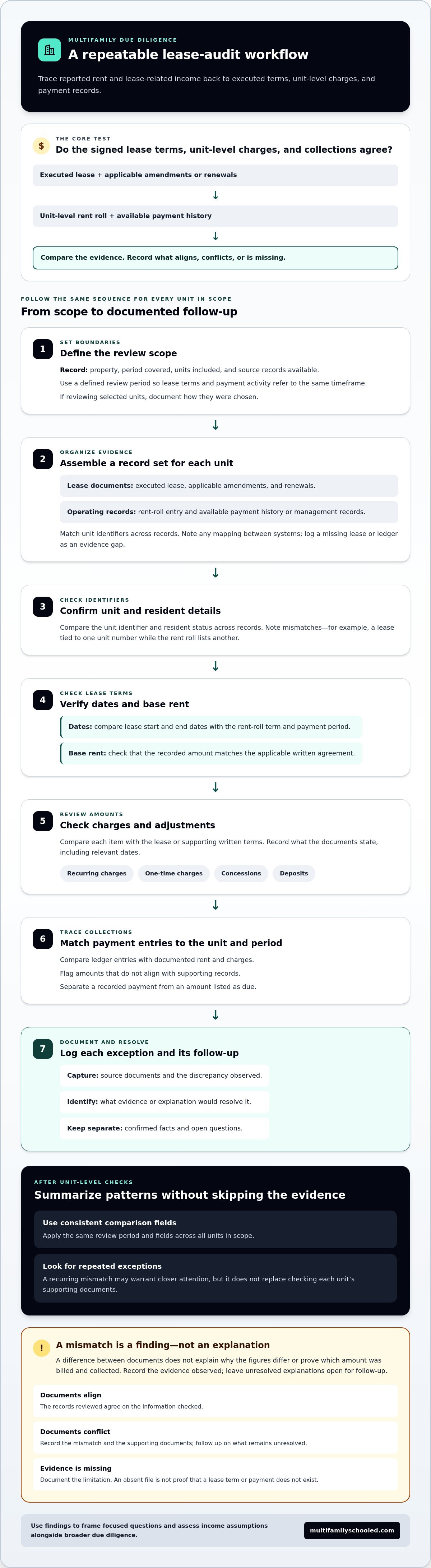
A practical multifamily lease audit defines the review period, gathers unit-level records, compares signed terms with recorded charges and payments, logs exceptions, and follows up on unresolved differences. Use the same sequence for every unit in scope so the results are easier to trace and compare.
Set the scope and assemble unit files
Before comparing figures, establish the boundaries of the review. Record the property, period covered, units included, and source records available. A defined period prevents you from mixing lease terms from one timeframe with payments from another. If you’re reviewing selected units rather than the full property, document how you chose them.
Build a file or clearly labeled record set for each unit. Match the unit identifier across the executed lease, applicable amendments or renewals, rent-roll entry, and available payment history. Identifiers may differ between systems, so note any mapping you use. If a lease or ledger is missing, log it as an evidence gap. Don’t assume the rent roll is correct to fill in absent terms.
Reconcile terms, charges, and collections
Once the unit files are organized, compare the documents field by field. Start at the unit level. After checking each individual record, you can assess patterns across the property.
- Confirm unit and resident details. Compare the unit identifier and resident status across records. Note mismatches, such as a lease tied to one unit number while the rent roll lists another.
- Check lease dates and base rent. Compare the lease start and end dates with the rent-roll term and the period of payment activity. Verify that the recorded base rent matches the applicable written agreement.
- Review additional amounts. Compare recurring charges, one-time charges, concessions, and deposits with the lease or supporting written terms. Record what the documents state, including relevant dates, instead of relying on a summary alone.
- Trace payment entries. Match ledger entries to the unit and review period. Flag amounts that don’t align with documented rent or charges, and distinguish a recorded payment from an amount merely listed as due.
- Log and follow up on exceptions. For each mismatch or missing record, note the source documents, the discrepancy, and what evidence or explanation would resolve it. Keep confirmed facts separate from open questions.
Apply the same review period and comparison fields across all units in scope. Then summarize repeated exceptions, such as the same charge mismatch appearing in multiple records. A pattern may warrant closer attention, but it doesn’t replace checking each unit’s supporting documents.
This workflow makes how to conduct a multifamily lease audit a repeatable due-diligence practice rather than a one-off search through files. To build broader deal-evaluation skills alongside this process, explore multifamily investing education.
Which Lease Audit Discrepancies Matter Most to Multifamily Investors?
Prioritize exceptions that could change your view of documented income, then resolve record inconsistencies that make the evidence difficult to trust. A mismatch is a signal to investigate, not automatic proof that rent was lost or a charge was wrong. Compare the same unit and review period, and capture the source behind each finding.
Income and charge differences to investigate
Start with rent and collections, then review other charges that may affect reported income. Check concessions, recurring and one-time fees, deposits, and secondary income entries against written terms and supporting records. Track deposits separately from rent and other income. Compare reported collections with recorded payments for the same period, and note timing or classification differences that may explain an apparent gap.
| Record field | Mismatch example | Supporting evidence | Follow-up question |
|---|---|---|---|
| Base rent | Lease rent differs from the rent roll. | Executed lease, amendments, rent-roll entry | Which written term applies during the review period? |
| Collections | Reported collections don’t match ledger payments. | Payment ledger and period-specific reporting | Are the dates and unit records aligned? |
| Concession | A rent credit appears in the ledger but not the lease file. | Lease, addendum, or written concession record | What document supports the amount and period? |
| Recurring fee | A fee is recorded without a matching written term. | Lease clause or applicable addendum | Where is the charge authorized in the records? |
| One-time charge | A charge appears in the ledger without supporting documentation. | Ledger entry and relevant written record | What event or term explains this entry? |
| Deposit | Recorded deposit differs from the lease file. | Lease and available deposit records | Do the records describe the same amount and unit? |
| Secondary income | An income entry has no matching support in the reviewed file. | Relevant agreement and transaction record | What source supports the entry for this period? |
Lease and unit-record inconsistencies to resolve
Administrative exceptions can undermine confidence in a comparison even when no income impact is clear. Check unit identifiers, resident status, lease dates, and term details across the file. Flag missing signatures, amendments, or renewals, and record which document is absent. Keep maintenance-responsibility differences separate from rent and collections. They may need review, but they aren’t proof of an income discrepancy.
A verified discrepancy is a mismatch supported by reviewed records; an unresolved question is a gap those records can’t yet explain. Preserve that distinction in your notes. For example, a rent-roll amount that conflicts with an executed lease is a documented mismatch, while a missing renewal leaves the applicable term unresolved. In how to conduct a multifamily lease audit, this distinction keeps follow-up focused on evidence instead of treating every exception as a confirmed loss. Record the competing values, source documents, review period, and next question so findings can be evaluated consistently.
How to Prioritize Findings and Document Follow-Up
A discrepancy log turns individual exceptions into a clear due-diligence record. It shows what you reviewed, what remains uncertain, and which issues could influence your view of the property’s income. Use one row for each finding, even when several findings involve the same unit. This makes follow-up easier to assign and shows whether a concern is isolated or repeated.
Create a clear discrepancy log
Use consistent fields so findings can be reviewed and updated without losing context. Capture the exact lease clause or data field involved, and cite the documents compared. Avoid reducing a detailed lease term to a vague label when the wording matters to understanding the issue.
- Unit: Record the unit identifier as it appears in the reviewed records.
- Issue: Describe the mismatch or evidence gap in neutral, specific language.
- Source documents: Name the records and relevant pages, fields, or dates.
- Financial category: Identify whether the item relates to rent, a fee, a concession, a deposit, collections, or a non-income matter.
- Status: Mark it as confirmed, open, resolved, or limited by missing documentation.
- Next action and owner: Note who will follow up, what evidence is needed, and the next step.
For example, if a rent-roll entry differs from the executed lease, record both figures and cite the applicable lease term and rent-roll field. If a renewal is missing, don’t mark the rent as incorrect. Label the applicable term unresolved and identify the renewal document as evidence needed. Update the same row when new information arrives so the record retains its history.
Prioritize and turn findings into questions
Rank findings using three practical tests: how strong the supporting evidence is, whether the issue could affect income assumptions, and whether the same exception appears across multiple units. A clear mismatch between written rent terms and recorded amounts deserves focused attention. A missing document may also matter, but it remains an evidence limitation until resolved, not proof of a loss.
Ask focused questions that point to evidence: What record explains the difference? Does it apply to this unit and review period? Is the explanation documented? If similar exceptions recur, group them to investigate whether they reflect a shared recordkeeping pattern, while retaining each unit’s individual support. Keep confirmed findings, open questions, and missing-document limitations distinct in summaries.
Use the audit log to inform relevant income assumptions in your investment analysis, not to replace broader underwriting. Focus on whether a finding is supported and what remains uncertain; don’t turn the log into a second full deal model. To connect lease findings with broader deal evaluation, use the multifamily investment toolkit as a related investment resource.
Use Lease Audit Findings to Make a More Informed Investment Decision
A lease audit earns its place in due diligence when its findings change how carefully you treat the income information in front of you. Carry the evidence into your investment review, but keep three categories distinct: verified lease facts, unresolved questions, and missing records. Each category supports a different conclusion.
Carry verified evidence into your investment review
Keep the source documents with the discrepancy log so another person can trace a finding back to the relevant lease, amendment, rent-roll field, or payment record. When summarizing a result, state what the documents show and identify the period and units reviewed. This creates a transparent trail from the evidence to the assumption used in your analysis.
Use confirmed findings to assess whether reported income is supported by the reviewed agreements and records. Treat open questions differently. If a rent amount conflicts across records and the explanation isn’t documented, don’t silently choose the figure that best fits the deal. Note the conflict and revisit the affected assumption when you have more evidence. A missing amendment limits what you can verify; it doesn’t prove a particular lease term.
This distinction matters when assessing a property’s income potential. A confirmed mismatch may warrant a change to an assumption; an unresolved item may call for further investigation or a more cautious view; missing records may limit confidence in the information reviewed. The effect depends on the evidence and scope. A lease audit alone can’t establish overall property performance, predict future results, or guarantee investment performance. It’s one part of broader due diligence, alongside other relevant financial and property review.
Build your multifamily investing knowledge
Lease review is one practical part of evaluating an apartment opportunity. It helps you test the support behind lease-related income, while broader analysis considers the property and investment from other angles. Keep those tasks connected, but don’t treat a lease audit as a substitute for underwriting or a complete assessment of the deal.
If you’re building foundational knowledge, Multifamily Schooled’s free e-book, “The Perfect Guide to Understanding Apartment Investing,” introduces the broader investment process. Understanding how document review fits into that process makes it easier to interpret findings without overstating what they prove. Follow the evidence, label assumptions clearly, and keep unanswered questions visible as you evaluate the opportunity.
To build your knowledge beyond lease review, explore Multifamily Schooled’s multifamily investing resources.
Make Evidence Your Next Investment Advantage
Turn careful review into a lasting investment habit. Use the questions raised by each audit to sharpen what you look for in future deals, and keep building your ability to distinguish supported income from assumptions that still need answers. That discipline can help you approach each opportunity with greater clarity, without treating a lease review as a guarantee of performance.
Learning how to conduct a multifamily lease audit is one part of becoming a more informed apartment investor. Justin Brennan has been active in real estate since 2006, and Multifamily Schooled states that it has helped 1,000+ students build their multifamily investing knowledge. Keep developing your skills with education focused on evaluating apartment opportunities.
Explore Multifamily Schooled’s multifamily investing resources to continue building your investment knowledge.
Frequently Asked Questions
What is a multifamily lease audit?
A multifamily lease audit is a document-based check of whether lease information matches the records used to bill and track residents. For investors learning how to conduct a multifamily lease audit, the key is tracing a figure back to its source. If a rent-roll amount differs from the signed agreement, for example, the audit records the difference and identifies what evidence could explain it. It doesn’t assess building condition.
How often should multifamily leases be audited?
There’s no single review schedule that fits every property or investment situation. Investors can include a lease review during acquisition due diligence, then set a consistent interval based on the property’s needs and available records. Consider another review after a change that affects lease records, such as a system migration or significant batch of renewals. Use comparable periods and scope so results can be tracked meaningfully.
What documents do I need for a multifamily lease audit?
Gather signed leases and any available amendments, renewals, or addenda, along with a rent-roll snapshot and payment history for the same review period. Supporting records for concessions, fees, deposits, or other charges can help explain entries. Preserve the report date and file version for each export, especially if records may change during review. If a key document is absent, list it as missing rather than substituting an informal note.
What should I look for when reviewing a multifamily lease?
Check that the document identifies the intended unit and residents, then review the rent amount, lease dates, term, and written provisions tied to charges or concessions. Confirm that amendments are associated with the correct lease and period. Pay attention to unclear or incomplete entries, such as a fee listed in an addendum without an effective date. Record the exact clause or field so another reviewer can locate it quickly.
Can a lease audit reveal rent-roll errors?
Yes. Comparing rent-roll entries with executed lease documents can reveal differences in rent, dates, unit identifiers, or lease status. For instance, a rent roll may show a current term while the file contains only an expired agreement. That comparison identifies an exception, not necessarily its cause. Look for a later renewal or correction before deciding which record is reliable, and document the evidence used to resolve the mismatch.
How do I prioritize discrepancies found in a lease audit?
Start with exceptions that have clear documentary support and could affect income assumptions. Then assess whether similar issues appear across multiple units, which may signal a broader recordkeeping pattern. Keep missing documents and unexplained entries visible, but don’t label them confirmed errors. A practical priority note can state the evidence strength, possible relevance to income, number of units affected, and the specific record or explanation needed next.
Can software conduct a multifamily lease audit?
Software may help organize records or compare data fields, depending on the tools and information available, but an automated flag still needs context. A system may identify different rent amounts without knowing whether an amendment explains the change. MFScout.ai supports deal-finding, analysis, and capital raising, and its Light Deal Analyzer can analyze a deal in one minute, delivering IRR, cash-on-cash, and other metrics. Use software output as a review aid, not proof that a charge is correct or incorrect. Keep references to original documents so each flagged item can be checked.
Is a lease audit the same as multifamily due diligence?
No. A lease audit is one focused part of multifamily due diligence, centered on lease documents and related operating records. Broader due diligence can involve other aspects of the property and investment that a lease review doesn’t establish, such as physical condition or the complete financial picture. Treat audit findings as evidence for specific assumptions, then assess them alongside the other information needed to evaluate the opportunity.



