

How to Calculate IRR for a Real Estate Investment: The Investor’s Guide
Most investors are flying blind because they're obsessed with the wrong metrics. You might know your monthly cash flow, but if you can't see the total lifecycle of your capital, you're leaving your wealth to chance. It's time to stop guessing and start dominating. This guide shows you exactly how to calculate IRR for a real estate investment so you can hunt down high-yield multifamily deals with surgical precision. In a 2026 market where the "One Big Beautiful Bill Act" has made 100% bonus depreciation a permanent game-changer, understanding your internal rate of return is the difference between a mediocre return and a massive exit.
We know the math feels intimidating. It's easy to get lost in the weeds of ROI versus Cash-on-Cash while the fear of overpaying keeps you on the sidelines. You want to pitch deals to partners with absolute confidence and see your long-term growth before you even sign the contract. This article is your roadmap to mastery. You'll learn to strip away the confusion, automate your analysis process, and use IRR as a high-speed filter for every property that crosses your desk. Let's turn that data into a blueprint for your financial empire.
Key Takeaways
- Master the "gold standard" of real estate metrics to compare disparate assets and measure the true annualized growth of your capital.
- Learn exactly how to calculate IRR for a real estate investment by organizing your initial outlay and projected cash flows into a clear, chronological roadmap.
- Stop confusing immediate "lifestyle" income with long-term "wealth" growth by mastering the critical differences between Cash-on-Cash returns and IRR.
- Use a precise, step-by-step analysis method to identify high-yield deals quickly and avoid the fatal mistake of overpaying for a property.
- Pivot from professional student to professional owner with a proven system designed to take you from analysis to closing in just 90 days.
Beyond the Formula: What IRR Really Tells You About a Real Estate Deal
Stop looking at static numbers; static numbers lie. You need to see the velocity of your capital. Knowing how to calculate IRR for a real estate investment gives you the power to see into the future of a deal. It isn't just a boring percentage on a spreadsheet. It represents the Internal Rate of Return (IRR), which is the annualized effective compounded rate of return you'll earn over the entire life of the asset. This is your ultimate filter for high-yield opportunities.
This is the gold standard for a reason. It allows you to compare a five-unit apartment building in the Midwest with a massive syndication in the Sunbelt. It levels the playing field. While other metrics look at a single moment in time, IRR tracks the momentum of your capital from day one to the final exit. It turns complex math into a massive competitive advantage.
To better understand this concept, watch this helpful video:
Shift your focus from complex math to actual momentum. Most beginners get paralyzed by the formula. They spend weeks staring at spreadsheets instead of making offers. IRR isn't here to slow you down. It's here to speed you up. Once you understand the flow of capital, you can scan a pro forma in seconds. You'll know immediately if a deal has the legs to reach your goals or if it's a waste of your time. Mastery leads to speed, and speed leads to ownership.
The Time Value of Money (TVM) Explained
Timing is everything. A dollar received today is worth more than a dollar received five years from now because you can reinvest that dollar immediately. Simple ROI ignores this reality. It treats every dollar the same regardless of when it hits your bank account. IRR fixes this by discounting future cash flows back to their present value. The time value of money is the core engine of the IRR calculation.
Why Multifamily Investors Prioritize IRR
Apartment buildings are complex machines. Unlike a single-family flip where you just hope for a quick price jump, multifamily deals have moving parts like rent bumps and massive tax benefits. The 100% bonus depreciation reinstated by the One Big Beautiful Bill Act accelerates your early returns. This front-loading of cash skyrockets your IRR. If you want to raise capital or pitch to partners, you must master how to calculate IRR for a real estate investment. It proves you understand how to build long-term net worth. This is your blueprint for economic empowerment.
The 3 Pillars of an IRR Calculation: What Data You Need First
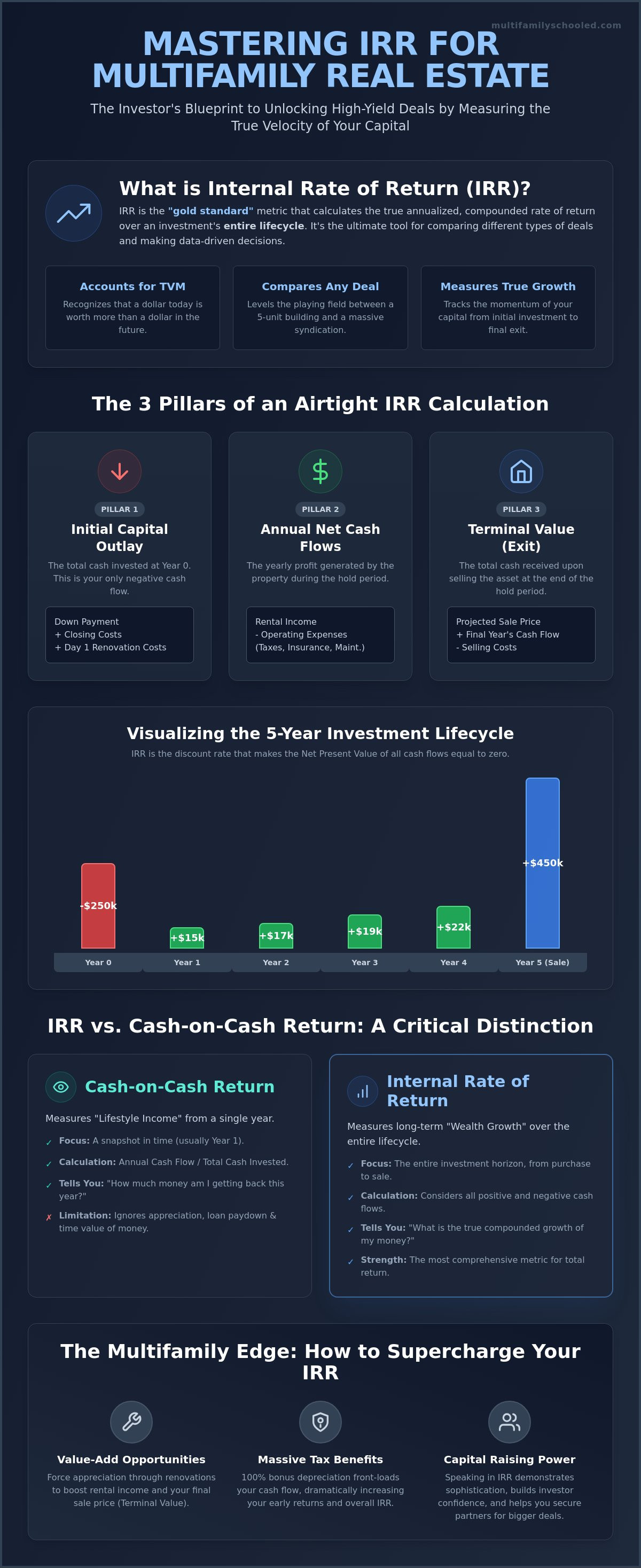
You can't build a financial empire on a foundation of guesswork. Before you can master how to calculate IRR for a real estate investment, you must gather your raw materials. These are the three pillars that hold up every successful analysis. If your data is weak, your projections will fail. You need to be a shark with your spreadsheets because numbers don't have feelings; they only have consequences. Start by identifying your initial capital outlay. This isn't just your down payment. It includes closing costs and every dollar of immediate "Day 1" repairs. This is your Year 0 investment. It's the fuel you're putting into the machine.
Next, you must project your annual net cash flows. This is your rental income minus every single operating expense. Taxes, insurance, management fees, and maintenance are the usual suspects. Finally, you need your terminal value. This is the projected sale price at the end of your hold period. Most investors get lazy here. They assume the market will always be better when they exit. That's a dangerous game. Use a conservative exit cap rate to ensure your deal still makes sense even if the market cools down. To automate these projections and keep your data airtight, consider using a professional Multifamily Tool Kit designed for precision.
Estimating Cash Flows for Value-Add Plays
In a value-add deal, your cash flow won't be a straight line. Renovations will temporarily increase your vacancy rates. You're trading short-term stability for long-term momentum. Your year-over-year IRR projections must account for these dips. As you renovate units and bump rents, your Net Operating Income (NOI) becomes the primary driver of your return. Every dollar you add to the NOI through better management or upgrades multiplies your wealth upon exit. Don't forget to factor in management fees even if you plan to self-manage. Your time has a price.
The Exit Strategy: Predicting Your Terminal Value
The sale price usually accounts for the largest chunk of your IRR. It's the "big payday" that rewards your patience. To get this right, look at current market data but build in a safety margin. If the national median home price is around $400,000 today, don't assume a 10% annual increase for the next five years. Aggressive appreciation assumptions are the fastest way to overpay for a property. Project your exit based on a slightly higher cap rate than what you see in the current market. This protects your downside while keeping your eyes on the prize of financial independence.
How to Calculate IRR for Real Estate: Step-by-Step Methods
Stop being a spectator. It's time to get your hands dirty with the data. Learning how to calculate IRR for a real estate investment is your first step toward true economic empowerment. You need a systematic approach to turn raw numbers into a clear signal to buy or walk away. Follow this blueprint to master your analysis with speed and precision.
- Step 1: List your cash flows. Create a chronological timeline from Year 0 to your projected exit. Include every dollar that enters or leaves your bank account.
- Step 2: Mark Year 0 as negative. This is your initial capital outlay. It includes your down payment, closing costs, and immediate capital expenditures. If you don't show this as a negative, the math won't work.
- Step 3: Run the baseline. Use the Excel =IRR function to get a quick pulse on the deal. This gives you an immediate annualized return based on your projections.
- Step 4: Scale with professional tools. Multifamily deals have too many moving parts for basic formulas. Use dedicated software to handle complex tax benefits and debt structures.
The Excel Method: A Quick Tutorial
Clarity is your best friend when pitching to partners. Format your spreadsheet so it's easy to read at a glance. A common rookie mistake is skipping years with zero cash flow. Don't do it. Every year needs a cell, even if the value is $0. If your cash flows don't happen on a perfect annual schedule, use the XIRR function. This allows you to input specific dates for each distribution. It's more accurate and shows you're a professional who respects the time value of money.
Software vs. Spreadsheets: Speeding Up Your Analysis
Manual spreadsheets fail in fast-moving markets. If you're still typing every expense into a cell, you're already behind. The pros are using AI and automation to scan hundreds of properties while you're still stuck on one pro forma. You need to analyze 100 deals to find the one that actually hits your IRR target. Speed is your greatest weapon. Leverage Real Estate Radar to automate your deal finding and analysis. This tool allows you to filter for high-yield opportunities in seconds. Stop wasting time on manual entry and start focusing on closing deals. The market doesn't wait for people who move slow. Get the right tools and take control of your financial future today.
IRR vs. Cash-on-Cash Return: Which Metric Should Drive Your Decision?
You need to know exactly what game you're playing. Are you looking for a paycheck today or a legacy tomorrow? Cash-on-Cash (CoC) is your lifestyle metric. It's the cold, hard cash hitting your bank account every month to pay your bills and fund your freedom. IRR is your wealth metric. It tracks the total velocity of your money from the moment you buy to the moment you exit. Knowing how to calculate IRR for a real estate investment ensures you aren't just surviving; you're building an empire.
Don't let a single number blindside you. A high IRR can sometimes hide a dangerously low CoC. If a property has zero cash flow for three years but a massive projected sale price, your IRR looks like a winner on a spreadsheet. But you can't pay your mortgage with projected sale prices. Conversely, a high CoC might come from a property in a declining area with no appreciation potential. You're just treading water while your asset loses value. You must use both metrics to see the full picture of a deal's health.
Skeptics often claim that IRR is too easy to manipulate. They're right. If you use aggressive exit assumptions or "hope-based" appreciation, you can make any bad deal look like a goldmine. Professional investors don't play that game. We use conservative exit cap rates and verified market data to keep our projections grounded in reality. Accuracy is your greatest protection against overpaying.
When to Prioritize Cash-on-Cash
Prioritize CoC when you need immediate replacement income to walk away from your 9-to-5. If you're in the first 90 days of your transition into full-time investing, you need cash flow to stay in the game. CoC gives you that immediate feedback. However, remember its limits. CoC ignores the massive wealth created through mortgage paydown and the tax advantages of bonus depreciation. If you only chase CoC, you'll leave the biggest part of your net worth on the table.
The "Total Return" Mindset
The most successful owners operate with a total return mindset. They balance immediate cash needs with long-term IRR goals. You use CoC to stay liquid and IRR to get wealthy. When you're pitching to equity partners, this distinction is vital. Some partners want monthly checks while others are hunting for a 2X equity multiple on exit. You need to speak both languages to close big deals. To keep your analysis sharp and your reporting professional, leverage the Multifamily Tool Kit. It provides the standardized frameworks you need to present your deals with absolute authority.
Stop over-analyzing and start taking action. Join our Mentorship Program today to get the exact blueprint for finding, analyzing, and closing high-yield multifamily deals with speed and precision.
Master Your Deal Analysis: From Math to Ownership in 90 Days
Knowledge without execution is just a hobby. You've now mastered how to calculate IRR for a real estate investment, but that knowledge only has value when it's applied to a real property. It's time to stop being a professional student. The market in 2026 is moving fast. With commercial real estate investment projected to hit $562 billion this year, you can't afford to sit on the sidelines. You need to move from analysis to ownership. The best IRR you'll ever see is the one on a deal you actually close. Guesswork is the enemy of progress. You need a proven system that replaces hesitation with a specific blueprint for success. Ownership is the only path to the economic empowerment you've been chasing.
The 90-Day Challenge: Finding Your Deal
Speed of analysis is your greatest competitive advantage. In a market where multifamily demand remains high due to a national housing affordability index of 110.6, the best deals disappear in hours. You now have the tools to filter deals in minutes. Use your IRR knowledge to gut-check every pro forma that hits your inbox. If the numbers don't scream "buy," move on immediately. Don't waste time on mediocre assets that won't move the needle for your net worth. You have 90 days to find, analyze, and lock down a deal. If you want to accelerate this process and get direct feedback on your analysis from experts who have been there, join our Mentorship Program. We'll show you how to find the diamonds in the rough before your competitors even open their spreadsheets. Stop guessing and start closing.
Taking the Next Step Toward Financial Freedom
You've gone from being intimidated by complex formulas to mastering the gold standard of real estate metrics. This is the foundation of your financial independence. But a foundation is just a slab of concrete until you build on it. Take immediate action today. The "One Big Beautiful Bill Act" has handed you a massive tax gift with 100% bonus depreciation. This is your chance to skyrocket your early-year returns and crush your wealth goals. Don't let this opportunity slip through your fingers while you wait for the "perfect" moment. Start your journey toward asset accumulation right now. Visit the Multifamily Schooled Store for the specific training resources and tools you need to dominate your market. Your future self is waiting for you to make this move. Close the gap between where you are and where you want to be. The time for economic empowerment is here.
Stop Analyzing and Start Closing
You have the blueprint. You've mastered the pillars of data and the chronological math required to see the true velocity of your capital. Understanding how to calculate IRR for a real estate investment is your ticket out of the spectator stands and into the owner's box. Don't let another 90 days pass while you're still "studying" the market. The tools are in your hands; it's time to build your legacy.
Justin Brennan, a multi-generational industry expert, has designed a proven system to move you from analysis to closing in record time. You don't have to guess. You don't have to fly blind. With our proprietary deal-finding software and strategic mentorship, you'll identify high-yield opportunities before the rest of the market even wakes up. Success is a choice; make yours today. Join the Mentorship Program and find your first deal in 90 days.
Your journey to economic empowerment starts with a single decisive action. The market is ready for you. We are ready for you. Let's get to work.
Frequently Asked Questions
What is a good IRR for a multifamily real estate investment in 2026?
A strong IRR in the 2026 market generally lands between 13% and 18% for value-add multifamily deals. With mortgage rates stabilized in the mid-6% range, you need a spread that compensates for the risk. Don't chase vanity numbers. Ensure your projections are grounded in current average rents, which currently sit between $1,661 and $1,750 per month. High-energy investors aim for the upper end of this range to build true wealth.
Can IRR be negative, and what does that mean for my investment?
Yes, a negative IRR means your total cash distributions and final sale price are less than your initial investment. It's the ultimate red flag. This happens when you overpay for a property or when vacancy rates crush your Net Operating Income. If you're learning how to calculate IRR for a real estate investment, use this as a shield to avoid toxic deals. It's better to stay liquid than to lock capital into a sinking ship.
How does the holding period affect the IRR calculation?
The holding period is the primary lever of your return because of the time value of money. Shorter holds typically produce higher IRRs if you force appreciation quickly, but they also carry higher transaction costs. A five to seven year hold is the sweet spot for many multifamily owners. It provides enough time to execute a value-add strategy and benefit from the 100% bonus depreciation rules reinstated in 2025.
What is the difference between IRR and Equity Multiple?
IRR measures the velocity of your money, while the Equity Multiple measures the total cash returned regardless of time. If you turn $100k into $200k in two years, your IRR is massive. If it takes ten years, your IRR drops even though the Equity Multiple is the same 2.0x. You need both to understand your economic empowerment. Don't ignore the clock because time is the one asset you can't buy back.
Is IRR the same as ROI (Return on Investment)?
ROI is a simple snapshot, but IRR is a movie that accounts for the timing of every dollar. ROI tells you the total percentage gain without caring when the money arrived. IRR accounts for every dollar's arrival date, making it the gold standard for multifamily owners. When you master how to calculate IRR for a real estate investment, you'll see why a dollar today is always worth more than a dollar tomorrow.
Why do investors use IRR instead of just looking at the profit?
Investors use IRR because profit is a static number that ignores the duration of the investment. A $50,000 profit sounds great, but it's mediocre if it took ten years to achieve. IRR forces you to look at the annualized efficiency of your capital. It tells you exactly how hard your money is working for you compared to other assets like stocks or bonds. Profit is the destination, but IRR is the speed.
How do I account for taxes in my IRR calculation?
Account for taxes by calculating your "After-Tax IRR" using current 2026 rates. Factor in long-term capital gains rates of 15% to 20% and the 25% maximum rate for depreciation recapture. The permanent 100% bonus depreciation makes this calculation even more vital for your exit strategy. Accurate tax projections ensure your wealth metric isn't an illusion that disappears when the IRS collects its share.
What happens to IRR if I refinance the property?
Refinancing usually causes your IRR to skyrocket because you're pulling out your initial capital. By replacing equity with debt, you reduce your remaining capital in the deal. Your return is then calculated against a much smaller "net" investment. This is a powerful strategy to recycle your capital into new deals while maintaining ownership and cash flow from the original asset. It's the ultimate move for rapid asset accumulation.



