

How to Build a Real Estate Portfolio: The Fast-Track Multifamily Blueprint for 2026
Stop collecting single-family houses and start building a real estate empire. Most investors stay stuck with one or two properties, paralyzed by the fear of a bad deal or a perceived lack of capital. You already know that traditional landlording is a slow grind that rarely leads to true independence. It's time to pivot. This guide reveals exactly how to build a real estate portfolio by leveraging high-impact multifamily investments in the 2026 market.
We agree that the old model of buying one house every few years is broken. You want financial freedom now, not in thirty years. I promise to give you the exact blueprint to scale from zero to a massive portfolio using a repeatable, proven system. We'll explore how to dominate the 2026 tax landscape, including the 100% bonus depreciation made permanent by the One Big Beautiful Bill Act. You'll learn how to stop the analysis paralysis and start using professional deal-finding software to secure your first apartment building in 90 days or less. Get moving. Your empire starts today.
Key Takeaways
- Stop wasting years on single-family houses and discover how to build a real estate portfolio that scales instantly through high-impact multifamily assets.
- Master the art of commercial valuation to control your wealth by increasing Net Operating Income (NOI) rather than waiting for market appreciation.
- Unlock strategic financing options like DSCR loans that prioritize property performance over your personal financial history to fund your empire.
- Implement a high-speed deal flow system to filter 100 properties and secure the one massive deal that replaces your active income.
- Follow a proven 90-day roadmap to move from analysis paralysis to total execution and secure your first apartment building.
What is a Real Estate Portfolio and Why the 'Slow Way' Fails?
A real estate portfolio is a curated engine of income-producing assets. It is not a collection of random properties. It is a strategic machine designed to replace your salary. Real estate investing requires a shift in mindset from owning property to operating a business. If your assets don't generate consistent cash flow, you don't have a portfolio; you have a collection of liabilities. Success requires a system that produces predictable results every single month.
Most beginners try to learn how to build a real estate portfolio by purchasing one single-family house every few years. This is a trap. It is called the Single-Family Ceiling. You hit a wall when banks stop lending based on your personal income. It takes thirty years to retire this way. You don't have thirty years to waste. The slow way is the risky way because it leaves you vulnerable to a single vacancy or one major repair.
To better understand this concept, watch this helpful video:
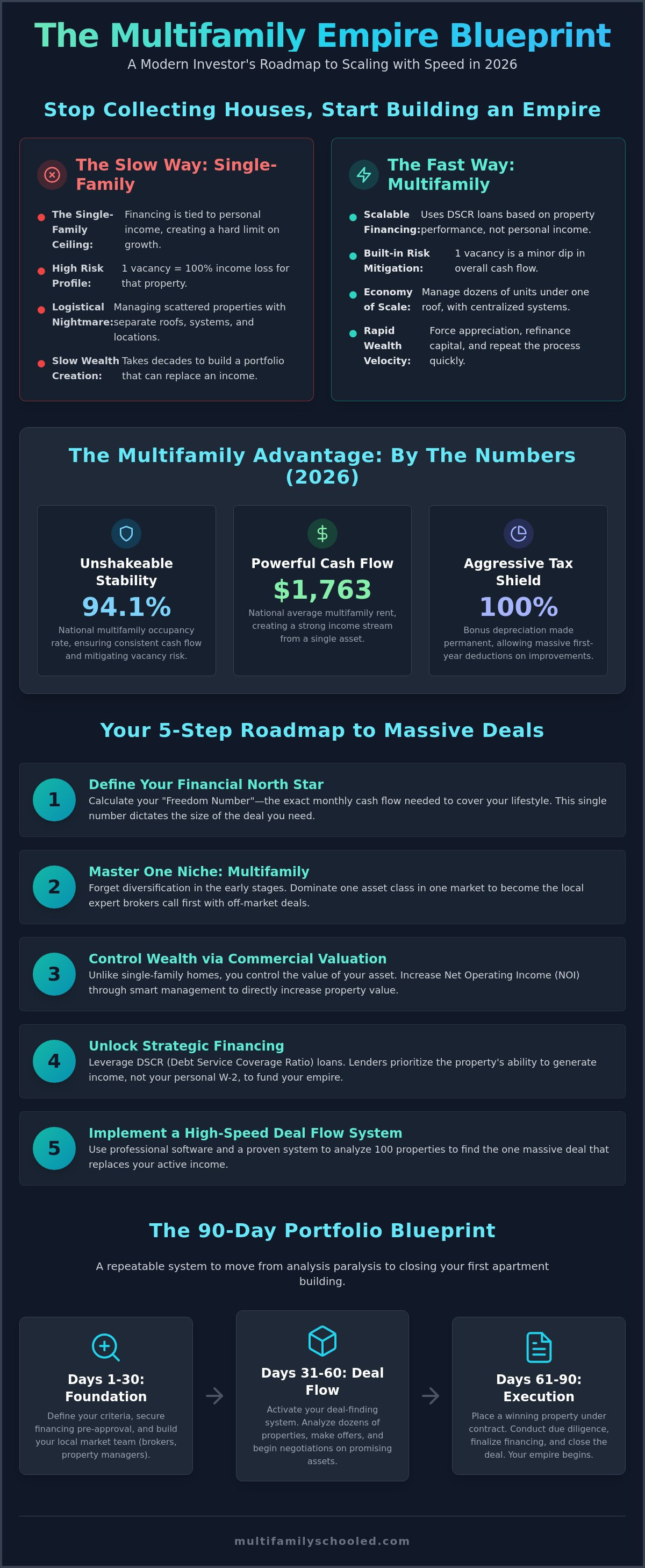
Stop treating real estate like a side hustle. Flipping houses is a job. If you don't find a new house to flip, you don't get paid. A true portfolio provides passive wealth that grows while you sleep. In 2026, the opportunity is massive. With the national average multifamily rent at $1,763 as of June 2026, the cash flow potential is higher than ever. The One Big Beautiful Bill Act (OBBBA) of 2025 changed the game by making 100% bonus depreciation permanent. This allows you to deduct the full cost of improvements in the first year. Commercial multifamily is the only way to scale with speed and efficiency.
Defining Your Financial North Star
You must have a target. Set a specific, non-negotiable income goal for your portfolio. Calculate your Freedom Number. This is the exact amount of monthly cash flow required to cover your lifestyle. If you need $12,000 a month, reverse-engineer your deal size. You might only need one 20-unit building instead of 20 separate houses. This is the first step in learning how to build a real estate portfolio that actually lasts. Stop dreaming and start calculating.
The Myth of Diversification in Early Stages
Diversification is for people who don't know what they are doing. Spreading your capital across different asset classes kills your momentum. Focus on one niche: multifamily. Mastery leads to scale. Use the power of Vertical Scaling within a single market. When you dominate one area, you see the off-market deals first. You build a reputation with local brokers. You win by being the expert, not a generalist. Focus equals power.
The Multifamily Advantage: Scaling Your Portfolio at Speed
Speed is the ultimate advantage in the 2026 market. If you want to know how to build a real estate portfolio that actually changes your life, you have to look at the math. Single-family homes are a trap for your time and capital. Managing twenty separate roofs, twenty HVAC systems, and twenty different zip codes is a logistical nightmare. Multifamily properties solve this problem instantly. You get twenty rent checks from one single location. This is the economy of scale in action, and it is the only way to grow without burning out.
Risk mitigation is the silent winner in this asset class. If a single-family rental goes vacant, your income drops to zero. You are 100% out of luck and paying the mortgage out of your own pocket. In a multifamily property, one vacancy is just a small dip in your monthly income. With the national multifamily occupancy rate holding at 94.1% as of June 2026, the stability is undeniable. You are building a winning real estate investment portfolio by prioritizing assets that don't fail when one tenant leaves.
This strategy also unlocks the velocity of money. You don't wait thirty years for a mortgage to disappear. You improve the property, increase the income, and refinance to pull your capital back out. Then you do it again. This is how empires are built in months, not decades. If you are ready to stop guessing and start executing, our Mentorship Program provides the exact roadmap to find these high-velocity deals.
One Roof, Multiple Checks
Commercial real estate is any residential property with 5 or more units. This distinction is critical. Once you cross this line, you are no longer at the mercy of personal debt-to-income ratios. You are running a business. Streamlining your management under one roof reduces overhead and protects your margins. You get more predictable cash flow because you have dozens of units absorbing the costs of operation. It's about working smarter, not harder.
Forced Appreciation: The Wealth Accelerator
In residential real estate, your house is worth what the neighbor's house sold for. That is luck. In multifamily, you control the value through forced appreciation. The formula is simple: Value equals Net Operating Income (NOI) divided by the Cap Rate. If you increase the laundry income or decrease the water bill, you aren't just saving pennies. You are adding thousands, or even millions, to the property's value. This is a skill-based wealth accelerator. It is the secret to how to build a real estate portfolio that scales at lightning speed.
Strategic Financing: Funding Your Real Estate Empire in 2026
Stop letting your personal bank account dictate your future. If you want to master how to build a real estate portfolio, you must understand that commercial lending is a different game. Your personal debt-to-income (DTI) ratio is irrelevant here. Lenders care about the asset. They want to see a property that produces enough income to cover its own debt. This is the ultimate shortcut to scaling without limits.
The secret weapon is the Debt Service Coverage Ratio (DSCR). Lenders look for a ratio typically above 1.2x. This means the property generates 20% more income than the mortgage payment. If the building performs, you get the cash. In 2026, programs like HUD 223(f) loans are more attractive than ever, offering terms up to 35 years and leverage up to 87% on affordable properties. You can also leverage Other People's Money (OPM). Use private capital to cover the down payment while you provide the expertise. This is how you close on a 50-unit building with zero of your own dollars in the deal.
Don't ignore seller financing. In the current high-interest environment, many owners are stuck with properties they can't sell at top dollar through traditional channels. Offer to take over their payments or pay them a higher interest rate than the bank. It's a win-win. They get a steady check. You get a massive asset without a traditional bank headache. This flexibility is essential for anyone serious about portfolio growth.
Mastering Commercial Loans
Success requires a professional approach. You need to present a Deal Package that lenders can't ignore. This includes a clear executive summary, a current rent roll, and the last 12 months of operating statements (T-12). If you lack a massive balance sheet, bring in a Key Principal. This is an experienced partner who signs on the loan to provide the required net worth and liquidity. Use their track record to secure the best rates. Multifamily rates currently range from 5.13% to 12.75% depending on property quality and location.
Raising Capital and Syndication
Syndication is the fastest way to learn how to build a real estate portfolio of institutional quality. You act as the General Partner (GP) while passive investors act as Limited Partners (LP). You find the deal and manage the asset. They provide the capital. Structure the deal with a preferred return to keep your investors happy and hungry for more. Staying organized is the only way to handle multiple investors and complex deals. Use the Multifamily Tool Kit to manage your data and keep your capital raises on track. Build the system. Scale the empire.
The 5-Step Roadmap to Your First (or Next) Massive Deal
Stop guessing. Start executing. If you want to master how to build a real estate portfolio, you need a repeatable system that removes emotion from the equation. Victory goes to the investor who follows a proven process. Most people fail because they wander aimlessly through listings. You won't be one of them. Follow these five steps to secure your empire.
First, identify your market. Look for the 'path of progress' where jobs are growing and supply is tight. In the second quarter of 2026, we saw a massive shift; demand finally outpaced new supply with 362,000 units absorbed compared to 358,000 delivered. This is the first time this has happened since early 2022. Target these high-absorption markets. Second, build your deal flow. You must see 100 deals to find ten worth underwriting and one worth buying. If you aren't looking at deals every day, you aren't in business.
Mastering Deal Flow with Technology
Waiting for the MLS is a recipe for failure. The best deals never hit the public market. They are traded in the shadows between brokers and elite investors. To win, you must go direct to the source. Use Real Estate Radar to identify off-market gems before your competition even knows they exist. Automate your lead generation. Set up systems that put property data in front of you while you sleep. A dry pipeline is the only thing that can stop your momentum. Keep it flooded.
Third, master the underwriting. This is where you prove the deal works on paper. Focus on the Cap Rate and your Cash-on-Cash return. Fourth, make the offer. Use specific, aggressive language. Show the seller you are a closer by having your financing lined up. Fifth, execute due diligence. Protect your portfolio from hidden liabilities by inspecting every unit and auditing every lease. Don't take the seller's word for anything. Verify everything.
Analyzing the Numbers Like a Pro
Speed is essential during the initial screening. Use the 'Quick Napkin Test' to see if a deal deserves a deep dive. If the gross rents don't cover the estimated mortgage and expenses with a healthy cushion, move on. Focus on Value-Add opportunities where you can raise rents or cut costs to spike the value. Net Operating Income (NOI) is calculated by subtracting all necessary operating expenses from the total income generated by the property. Increasing this single number is the fastest way to learn how to build a real estate portfolio that creates generational wealth. Ready to take the first step? Join our 5-Day Challenge and start your journey today.
Accelerate Your Success: The 90-Day Portfolio Blueprint
Success loves speed. Most people spend years thinking about how to build a real estate portfolio, but they never pull the trigger. In fact, 90% of solo investors quit within their first twelve months. They get buried in data or paralyzed by the fear of making one bad move. You don't have to be a statistic. The secret to winning in 2026 is moving from education to execution in a fixed, 90-day window. If you don't have a deal under contract in three months, your momentum will die.
You cannot build an empire alone. You need a team of experts who speak the language of multifamily. This includes commercial brokers who bring you off-market deals, lenders who understand DSCR requirements, and property managers who protect your Net Operating Income. Accountability is the glue that holds this together. Without a coach pushing you to hit your milestones, it's too easy to retreat to the comfort of your daily grind. Your financial freedom goals deserve a professional approach. Demand is currently outpacing supply for the first time in years; the window to act is now.
Why Mentorship is the Ultimate Shortcut
Mistakes in commercial real estate are expensive. One bad assumption in your underwriting can cost you hundreds of thousands of dollars. Rookies guess; professionals follow frameworks. By joining the Multifamily Mentorship Program, you get direct access to the exact systems used to scale portfolios at lightning speed. We provide the proven deal-finding software and the strategic guidance to ensure you don't trip at the finish line. We even guarantee the results. Find a deal in 90 days or we provide one for you.
Join the Multifamily Schooled Movement
The time for hesitation is over. The 2026 market is rebalancing. You have the tools. You have the blueprint. Now, you need the community. Start your journey with the 5-Day Multifamily Challenge to sharpen your skills and find your first deal. If you need specific resources or proprietary software to fuel your growth, visit the Multifamily Store to access our full ecosystem. Stop wondering how to build a real estate portfolio and start building your legacy today. The next 90 days will define your future. Take the first step.
Claim Your Financial Empire Today
The 2026 market is moving fast. You've seen why the single-family grind fails and how multifamily assets provide the ultimate shortcut to scale. Stop waiting for the perfect moment. Real wealth is built through forced appreciation and strategic commercial financing. Mastering how to build a real estate portfolio is no longer a mystery; it's a systematic process of market selection, underwriting, and execution. You have the blueprint. Now, you need the tools and the accountability to cross the finish line.
Led by industry veteran Justin Brennan, our program removes the guesswork. You'll gain immediate access to our proprietary Real Estate Radar software to find off-market gems before anyone else. We are so confident in our system that we offer a bold guarantee: find a deal in 90 days or we provide one for you. Don't let another year slip away in analysis paralysis. Take control of your legacy right now.
Start Your 90-Day Deal Hunt Now
Your freedom is closer than you think. Step up and build it.
Frequently Asked Questions
How much money do I really need to start a real estate portfolio?
You can start with as little as 3.5% down if you utilize an FHA loan for an owner-occupied 2 to 4 unit property. For larger commercial assets, you typically need 20% to 25% of the purchase price. However, you don't need to use your own cash. By leveraging syndication or private money partners, you can fund 100% of the deal while providing the expertise. Learning how to build a real estate portfolio is about your ability to find and structure deals, not the size of your personal bank account.
Is it better to invest in single-family or multifamily properties first?
Multifamily is the superior choice for anyone who wants to scale quickly. Single-family homes carry a 100% vacancy risk and limit your growth to one roof at a time. Multifamily properties offer economies of scale, allowing you to manage multiple units in one location and spread your operating costs. You also gain control over the property value through forced appreciation. Don't get stuck under the single-family ceiling when you can build a massive engine of passive income faster with apartments.
How do I find off-market real estate deals in 2026?
The best deals are found by using proprietary deal-finding software to target motivated sellers before they reach the public market. Direct-to-seller marketing and building deep relationships with commercial brokers are essential strategies for 2026. With demand outpacing supply, you must bypass the MLS to find gems with high value-add potential. Use technology like Real Estate Radar to identify properties with equity and high vacancy rates. Speed and data are your best friends in a competitive landscape.
What is a good debt-service coverage ratio (DSCR) for a portfolio?
A DSCR of 1.20 or higher is the standard requirement for most commercial lenders in 2026. This ratio proves that the property generates 20% more income than is required to pay the mortgage. Lenders prioritize the property's performance over your personal income. Aiming for a ratio of 1.25 or 1.30 provides a safer cushion for your cash flow and makes your deal package more attractive to banks. If the building doesn't hit these numbers, it's time to renegotiate the price or walk away.
Can I build a real estate portfolio while working a full-time job?
You absolutely can build a massive portfolio while maintaining your 9-to-5 by focusing on a systematic, time-bound approach. Use your evenings to analyze deals and your weekends to tour properties. The key is to hire professional property management so you aren't fixing toilets or chasing rent checks. Many of our most successful students use their full-time income to qualify for initial financing while they scale their passive wealth. Efficiency and the right systems make it possible to replace your salary in record time.
What are the biggest risks when building a multifamily portfolio?
The primary risks are poor underwriting and failing to account for capital expenditures. If you overpay for a property or ignore a failing roof, your margins will vanish. Higher interest rates in 2026 also make it difficult for sponsors who didn't plan for a refinance. Mitigate these risks by performing rigorous due diligence and auditing every lease before you close. Always maintain a healthy cash reserve to handle market fluctuations. A proven framework is your best defense against these common pitfalls.
How does real estate syndication work for beginners?
Syndication is a partnership where you pool capital from passive investors to buy large-scale apartment buildings. You act as the General Partner (GP) and handle the deal finding, financing, and management. Your investors act as Limited Partners (LP) and provide the equity. This is the fastest way to learn how to build a real estate portfolio of institutional-grade assets. It allows you to close on 50 or 100 units at once without needing millions of your own dollars. It's a game of scale and trust.
Is a real estate mentor worth the investment?
A mentor is the ultimate shortcut to avoiding million-dollar mistakes that rookies make. They provide you with the exact blueprints, proprietary tools, and the accountability needed to stay on track. Why spend years guessing when you can follow a system that has already been proven to work? Investing in a mentor like Justin Brennan ensures you have an expert in your corner to help you navigate complex deals. It's the difference between struggling for a decade and reaching financial freedom in 90 days.



