

How to Analyze a T12 Financial Statement: Master the Numbers in 2026
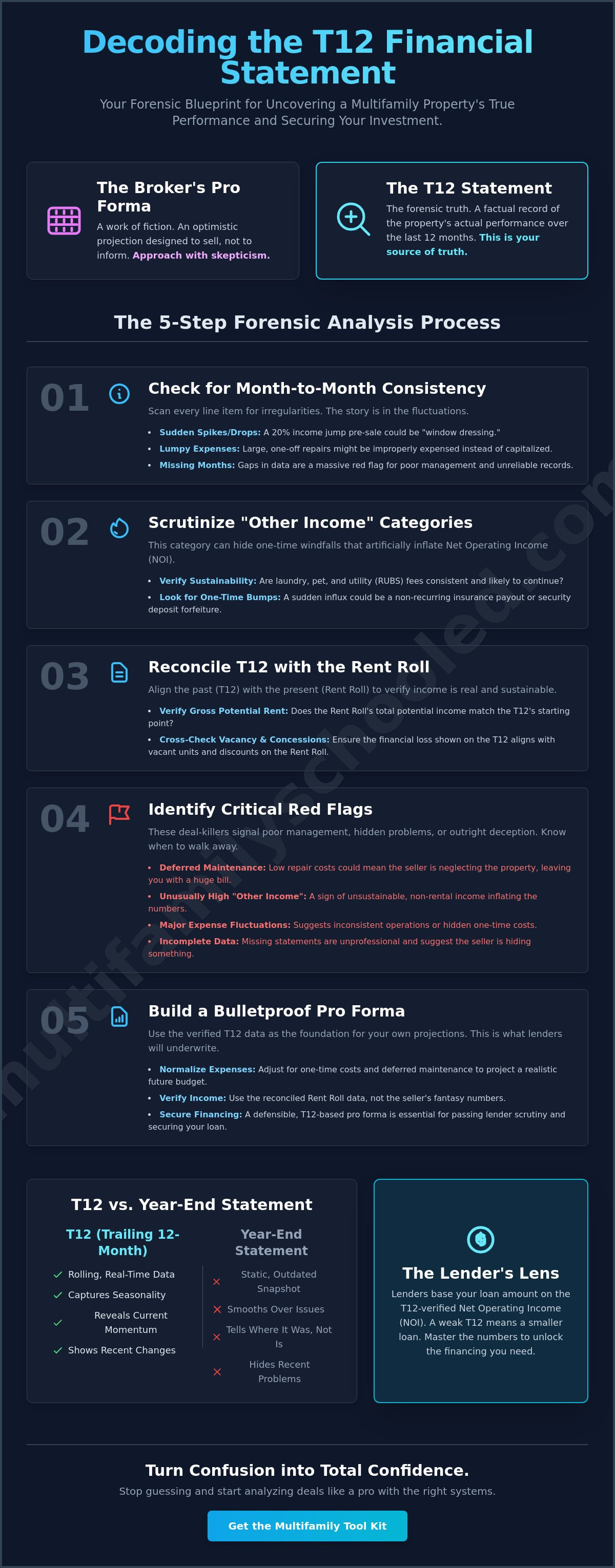
The broker's pro forma is a work of fiction, but the Trailing 12-Month statement is a forensic map of the property's absolute truth. You've likely felt that familiar dread while staring at a spreadsheet, fearing you'll overpay because you missed a massive expense buried in accounting jargon. It's exhausting to manually scrub data while wondering if the seller is hiding the real story. You deserve a system that turns confusion into total confidence.
Mastering how to analyze a T12 financial statement is the single most important skill for your journey toward economic empowerment. This guide gives you the exact blueprint to dissect these numbers so you can spot hidden risks and high-value opportunities before you commit your capital. You'll learn how to verify the actual Net Operating Income (NOI) and expose the "phantom" expenses sellers often try to mask. We're going to move past the guesswork and build a bulletproof pro forma that secures lender approval and protects your future. Let's dive into the forensic process and seize your next deal with total authority.
Key Takeaways
- Stop relying on outdated tax returns. Learn why the T12 is the heartbeat of any multifamily asset and how it reveals the property's true performance.
- Master the five-step forensic process of how to analyze a T12 financial statement to find the hidden story behind the seller's numbers.
- Align the past with the future. Reconcile your T12 data with the Rent Roll to ensure every dollar of income is verified and sustainable.
- Spot management malpractice before it's too late. Use our red flag checklist to identify deal-killers that signal it's time to walk away.
- Build a bulletproof pro forma with speed. Ditch manual data entry for professional systems that help you analyze deals faster than the competition.
What is a T12 Financial Statement and Why It Matters
The T12, or Trailing 12-Month statement, is the absolute heartbeat of your multifamily asset. It isn't just a boring report. It is a living record of every dollar that entered and exited the property over the last year. While a balance sheet gives you a frozen snapshot of assets and liabilities, the T12 shows you the momentum. It reveals the trends that either build multi-generational wealth or bleed your cash reserves dry. You must treat this document as a forensic map of the property's soul.
Don't make the amateur mistake of relying on tax returns like a Schedule E. Tax documents are designed for the IRS, not for high-level investors looking to seize a massive opportunity. They are often outdated by months or even a full year. If you want to master how to analyze a T12 financial statement, you must understand that real-time data is your greatest weapon. Without it, you aren't investing. You are gambling with your future. Demand the truth from the numbers before you commit a single cent of your hard-earned capital.
To better understand the core concepts of these financial reports, watch this helpful video:
T12 vs. Year-End Statements
Most sellers will try to hand you a year-end statement from the previous December. That is a trap. A T12 provides a rolling view that accounts for recent economic shifts and immediate management changes. It captures the seasonal fluctuations in utility costs and maintenance that a static report might smooth over. If a pipe burst in February, a T12 from June will show you that expense. A year-end report won't show it for another six months. Remember this: A year-end statement tells you where the property was; a T12 tells you where it is going. Use this foresight to protect your downside.
The Role of the T12 in Commercial Financing
Lenders are obsessed with the T12 because it's the foundation of the Debt Service Coverage Ratio (DSCR). They use this data to verify if the property generates enough cash to pay the mortgage. Your loan amount depends entirely on these numbers. If you don't know how to analyze a T12 financial statement, you won't be able to defend your valuation to a bank. Pros often pair this with a Schedule of Real Estate Owned (SREO) to prove their track record. If you can't defend the T12, you won't get the gold. Master the numbers to unlock the financing you need. Check our Multifamily Tool Kit for the systems you need to track these metrics like a pro.
How to Analyze a T12 in 5 Decisive Steps
Analyzing a T12 is not a passive task. It is an active sport that requires your full focus. Grab a highlighter and print the document. You are looking for the story behind the numbers, not just the bottom line. Brokers love to paint a perfect picture in their Offering Memorandum (OM), but the T12 exposes the gaps between their pro forma dreams and the property's reality. Compare the T12 line-by-line against the broker’s claims. If the OM says utilities are decreasing but the T12 shows a steady climb, you've found your first point of negotiation. Don't let a glossy brochure distract you from the hard data.
When you learn how to analyze a T12 financial statement, you are training your eyes to see what others miss. You aren't just checking totals. You are hunting for inconsistencies that signal either a massive opportunity or a hidden disaster. This systematic approach ensures you never overpay for a property based on fake performance. It's about taking control of the narrative before the seller does. Move quickly, but move with precision.
Step 1: Check for Month-to-Month Consistency
Scan every row for sudden spikes or drops. If income jumps 20% in the three months before the sale, the seller might be window dressing the property with aggressive collections or one-time fees. Look for lumpy repair costs. A $10,000 plumbing bill in October should probably be capitalized as a major improvement rather than expensed as routine maintenance. Missing months or erratic data entries are huge red flags. They suggest poor management and unreliable records that will make lenders nervous. You need a clean trail to build a solid deal.
Step 2: Scrutinize the "Other Income" Categories
Examine laundry, pet fees, and RUBS income carefully. These are great for boosting NOI, but they must be sustainable. A sudden influx of "Other Income" might actually be a one-time insurance settlement or a legal payout masquerading as recurring profit. Don't buy a deal based on income that won't be there next year. If you want to see how the pros filter these deals instantly, take a look at our Deal Finding Software to streamline your workflow and find the truth faster. Speed is the currency of this market.
Step 3: Normalize the Operating Expenses
You must normalize the statement to see how the property will perform under your ownership. Sellers often hide personal expenses like vehicle leases or cell phone plans in the property's books. Strip those out immediately. Ensure the property management fee is at a market rate. If the seller’s cousin is managing it for 2%, you need to adjust that to a realistic 4% to 8% for your pro forma. Move any non-recurring capital expenditures (CapEx) out of the Repairs and Maintenance line to reveal the true operating cost. This process turns a messy T12 into a clear vision of your future profit.
Reconciling the T12 with the Rent Roll
Your Rent Roll is a snapshot of the future. It tells you what the seller promises will happen next month. Your T12 is a forensic record of the past. It tells you what actually happened. To master how to analyze a T12 financial statement, you must force these two documents to speak the same language. If they don't agree, the seller is hiding a truth you can't afford to ignore. This is where most amateurs lose money. They trust the paper instead of the bank account.
Look for phantom tenants. These are names on the Rent Roll that don't show up as paying residents on the T12. This often happens when a manager keeps "occupied" units on paper to boost the sale price while the units sit empty or the tenants haven't paid in months. Never believe a Rent Roll that isn't backed by T12 bank deposits. Cash in the bank is the only metric that matters for your economic empowerment. If you can't find the deposit for a lease, that lease doesn't exist.
Spotting Vacancy and Concession Lies
Compare the Gross Potential Rent (GPR) on the T12 to the actual collections. Physical vacancy is just empty units. Economic vacancy is the real killer. It includes concessions, non-revenue units, and bad debt. It's the only number that dictates your Net Operating Income. Watch for concessions that are "burning off." If the seller gave one month free to fill the building, your income will drop the moment those leases renew. Verify the lease start dates. If the building was "stuffed" right before the sale, your vacancy will spike in twelve months. You need to know how to analyze a T12 financial statement to spot these traps before they become your problem.
The Bad Debt Deep Dive
Scrub the Bad Debt line item. This is rent that was billed but never arrived. If bad debt is higher than 2%, the management is failing. Don't be afraid of this number. High bad debt is often a prime Value-Add opportunity. It means you can increase the property value simply by installing a better screening process and tighter collections. Ask for an Aged Receivables report to see exactly who owes what and for how long. If you want to master this forensic process with a coach who has seen it all, join our Mentorship Program. We help you find the gold hidden in the data so you can buy with total confidence.
T12 Red Flags: When to Walk Away from the Deal
Red flags in a financial report aren't just warnings to stay away. They are your greatest tools for negotiation. When you master how to analyze a T12 financial statement, you stop being a victim of the seller's narrative and start dictating the terms of the deal. A red flag in the T12 is a green light for a price reduction, if you know how to ask. You are looking for the gap between what the property is doing today and what it could do under elite management. This is the foundation of your economic empowerment.
You must distinguish between management malpractice and market realities. Management issues, like high bad debt or missed utility billings, are fixable problems that represent massive upside for you. Market realities, such as a declining neighborhood or a permanent shift in local employment, are deal-killers. Use the T12 to expose the truth. If the seller is failing because they are lazy, buy the property at a discount. If the property is failing because the market is dying, walk away and keep your capital safe for a better opportunity.
Declining Income Trends
Watch the last three months of income (the T3) with extreme caution. If the T3 average is lower than the T12 average, the property is bleeding. This is often the start of a death spiral. Lower income leads to deferred maintenance, which leads to lower-quality tenants, which further tanks the income. Always annualize the T3 to see the current reality of the asset. Don't let a seller sell you on "average" performance when the most recent 90 days show a property in freefall. You need to buy momentum, not a sinking ship.
Understated Property Taxes
The number one mistake new investors make is ignoring the "tax pop." Sellers almost always show property taxes based on their old, lower purchase price. The moment you buy the property, the local tax assessor will revalue it based on your new purchase price. This can result in a 20%, 30%, or even 50% jump in your largest expense. Use the local tax assessor's site to pro forma the real tax bill. If the T12 doesn't account for this jump, your projected NOI is a lie. Protect your future by calculating the real numbers before you sign the contract.
Stop guessing and start winning by using a proven system to filter your deals. If you want to learn the exact forensic methods we use to find hidden gold in these reports, join our Mentorship Program today. We provide the blueprint for your success so you can seize the best multifamily opportunities in 2026 with total authority.
Accelerate Your Analysis with the Right Systems
Speed is the ultimate currency in the 2026 real estate market. While others are drowning in messy spreadsheets, you must be making offers. If you spend days trying to figure out how to analyze a T12 financial statement manually, you've already lost the deal to a faster, more systematic investor. Amateurs guess; pros follow a proven framework. It's time to stop treating your financial future like a hobby. Start treating it like the multi-generational wealth-building machine it is. You need to move from "thinking" to "doing" in record time to capture the best opportunities.
Manual data entry is a relic of the past that leads to fatigue and expensive errors. You deserve a system that empowers you to see the truth of a property instantly. By leveraging technology, you can filter through dozens of deals while your competition is still stuck on their first one. This isn't just about efficiency. it's about economic empowerment and seizing the lifestyle you've worked for. Multifamily Schooled acts as the bridge between your current state and your first major closing.
Leveraging the Multifamily Tool Kit
You cannot scale to 100+ units using a simple calculator and a prayer. You need a standardized "Deal Analyzer" that turns raw T12 data into actionable intelligence in minutes. Our Multifamily Tool Kit automates the heavy lifting. It scrubs the math, highlights the red flags we discussed earlier, and builds your pro forma instantly. This is the core of our 90-day system. It's designed to take you from a raw lead to a closed contract on a fixed, rapid timeline. When the math is automated, you can focus on building relationships and winning the negotiation. That is how you dominate your market.
Mentorship: The Ultimate Due Diligence
Even with the best software, the most dangerous part of any deal is what you don't know you don't know. A mentor is your ultimate safeguard against six-figure mistakes. When you learn how to analyze a T12 financial statement under the guidance of someone who has closed hundreds of millions in deals, you gain a decades-long edge in just weeks. Our Mentorship Program provides that second set of expert eyes. We don't just teach you the theory. We help you verify the truth of your specific deal before you commit your capital. This is the difference between a successful acquisition and a costly lesson.
Multifamily Schooled is the complete ecosystem you need to win. We provide everything from educational tiers to proprietary software. Don't let fear or data fatigue stop your progress toward independence. Seize the tools available to you. Master the T12. Close the deal. Change your life. Your future self is waiting for you to take this decisive step today.
Master the Truth and Claim Your Future
You now possess the forensic blueprint to look past a broker's fiction and find the absolute truth of any multifamily asset. Mastering how to analyze a T12 financial statement has moved you from an amateur observer to a sophisticated investor. You know how to spot the red flags others miss. You can reconcile every dollar against the Rent Roll with precision. This knowledge is the foundation of your long-term independence. Don't let this momentum go to waste.
The 2026 market moves fast. You need elite systems to keep pace. Led by multi-generational investor Justin Brennan, our ecosystem provides the proprietary deal finding software and expert guidance you need to win. We are so confident in our systematic approach that we offer a 90-Day Deal Guarantee. It's time to stop guessing. Start closing with total authority and professional speed.
Join the Mentorship Program and Find Your Deal in 90 Days
Your journey to accumulating massive assets starts with a single, decisive action. Take the leap today and build the prosperous life you've always envisioned. We are ready to help you win.
Frequently Asked Questions
What is the difference between a T12 and a T3?
A T12 covers the last 12 months of operations, while a T3 focuses only on the most recent 90 days. The T12 is essential for seeing seasonal trends like winter heating costs or summer pool maintenance. You use the T3 to see the property's immediate momentum. If the annualized T3 income is lower than the T12, the property is trending down, and you must investigate why before closing.
Can I use a T12 to get a commercial loan?
Yes, lenders require a T12 to verify the property's cash flow and ability to service debt. It is the primary document used to calculate the Debt Service Coverage Ratio (DSCR). Without a clean, verifiable T12, you won't secure competitive commercial financing. Banks need to see a consistent track record of income to justify the risk of the loan.
How do I calculate Net Operating Income (NOI) from a T12?
Subtract all operating expenses from the total effective gross income shown on the statement. Do not include mortgage payments, capital expenditures, or depreciation in this specific calculation. Learning how to analyze a T12 financial statement correctly ensures you find the true NOI. This number is the foundation of your property valuation and your future profit.
What are "add-backs" in a T12 analysis?
Add-backs are non-recurring or personal expenses the seller paid that won't exist under your ownership. Common examples include the seller's personal travel, one-time legal fees, or excessive owner draws hidden in the books. Removing these costs "adds back" profit to the NOI. This process reveals the property's true earning potential and helps you justify a higher valuation for your lenders.
Should I trust the "Pro Forma" numbers provided by a broker?
Never trust a broker's pro forma without forensic verification. These documents represent a "best-case scenario" designed to sell the asset at the highest possible price. Your job is to use the T12 to build your own pro forma based on hard reality. Use the historical data to challenge every assumption the broker makes about future rent growth or expense savings.
How often should I request a new T12 during due diligence?
Request an updated T12 every 30 days until the deal is closed. This prevents the seller from hiding a sudden dip in occupancy or a massive new expense right before you take over. Staying current with the data ensures you are buying the property based on its actual performance today. Don't let your information go stale during the final stages of the deal.
What happens if a seller refuses to provide a T12?
Walk away from the deal immediately. A seller's refusal to provide a T12 is a massive red flag that suggests financial distress or fraudulent reporting. You cannot verify the asset's value or secure a loan without this forensic map. Don't gamble your capital on a mystery asset. Real investors demand transparency and move on when it's not provided.
How do I identify capital expenditures (CapEx) in a T12?
Look for large, one-time spikes in rows like "Repairs and Maintenance" or "Unit Turnover." True CapEx items, such as a new roof or HVAC replacements, should be moved out of the operating expenses. This "normalization" process prevents one-time costs from artificially lowering the property's NOI. Identifying these correctly is a key part of how to analyze a T12 financial statement for maximum accuracy.



