

How to Analyze a Rent Roll: The Investor’s Blueprint for Decoding Deals
What if the most profitable deal of your career is hiding behind a spreadsheet you don't know how to read? Learning how to analyze a rent roll is the difference between building an empire and losing your shirt. Most investors look at a document and see rows of numbers, but the pros see the property's financial DNA. You're likely tired of staring at complex data and worrying about "ghost" tenants or hidden liabilities. It's time to stop guessing and start executing with precision.
You are about to master the art of deep data diving to spot hidden value and avoid the red flags that sink average deals. With national vacancy rates hitting 6.8% in early 2026, you can't afford a single mistake. We're giving you the blueprint to verify income, identify immediate rent increase opportunities, and leverage the permanent 100% bonus depreciation from the One Big Beautiful Bill Act to crush your ROI targets. This is the same systematic approach we use in our Mentorship Program to evaluate deals with lightning speed. You'll gain the confidence to walk into any negotiation knowing exactly what that building is worth. Let's turn that raw data into a clear plan for long term wealth. Your journey to multifamily mastery starts right here.
Key Takeaways
- Decode the property’s financial DNA to see the future of your investment rather than just its past history.
- Master how to analyze a rent roll with a 5-step blueprint that exposes hidden vacancies and true economic occupancy.
- Learn to spot dangerous red flags like ghost tenants and employee units that can mask a deal’s real risk.
- Quantify massive upside by identifying Loss-to-Lease gaps and proving the ROI of future unit renovations through data.
- Move from data analysis to a closed deal in 90 days by integrating professional deal-finding software into your workflow.
What is a Rent Roll? Decoding the Property’s Financial DNA
Stop looking at properties as piles of brick and mortar. A multifamily asset is a stream of income, and the rent roll is the blueprint for that stream. It provides a real-time snapshot of every single lease agreement within a property. While many beginners rely on the Rent Roll Definition as a simple list of tenants, elite investors treat it as a diagnostic tool. Mastering how to analyze a rent roll allows you to see the property's financial DNA before you ever step foot on the grounds. It reveals the health of the asset, the quality of the management, and the loyalty of the tenant base.
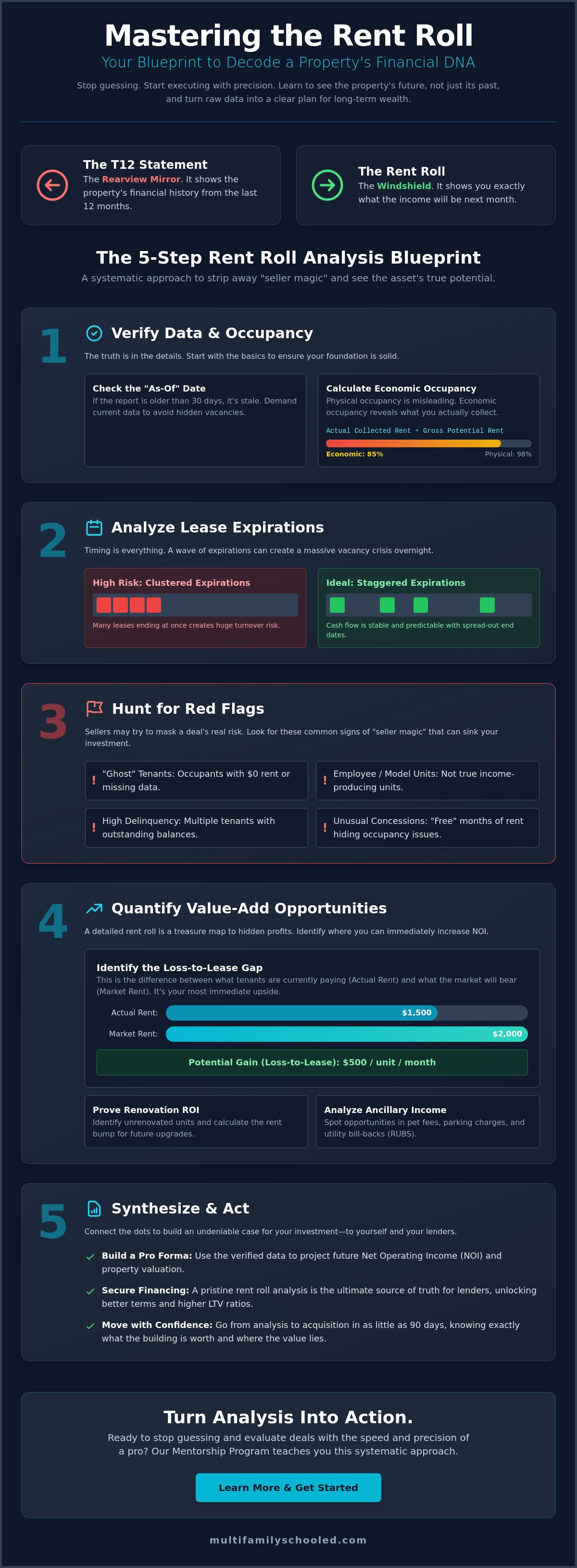
You might hear other investors talk about the Trailing 12-Month statement (T12). Don't get confused. The T12 is your rearview mirror; it shows you the history of what happened last year. The rent roll is your windshield. It shows you exactly what the income will be next month. It captures unit numbers, tenant names, lease start and end dates, and the crucial gap between actual rent and market rent. If the T12 says the property is profitable but the rent roll shows half the leases expire in 30 days, you aren't buying a gold mine. You're buying a vacancy crisis. With national vacancy rates sitting at 6.8% as of Q1 2026, you must know exactly who is staying and who is going.
To better understand this concept, watch this helpful video:
The Anatomy of a Multifamily Rent Roll
A professional rent roll breaks down the unit mix with surgical precision. You'll see the distribution of studios, one-bedroom, and two-bedroom units. Timing is everything here. You want to see staggered lease expirations so you don't face a massive turnover all at once. Look closely at the ancillary income section too. This is where you find pet fees, parking charges, and utility bill-backs (RUBS). In 2026, savvy operators are also tracking compliance with laws like California’s AB 628, which requires landlords to provide specific appliances. If those charges aren't reflected correctly, your "income" might actually be a legal liability.
Why Investors Start (and End) Here
The rent roll is the engine room of your Net Operating Income (NOI). Because your property's value is a multiple of its NOI, a single error on this document can cost you hundreds of thousands of dollars in valuation. Lenders also obsess over this data. Your financing options and loan-to-value (LTV) ratios depend entirely on the stability of the income shown here. If you want to secure those competitive 5.54% rates for deals over $6 million, your rent roll must be pristine. The rent roll stands as the ultimate source of truth in real estate because it documents the actual cash commitments of every resident. If you can't decode it, you're just gambling with your future. If you're ready to stop guessing, our Mentorship Program teaches you to tear these documents apart like a pro.
The 5-Step Rent Roll Analysis Blueprint for Investors
Don't let a seller's shiny brochure distract you. You need to act like a forensic accountant when evaluating a new deal. Most people look at the total income and move on, but the profit is in the details. Learning how to analyze a rent roll means looking for the story the seller isn't telling you. You're hunting for the truth behind the numbers to ensure your investment is built on a solid foundation. If you skip this detective work, you aren't investing; you're just hoping for the best. Use this blueprint to strip away the "seller magic" and see the asset for what it truly is.
Step 1 & 2: Verifying Data and Occupancy
The first thing you check is the "As-Of" date. If that date isn't within the last 30 days, the data is dead. Sellers often try to use stale rent rolls to hide recent move-outs or delinquency spikes that happened last week. Once you verify the date, move to occupancy. Most rookies only look at physical occupancy. That's a massive mistake. You need to calculate economic occupancy. Use this formula: Actual Collected Rent divided by Gross Potential Rent. If physical occupancy is 98% but economic occupancy is 85%, you have a major collection problem. Someone isn't paying their bills. Interestingly, a building that is 100% occupied can actually be a red flag. It often signals that the current owner is afraid to raise rents or is stuffing units with unqualified "ghost" tenants just to make the numbers look good for a sale.
Step 3 & 4: Benchmarking and Expirations
Next, you must benchmark the in-place rents against the local market. With national rent growth rising only 0.4% year-over-year as of May 2026, you have to be precise with your projections. Compute the average rent by unit type. Compare these numbers to real-world data from sources like Rentometer or CoStar. If the average one-bedroom is $1,200 but the market is $1,400, you've found your value-add. But you also have to watch the clock. Map out the lease expiration schedule. Apply the 10% Rule: no more than 10% of your leases should expire in any single month. A mass exodus in month two will kill your cash flow before you even get started. Look for hidden concessions too. If a tenant is paying $1,500 but got two months free, their effective rent is much lower than the "headline" number on the page.
Finally, hunt for outliers. Find the units with rents significantly higher or lower than the building average. A unit paying $500 less than its neighbor might have a "legacy" tenant or a friend of the owner. These are your immediate opportunities for a rent bump. You can't afford to miss these details in the fast-moving 2026 market. If you want the exact templates we use to spot these gaps, check out our Multifamily Tool Kit to streamline your underwriting. This systematic approach transforms raw data into a clear roadmap for profit and ensures you never overpay for a deal.
Detecting Red Flags: How to Spot "Seller Magic" Before You Buy
Sellers want the highest exit price possible. Sometimes, they use "smoke and mirrors" to get it. When learning how to analyze a rent roll, you have to look for what is missing. The most dangerous red flag is the "Ghost Tenant." These residents appear on the roll, but they have no security deposit on file. If they have no skin in the game, they can vanish the day after you close. You also need to hunt for employee units. A property manager getting a "free" unit is actually a hidden labor cost. That unit could be generating revenue. If it isn't, your Net Operating Income (NOI) is artificially deflated and your valuation is wrong.
Watch out for the "Pre-Sale Spike." Sellers often sign a handful of leases at inflated, above-market rates just before listing. This juices the cap rate and tricks you into overpaying based on a false "market" ceiling. Look at the lease start dates. If five units signed in the last 30 days at $300 above the building average, be skeptical. Finally, check for delinquency traps. A tenant might show as "current" on the rent roll today, but a quick check of the T12 might reveal they pay 20 days late every single month. You aren't buying a stable income stream. You're buying a ticking time bomb. With the national multifamily vacancy rate sitting at 6.8% in Q1 2026, you cannot afford to inherit bad tenants who will leave you with empty units and zero cash flow.
Security Deposit Mismatches
Don't just trust the spreadsheet. Cross-reference the rent roll with the actual security deposit bank statement. If the totals don't match, you have a problem. A $0 deposit on the roll is a massive warning sign. These tenants have zero incentive to leave the unit in good condition when they move out. Conducting a thorough security deposit audit prevents post-closing surprises and ensures you aren't left holding the bag for damages. It's your first line of defense against a "skip" move-out.
The Lease Expiration Trap
Sellers love to stack expirations in the first 90 days of your ownership. They want the building to look full while they own it, even if it collapses the moment you take over. This is a classic trap. If you see a cluster of expirations, demand a credit at closing to cover the potential turnover costs. Watch for month-to-month tenants as well. These residents can walk away without notice, leaving you with unexpected vacancies. If you want to see how the pros handle these high-stakes negotiations, our Mentorship Program provides the exact scripts and strategies to protect your capital. Success in this game requires more than just reading numbers. It requires seeing through the "magic" to find the truth.
Turning Data into Dollars: Identifying Value-Add Opportunities
Stop playing defense. Once you've scrubbed the data for red flags, it's time to hunt for the gold. Learning how to analyze a rent roll is about identifying the massive gap between where a property is and where it could be. In a market where investment volume hit $170.4 billion for the year ending March 2026, you need to find the deals others are too lazy to underwrite. The rent roll is your treasure map to forced appreciation. It shows you exactly where the current owner is leaving money on the table.
Calculating the Loss-to-Lease Upside
The most powerful number on your spreadsheet is the Loss-to-Lease (L2L). This represents the difference between the actual collected rent and the current market potential. You calculate it using a simple formula: (Market Rent minus Actual Rent) multiplied by Total Units. Let's look at the massive impact of this math. If you identify a $50 rent gap across a 50-unit building, you've just found $30,000 in annual Net Operating Income. At the average national cap rate of 5.8%, that simple adjustment adds over $517,000 in property value. You can master these high-level calculations and more through our resources at Multifamily University. Don't leave your wealth to chance when you can calculate it with precision.
Don't stop at base rent. Audit the ancillary income with the same intensity. Are tenants paying for their share of water and trash? If the rent roll shows $0 for utility bill-backs (RUBS), you’ve found an immediate profit center. The same applies to pet fees, parking, and storage. In a 2026 market where rent growth is moderating at 0.4% year-over-year, these secondary income streams are the key to maintaining your yield. Every dollar of expense you bill back is a dollar of pure profit added to your bottom line.
The Renovation Roadmap
Group units by finish level to build your execution plan. The rent roll tells you exactly which units are "classic" and which have already been renovated. Use this data to prove your ROI to lenders. If the roll shows that renovated units are already fetching a $200 premium, your renovation budget for the remaining units is instantly justified. You also need to flag "legacy" tenants. These are long-term residents paying significantly below market who have lived there for years. They are your prime candidates for lease non-renewals or major rent bumps upon expiration. Identifying these strategic shifts is the core of how to analyze a rent roll for maximum profit. Ready to build your empire with a proven system? Grab our Multifamily Tool Kit and start decoding deals like a pro today.
Master the Deal: From Analysis to Acquisition in 90 Days
The 2026 multifamily market does not wait for the slow or the hesitant. With $170.4 billion in investment volume flowing through the sector annually, the best deals are snatched up in hours, not weeks. If you are still trying to figure out how to analyze a rent roll manually using a basic Excel sheet, you have already lost the deal to a faster competitor. You need a system that moves at the speed of the market. Our 90-Day System is designed to take you from raw data to a closed acquisition with surgical precision. By the time most investors finish their first cup of coffee, you should already have a clear "yes" or "no" on a deal.
The pros don't even wait for a public listing. They use Real Estate Radar to identify opportunities before the rent roll is ever officially published. This allows you to approach sellers with a firm understanding of their property's potential before a bidding war starts. In a climate where national multifamily vacancy is 6.8%, finding the right asset requires looking where others aren't. Once you have the data, your analysis must be instantaneous. You aren't just looking at numbers; you're looking for the path to wealth.
Speed is Your Competitive Advantage
Spreadsheet paralysis is the number one killer of investment dreams. You don't need to spend days staring at unit types and lease dates. You need to know how to analyze a rent roll in 15 minutes or less to decide if an asset deserves a Letter of Intent (LOI). By integrating your analysis into the Multifamily Tool Kit, you can automate the heavy lifting. This allows you to focus on the high-level strategy rather than the data entry. Speed allows you to submit more offers, and more offers lead to more closed deals. It is a simple numbers game that rewards the efficient.
The Power of Professional Mentorship
Even with the best tools, a second pair of expert eyes is your ultimate insurance policy. A mentor can spot the one red flag you missed in a 50-unit roll, such as a subtle pattern of delinquency that matches the 4.4% overall vacancy trends in specific gateway markets. Joining the Multifamily Schooled Mentorship gives you a direct line to experts who have seen every seller trick in the book. We help you close the gap between "learning" and "earning" by reviewing your deals in real-time. Don't gamble your capital on a "maybe" when you can move forward with the confidence of a seasoned pro. The blueprint is ready. The tools are here. Now, it's time for you to take action and secure your legacy.
Claim Your Future in Multifamily Today
You now hold the master blueprint. You know that a rent roll isn't just a list of names; it's the financial DNA of your future empire. Mastering how to analyze a rent roll means you can walk into any negotiation with total confidence. You can spot the ghost tenants, calculate the hidden Loss-to-Lease upside, and outpace every other investor in this fast-moving market. Stop waiting for the perfect time. The 2026 market rewards the decisive. You have the knowledge to turn raw data into life-changing assets. It's time to move from the sidelines to the closing table.
Take the next step and secure your legacy. Start your 90-day journey to your first apartment deal with our Mentorship Program! You will learn directly from Justin Brennan's multi-generational real estate expertise and gain immediate access to our proprietary Deal Finding Software. We are so confident in our systematic approach that you'll find a deal in 90 days or we find one for you. Your path to wealth is clear. Let's go get it.
Frequently Asked Questions
What is the difference between a rent roll and a T12?
The T12 statement tracks the property's historical financial performance over the last twelve months. It is your rearview mirror. The rent roll is a real-time snapshot of current lease contracts and future income. While the T12 shows what happened in the past, the rent roll tells you exactly what the income will be next month. You need both to ensure historical trends match current contractual obligations.
How do I verify that the tenants on the rent roll actually exist?
You verify tenants through physical unit walks and by requiring signed estoppel certificates during due diligence. An estoppel certificate is a document signed by the tenant that confirms their current rent, security deposit, and lease terms. Cross-reference these certificates with the rent roll and the seller's bank statements. If a unit has no furniture or no security deposit on file, you likely found a ghost tenant.
What is 'Loss-to-Lease' and why does it matter to an investor?
Loss-to-Lease represents the difference between the current in-place rents and the actual market rates you could achieve today. It is your roadmap to profit. When you master how to analyze a rent roll, you can quantify this gap to find hidden value. Closing this gap through management or renovations is the fastest way to increase your Net Operating Income and force property appreciation.
How often should a rent roll be updated during the due diligence process?
Request an updated rent roll every week during your due diligence period and a final certified version on the day of closing. Property conditions change fast. You need to see if any tenants moved out or stopped paying after you went under contract. Frequent updates prevent you from inheriting a sudden vacancy crisis that wasn't there when you first saw the deal.
What is considered a 'good' economic occupancy rate for an apartment building?
A strong economic occupancy rate for a stabilized asset typically stays between 90% and 95%. While the national multifamily vacancy rate hit 6.8% in Q1 2026, you must distinguish between physical heads in beds and residents who actually pay. If your economic occupancy drops below 85%, you have a collection problem or a management issue that requires immediate intervention to protect your cash flow.
Can I use a rent roll to get a better interest rate on my loan?
Yes, a clean and stable rent roll improves your Debt Service Coverage Ratio (DSCR), which directly influences your loan terms. Lenders offer more competitive rates when they see low-risk, well-documented income. With multifamily mortgage rates starting at 5.54% for deals over $6 million in June 2026, providing a precise analysis of your income stream can help you secure the most favorable financing available.
How do I handle 'ghost tenants' during a real estate negotiation?
Identify every unit that lacks a verified resident and demand a seller credit or a purchase price reduction. You are essentially buying a vacancy, and you shouldn't pay a premium for "fake" income. Force the seller to account for the risk of an immediate turnover. If they can't provide a signed lease and a matching security deposit, that unit's income should be excluded from your valuation.
What are the most common red flags to look for on a multifamily rent roll?
Watch for a massive cluster of lease expirations in the first 90 days of your ownership. This is a trap designed to leave you with a half-empty building. Other red flags include recent "pre-sale" rent spikes and units with $0 security deposits. Learning how to analyze a rent roll means spotting these inconsistencies before they become your financial burden. Stay alert and trust the data over the seller's word.



