

Hidden Costs of Owning Apartments: 2026 Investor Guide
Did you know that property insurance costs for multifamily buildings surged by a cumulative 57.9 percent over the last five years? Most investors focus on the purchase price while ignoring the "Iceberg Effect" of operational leaks. These hidden costs of owning an apartment building are the silent killers that turn a potential goldmine into a stressful money pit. You're right to feel anxious about fluctuating utility rates and rising maintenance costs that outpace your revenue growth. It's exhausting to play defense with your bank account every single month.
This 2026 guide will empower you to master the unseen expenses that drain multifamily profits so you can protect your cash flow and scale your portfolio with total confidence. Stop guessing and start winning with a strategic approach to your pro forma. We'll dive into a bulletproof underwriting checklist, clarify the confusion between CapEx and OpEx, and show you how to predict the "unpredictable" before it hits your bottom line. Get ready to transform your investment strategy into a predictable engine for financial freedom and long-term independence.
Key Takeaways
- Expose the "Iceberg Effect" to understand why the purchase price is only 10 percent of your property’s true financial reality.
- Identify and plug the hidden costs of owning an apartment building, from utility slippage to the $3,000 per unit "invisible" expense of tenant turnover.
- Avoid the CapEx trap by identifying aging systems and structural surprises that turn a "good deal" into a massive liability.
- Protect your cash flow by implementing the 10 percent OpEx slush fund rule and stress-testing your debt service coverage ratio.
- Accelerate your success with a proven mentorship system designed to find and purchase profitable apartment buildings in just 90 days.
Beyond the Mortgage: The ‘Iceberg Effect’ of Multifamily Expenses
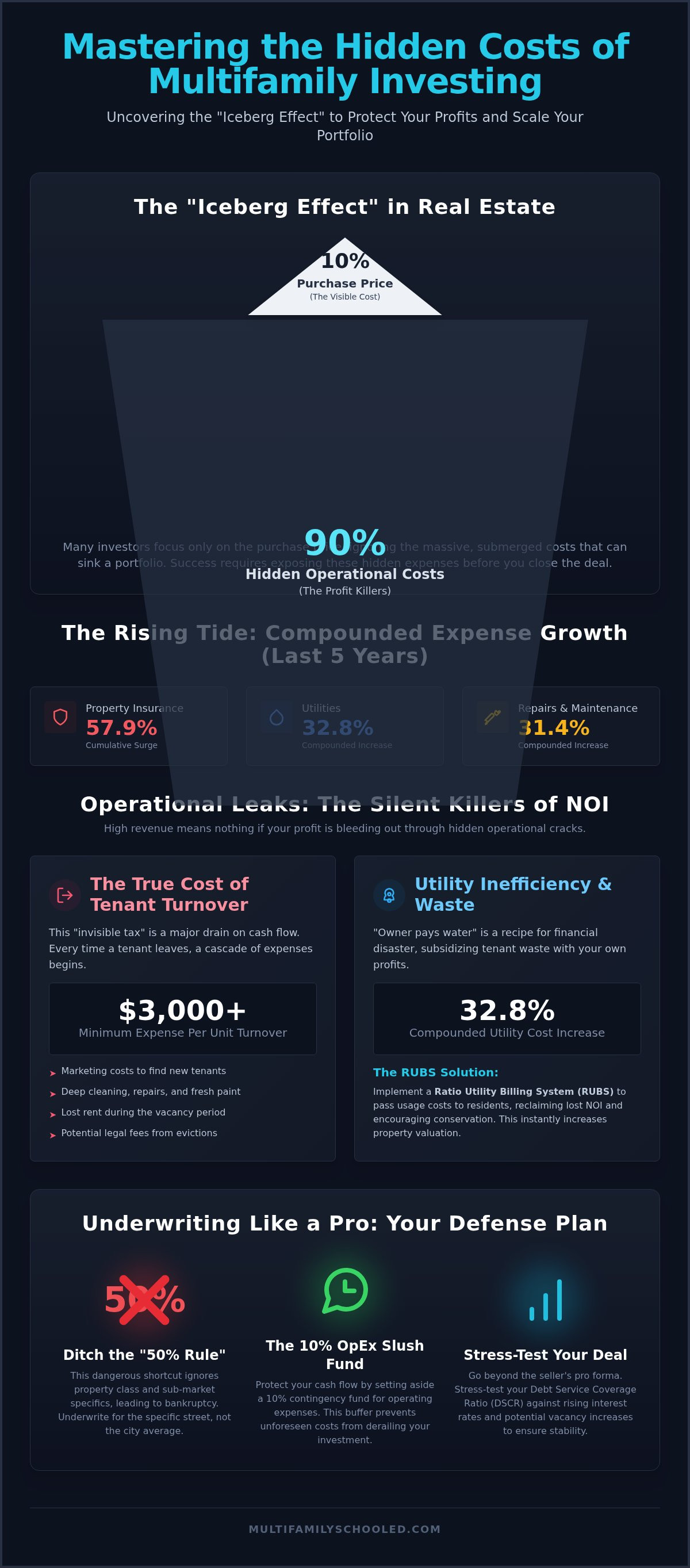
The purchase price is just the tip of the iceberg. Many investors crash their portfolios because they ignore the 90 percent of financial reality lurking beneath the surface. In 2026, the margin for error has vanished. Total operating expenses rose by a compounded 32.4 percent between 2021 and 2025. If you don't account for every dollar, you aren't investing; you're gambling. A single un-underwritten expense can slash your 10 percent cap rate into a negative return overnight. Success requires you to expose the hidden costs of owning an apartment building before you sign the closing papers.
Visible vs. Invisible: Mapping the Property P&L
Your mortgage, taxes, and insurance are easy to see. They're the visible expenses that every rookie includes in their pro forma. However, the real profit killers are the ghost line items that sellers often hide or underestimate. Gaining a deep level of understanding operating expenses is what separates the pros from the amateurs. Consider these often-ignored leaks that can drain your cash flow:
- General and Administrative: These costs rose by a compounded 30.4 percent over the last five years.
- Repairs and Maintenance: These spiked by a compounded 31.4 percent between 2021 and 2025.
- Utility Slippage: Compounded increases of 32.8 percent since 2021 are common.
Net Operating Income (NOI) is the lifeblood of your investment. If your P&L statement lies to you about these invisible costs, your valuation is a fantasy.
Why 'Average' Expense Ratios Lead to Disaster
Stop using the 50 percent rule for every deal. It's a recipe for bankruptcy. Your expense ratio depends entirely on the property class and the specific sub-market. Class C properties might have lower vacancy rates, around 5.4 percent in Q2 2026, but they often carry much higher maintenance burdens than Class A assets. You must underwrite for the specific street, not the city average. Use tools like Real Estate Radar to filter out money pits before you waste time on a site visit. Mastering these hidden costs of owning an apartment building allows you to scale with absolute confidence. Don't settle for average numbers when your financial freedom is on the line. Build a bulletproof pro forma that accounts for local utility rates and current insurance trends.
Operational Leaks: The Silent Killers of Your Net Operating Income (NOI)
Stop letting your profit bleed out through the cracks. High revenue means nothing if your operational expenses are out of control. In the multifamily world, NOI is your scoreboard. If you aren't protecting it, you're losing the game. Many investors focus on the mortgage while ignoring the hidden costs of owning an apartment building that occur every single day. These leaks are silent, but they are deadly to your long-term wealth. You must identify them, quantify them, and plug them immediately.
The True Cost of Tenant Turnover
Tenant turnover is an invisible tax on your portfolio. Every time a door turns, you're looking at a $3,000 minimum expense. This isn't just about a fresh coat of paint. You have to factor in marketing costs, deep cleaning, and the brutal sting of lost rent during the vacancy period. Professional tenants often exploit properties with weak management, leading to high-friction evictions and legal fees. Building a sense of community isn't just a "nice" thing to do; it's a strategic move to reduce turnover and keep your units occupied. Long-term tenants are the foundation of predictable cash flow.
Utility Inefficiency and the 'RUBS' Solution
"Owner pays water" is a recipe for financial disaster. Between 2021 and 2025, utility costs for multifamily buildings saw a compounded increase of 32.8 percent. If you're footing the bill for aging plumbing and leaky faucets, you're subsidizing your tenants' waste. The 2026 market demands efficiency. Implementing a Ratio Utility Billing System (RUBS) allows you to reclaim that lost NOI by passing usage costs back to the residents. Combine this with low-flow retrofits and LED lighting to slash your baseline expenses. This isn't just maintenance; it's a value-add strategy that increases your property's valuation instantly.
Administrative friction also drains your energy and your bank account. Compliance paperwork, legal filings, and the mental load of management fatigue are real costs. Many rookies think self-managing is "free," but it actually costs you the time you should spend finding your next deal. Don't let management fatigue stop your momentum. If you want to scale faster, you need a system that filters out the money pits from the start. Our Mentorship Program provides the blueprint to handle these operational challenges like a seasoned pro. Mastery over these hidden costs of owning an apartment building is the only path to true financial independence. Take control of your P&L today and watch your portfolio thrive.
The CapEx Trap: Why Aging Systems Are More Expensive Than You Think
Don't get fooled by a low purchase price. A "good deal" is often just a "delayed bill" in disguise. While operational leaks drain your monthly cash flow, Capital Expenditures (CapEx) are the heavy hitters that can wipe out years of equity in a single week. These are the ultimate hidden costs of owning an apartment building. If you aren't budgeting for the 10-year failure cycle, you're setting yourself up for a financial disaster. You must see the bill before it arrives to protect your legacy.
The 'Big Three' System Failures
Centralized systems like HVAC units and boilers are high-stakes assets. When a boiler fails in a 50-unit building, it's not a minor repair; it's a massive capital event that demands immediate cash. Roofing is another common trap for the unwary. A "minor leak" is rarely just a leak. It's often a symptom of structural rot or failed decking that requires a full, six-figure tear-off. Plumbing and electrical issues are even more insidious because they're buried inside the walls. You can't see the corroded galvanized pipes or outdated wiring until they cause a catastrophic failure. For stabilized assets, you must maintain an annual reserve of at least $200 to $400 per unit just to keep pace with these inevitable breakdowns.
Structural surprises can also derail your momentum. Foundations, balconies, and parking lot drainage are often overlooked during a standard walk-through. A shifting foundation or a crumbling balcony isn't just a repair issue; it's a massive liability. In 2026, structural integrity is under a microscope. Deferred maintenance in these areas is a weight that will eventually pull your ROI underwater.
Compliance and Regulatory Shifts in 2026
The regulatory landscape is shifting faster than most investors can track. New local "Green" mandates are no longer optional suggestions. Retrofitting for energy efficiency to meet 2026 standards requires significant upfront capital for insulation, window upgrades, and high-efficiency appliances. Then there's the risk of ADA accessibility lawsuits. One legal challenge regarding a non-compliant ramp or doorway can cost more than your entire annual profit. You must also account for new 2026 fire safety mandates that require updated alarm systems and expanded sprinkler coverage. These aren't just suggestions; they're requirements for staying in business.
Success in this industry is about being proactive, not reactive. You need to identify these traps during the inspection phase, not after you've closed. Check out our Multifamily Tool Kit for comprehensive due diligence checklists that expose these traps early. Mastering the hidden costs of owning an apartment building means understanding that today's savings on maintenance are tomorrow's losses on the balance sheet. Protect your portfolio by underwriting for the long haul and seizing the opportunity to build a bulletproof asset.
Underwriting Like a Pro: How to Account for the Unforeseen
Underwriting isn't just a math exercise; it's a survival strategy. If you want to protect your assets, you must look past the seller's "pro forma" fantasy. The most dangerous hidden costs of owning an apartment building are the ones you fail to account for during the honeymoon phase. You need a margin for error that can withstand market shifts. Implement the 10 percent rule immediately. Always budget a 10 percent "slush fund" for operating expenses above your initial projections. This buffer ensures that a sudden repair or a spike in insurance doesn't cripple your monthly distribution.
Stress-testing your Debt Service Coverage Ratio (DSCR) is non-negotiable. Lenders typically require a minimum DSCR of 1.25x, but a pro-level investor tests for a 1.35x or higher. If your deal falls apart when occupancy drops by 5 percent or expenses rise by 10 percent, it isn't a deal; it's a liability. Use Real Estate Radar to find deals with better margins from the start. This software allows you to filter for properties that actually have the meat on the bone to survive a downturn. Before you ever hire an inspector, do your own walk-through. Look for water stains on ceilings, uneven floors, and the smell of mildew. These are the red flags that signal deep-rooted issues before you spend a dime on formal due diligence.
Advanced Due Diligence: The 'Audit' Phase
Never trust the income numbers on a spreadsheet without verification. Conduct a thorough lease audit to ensure every "active" tenant is actually paying rent. Cross-reference the rent roll with bank deposits to spot "ghost" tenants or uncollected balances. A physical audit is equally critical. Hire a specialized commercial inspector who understands multifamily systems, not a residential generalist. Finally, perform a "T-12" analysis. Scrutinize the last 12 months of trailing expenses to find hidden spikes in maintenance or utilities that the seller might be trying to normalize. This is where you expose the true hidden costs of owning an apartment building.
Stress-Testing Your Exit Strategy
Market conditions change fast. You must know what happens to your cash flow if interest rates rise another 1 percent during your hold period. If your exit strategy relies on a perfect market, you don't have a strategy. You also need to account for the "Opportunity Cost" of your down payment. Could that cash work harder elsewhere? A solid 90-day plan is your secret weapon. This plan outlines exactly how you will cut costs and increase income the moment you take over a "tired" building. Don't wait until after closing to build your blueprint. If you want a proven system to master these numbers, join our Mentorship Program today. We give you the tools to underwrite with absolute authority so you can scale your portfolio with confidence.
Master the Deal: Why Professional Mentorship Prevents Costly Mistakes
Some people suggest "learning as you go." On forums like Reddit, you'll see users telling you to learn from your own mistakes. In the world of multifamily investing, that is the most expensive advice you will ever receive. A single oversight during due diligence can cost you $100,000 or more in capital repairs or legal fees. You don't have the luxury of "guessing" when your financial future is on the line. Professional mentorship is the only way to bypass the hidden costs of owning an apartment building that stop most investors before they even start. You need a guide who has already walked the path and seen every trap.
A mentor acts as your strategic filter. They spot the red flags you are programmed to ignore because of your excitement for the deal. They understand the difference between a minor cosmetic fix and a structural failure that drains your ROI. By leveraging a proven system, you move from hesitation to execution. You gain the confidence to make bold decisions because you know the numbers are backed by real-world expertise. 2026 is the year to stop playing small and start building the legacy your family deserves. The window of opportunity is open; it requires decisive action and a bulletproof strategy.
The 90-Day Multifamily Blueprint
Stop wasting time on endless research. You need a structured path that leads to a closed deal. Our system is designed to help you find and purchase an apartment building within 90 days. We don't just teach theory; we provide the tools for immediate results. If you can't find a deal that meets our strict criteria, we provide one for you. This is the ultimate safety net for your investment journey. Join the Mentorship Program to start your journey today and secure your first asset with total peace of mind. We take the guesswork out of the process so you can focus on scaling your portfolio.
From Novice to Pro: The Multifamily Schooled Advantage
Success leaves clues. When you join our community, you gain access to proprietary Deal Finding Software that filters out money pits instantly. You attend live workshops where we tear apart real deals in real-time. This isn't just about one property; it's about building a multi-generational family business. We provide the ecosystem you need to master the hidden costs of owning an apartment building and turn them into profit centers. Don't wait for the "perfect" time to invest. Create that time by surrounding yourself with winners who have a track record of success. Your path to financial freedom starts with the right guidance and a commitment to mastery.
Forge Your Path to Generational Wealth
You now have the blueprint to expose the hidden costs of owning an apartment building before they erode your profits. Don't let the "Iceberg Effect" or deferred maintenance sink your dreams of financial independence. You've learned how to stress-test your numbers and plug the operational leaks that kill cash flow. Now, it's time to stop analyzing and start executing. The 2026 market doesn't wait for the hesitant. It rewards those who move with speed, precision, and a proven system.
You don't have to do this alone. Get direct guidance from Justin Brennan and gain access to our proprietary Deal Finding Software to filter out the money pits instantly. We are so confident in our process that we guarantee a deal found in 90 days or we provide one for you. Secure your financial future with our 90-Day Mentorship Program and build your legacy with total confidence. Success is within your reach; grab it today.
Frequently Asked Questions
What is the single biggest hidden cost of owning an apartment building?
Un-underwritten operational leaks are the single biggest drain on your profits. While many focus on the mortgage, the compound growth of property insurance and general administrative expenses often catches rookies off guard. Between 2021 and 2025, insurance costs saw a cumulative increase of 57.9 percent. These hidden costs of owning an apartment building require precise underwriting to ensure your cash flow remains protected against aggressive market shifts and rising premiums.
How much should I set aside for a capital expenditure (CapEx) reserve?
For a stabilized multifamily asset, you should set aside an annual reserve between $200 and $400 per unit. This fund is essential for handling large-scale replacements like roofs, boilers, or HVAC systems that fail on a predictable cycle. Failing to budget for these capital expenditures can force you to use personal capital or high-interest loans, effectively destroying your yield. Always treat these reserves as a mandatory, non-negotiable expense in your pro forma.
Are utilities always the owner’s responsibility in multifamily properties?
Utilities are not always the owner's responsibility; in fact, paying for them directly is often a recipe for financial ruin. Utility costs spiked by a compounded 32.8 percent between 2021 and 2025. Pro-level investors use Ratio Utility Billing Systems (RUBS) to pass these costs back to tenants based on occupancy or square footage. This strategy instantly improves your Net Operating Income (NOI) and incentivizes residents to conserve resources, protecting your bottom line from astronomical bills.
What is 'management fatigue' and how does it impact my ROI?
Management fatigue is the mental and emotional exhaustion that comes from handling tenant disputes, maintenance emergencies, and administrative friction. It impacts your ROI by causing you to miss critical details during lease audits or ignore small repairs that turn into massive capital events. Self-managing might look like a way to save money, but the cost of your time and the risk of burnout are far more expensive. Professional systems are the only way to scale effectively.
How do local 2026 regulations affect the cost of owning older buildings?
New 2026 regulations focus heavily on green energy mandates and fire safety upgrades, which can significantly increase the hidden costs of owning an apartment building. Older properties often require expensive retrofitting for high-efficiency insulation, low-flow plumbing, and updated sprinkler systems to remain compliant. Additionally, ADA accessibility lawsuits are on the rise. One compliance failure can lead to legal fees that wipe out your annual profit, making thorough due diligence more critical than ever before.
Does property insurance cover the cost of aging system failures?
Property insurance generally does not cover the failure of aging systems due to normal wear and tear. Insurance is designed for sudden, accidental events like fire or storm damage. If your 20-year-old boiler finally dies or your roof reaches the end of its life, the replacement cost comes directly out of your CapEx reserves. This is why understanding the difference between insurable losses and predictable maintenance is vital for maintaining a healthy and predictable balance sheet.
How can I accurately estimate tenant turnover costs before buying?
You can accurately estimate turnover by budgeting at least $3,000 per unit for every door that turns. This figure accounts for more than just paint and cleaning; it includes marketing, tenant screening, and the "invisible" cost of lost rent during the vacancy period. With national vacancy rates reaching 6.8 percent in mid-2026, keeping your residents happy through community building is a strategic necessity. Reducing turnover is the fastest way to stabilize your long-term cash flow.
What is the difference between a repair and a capital improvement?
A repair is a recurring expense that keeps a property in its current operating condition, such as fixing a leaky faucet. These are generally tax-deductible in the year they occur. A capital improvement adds value or extends the property's life, like a full roof replacement. According to IRS Publication 527, these must be depreciated over 27.5 years. Distinguishing between the two is essential for accurate tax planning and ensuring your asset management strategy remains profitable.



