

Get Commercial Brokers to Take You Seriously: No Experience
Commercial real estate brokers don't care about your personal resume; they care about closing certainty. If you are fighting to figure out how to get brokers to take you seriously with no experience, you already know the sting of being labeled a tire-kicker. You dial a listing broker, admit you haven't closed a 50-unit complex yet, and watch your calls get ignored while high-performing off-market multifamily properties go to seasoned operators.
You don't need twenty years of personal transactions to command immediate respect. In this guide, you will master the exact language, underwriting criteria, and credibility frameworks needed to get commercial brokers to prioritize your calls and send deals directly to your inbox. We will reveal how to establish a razor-sharp Buy Box, leverage experienced mentorship backing to project instant institutional authority, and underwrite assets with the decisive speed top brokers demand.
Key Takeaways
- Eliminate the novice label by abandoning vague deal requests and framing your criteria around closing certainty and broker commission viability.
- Establish a razor-sharp Buy Box specifying exact unit counts, property vintage, and submarkets to project immediate market literacy.
- Master opening call protocols that prove how to get brokers to take you seriously with no experience by discussing recent comps instead of begging for listings.
- Secure priority access to off-market multifamily properties by executing rapid 24- to 48-hour underwriting turnarounds on trailing-12 financials.
- Borrow institutional posture through strategic team stacking and experienced mentorship backing to close the track record gap cleanly.
Why Commercial Brokers Ignore Beginners (And How to Change Their Mind)
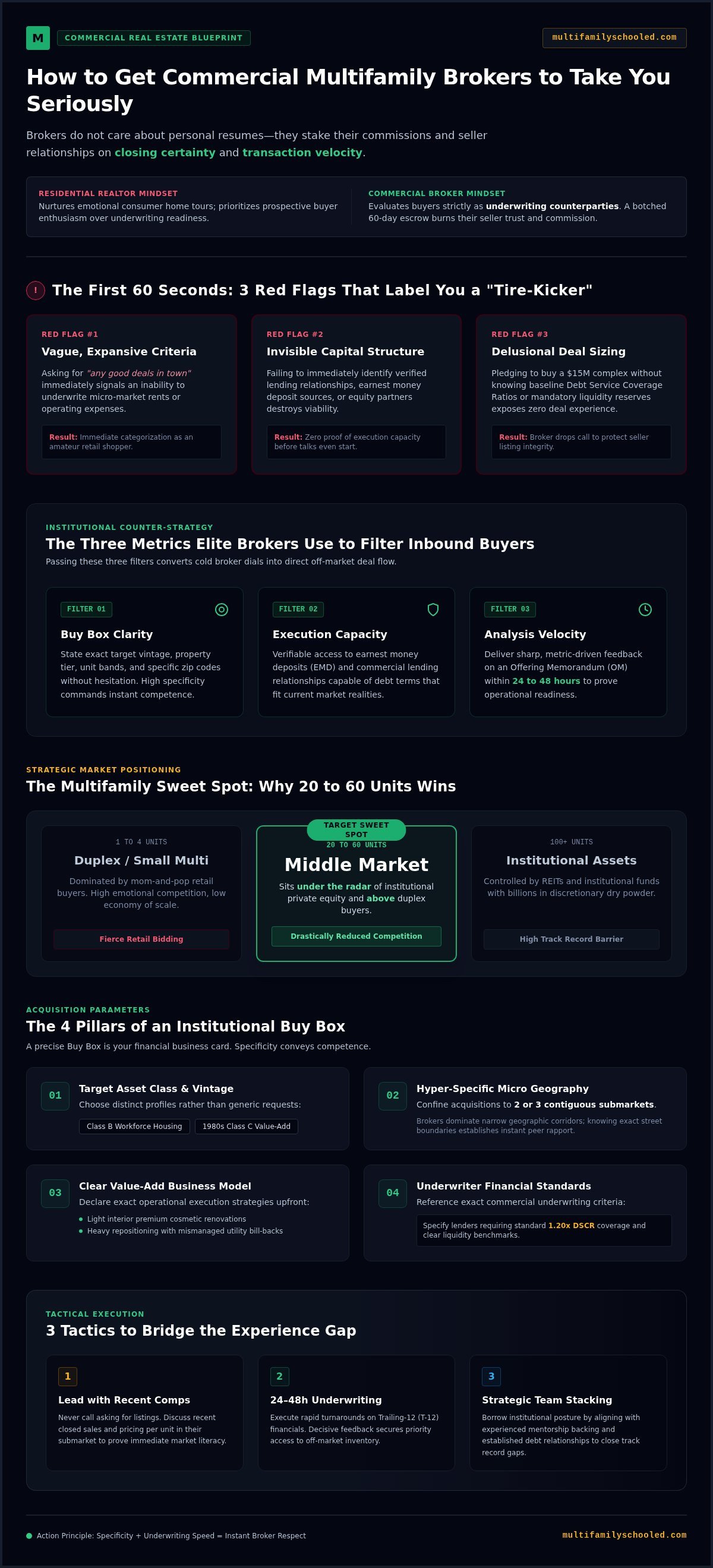
Commercial listing brokers do not ignore beginners out of malice. They ignore them to survive. An elite commercial broker makes money when an asset crosses the finish line, period. When an investor ties up a 40-unit property for sixty days and fails to secure debt, the broker's reputation with the seller burns down along with their commission check. Transaction velocity and closing certainty trump polite enthusiasm every single time.
Understanding commercial real estate fundamentals means recognizing the massive gulf between residential agents and commercial investment brokers. Residential realtors nurture prospective buyers through emotional home tours. Commercial brokers evaluate buyers strictly as underwriting counterparties. If you want to know how to get brokers to take you seriously with no experience, you must stop acting like a retail consumer and start operating like an institutional asset manager.
The Anatomy of a 'Tire-Kicker' Red Flag
Novice investors consistently broadcast their amateur status during the first sixty seconds of a call. Brokers spot these clear red flags immediately:
- Vague, expansive criteria: Asking for "any good deals in town" signals that you cannot underwrite submarket rents or operating expenses.
- Invisible capital structures: Failing to name your lending relationships, earnest money sources, or equity partners destroys your credibility before the conversation begins.
- Delusional transaction sizes: Pledging to buy a $15 million property without knowing standard debt service coverage ratios or required liquidity reserves proves you cannot perform.
The Three Metrics Brokers Use to Filter Buyers
Top brokers run incoming buyer leads through three rapid filters to separate serious acquirers from time-wasting amateurs:
- Clarity of your Buy Box: You must state your exact target vintage, unit count, and zip codes without hesitation. Specificity proves competence.
- Execution capacity: You need verifiable access to earnest money deposits and debt partners who can underwrite to current market terms.
- Analysis turnaround speed: Delivering sharp, metric-driven feedback on an Offering Memorandum within 24 to 48 hours proves you possess serious systems and respect the broker's pipeline.
Master these operational mechanics, and you flip the dynamic entirely. That is the exact blueprint for how to get brokers to take you seriously with no experience, transforming your calls from unwanted interruptions into lucrative transaction partnerships.
How to Build an Irresistible Buy Box That Demands Respect
Your Buy Box is your financial business card. When rookie investors ask how to get brokers to take you seriously with no experience, the answer begins with ruthless acquisition parameters. A broker will instantly forget a buyer who claims they look at everything. Conversely, they prioritize an investor who defines their target box down to the asset vintage, mechanical systems, and corridor.
Clarity conveys competence. When you define realistic return hurdles, target cap rates, and specific value-add business plans, brokers view you as an educated operator rather than an amateur dreamer. To structure your parameters cleanly, utilize the Multifamily Tool Kit to align your acquisition profile with institutional standards.
Defining Your Asset Class and Geography
Narrow your operational focus to two or three contiguous submarkets. Brokers dominate specific micro-locations; if you know their territory's street boundaries, you gain instant rapport. Target specific physical profiles to carve out an operational advantage:
- Target unit sweet spots: Focus on 20 to 60 units. This segment sits right below institutional private equity radars and right above mom-and-pop duplex buyers, drastically reducing your bidding competition.
- Select distinct asset tiers: Choose between Class B workforce housing and 1980s Class C value-add properties. Each requires entirely different capital expenditures and operational plans.
- Pinpoint business models: Declare whether you hunt light interior renovations or heavy operational repositioning with mismanaged utility bill-backs.
Articulating Financial Criteria Like an Underwriter
Talk numbers, not generalities. Brokers test your financial literacy within seconds of receiving your criteria. State your baseline debt requirements upfront, referencing lenders requiring a 1.20x to 1.25x debt service coverage ratio (DSCR) and conservative 65% to 75% loan-to-value (LTV) assumptions.
Condense this data into a professional, one-page investment profile. Outline your target going-in cap rates, minimum cash-on-cash yield requirements, and realistic exit cap rate expansions based on current interest rate realities. When a broker saves your one-pager to their desktop, you have separated yourself from 95% of retail competition. That disciplined presentation demonstrates exactly how to get brokers to take you seriously with no experience from day one.
Scripts and Communication Protocols for Your First Broker Call
Dialing a commercial broker demands total intentionality. You have roughly thirty seconds to establish authority, eliminate friction, and prove that you aren't another tire-kicker dialing random phone numbers. When mastering how to get brokers to take you seriously with no experience, your conversation opener must lead with market awareness rather than desperate deal requests.
Do not call asking what properties they have available. Instead, ask about closed transactions. Discussing recent sales comps positions you as an active market researcher analyzing pricing trends, which immediately earns professional courtesy from listing agents.
Cold Outreach Phone Script for New Investors
Use this tight, direct script to control the dialogue from the start:
- Opening hook: "Hi [Broker Name], my name is [Your Name] with [Company Name]. We are actively allocating private capital into 20 to 60-unit multifamily assets throughout [Target City/Submarket]."
- Transition to comps: "I noticed your recent closing on the 32-unit asset over on Maple Street. I'm calibrating our local underwriting models and wanted to confirm if that closed near the whisper cap rate."
- Strategic ask: "Do you have two minutes to share where you see price-per-door metrics trending for 1980s vintage in that submarket? I'd like to review your team's next offering memo that fits our parameters."
How to Answer 'What Have You Bought Before?'
Never fabricate a track record. Commercial real estate is a remarkably tight-knit ecosystem; getting caught in a lie permanently blacklists your name across regional brokerages. When the broker inevitably asks, "What else have you bought in this market?", handle the question with complete poise.
Shift the narrative from personal history to structural execution capacity. Use this exact response:
"This will be our group's first acquisition directly in this specific submarket. However, our advisory team and property management partners currently oversee hundreds of units across the region, and our capital partners are fully committed for transactions matching our criteria. We don't submit speculative offers, and we provide clean underwriting feedback within 48 hours."
This response acknowledges reality while highlighting real execution security. Establish a rolling 21-day check-in cadence to follow up on new off-market opportunities. That disciplined cadence reinforces how to get brokers to take you seriously with no experience by proving your staying power over time.
Underwriting Speed: How Fast Analysis Wins Off-Market Deal Flow
Speed builds reputation. Top listing brokers don't wait five business days for a prospective buyer to analyze an Offering Memorandum. They reward operators who digest trailing-12 (T12) statements, audit rent rolls, and return actionable feedback within 24 to 48 hours. Novices sabotage their credibility here by missing obvious expense adjustments, such as tax reassessments upon sale or rising insurance premiums. If you want to know how to get brokers to take you seriously with no experience, rapid underwriting turnaround is your ultimate competitive weapon.
The 10-Minute Deal Screening Framework
Eliminate manual spreadsheet lag. Deploy Real Estate Radar to pinpoint, filter, and analyze prospective opportunities before competing buyers even open the file. Run every incoming deal through a rapid initial screen:
- Audit Net Operating Income (NOI): Strip out seller-projected pro forma numbers immediately. Focus on actual historical revenues and normalized operating expenses.
- Stress-test expense ratios: Sanity-check payroll, contract services, and maintenance reserves against current market realities to ensure the property meets standard 1.20x to 1.25x DSCR thresholds.
- Submit decisive terms: If the numbers validate your yield targets, deliver a concise Letter of Intent (LOI) with tight inspection windows and minimal contract contingencies.
Delivering Broker Feedback That Builds Professional Respect
Never ghost a broker when a property fails to pencil. Amateurs disappear when the asking price is unrealistic. Institutional buyers do the exact opposite; they respond quickly with precise, data-backed rationale:
"Thanks for sending this 38-unit asset, Mark. We completed our preliminary underwriting today. At the current $6.2 million whisper price, the required loan-to-value structure falls short of our cash-on-cash yield requirements. If the seller has flexibility around $5.4 million, our equity is ready to execute immediately. If not, please keep sending deals in this submarket."
This response proves market literacy and shows you know how to get brokers to take you seriously with no experience. You don't waste their time, and you provide genuine market feedback they can share directly with their seller. To sharpen your speed and master institutional underwriting protocols, access our complete deal analysis training today.
Borrowing Credibility: How Team Stacking and Mentorship Close the Experience Gap
Commercial real estate is fundamentally a team sport. Lone-wolf investors rarely close large multifamily assets because sellers and listing brokers look for enterprise-level execution. When you understand how to get brokers to take you seriously with no experience, you realize you don't need decades of individual transactions. You stack your bench with seasoned professionals and step onto the field with borrowed institutional posture.
Building an Institutional Advisory Board Before Offering on Deals
Assemble your core operational partners before dialing brokers or submitting offers. Listing brokers look closely at the strength of your advisory team:
- Commercial mortgage brokers: Secure debt sizing memos and soft quotes from established commercial lenders who understand regional bank spreads and agency requirements.
- Third-party property management: Partner with established property management firms overseeing thousands of units across your target submarkets. Feature their portfolio resume prominently in your buyer acquisition profile.
- SEC securities counsel: Retain specialized legal counsel to structure equity syndication documents cleanly, ensuring compliance with federal investor disclosure rules.
Leveraging Structured Mentorship to Eliminate Execution Risk
Commercial listing brokers view unguided first-time buyers as massive closing risks. A single botched physical inspection contingency, escrow misstep, or financing delay can kill an entire transaction. Having an experienced operator standing behind your acquisition strategy changes everything.
When you align with the Multifamily Mentorship Program, you replace personal uncertainty with battle-tested methodology. Brokers know that mentored investors have experienced eyes auditing every trailing-12 financial, stress-testing debt covenants, and reviewing contract language. That institutional backing immediately alleviates broker skepticism.
This strategic framework solves the core dilemma of how to get brokers to take you seriously with no experience. You don't approach listings as an isolated amateur guessing at numbers. You enter the commercial marketplace backed by multi-generational real estate heritage and structured acquisition frameworks. Explore our comprehensive mentorship programs to secure early looks at off-market multifamily properties with complete operational certainty.
Command the Room and Close Your Next Multifamily Deal
Mastering how to get brokers to take you seriously with no experience comes down to professional execution. You don't need decades of solo transactions to win immediate respect. Define an unmistakable Buy Box, audit trailing-12 statements with 24-hour turnaround speed, and stack your advisory bench to prove closing viability. Commercial listing brokers respect buyers who eliminate friction, communicate like institutional analysts, and honor their deal pipeline.
Stop letting the absence of a personal track record sideline your multifamily journey. Step into the market backed by Justin Brennan's multi-generational real estate heritage and our structured 90-day deal finding methodology. With comprehensive deal-finding software and hands-on mentorship backing every offer, you possess the operational posture required to win.
Seize the current market window and claim your place at the closing table. Take decisive action today: Join the Multifamily Mentorship Program and start securing off-market commercial properties with complete confidence.
Frequently Asked Questions
Can you buy commercial multifamily properties without any previous real estate experience?
Yes, you can acquire commercial multifamily properties without personal transaction history by leveraging team infrastructure. Commercial real estate operates on asset performance and execution certainty rather than individual resumes. When you partner with experienced property management firms, reputable lenders, and seasoned mentors, listing brokers evaluate the collective strength of your group. That strategic team posture is exactly how to get brokers to take you seriously with no experience on your first acquisition.
What should I say when a commercial broker asks for my past transaction track record?
Be completely transparent while pivoting immediately to your team's operational capabilities. State that this represents your group's initial acquisition in this target submarket, then highlight your partners. Reference your third-party property managers who oversee thousands of local units, your debt relationships, and committed equity partners. Brokers value honesty paired with verifiable execution capacity over fabricated stories, respecting buyers who present organized advisory backing from day one.
How much capital or earnest money do brokers expect a serious buyer to have ready?
Brokers expect buyers to produce 1% to 2% of the total purchase price in liquid earnest money upon contract execution. For a $5 million asset, this equates to $50,000 to $100,000 held in escrow. Beyond earnest deposits, you must demonstrate access to 25% to 35% equity to satisfy conventional loan-to-value limits and lender liquidity reserves required to cover six to nine months of debt service.
Why do commercial brokers stop answering emails or phone calls after sending one property?
Brokers disappear when prospective buyers ghost them or fail to provide structured feedback on an Offering Memorandum. If you review a deal and fail to respond within 48 hours, the broker assumes you are an unfocused tire-kicker. Even when a deal doesn't match your criteria, sending a concise, data-driven pass notice explaining your numbers keeps communication lines wide open for future off-market inventory.
Is it better to contact listing brokers directly or hire a dedicated buyer's broker?
Contacting listing brokers directly yields far superior access to off-market multifamily opportunities. Commercial listing brokers often favor direct buyers because it eliminates fee-splitting friction and ensures clear, direct communication during contract negotiations. While a buyer's broker can assist with basic searching, mastering direct relationships is fundamental to discovering how to get brokers to take you seriously with no experience and winning early looks at off-market deals.
What documents should I prepare before contacting commercial brokers in my market?
Prepare a concise, one-page investment profile and a verified proof-of-funds letter or lender pre-qualification memo. Your profile should define your target unit counts, vintage, asset class, and return criteria. Having these materials ready shows you run a disciplined acquisition desk. Brokers can quickly save your document to their buyer databases, ensuring you get notified immediately when a matching off-market asset surfaces.
How quickly must I analyze an Offering Memorandum to keep the broker engaged?
Return clean feedback to the listing broker within 24 to 48 hours. Fast turnaround proves you possess streamlined underwriting systems and respect their schedule. If the numbers work, submit a clear Letter of Intent immediately. If the underwriting falls short, send a brief breakdown detailing where your pricing lands based on current debt terms and cap rates. Speed builds trust faster than any resume.



