

From House Hacking to First Multifamily Property: The 2026 Scaling Guide
Your house hack was never meant to be the finish line. It was the launchpad. If you feel stuck behind residential lending caps or find yourself drowning in the manual labor of a small multi-unit, you aren't alone. Making the move from house hacking to first multifamily property requires a complete shift in your strategy and your mindset. Stop thinking in terms of comps. Start thinking in terms of Net Operating Income.
Most investors hit a wall because they treat real estate like a hobby instead of a scalable enterprise. You have the drive. Now you need the professional framework to find off-market apartment deals and manage larger tenant bases without losing your sanity. That changes right now. We'll provide you with a clear roadmap to bridge the gap between residential limits and commercial mastery.
This guide reveals the exact system to leverage your existing equity and secure your first 5+ unit deal. You'll learn how to value properties like a pro and build a repeatable deal flow engine. Stop playing small. It's time to start building your legacy and securing your financial independence today.
Key Takeaways
- Break through the "Residential Ceiling" by shifting your mindset from property management to professional asset management.
- Learn why the transition from house hacking to first multifamily property depends on mastering Net Operating Income (NOI) over emotional neighborhood comps.
- Stop hunting on the crowded MLS and implement a systematic approach to find high-yield, off-market apartment deals.
- Unlock professional capital through commercial financing and syndication models to fund larger acquisitions with less personal cash.
- Follow a proven 90-day blueprint to transform your house hacking experience into a scalable multifamily investment empire.
The House Hacking Bridge: Why Most Investors Get Stuck
House hacking is the ultimate training ground. It proves you can manage a property, handle difficult tenants, and collect rent on time. But for most investors, a duplex or triplex is where the journey ends. They hit an invisible wall known as the "Residential Ceiling." To move from house hacking to first multifamily property, you must stop thinking like a hobbyist. You have the foundation. Now it's time to build the empire.
Scaling requires you to conquer three major hurdles: capital, commercial knowledge, and deal flow. While residential deals rely heavily on your personal credit and income, multifamily investing depends on the asset's performance. You're shifting from a landlord who fixes toilets to a strategic asset manager who drives value. Mastering real estate investing fundamentals is your first step toward professional independence. Stop waiting for the market to give you a break. Create your own opportunity.
The Limitations of 1-4 Unit Residential Lending
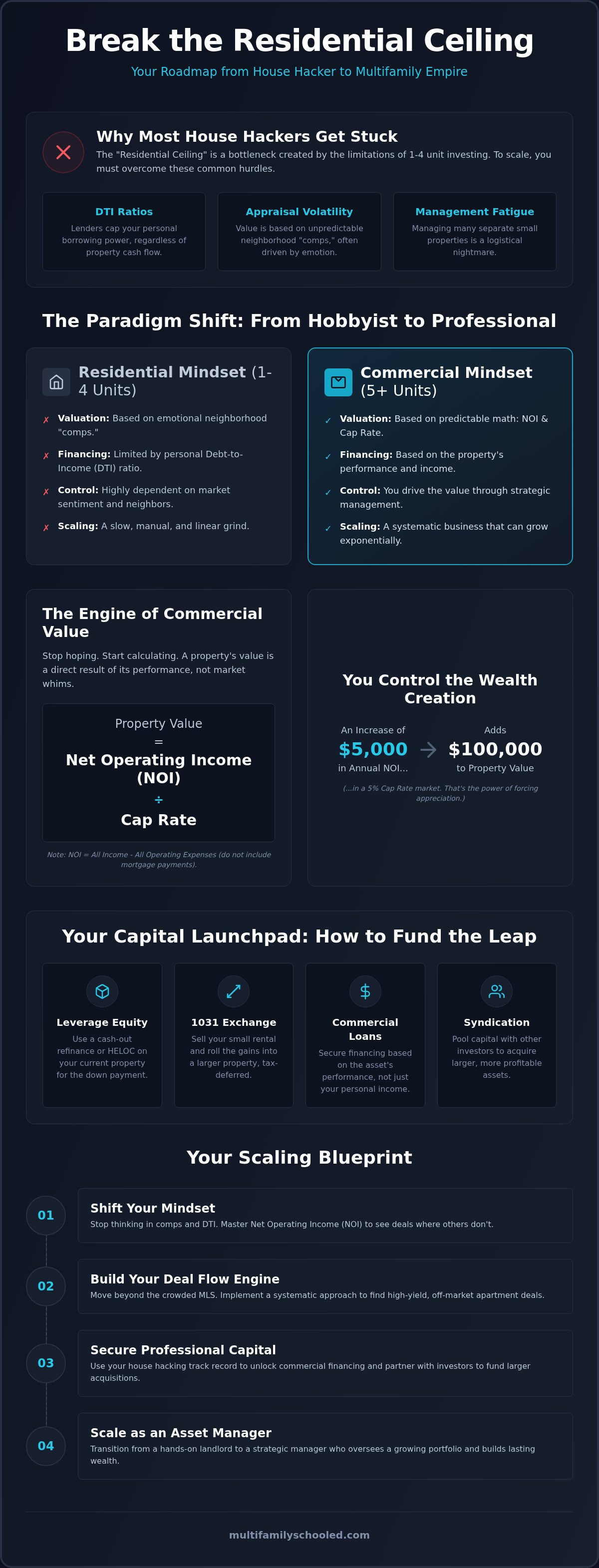
Residential lending is a bottleneck for the ambitious. Banks focus on your Debt-to-Income (DTI) ratio. Eventually, your personal income simply cannot support more debt, no matter how well your duplex performs. Residential valuation also depends on "comps." If a neighbor sells their house at a discount, your equity vanishes instantly. Commercial properties are different. Value is driven by math, not market sentiment. Scaling small residential units is a slow, manual grind. Scaling 5+ units is a systematic business move. Consider these limitations:
- DTI Ratios: Lenders eventually cap your personal borrowing power regardless of property cash flow.
- Appraisal Volatility: Residential comps are unpredictable and often driven by emotional buyers.
- Management Fatigue: Managing ten separate houses is a logistical nightmare compared to one 10-unit building.
Leveraging Your House Hack Equity
Your house hack is a massive engine for growth. Don't let your equity sit stagnant. Execute a cash-out refinance or open a HELOC to secure the capital for your first apartment down payment. If you want to maximize your move from house hacking to first multifamily property, use a Section 1031 Exchange. This powerful tax strategy allows you to trade your small units for a larger building while deferring capital gains taxes. It's the ultimate wealth staircase. Present your house hacking track record to lenders with confidence. Show them your low vacancy rates and efficient management systems. If you want to accelerate this transition, the Mentorship Program provides the fast track to bypass years of trial and error. Your experience is your greatest asset. Use it to secure your first apartment deal today.
Shifting the Paradigm: Residential Comps vs. Commercial Valuation
Residential investing is emotional. You hope the neighbor sells their house for a high price. You pray the appraiser likes your kitchen tiles. This approach is a gamble. When you transition from house hacking to first multifamily property, you move from hope to math. Commercial valuation is a pure business calculation. It gives you control over your wealth. You stop being a victim of the market and start being an architect of value.
The formula is simple but powerful: Value = Net Operating Income (NOI) / Cap Rate. This is the secret weapon of the professional investor. Understanding this math is essential when buying your first multifamily property. It allows you to spot mismanaged assets that others miss. You aren't just buying bricks and mortar. You're buying a cash-flow engine. You have the power to dictate the worth of your asset through strategic management.
Mastering the Cap Rate and NOI
Cap Rate is the unleveraged yield of a property in its first year of ownership. It represents the market's perception of risk and reward. To find your value, you must first master the NOI. Calculate your total income and subtract all operating expenses. Do not include your mortgage payment in this calculation. This is a common rookie mistake that ruins deal analysis. Debt service is a financing cost, not an operating expense. Focus on the property's performance first.
Why does this matter? Imagine a property in a 5% Cap Rate market. If you increase the annual NOI by just $5,000 through better management, you've added $100,000 in property value. That is the power of commercial math. You don't wait for the market to go up. You drive the value yourself. This shift in perspective is what separates the house hacker from the professional asset manager.
The Power of Forced Appreciation
Forced appreciation is your superpower. In a house hack, a new bathroom might add a few thousand dollars in value based on what a family is willing to pay. In a 20-unit building, that same renovation allows for rent increases that compound across every unit. You can also implement a Ratio Utility Billing System (RUBS) or add coin-operated laundry to slash expenses and boost revenue. Every dollar saved or earned is multiplied by the market Cap Rate.
Use the Multifamily Tool Kit to run these scenarios with precision. Compare the impact of a $50 rent hike on a duplex versus a 20-unit complex. The scale of multifamily allows for exponential wealth creation that residential properties simply can't match. If you're ready to master these numbers, our Mentorship Program provides the exact blueprint to find and analyze these high-upside deals. Take control of your financial future. Stop guessing and start calculating.
Finding the Deal: Moving Beyond the MLS
The MLS is where deals go to die. If you're waiting for a 10-unit apartment building to pop up on Zillow, you've already lost. Most professional multifamily transactions happen in the shadows. They are handled through private networks and direct conversations. Transitioning from house hacking to first multifamily property means you must stop being a consumer and start being a hunter. You need to build a pipeline that feeds you opportunities while your competitors are still refreshing their browser tabs.
Commercial brokers are the gatekeepers of this industry. They don't care about your personal story; they care about your ability to close. To get them to take you seriously, you must speak their language. Show them your proof of funds. Demonstrate your understanding of the market. Once you prove you're a closer, the "pocket listings" start flowing. But don't rely on brokers alone. You must take control of your own deal flow. Seize the lead by going directly to the source.
Direct-to-Seller Marketing for Apartments
Tired landlords are your greatest opportunity. These are mom-and-pop owners who've managed their buildings for decades and are finally ready to retire. They don't want the hassle of a public listing or a parade of strangers walking through their property. They want a clean, quiet exit. Craft a message that offers them a solution to their management headaches. Build a relationship based on trust. When you bypass the middleman, you eliminate competition and negotiate better terms. This is how you secure a high-yield asset before the rest of the world even knows it's for sale.
Leveraging AI and Software for Deal Flow
Speed is the currency of the professional investor. You cannot afford to spend forty hours a week manually skip-tracing owners. Use technology to automate the heavy lifting. Real Estate Radar allows you to identify high-probability sellers with surgical precision. Filter for distressed owners, high vacancy rates, or properties with significant equity. This isn't just searching; it's targeting.
Automate your outreach so your message hits the right inbox at the right time. This systematic approach is what allows you to scale from house hacking to first multifamily property without burning out. You have the tools. Now you need the discipline to use them. Stop guessing where the deals are. Start building your off-market engine today and secure your first apartment deal in record time.
Financing the Leap: How to Fund Your First Apartment
Financing is the bridge that turns your vision into a tangible asset. When you move from house hacking to first multifamily property, you leave the world of personal debt-to-income ratios behind. Commercial lenders don't care about your car payment or your student loans. They care about the property's ability to pay for itself. This shift is liberating. It allows you to scale at a pace that residential lending cannot match. You aren't just a borrower anymore; you're a sponsor.
Mastering various debt instruments is your next priority. Agency loans from Fannie Mae or Freddie Mac offer incredible long-term rates for stabilized properties. Bridge debt provides the short-term capital needed for heavy renovations before you refinance into long-term debt. But for many, seller financing is the true holy grail. It allows you to negotiate terms directly with the owner, often with lower down payments and no bank red tape. Prepare an "Investor Resume" that highlights your house hacking success to prove you are a high-level operator who knows how to manage a building.
Understanding DSCR Loans
Debt Service Coverage Ratio (DSCR) loans are the backbone of small multifamily investing. Lenders look at the annual Net Operating Income and divide it by the annual debt service. Most banks require a ratio of at least 1.25x. This means the property must generate 25% more income than the mortgage payment. Because the focus is on the asset, these loans often close faster and with less personal documentation than traditional mortgages. You stop being scrutinized for your personal spending and start being judged on your ability to pick winning properties.
Raising Capital and Partnership Structures
You don't need to fund every deal with your own cash. Joint Ventures (JV) are perfect for your first 10-unit or 15-unit acquisition. Pitch your deal to private money lenders by showing the "Forced Appreciation" math we covered earlier. Use your house hacking track record as proof of concept. A typical split might involve giving your partners a preferred return while you retain equity for finding and managing the deal. This systematic approach is the only way to move from house hacking to first multifamily property without hitting a financial wall. It turns real estate into a team sport where everyone wins.
If you want to master the art of the pitch and secure high-leverage funding, join our Mentorship Program to get the exact templates we use to win over lenders and partners. Stop playing small and start building your empire today.
The 90-Day Scaling Blueprint: From House Hacker to Asset Manager
Scaling isn't a vague dream. It's a 90-day deadline. Most people talk about growth for years and never sign a deed. You don't have that luxury. To move from house hacking to first multifamily property, you need a clock that's ticking. This blueprint isn't just a suggestion; it's a battle plan for 2026. You have the foundation. Now you need the speed.
The transition requires a shift from being a "doer" to being a "director." You are no longer just looking for a place to live; you are looking for an asset to perform. This 90-day sprint forces you to stop over-analyzing and start executing. Every day you wait is a day of lost cash flow and equity growth. Your legacy starts the moment you commit to the system.
Phase 1: Building the Foundation
Stop looking at every property on the market. Start defining your "Buy Box" with surgical precision. You must identify your target unit count, specific neighborhoods, and asset class. Are you hunting for 10-unit value-adds or 20-unit stabilized buildings? Pick your lane and stay in it. This focus allows you to spot a deal the second it hits your desk.
Compress your learning curve immediately. Don't spend six months guessing. Attend a 3-Day Live Workshop to get the professional systems you need in a single weekend. Use the rest of your first 30 days to build your local "Power Team." Call property managers. Interview commercial lenders. Make sure they know you are a serious player ready to close.
Phase 2 & 3: Execution and Closing
This is where the math meets the pavement. Once your foundation is set, you must flood the market with offers. Aim to submit 5-10 Letters of Intent (LOIs) every single week. It's a pure numbers game. You won't win every deal, but you'll never win the deal you don't offer on. Use your lead generation software to target off-market owners who are ready for an exit.
Closing your first apartment is the most significant hurdle you'll ever face. You'll face anxiety during due diligence and lease audits. Our Mentorship Program provides the "Done-With-You" support to ensure you navigate the closing process without making a million-dollar mistake. We provide the expert oversight you need to sign with confidence.
Adopt the "90-Day Challenge" mindset. Momentum is your greatest asset. If you stop, you lose. Stay aggressive and stay systematic. By Day 90, you shouldn't just be looking at properties. You should be holding the keys to your future. The journey from house hacking to first multifamily property is a proven path. Take the first step today and secure your first apartment deal.
Secure Your First Apartment Deal Today
You have the knowledge to break through the residential ceiling. You understand that commercial math and off-market deal flow are the ultimate keys to economic empowerment. The transition from house hacking to first multifamily property is more than just a financial strategy. It is a life-transforming journey toward long-term independence and asset accumulation. You've seen the blueprint. Now you must take decisive action to secure your future.
Stop playing small and start thinking like an asset manager. Get direct mentorship from Justin Brennan and gain immediate access to our proprietary Real Estate Radar AI software. We provide the strategic framework and the tools you need to scale with speed and efficiency. We're so confident in our system that we offer a 90-day deal guarantee. Scale your portfolio and find your first deal in 90 days: Join the Mentorship Program. Your first apartment building is waiting for you. Seize this opportunity and build the legacy your family deserves today.
Frequently Asked Questions
Is it better to buy a 5-unit or a 10-unit for my first multifamily property?
Aim for the highest unit count your capital and management plan can support. While a 5-unit property moves you into commercial lending, a 10-unit building often provides better economies of scale. You can spread fixed costs like landscaping and taxes across more doors. This makes the move from house hacking to first multifamily property more profitable from day one. Don't be afraid of the larger number.
Can I use an FHA loan for a property with more than 4 units?
You cannot use an FHA loan for any property with more than four units. FHA is strictly for residential properties. Once you cross the 5-unit threshold, you enter the world of commercial financing. You'll need to look at DSCR loans or Agency debt. These products focus on the building's income rather than your personal debt-to-income ratio. It's a different game with different rules.
How much money do I actually need to transition from house hacking to multifamily?
Your cash requirement depends on the financing structure and deal size. Commercial lenders typically require 20% to 25% down. However, you don't have to provide all the cash yourself. You can leverage the equity in your current house hack through a HELOC or bring in private partners. Transitioning from house hacking to first multifamily property is about being resourceful with capital, not just having a massive bank account.
What is the biggest mistake house hackers make when scaling to apartments?
The most dangerous mistake is relying on residential "comps" to value an apartment building. In the commercial world, your neighbor’s sale price doesn't dictate your value. Your Net Operating Income (NOI) does. House hackers who don't master commercial math often overpay for assets. They treat the purchase like a home buy instead of a business acquisition. Focus on the data and the spreadsheets.
Do I need a property manager for a 10-unit building if I've been self-managing my duplex?
You should hire professional management as soon as possible. Self-managing a duplex is manageable, but a 10-unit building requires a different level of systems and legal compliance. Most commercial lenders actually prefer or require professional management for larger assets. This allows you to stop fixing toilets and start focusing on high-level asset management. Your time is better spent finding the next deal.
How do I find off-market multifamily deals in 2026?
Stop looking at public listing sites. In 2026, the best deals are found through direct-to-seller marketing and proprietary software. You must identify "tired landlords" who own properties with high equity and low management efficiency. Use tools like Real Estate Radar to skip-trace owners and send personalized outreach. The goal is to solve the owner's problem before they ever think about hiring a broker.
What happens if I can't find a deal within 90 days?
If you don't find a deal in 90 days, you need to audit your "Buy Box" and offer volume. Success in this industry is a numbers game. You should be submitting multiple LOIs every week to secure a winner. Our Mentorship Program includes a 90-day deal guarantee because our system is designed for speed. If you follow the framework and stay aggressive, the opportunities will present themselves.
Is multifamily real estate still a good investment with current interest rates?
Multifamily remains a premier investment because you control the value. While interest rates fluctuate, people always need a place to live. High rates simply mean you must be more disciplined with your "Value-Add" strategies. By increasing the NOI through renovations or expense reduction, you can outpace interest costs. Professional investors don't wait for rates to drop. They find deals that work in any environment.