

Evaluating Existing Property Management: The Secret to Multifamily Deal Mastery
Stop looking for the perfect property. Start looking for the perfect problem. The most disorganized, inefficient property manager you will ever find is actually your ticket to a massive payday. Most rookies run from messy T12 statements and deferred maintenance. They see a headache; you should see a goldmine. When you are evaluating existing property management on a multifamily deal, you aren't just checking boxes. You are hunting for the hidden alpha that the current owner is too tired or too blind to see.
It's natural to fear buying a job instead of an investment, especially when maintenance issues are masked by lazy reporting. With average multifamily operating expenses hovering between 35% and 50% of gross income, there is no room for amateur mistakes. You need to know if the deal is a lemon or if the management is simply failing. This article gives you the exact blueprint to audit performance, uncover suppressed income, and decide whether to keep or fire the incumbent team. We will break down a clear framework to help you spot operational traps and find the value others miss so you can close every deal with absolute certainty.
Key Takeaways
- Stop buying jobs and start building empires by mastering the "Operator Gap" to find hidden alpha in every deal.
- Use our 3-pillar framework for evaluating existing property management on a multifamily deal to audit financials and operations with professional precision.
- Identify silent profit killers like economic vacancy and bad debt that amateur investors consistently miss on the T12.
- Unlock the "Maintenance Secret" by bypassing the VPs and getting the raw truth directly from onsite staff.
- Execute a decisive "keep or fire" strategy and use operational data to renegotiate the purchase price before you close.
Why Evaluating Existing Property Management is Your #1 Due Diligence Priority
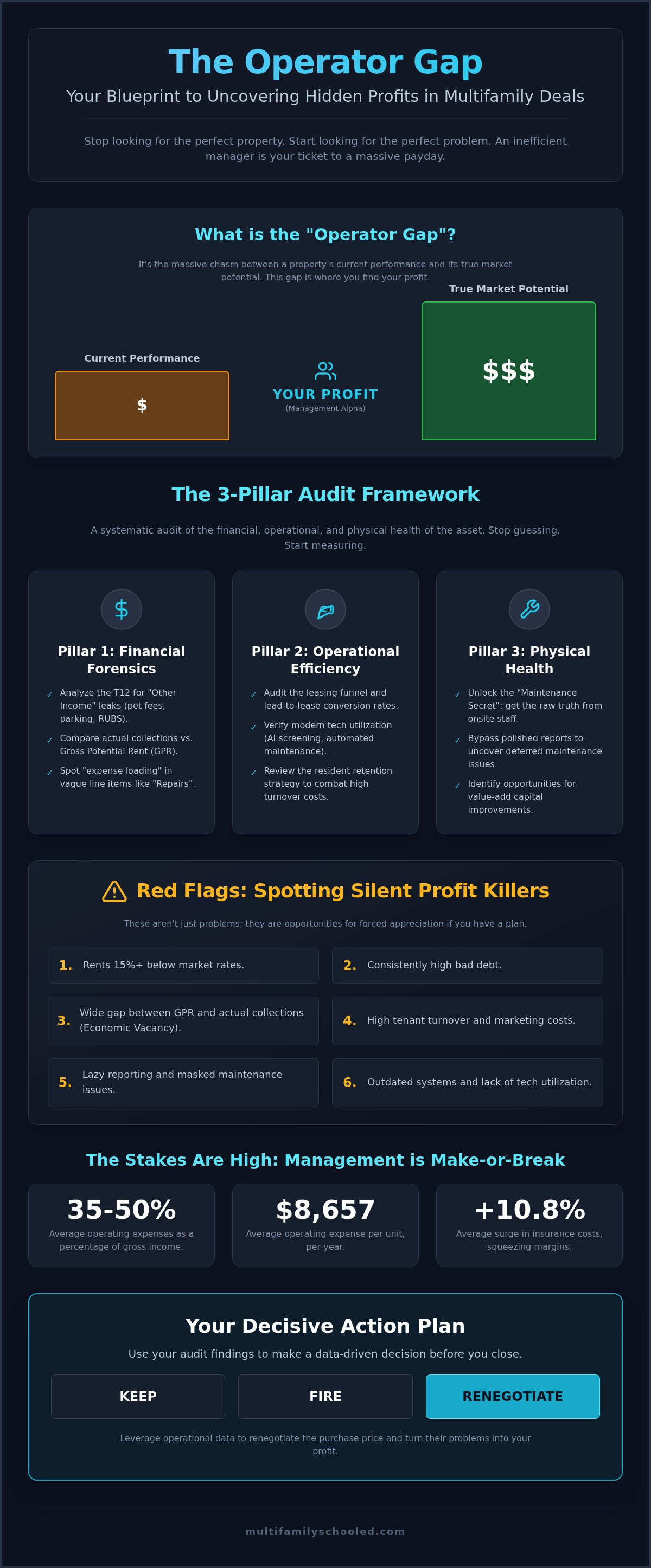
You can fix a roof. You can repaint a facade. But you cannot fix a broken investment if you ignore the people running it. Evaluating existing property management on a multifamily deal is the process of auditing the incumbent operator's efficiency to see if they are actually maximizing the asset. Most investors fall into a psychological trap. They obsess over the physical bricks and mortar while completely ignoring the operational engine. This is a fatal mistake in 2026. With insurance costs surging by 10.8% and operating expenses hitting an average of $8,657 per unit, management is no longer just a line item. It is the make or break factor for your syndication.
The "Operator Gap" is the secret weapon of the elite investor. It represents the massive chasm between how a property is performing now and its true market potential. When you understand what is property management at its core, you realize it is about systems, not just collecting checks. If the current operator is leaving money on the table, that gap is your profit. You aren't just buying real estate; you are buying an inefficient business that you can optimize for massive gains. Seize this opportunity to build your future by looking past the physical structure.
The Difference Between a Good Deal and a Good Manager
Don't be fooled by a clean T12. A world-class manager can mask a property's deepest flaws with aggressive leasing and perfect maintenance records. Conversely, a bad manager is an investor's best friend. In a value-add play, poor management creates the "mess" you need to build equity. If a property is struggling despite being in a prime location, the manager is likely the culprit. Improving those operations directly impacts your exit cap rate. A property that runs like a Swiss watch is always worth more than a chaotic one, regardless of the zip code.
Identifying the 'Management Alpha' in Your Pro Forma
When evaluating existing property management on a multifamily deal, look for the "lazy" signs in the initial offering memorandum. Are the rents 15% below market? Is the bad debt line item consistently high? These aren't problems; they are opportunities for forced appreciation. Management Alpha is the untapped profit potential left by inefficient operators. By applying a Mentorship Program framework to tighten collections and cut waste, you turn these inefficiencies into immediate equity. This is how you find the "hidden alpha" that makes a deal go from average to legendary. Stop looking at what the property is. Start looking at what it becomes under your leadership.
The 3-Pillar Framework for Auditing Multifamily Management
You need a battle plan. Evaluating existing property management on a multifamily deal requires more than a quick glance at a spreadsheet. It demands a systematic audit of the financial, operational, and physical health of the asset. Stop guessing. Start measuring. Use this 3-pillar framework to verify the truth behind the broker's pitch. You can even use the Multifamily Tool Kit to automate this process and save hours of manual analysis. Master the details now or pay for them later.
Pillar 1: Financial Forensics and the T12
The T12 is just the starting point. You must look for "Other Income" leaks. Is the manager capturing pet fees, reserved parking, and RUBS? If they aren't, that is easy money for you to claim on day one. Compare actual collections against Gross Potential Rent (GPR). A wide gap suggests poor screening or lazy enforcement. Watch out for "expense loading." Managers often hide inefficiencies by dumping unrelated costs into the "repairs" line item to keep their payroll looking lean. This framework for assessing property management provides a solid foundation for spotting these financial anomalies before you commit capital.
Pillar 2: Operational Efficiency and Tech Utilization
Efficiency is the heartbeat of your NOI. Audit the leasing funnel with a critical eye. What is the lead-to-lease ratio? If leads are dying in the CRM, your manager is failing at the most basic level. In 2026, there is no excuse for manual, slow-moving screening. Check if they use AI for resident vetting and automated maintenance routing. High turnover costs are a silent profit killer. Review the resident retention strategy. If residents are fleeing because of poor communication, your "good deal" will quickly evaporate into a sea of vacancy and marketing costs. Demand better systems to ensure long-term stability.
Pillar 3: The Maintenance-Management Connection
Maintenance tickets are the property’s diary. Read them. When evaluating existing property management on a multifamily deal, you must compare the work order history against the actual deferred maintenance list. If the T12 shows high repair costs but the property looks like a wreck, the manager is "band-aiding" issues. They are spending your money to delay inevitable failures. Preventative maintenance is the only way to preserve your NOI long-term. If you want to master this evaluation and close with confidence, consider joining our Mentorship Program to see how the pros audit deals in real-time. Don't just buy a building. Buy a high-performing machine.
Red Flags: Spotting Poor Management Before You Close
Red flags are not just warnings. They are a roadmap to your future wealth. When you are evaluating existing property management on a multifamily deal, you must look for the cracks where money is leaking out of the asset. Most investors only look at physical vacancy. They see a building that is 95% full and think it's a winner. They are wrong. You need to look at economic vacancy. This is the difference between what the property should be making and what actually hits the bank account. If physical occupancy is high but collections are low, you have a management crisis. This is the silent profit killer that destroys your NOI before you even take over.
Watch the "Bad Debt" line item like a hawk. High bad debt is a direct reflection of poor resident screening. It means the manager is letting anyone with a pulse move in just to hit occupancy targets. Similarly, static rents in a market that is clearly rising are a massive red flag. If market rents are trending up but the T12 shows flat numbers, the manager is passive. They are afraid of turnover, or they are just lazy. If the turnover rate is above 50% annually, you have a resident satisfaction problem. Residents don't leave good managers. They leave chaos.
The 'Lazy Landlord' Indicators
Look for the "Lazy Landlord" signs. Are there expired leases sitting on month-to-month status without a single rent bump? That is pure negligence. In 2026, social proof is everything. A lack of online presence or a string of 1-star reviews on Google and Yelp tells you exactly how the property is being run. If the current owner is missing monthly reports or receiving them late, the manager isn't just lazy; they are hiding something. You can't manage what you don't measure. Don't let their lack of discipline become your financial burden.
Financial Leakage: Where the Money is Disappearing
Check the utilities immediately. If you see high water or electric bills without a RUBS (Ratio Utility Billing System) in place, you are paying the residents' bills. That is immediate upside for you. Look at the marketing spend. If they are dumping thousands into advertising but the leasing velocity is still crawling, the manager doesn't know how to close leads. Finally, check vendor contracts. Overpaying for third-party services is common when managers don't bother with competitive bidding. Every dollar saved here is a dollar added to your valuation. Stop guessing and start auditing. If you want to see how we spot these traps in under 90 days, check out our Mentorship Program. We teach you to see the numbers the brokers try to hide.
The Incumbent Interview: Questions Every Investor Must Ask
Don't get played by the corporate spin. When you are evaluating existing property management on a multifamily deal, the regional VP is the last person you should trust for the raw truth. They are paid to make the asset look like a trophy. You need to get in the trenches with the onsite staff. These are the people who see the leaks, hear the resident complaints, and deal with the broken boilers. They know where the bodies are buried. Your job is to dig them up before you sign the closing documents.
Evaluating existing property management on a multifamily deal requires you to be a detective, not just a bystander. You must determine if the team has a "Leasing Culture" of high-performance sales professionals or if they are merely "order-takers" waiting for the phone to ring. Use Real Estate Radar AI to verify every market rent claim they make. If their numbers don't match the AI data, they are either lying to you or they don't understand their own market. Either way, it's a massive opportunity for you to step in and optimize.
Tactical Interview Questions for Onsite Staff
Walk the property with the lead maintenance tech and the leasing agent. Ask the "Maintenance Secret" question: "If I gave you an unlimited budget, what is the one thing you would fix today?" Their answer will reveal the catastrophic failure waiting to happen that isn't on the T12. Follow up with these high-impact questions:
- "What is the #1 reason people decide NOT to rent here?" This exposes the property's biggest weakness, from bad smells to noisy neighbors.
- "How long does it take to turn a unit from move-out to move-in?" If the answer is more than 5 to 7 days, they are burning your potential NOI through pure inefficiency.
- "Tell me about the most difficult resident currently on the rent roll." This tells you exactly how much "management hair" you are inheriting and how the team handles conflict.
Evaluating the Regional Manager's Oversight
Once you've grilled the onsite team, hold the Regional Manager accountable. You need to know if they are actually leading or just collecting a fee. Ask how often they visit the site in person. If it isn't at least once a month, the property is drifting. Demand to see their 2026 Capital Expenditure (CapEx) priority list. A manager without a plan for the next year is a manager who is just reacting to disasters. Ask how they plan to compete with the new "Class A" build down the street. If they don't have an answer, they are already losing. Stop guessing and start leading. Join our Mentorship Program today to master the art of the interview and never get burned by poor management again.
Taking Action: Keep, Fire, or Renegotiate?
The audit is complete. The data is in. Now it's time to lead. Evaluating existing property management on a multifamily deal is only valuable if you have the courage to act on your findings. You're no longer just an observer; you're the owner. You must decide if the current team is an asset or a liability to your long-term independence. Every day you wait is a day of lost profit. Move fast. Move with certainty. Your financial freedom depends on the decisions you make right now.
Execution is everything. You have three paths: keep the team, fire them immediately, or use their failures to lower the price. When evaluating existing property management on a multifamily deal, you must be prepared to walk away if the operational rot is too deep. Indecision is a profit killer. Follow the blueprint. Take control of the asset and start your journey toward true economic empowerment today.
Renegotiating the Deal Based on Operational Audits
Don't pay full price for someone else's mistakes. If your audit revealed $100,000 in deferred maintenance or thousands in uncollected RUBS, demand a credit at closing. Use a poor T12 with high bad debt and stagnant rents as documented proof that the asset's current valuation is inflated by operational negligence. This is how you win at the closing table. You're buying the future potential, not the past failures. Make the seller pay for the "Operator Gap" you identified.
Your Next Step: Finding the Right Deal
Stop guessing. Start winning. You need a proven system for deal analysis that works in any market. Follow the "Fire Fast" rule. If the incumbent manager is toxic to your ROI or lacks a modern tech stack in 2026, cut ties immediately. You cannot build a high-performance machine on a broken foundation. Bring in a team that understands the 2026 regulatory landscape, like the new 14-day non-payment notice periods in Virginia or the $65.86 screening fee caps in California.
Join our Online Challenges or the 5-Day Multifamily Challenge to master the A-Z of apartment investing. Secure your financial future by working with a mentor who has already achieved the success you desire. Leverage the Mentorship Program to vet your management decisions and close your next deal in 90 days. The opportunity is here. Take it.
Master the Operator Gap and Claim Your Future
The "Operator Gap" is the secret weapon of the elite investor. You now have the tactical blueprint for evaluating existing property management on a multifamily deal. Stop viewing management as a static expense. Start seeing it as your primary engine for growth. By auditing the T12 with financial forensics and interviewing onsite staff for the raw truth, you uncover the hidden alpha that others miss. The 2026 market demands precision. Don't let a "lazy landlord" or a toxic manager stand between you and your financial independence.
The system is proven. The tools are ready. You don't have to navigate this journey alone. Get direct access to Justin Brennan's industry expertise and our proprietary deal-finding software to accelerate your results. We offer a 90-day deal guarantee because our frameworks work. Stop dreaming and start closing.
Secure Your Path to Multifamily Success: Join Our Mentorship Today!
Your future starts with the very next deal you analyze. Believe in the system, take the action, and claim the prosperity you deserve.
Frequently Asked Questions
What is the most important document to review when evaluating existing management?
The Trailing 12-Month (T12) Profit and Loss statement is the most critical document. It provides a month-by-month look at actual income and expenses rather than a simple snapshot. You must compare the T12 against the rent roll to find discrepancies in collections and bad debt. This is the foundation of evaluating existing property management on a multifamily deal.
Should I keep the current property management company after I buy the building?
Only keep the current manager if their performance matches your investment goals. If you find high economic vacancy or stagnant rents during your audit, it is time to move on. Most value-add plays require a fresh team that can execute your specific business plan. Never keep a toxic manager out of convenience; it will cost you your ROI.
How do I know if the property manager is hiding maintenance issues?
Compare the work order history against a physical site walk. If the T12 shows high repair costs but you see peeling paint and leaky faucets, they are band-aiding problems. Look for repeated tickets for the same mechanical systems. This indicates they are spending your money on temporary fixes instead of solving the root cause of the issue.
What is a 'normal' property management fee for a multifamily property in 2026?
The national average monthly management fee is 8.49% of collected rent as of 2026. For larger multifamily properties with 10 or more units, you can often negotiate lower rates between 4% and 7%. Always account for the "all-in" cost. This includes leasing fees and renewals, which can total 18% to 20% of gross rent in the first year.
Can I fire the property manager as soon as I take ownership?
Yes, you can usually terminate the incumbent manager upon closing the deal. Most management contracts have a "termination upon sale" clause that allows the new owner to bring in their own team immediately. Review the existing contract during due diligence to confirm the notice period. Fire fast if the current operator is a liability to your success.
What happens if the current manager refuses to provide historical data?
A refusal to provide data is a massive red flag that usually means they are hiding financial mismanagement. Make the delivery of historical T12s and rent rolls a requirement of your purchase agreement. If the seller cannot produce these documents, you should either renegotiate for a massive price reduction or walk away from the deal entirely.
How does bad property management affect my ability to get a loan?
Lenders look at the Net Operating Income (NOI) to determine your loan-to-value ratio. If evaluating existing property management on a multifamily deal reveals poor collections or high expenses, your NOI will be lower. This directly reduces the amount of capital a bank will lend you. Efficient management is the key to securing better financing terms and higher leverage.
Is it possible to manage a 20-unit building myself to save on costs?
You can manage a 20-unit building yourself, but you are buying a job instead of an investment. Professional management allows you to scale and focus on finding more deals. In 2026, navigating complex laws like Virginia's 14-day non-payment notices or Colorado's portable screening report requirements is a full-time responsibility. Use a pro so you can stay in the owner's box.



