

Creating a 3-Year Multifamily Real Estate Business Plan: The Scalable Blueprint
What if your business plan was more than just a stack of papers gathering dust? Most investors treat their multifamily real estate business plan as a static document; the elite players know it's actually a 3-year execution engine designed to turn raw market data into closed deals. You've probably felt the weight of complex financial modeling or the anxiety of projecting growth in a fluctuating market. It's overwhelming to try and pitch a high-net-worth individual when you aren't 100% sure of your own value proposition. We understand that frustration because we've been in the trenches.
You deserve a clear path to economic empowerment and long-term independence. Today, you'll master the exact framework used to build professional plans that attract capital and scale portfolios in record time. We're handing you the scalable blueprint to go from overwhelmed to investor-ready. This guide breaks down the system for finding and closing deals within 90 days by leveraging strategic roadmaps and proprietary deal-finding tools. Stop guessing and start building your legacy right now.
Key Takeaways
- Discover why a 3-year horizon is the strategic sweet spot for scaling your assets and securing long-term economic independence.
- Identify your exact "Buy Box" by analyzing sub-market demographics and job growth to find high-performing properties faster.
- Learn the framework for a professional multifamily real estate business plan that builds immediate trust with sophisticated investors and lenders.
- Structure your syndication team and master the pro-forma modeling needed to calculate ROI on value-add renovations and rent bumps.
- Execute a 90-day sprint to transition from a theoretical document to a closed deal using a proven market immersion system.
What is a Multifamily Real Estate Business Plan?
A multifamily real estate business plan isn't just a static document. It's your tactical execution engine. It transforms a vague vision of apartment investing into a precise, results-driven system for wealth accumulation. While amateur investors guess their way through acquisitions, elite players use a professional blueprint to secure their financial future. When you're targeting multifamily residential properties, this plan acts as the master map for every high-stakes decision you make.
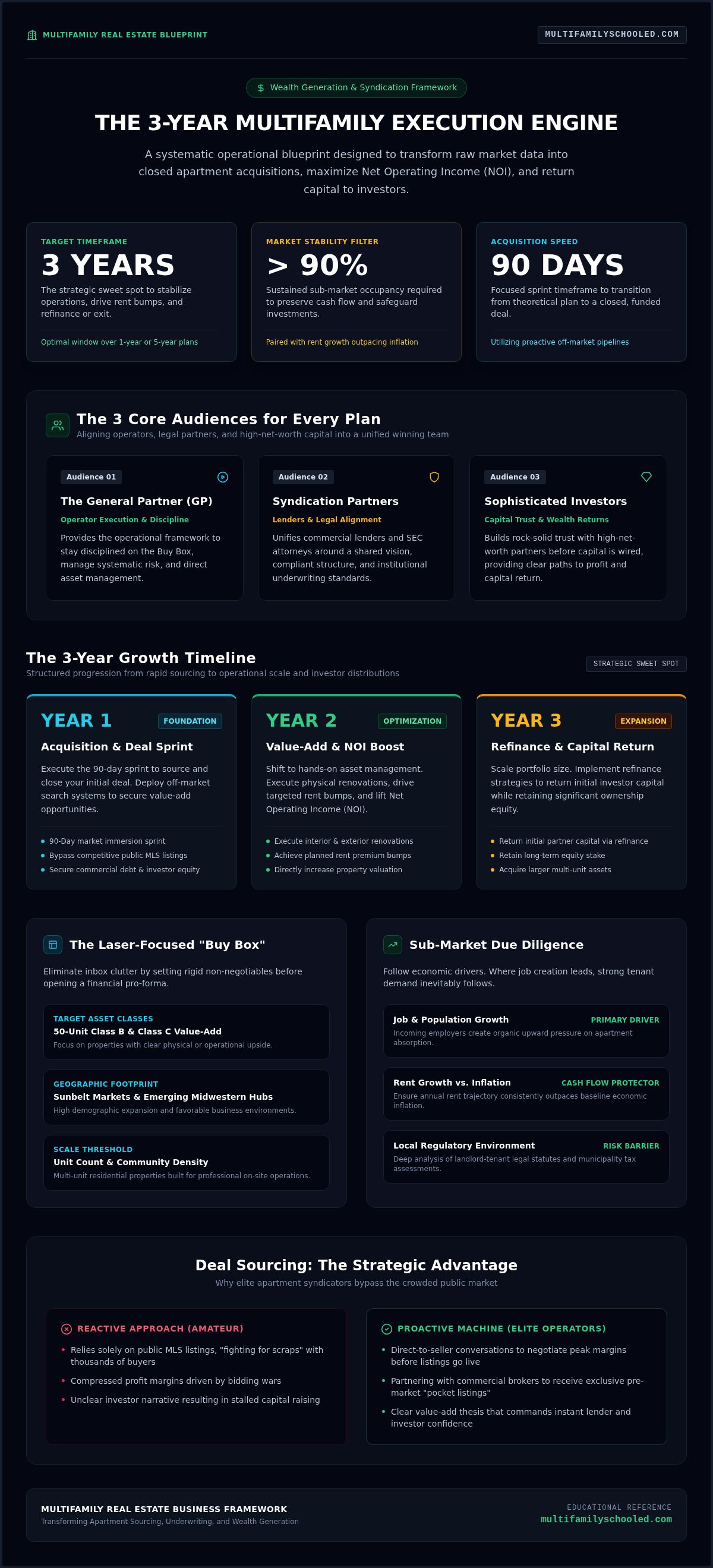
Your plan must speak to three core audiences. First, it guides you as the operator, keeping you disciplined and focused on your specific "Buy Box." Second, it aligns your syndication team, including SEC attorneys and commercial lenders, around a shared vision. Third, it builds undeniable trust with your investors. They need to see a professional strategy before they ever wire capital into your deals. This isn't a generic real estate summary; it's a syndication model designed for rapid scale and massive impact.
Why focus on a 3-year horizon? It's the strategic sweet spot. One year is too short to realize the full potential of a value-add strategy. Five years feels like an eternity in a shifting economy. A 3-year plan allows you to stabilize operations, maximize Net Operating Income (NOI), and provide a clear exit or refinance window for your partners.
The Core Components of a Scalable Plan
Start with a high-impact Executive Summary. This section defines your "why" and your mission statement. It shouldn't be dry; it should be motivational. Next, detail your Company Overview. You must clearly define your roles as the General Partner (GP). Show your team and your investors exactly how you'll source, fund, and manage assets. A multifamily business plan is an operational engine for wealth accumulation. It proves you have a systematic approach to risk and a clear path to profit.
Setting 3-Year Milestones
Success requires aggressive, time-bound targets to keep your momentum high. Use these milestones to track your progress:
- Year 1: Focus on the foundation. This is your 90-day sprint to source and close your first deal. Use proprietary software to find off-market opportunities while others fight over scraps on the MLS.
- Year 2: Shift to operational optimization. Implement your value-add renovations and drive rent bumps. This is where you transform the property's performance and increase its overall valuation.
- Year 3: Scale your legacy. Use your proven systems to acquire larger assets or explore refinancing options to return initial capital to your investors while maintaining equity.
By following this multifamily real estate business plan, you move from a dreamer to a disciplined professional. You aren't just buying buildings; you're building a scalable business that generates long-term independence.
Market Analysis and Deal Sourcing Strategy
Stop chasing every lead that hits your inbox. A winning multifamily real estate business plan requires a laser-focused "Buy Box." This is your filter for success. You must define your unit count, asset class, and geographic focus before you ever look at a pro-forma. Are you hunting for 50-unit Class B properties in the Sunbelt? Or are you looking for Class C value-add opportunities in emerging Midwestern hubs? Decisiveness saves time. It prevents you from wasting energy on deals that don't fit your long-term vision. Your multifamily real estate business plan only works if the underlying market data is rock solid.
Defining Your Target Market
You can't scale in a dying market. You need to perform a deep dive into sub-market demographics and job growth. Follow the jobs; the renters will follow. Look for rent growth trends that outpace inflation and occupancy rates that remain steady above 90%. You also need to understand the local environment. Landlord-tenant laws and tax assessments can make or break your cash flow. Don't guess on these variables. Use the Multifamily Tool Kit to evaluate markets with professional precision.
The Deal Finding Machine
The "Secret Sauce" of elite investors is moving from reactive to proactive sourcing. If you're only looking at the MLS, you're fighting for scraps. You need to build a machine that brings deals to you. This starts with commercial brokers. They are the gatekeepers of the industry. Prove you're a serious closer, and they'll send you pocket listings before they go public. Direct-to-seller strategies are your next level of growth. You want to talk to owners before they even think about hiring a broker. This is where you find the best margins.
You can gain a massive proprietary advantage by utilizing Real Estate Radar to identify motivated sellers instantly. This software allows you to skip the line and secure off-market apartment buildings while your competition is still sleeping. Stop waiting for the market to give you a deal. Go out and take it. If you're ready to stop browsing and start buying, consider joining our mentorship program to sharpen your sourcing skills. Success is a choice. Build your machine today.
Building the Machine: Operations and Team Structure
Success in this industry isn't a solo sport. It's a team game. If you want to scale to hundreds of units, you must stop acting like a landlord and start acting like a CEO. Your multifamily real estate business plan needs to detail a team that can execute under pressure. This is where you define the syndication machine. You're building a structure that separates the General Partners (GPs) from the Limited Partners (LPs). The GPs are the active drivers; they source deals, manage assets, and deliver results. The LPs are the passive fuel; they provide the capital that makes the deal possible. This partnership is the engine of your growth.
The General Partnership (GP) Hierarchy
A high-performance GP team usually consists of three core roles. First is the Acquisitions Lead. This is your deal hunter who lives in the software and talks to brokers every day. Second is the Capital Raiser. They manage investor relationships and articulate your unique value proposition to potential LPs. Third is the Operations or Asset Manager. This person is the value-add executor. They ensure the 3-year plan actually happens on the ground. Don't try to wear all three hats at once. Specialize to scale. You can find your core team and learn these roles inside our Mentorship Program.
Beyond your internal team, you need elite external partners. Your multifamily real estate business plan must account for high-level advisors. You need an SEC attorney to ensure your syndication is compliant and legal. You need commercial lenders who understand your specific asset class. You also need insurance brokers who can protect your assets from the unexpected. These aren't just service providers. They are the guardians of your legacy.
Strategic Third-Party Partners
Your property management company is your "boots on the ground." You must vet them with extreme prejudice. Do they align with your 3-year plan? Do they have experience with your specific asset class? If they can't handle a value-add renovation schedule, they will sink your deal. Similarly, a commercial mortgage broker is vital. They don't just find loans; they secure the favorable debt structures that make your ROI pop. Asset management is where you drive the Net Operating Income (NOI). It's the strategic oversight of the property manager to ensure rent bumps and expense cuts happen on schedule. Master the machine, and the assets will follow.
Financial Modeling: Forecasting Growth and Exits
Numbers don't lie. They provide the cold, hard truth about your potential for success. Your multifamily real estate business plan must feature a rock-solid pro-forma that projects income and expenses over your 3-year horizon. This isn't about optimistic guessing. It's about defensible data. A defensible financial model is the bridge between a pitch and a funded deal when speaking with sophisticated investors. You must account for every variable, from property taxes to maintenance reserves, to prove your deal's viability and your own competence as an operator.
Key Multifamily Metrics to Master
To speak the language of elite players, you must master three specific metrics. First is the Cap Rate. You need to understand how market compression or expansion affects your property's terminal value. Second is Cash-on-Cash Return. This is the metric your investors care about most; it tells them exactly how much liquid profit they'll see relative to their initial outlay. Finally, you must calculate the Debt Service Coverage Ratio (DSCR). If your DSCR doesn't meet the bank's requirements, your financing will collapse. Use our Multifamily Tool Kit to run these numbers with professional accuracy.
The 3-Year Exit Strategy
How do you get the money back? Your investors are waiting for the "Capital Event." In a 3-year plan, you generally choose between two paths: refinancing or selling. Refinancing is the "BRRRR" method for apartments. You pull out the initial capital, return it to your partners, and keep the cash-flowing asset. Selling allows for a total exit and a massive payout based on the increased Net Operating Income (NOI). Both paths require a clear value-add strategy where renovations lead to rent bumps and higher property valuations.
Structure your investor distributions using a "waterfall" model. This ensures your Limited Partners get paid first while incentivizing you as the General Partner to exceed performance targets. Always include a sensitivity analysis in your multifamily real estate business plan. Show your partners what happens if interest rates rise or occupancy drops. Transparency builds trust. Trust closes deals. If you want to master these complex models and secure your future, apply for our mentorship program today and start building your financial legacy.
Execution: The 90-Day Multifamily Sprint
Planning is a trap if it doesn't lead to immediate action. Your multifamily real estate business plan is a piece of paper until you put it into motion. You have 90 days to turn your blueprint into a closed deal. This isn't a slow crawl; it's a high-stakes sprint toward economic empowerment. Success requires you to stop analyzing and start executing. The transition from document to deal happens when you commit to a relentless schedule of market immersion and offer submission.
Phase 1 (Days 1-30) is about market immersion and sourcing setup. You must live in your data. Set up your deal-finding machine and start contacting owners directly. Phase 2 (Days 31-60) is the volume game. Underwrite properties every single day. Submit offers relentlessly. You can't win if you don't play, and you can't play if you're afraid of a "no." Phase 3 (Days 61-90) is where you cross the finish line. This phase covers due diligence and capital raising. You're no longer just an aspiring investor; you're a closer.
The Velocity of Implementation
Speed is your greatest asset in a competitive multifamily market. The slow get left behind while the decisive secure the best assets. You need to move with absolute urgency. Don't wait for the perfect moment because it doesn't exist. Set weekly KPIs for your deal flow. Track how many brokers you called, how many units you analyzed, and how many letters of intent (LOIs) you sent. If you aren't hitting your numbers, you aren't building a business. You're just having a hobby. To move faster and avoid common pitfalls, join the 90-Day Mentorship to execute this plan with expert guidance.
Overcoming The "First Deal" Hurdle
Don't let a lack of experience stop your progress. You can build massive credibility even with zero prior units under your belt. The secret is leveraging a mentor’s track record to close your first apartment building. When you show up with a professional multifamily real estate business plan and the backing of a proven system, brokers and investors listen. You aren't just a beginner; you're a student of a multi-generational legacy. Credibility is earned through preparation and the team you bring to the table. Stop making excuses and start making moves. Start your 5-Day Challenge today to kickstart your plan and secure your first deal in record time.
Build Your Legacy and Scale Your Portfolio
Your multifamily real estate business plan is now more than a document; it is an active roadmap for massive wealth accumulation. You have the framework to define a precise Buy Box, structure an elite syndication team, and model financials that command respect from high-net-worth investors. A plan without execution is just a dream. It is time to shift from strategy to reality and claim your seat at the table. You have the tools to dominate this market and secure your long-term independence.
We provide the complete ecosystem you need to win. Leverage our multi-generational industry heritage and gain exclusive access to our proprietary Real Estate Radar technology to find off-market deals before anyone else. We don't just teach theory; we provide a proven system that delivers results. Are you ready to stop watching from the sidelines and start closing?
Secure Your First Deal in 90 Days; Join the Mentorship Program. We are so confident in our framework that we offer a 90-day deal delivery guarantee. Your future is waiting for you to take charge. Start your journey today and build the prosperous life you deserve.
Frequently Asked Questions
How long should a multifamily real estate business plan be?
A professional plan typically spans 15 to 30 pages depending on the complexity of your deals. It needs to be long enough to cover deep market analysis, team biographies, and detailed financial pro-formas; however, it must remain concise enough for an investor to digest in one sitting. Quality always beats quantity. Focus on a high-impact executive summary and a clear 3-year execution roadmap that proves you have a systematic approach to scaling.
Do I need a business plan if I am not raising outside capital?
Yes, you absolutely need one to maintain discipline and track your operational milestones. A multifamily real estate business plan acts as your strategic manual even if you are using your own funds. It prevents mission creep and ensures you stay focused on your specific Buy Box. Without a plan, it is easy to overpay or mismanage a value-add renovation. Treat your own capital with the same professional rigor you would use for a partner's money.
What is the most important section of a multifamily business plan for investors?
The Executive Summary and the Financial Pro-Forma are the most critical sections for any potential partner. Investors look at the Executive Summary to understand your mission and the "why" behind the project. Then, they dive into the numbers to verify your projected returns. They want to see realistic rent bumps, expense ratios, and a clear exit strategy. If your math does not hold up under their scrutiny, the rest of the document won't matter.
How often should I update my 3-year real estate business plan?
You should review your plan quarterly and perform a major update annually to reflect current market conditions. Markets shift, interest rates fluctuate, and local demographics change. A static document becomes obsolete quickly in a dynamic economy. Regular updates allow you to pivot your sourcing strategy or adjust your renovation budget based on real-world performance. This ongoing refinement ensures your 3-year milestones remain achievable and your team stays aligned with your long-term vision.
What software is best for multifamily financial modeling?
Most professionals use Excel-based models or proprietary tools designed specifically for syndication. We provide specialized Deal Finding Software and analytical tools through Multifamily Schooled to streamline this process. These resources allow you to run sensitivity analyses and calculate complex metrics like the Debt Service Coverage Ratio (DSCR) instantly. Using a proven system reduces the risk of manual errors and gives you the confidence to present your numbers to high-net-worth individuals.
Can I start a multifamily business with no prior experience?
You can start with zero units if you leverage the right mentorship and strategic systems. Many of our successful students began with no background in real estate but followed our 90-day sprint framework to close their first deal. The key is to borrow credibility by partnering with experts or joining a program with a proven track record. By using a professional multifamily real estate business plan, you prove to brokers and lenders that you have a systematic approach to success.
How much capital do I need to execute a 3-year multifamily plan?
The amount varies based on your target asset class, but you don't always need your own cash to start. Syndication allows you to raise capital from Limited Partners while you act as the General Partner. You will need some liquid capital for due diligence costs, earnest money deposits, and initial marketing. However, the core of the 3-year plan is often built on your ability to attract outside investors who provide the bulk of the acquisition funds.
What happens if I cannot find a deal within the first 90 days?
Persistence is vital, but having a performance guarantee helps reduce the pressure of the search. Our mentorship program specifically promises to help you find a deal within 90 days, or we will provide one for you. If you are working alone and hit a wall, you must analyze your weekly KPIs. Usually, a lack of deals is a sourcing problem that can be fixed with better technology and a more aggressive outreach strategy to motivated sellers.



