

Common Underwriting Mistakes in Multifamily: How to Avoid Deal-Killing Math in 2026
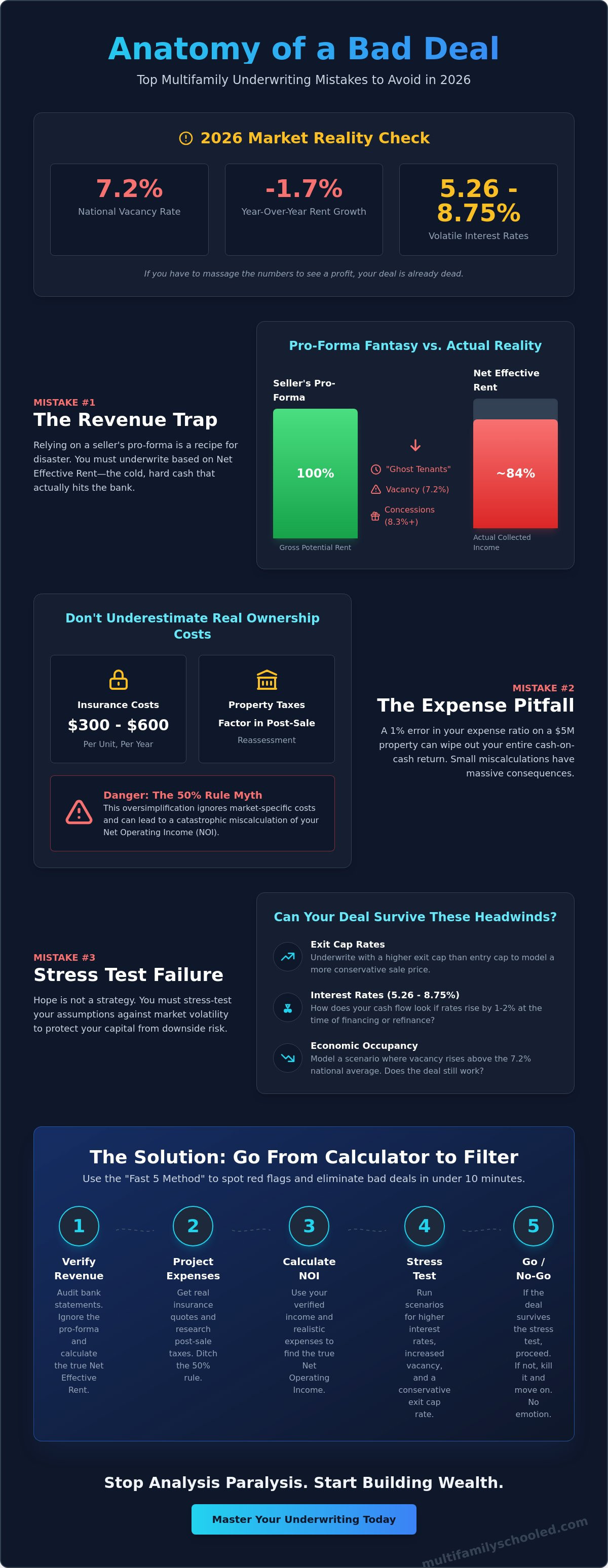
If you have to massage the numbers to see a profit, your deal is already dead. Most investors fail because they treat their spreadsheet like a calculator instead of a filter. With national vacancy rates hitting 7.2% and rent growth dropping to -1.7% as of May 2026, you can't afford a single math error. Identifying common underwriting mistakes in multifamily is the difference between achieving financial freedom and losing your capital on a bad investment. You're likely tired of analysis paralysis or feeling confused by pro-forma numbers that look nothing like the actuals.
It's time to stop the guessing game. You deserve a proven system that spots hidden traps before they kill your deal. This article will show you how to stress-test your projections against current 5.26% to 8.75% interest rates and rising insurance costs that now average $300 to $600 per unit. We're diving into the exact math you need to master to avoid the revenue trap, unlock Green Light deals, and confidently secure your next apartment building today.
Key Takeaways
- Stop treating underwriting like a calculator and start using it as a powerful filter to eliminate bad investments instantly.
- Learn to spot the "Revenue Trap" by identifying the gap between seller pro-formas and the actual net effective rent.
- Avoid common underwriting mistakes in multifamily by correctly projecting tax reassessments and avoiding dangerous oversimplifications like the 50% rule.
- Protect your capital by stress-testing your exit cap rates and interest rate assumptions against 2026 market volatility.
- Use the "Fast 5 Method" to filter deals in under 10 minutes so you can stop the analysis paralysis and start building wealth now.
Common Underwriting Mistakes in Multifamily: Why Your Math Is Secretly Sabotaging Your Wealth
Your spreadsheet should be a filter, not a calculator. If you find yourself adjusting numbers just to see a profit, you've already lost. In the volatile market of May 2026, guessing on your math is a fast track to financial ruin. Identifying common underwriting mistakes in multifamily is the only way to protect your capital and secure your path to wealth. Most investors fail because they underwrite based on what they want to happen, rather than what the data actually says. They ignore the truth to chase a dream, but a bad deal is a nightmare in disguise.
To better understand this concept, watch this helpful video:
What Is Multifamily Underwriting Really?
Real estate underwriting is a specialized risk-mitigation framework used to verify income and predict the future performance of an apartment asset. It's the bridge between a broker's marketing pitch and the cold, hard reality of the property's bank statements. Many rookies confuse data entry with analysis. Typing numbers into a cell is easy; thinking about how those numbers shift when national vacancy hits 7.2% is where mastery happens. You need a system that forces you to look at the worst-case scenario. Our mentorship program teaches you the "Green Light" system to ensure every deal you pursue is a winner.
The Cost of a Math Error in 2026
A tiny mistake can have massive consequences. For example, a 1% error in your projected expense ratio on a $5 million property can instantly wipe out your entire cash-on-cash return. Single-family investors often fall into this trap when moving into 5 to 50 unit buildings. They underestimate the complexity of commercial utilities, payroll, and professional maintenance. They treat a 20-unit building like 20 houses. That's a deal-killing mistake. Commercial assets live and die by the Net Operating Income. If you don't respect the math, the math won't respect your bank account.
The most dangerous variable in your spreadsheet isn't the interest rate; it's hope. "Hope" is a psychological trap fueled by deal FOMO. It makes you overlook a 39% increase in construction costs since 2020 or ignore the fact that rent growth has cooled to -1.7% as of May 4, 2026. You might feel the urge to "make the deal work" just to stay busy. Don't do it. Your goal is to reach your 90-day acquisition target safely and profitably. Master the math today. Unlock your financial freedom by finding the truth in every deal you analyze.
The Revenue Trap: Why Pro-Forma Rents Are Often Lies
A seller's pro-forma is a wish list, not a reality. Relying on these optimistic projections is one of the most common underwriting mistakes in multifamily. With year-over-year asking rent growth sitting at -1.7% as of May 4, 2026, you cannot afford to be naive. You must understand the difference between Gross Potential Rent (GPR) and Net Effective Rent. GPR represents the absolute maximum rent if every unit was occupied at market rates with zero concessions. Net Effective Rent is the cold, hard cash that actually pays your mortgage. If you confuse the two, your cash flow will vanish before you finish your first year of ownership.
The Concession Haircut
Lease concessions are silent wealth destroyers. When a landlord offers "one month free" to keep units filled, your annual revenue takes an immediate 8.3% hit. Many investors see a $1,500 rent on a lease and plug that into their spreadsheet. That's a deal-killing error. You must look for "Ghost Tenants" on the rent roll. These are people listed as "active" who haven't paid rent in 60 or 90 days. Sellers use these to hide a 7.2% national vacancy reality and inflate their property's value. Audit the bank deposits. If the cash isn't in the bank, the rent doesn't exist.
The Renovation Premium Myth
Never assume that "luxury" upgrades guarantee higher rents. This renovation myth is a trap. You might spend $10,000 per unit on quartz counters and stainless steel, but if the submarket is saturated, you won't see a dime in return. Check your comps carefully. If 70% of the units in your three-mile radius already have these finishes, your upgrade is just a requirement to stay competitive. It's not a value-add. To avoid overpaying for "potential" that isn't there, check out our mentorship program to learn how to analyze submarkets like a pro.
Hidden bad debt is the final nail in the revenue coffin. Brokers often "normalize" bad debt in their marketing packages. They'll tell you it's a one-time issue or a result of "poor management" that you'll easily fix. Don't believe them. If a property has a history of non-payment, that culture is difficult and expensive to break. Verify every lease. Check every security deposit. If you don't find the truth during your due diligence, you'll pay for it with your own capital later. Master the math now so you can build wealth with confidence.
The Expense Pitfall: Underestimating the Real Cost of Ownership
Lazy math leads to empty bank accounts. The "50% Rule" is a dangerous oversimplification that has no place in a professional deal analysis. While it might work for a duplex, applying it to a 20-unit commercial asset is one of the most common underwriting mistakes in multifamily. Commercial properties carry complex overhead that a simple percentage can't capture. You're dealing with payroll, professional contract services, and sophisticated utility structures. If you don't account for every line item, your projected 8% cash-on-cash return will evaporate before the first year ends.
The "Tax Reassessment" trap is where most rookies lose their shirt. Never look at the seller's current property tax bill and assume it will stay the same. In Montana, the 2026 property tax rate for long-term rentals is a flat 1.10%. In Indiana, a new 6% deduction applies for the 2025-pay-2026 period. However, your purchase price often triggers a fresh assessment. If you buy a property for $4 million that was last assessed at $2 million, your tax bill could double overnight. You must underwrite based on the future assessed value, not the historical numbers the broker gave you.
Understanding the difference between Capital Expenditures (CapEx) and Operating Expenses (OpEx) is vital for your long-term wealth. OpEx keeps the lights on; CapEx builds the future. If you misclassify a $50,000 roof replacement as an operating expense, you'll artificially tank your Net Operating Income and kill your property's valuation. Conversely, ignoring necessary CapEx reserves is a recipe for a cash-call disaster. Stop guessing and start using a proven system to model these costs accurately.
The Property Management Reality Check
You must underwrite for professional management even if you plan to manage the building yourself. Your time isn't free. For 5-50 unit buildings, expect management fees to range from 6% to 10% of gross income. Larger 100+ unit complexes benefit from economies of scale and often see fees closer to 3% or 4%. If you don't include this cost, your deal isn't "bankable" for future buyers. Use the Multifamily Tool Kit to automate these expense models and ensure your math stands up to lender scrutiny.
Insurance and Utility Surges
Insurance premiums are a massive variable in 2026. National costs rose by more than 75% between 2019 and 2024; today, you should budget between $300 and $600 per unit annually. In high-risk areas, those costs can exceed $1,000 per unit. Don't assume a Ratio Utility Billing System (RUBS) can be implemented overnight to offset these costs. Local regulations in cities like Boston or Seattle are tightening, and tenants might resist new fees. Budget at least $500 per unit for annual maintenance reserves on older assets. Anything less is just wishful thinking that will sabotage your financial freedom.
Stress Testing for 2026: Exit Caps and Interest Rate Volatility
Market conditions change, but your math must remain bulletproof. Relying on "perfect world" scenarios is one of the most common underwriting mistakes in multifamily. With commercial mortgage rates currently ranging from 5.26% to 8.75% as of May 2026, you cannot afford to guess. You must stress-test your deal against interest rate volatility and shifting cap rates. If your deal only makes money when interest rates drop or rent spikes, you don't have a deal; you have a gamble. Real wealth is built on conservative assumptions that survive economic storms.
Your Debt Service Coverage Ratio (DSCR) is the lender's ultimate safety net. Most banks require a DSCR of at least 1.20 to 1.25. If your underwriting shows a tight margin, any dip in performance could trigger a loan default. A property that requires 95% occupancy just to break even is a "Red Light" deal. Given that the national multifamily vacancy rate is 7.2%, underwriting for 95% occupancy is delusional. You need room for error. If the market shifts, your deal must still provide cash flow to your investors and cover the debt.
The Exit Cap Sensitivity Analysis
You must build a sensitivity matrix to see how your returns change based on different exit scenarios. This "What If" table is your most powerful defense against overpaying. Always assume your Exit Cap Rate will be higher than your Entry Cap Rate. A safe rule of thumb is to add 10 to 20 basis points to your cap rate for every year you plan to hold the asset. This accounts for the building being older and potential market cooling at the time of sale. Breakeven Occupancy is the specific percentage of units that must be filled to cover all operating expenses and debt service. If this number is higher than 85%, your risk profile is likely too high for today's market.
Financing Fails: Floating Rates vs. Fixed
Floating rate bridge debt is a high-stakes game in a "higher for longer" environment. Many investors who used bridge debt in 2023 are facing "deal-killing" math today because they didn't underwrite for the "Refinance Test." You must ensure your property qualifies for a new permanent loan at year 3 or 5, even if rates stay at 8.75%. Use Real Estate Radar to track market-specific cap rate trends and stay ahead of the competition. Stop leaving your financial future to chance. Join our Mentorship Program today and learn how to underwrite with the confidence of a 3rd generation investor.
Master the Underwriting Game: The Fast 5 Method
Speed is your secret weapon in the 2026 apartment market. If it takes you four hours to analyze a single property, you'll never hit your 90-day acquisition goal. The Fast 5 Method allows you to filter deals in under 10 minutes. This isn't about cutting corners; it's about extreme focus. Most investors waste weeks on "Red Light" deals because they lack a proven system to say "no" quickly. Building your own spreadsheet from scratch is one of the most common underwriting mistakes in multifamily. You're likely to miss a critical cell reference or overlook a 2026 expense surge like the rising insurance costs that now average $300 to $600 per unit. Stop playing developer and start playing investor. Use a battle-tested model that has already processed thousands of successful units.
Street Smarts vs. Spreadsheet Smarts
Justin Brennan, a 3rd Generation Multifamily Investor, always says that theoretical math won't save you in the streets. You need "Hands-On" experience to win. A spreadsheet might show you a 10% return, but it won't tell you if a neighborhood is declining or if the seller's "bad debt" is actually a systemic management failure. Spreadsheet smarts are easy to find, but street smarts are earned. Having a mentor look over your shoulder at your first three deals is the ultimate shortcut to mastery. It eliminates the expensive lessons of trial and error that often cost rookies their entire down payment. Don't gamble with your financial future. Get instant access to the Multifamily Schooled Mentorship today and stop second-guessing your math. We provide the blueprint so you can move with total confidence.
Your Next Steps to Financial Freedom
The path to building massive wealth is right in front of you. You don't need more information; you need a better system. Start by downloading our Free eBook to master the fundamentals of apartment investing without the fluff. For those ready to accelerate their results, register for our 3-Day Live Workshop. We'll do a deep dive into underwriting mastery and show you exactly how to navigate 2026 market volatility, including the -1.7% rent growth trends we're seeing today. Commit to the 90-day goal right now. You have the power to own apartments, build generational wealth, and finally unlock your time. Take the challenge today. See if you qualify for our VIP programs and join a movement of successful investors who are changing their lives through multifamily. Your journey to financial freedom starts with one click.
- Download the Free eBook to start your education today.
- Register for the 3-Day Live Workshop for a deep dive into underwriting mastery.
- Commit to the 90-day goal: Own apartments, build wealth, unlock time.
Unlock Your Financial Freedom Today
You now have the tools to stop sabotaging your wealth. Avoiding common underwriting mistakes in multifamily isn't just about math; it's about having the discipline to see the truth. You've learned to spot the revenue trap where rent growth is down -1.7% as of May 2026. You know how to account for national vacancy rates of 7.2% and rising insurance costs. A single 1% error in expenses can kill your cash flow, but you now know how to stress-test your way to safety. Don't let fear or analysis paralysis hold you back from the life you deserve.
It's time to move from theory to action. Get the exact blueprint from a 3rd Generation Multifamily Investor who has already paved the way. Our proven "Fast 5" Underwriting Method is designed to help you filter deals in minutes, as featured on major real estate platforms. Stop guessing and start winning. Own Apartments in 90 Days, Apply for Mentorship Today! Unlock your financial freedom and build the legacy your family deserves. Success is waiting for you; take the first step today.
Frequently Asked Questions
What is a good expense ratio for a multifamily property?
A typical operating expense ratio for multifamily properties falls between 35% and 50% of gross income. An analysis from July 2024 noted that the average has stabilized at 45% in recent years. If your ratio is lower than 35%, you're likely missing hidden costs like payroll, contract services, or professional management fees. Always verify these against actual bank statements to avoid overpaying for a property that isn't actually profitable.
How do I verify the seller's income and expense claims?
You verify claims by performing a forensic audit of bank deposits and federal tax returns. Don't take the broker's marketing package at face value. Review the last 12 months of actual cash collected, not just the lease rates listed on a spreadsheet. Look for "Ghost Tenants" who are listed on the rent roll but haven't made a payment in 60 days. This is how you catch common underwriting mistakes in multifamily before they cost you your earnest money.
What is the difference between a pro-forma and a T-12 statement?
A T-12 statement shows the actual trailing 12 months of financial performance, while a pro-forma is a future projection. Think of the T-12 as the property's current report card and the pro-forma as its New Year's resolution. Successful investors underwrite based on the T-12 and use the pro-forma only as a secondary guide for potential value-add opportunities. If the seller's pro-forma looks too good to be true, it probably is.
How much should I budget for Capital Expenditures (CapEx)?
Budget at least $500 per unit per year for older assets to cover major repairs and replacements. Construction costs have risen by 39% since 2020, so your reserves must reflect this expensive reality. If you underfund your CapEx account, you'll face a cash-call disaster when the roof or HVAC system inevitably fails. Mastery of these numbers is the key to unlocking long-term financial freedom and building generational wealth.
Why is the exit cap rate so important in underwriting?
The exit cap rate determines your eventual sale price and your total return on investment. If you underwrite an exit cap that is too low, you're assuming the market will be better when you sell than when you bought. This is a dangerous gamble that can wipe out your equity. Add 10 to 20 basis points to your entry cap for every year you hold to ensure your capital is protected against future market cooling.
Can I use single-family underwriting software for apartments?
You cannot use single-family software for commercial apartments because the valuation methods are completely different. Single-family math relies on neighborhood comps, while multifamily value is driven strictly by Net Operating Income (NOI). Using the wrong tools is a deal-killing error. You need a proven system like our Fast 5 Method to analyze commercial risk, debt coverage, and complex operating expenses with total accuracy.
What happens if my DSCR drops below 1.25?
If your Debt Service Coverage Ratio (DSCR) drops below 1.25, most commercial lenders will reject your loan application immediately. Lenders require this 25% cushion to ensure the property can still pay its mortgage even if vacancy spikes or expenses rise. If your underwriting shows a tight DSCR, your deal is a "Red Light" and needs to be restructured or abandoned to save your capital for a better opportunity.
How do I underwrite a deal with high vacancy?
Underwrite for high vacancy by calculating your specific "Breakeven Occupancy" point. With the national vacancy rate at 7.2% as of May 2026, you must ensure your property stays profitable even if 10% or 15% of units are empty. Factor in the cost of aggressive marketing and lease concessions to attract new tenants. If the math only works at 95% occupancy, the deal is too risky for today's fluctuating economy.