

Common Underwriting Mistakes in Multifamily: Avoid These Wealth-Killers in 2026
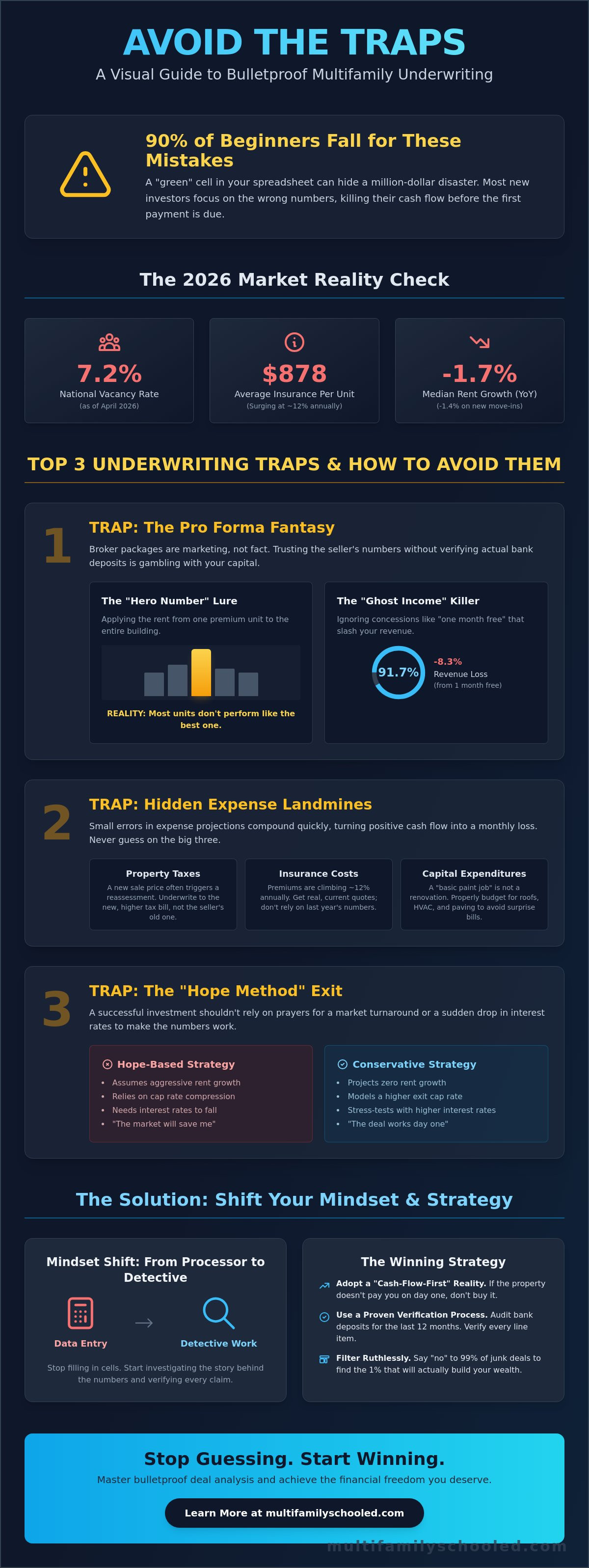
Your spreadsheet is lying to you. In May 2026, a "green" cell can still lead to a million-dollar disaster if you don't know where the traps are hidden. Most new investors focus on the wrong numbers. In fact, 90% of beginners fall into common underwriting mistakes in multifamily that kill their cash flow before the first mortgage payment is even due. You're likely terrified of overpaying while national vacancy rates sit at 7.2% and insurance costs have surged to an average of $878 per unit. It's exhausting to waste weeks on deals that simply don't pencil out.
I know you want to protect your downside and stop the confusion over complex financial metrics. You're here because you want to build a legacy, not lose your shirt on a bad cap rate. This guide will teach you how to master the art of bulletproof deal analysis so you can spot a wealth-killer from a mile away. We're going to break down the specific traps hiding in your pro forma. You'll learn how to confidently analyze any deal in minutes and finally achieve the financial freedom you deserve.
Key Takeaways
- Stop treating underwriting as just a spreadsheet exercise and start using it as a powerful shield to verify real-world financial performance.
- Identify and avoid the common underwriting mistakes in multifamily like the "Hero Number" trap that can instantly turn a promising deal into a financial nightmare.
- Learn how to protect your downside by accurately projecting property tax reassessments and lease concessions before you sign the contract.
- Master the art of conservative exit strategies so you never have to "hope" for a market turnaround or a sudden interest rate drop to make your numbers work.
- Use the 1-Minute Green Light Deal Analyzer and a proven 3-step verification process to filter through junk and find your next apartment deal in record time.
What is Multifamily Underwriting and Why Do Most Investors Get It Wrong?
Underwriting isn't just a spreadsheet exercise. It is the pulse of your future wealth. At its core, What is Underwriting involves verifying a property's actual financial performance to predict exactly how much money it will put in your pocket. Think of it as the ultimate shield for your investment portfolio. If your shield is weak, a single bad deal can wipe out years of hard work. Most people fail because they treat this process like data entry rather than detective work. They fall into common underwriting mistakes in multifamily by trusting the seller's "pro forma" without question.
To master the fundamentals and see how the pros analyze a deal, watch this helpful video:
The biggest danger is the "Processing vs. Thinking" trap. New investors often spend hours filling in cells on a template but never actually analyze the story the numbers are telling. You must look past the digits. If you miss a 1% error in expense estimation, you could easily see your projected cash flow evaporate. In a market where insurance premiums are rising at nearly 12% annually, guessing is not an option. You need a proven system to verify every line item before you commit your capital. This is where common underwriting mistakes in multifamily start to compound and destroy your returns.
The 2026 Underwriting Landscape
The market in May 2026 demands a new level of discipline. Historical data from 2024 is no longer a reliable guide for today's decisions. With the national multifamily vacancy rate hitting 7.2% in April 2026, you can't assume 100% occupancy or aggressive rent growth. In fact, many institutional units are seeing negative new-move-in growth at -1.4%. Successful investors have shifted from chasing "appreciation-driven" gambles to "cash-flow-first" reality. If the property doesn't pay you today, don't buy it.
The Goal: Financial Freedom, Not Just a Closed Deal
Your objective isn't just to close a deal; it's to achieve financial freedom. Underwriting acts as the gatekeeper for your 90-day goal. It empowers you to say "no" to 99% of the junk out there so you can say a confident "yes" to the 1% that will actually build your wealth. Don't let the fear of missing out cloud your judgment. Mastery of this skill is the only way to protect your downside. If you want to accelerate this process, using professional Deal Finding Software can help you filter through the noise instantly. Stop guessing and start winning.
Income Pitfalls: Why Your Pro Forma Might Be a Fantasy
Broker packages are marketing, not truth. If you take a broker's pro forma at face value without auditing the actual bank deposits from the last trailing twelve months, you are gambling with your future. The "Hero Number" trap is the most frequent lure. This happens when an underwriter uses the highest rent achieved in a single, premium unit and applies it to the entire building. In May 2026, with national median rents down 1.7% year-over-year, assuming every tenant will pay top-of-market rates is a recipe for disaster. You must verify collected rents, not just asking prices.
Concessions are the silent wealth-killers in today's market. If a property offers "one month free" to maintain physical occupancy, that is an immediate 8.3% haircut on your annual revenue. Many beginners overlook this, leading to common underwriting mistakes in multifamily that cause them to overpay for properties with "ghost" income. According to a report on common underwriting mistakes, failing to account for these revenue gaps is a primary reason deals fail to meet debt service requirements. Don't be fooled by a basic paint job either; a "renovated" unit only commands premium rent if it truly competes with luxury gut-renovations in the same submarket.
The Rent Comp Reality Check
To find the truth, look within a strict 1-mile radius of your target property. Focus on rent per square foot rather than just the total monthly rent to get an apples-to-apples comparison. You must also track the leasing velocity of your competitors. Leasing velocity is the speed at which units are filled at target rents. If the building down the street has had five vacant units sitting for 60 days, your projected rent increases are likely a fantasy.
Occupancy and Economic Vacancy
Physical occupancy is a vanity metric; economic occupancy is what pays the mortgage. You need to know who is actually paying their bills on time. Your underwriting must account for bad debt, model units, and employee units that don't generate cash. Even in a "full" building, you should model for at least a 5% to 10% vacancy rate to protect your downside. Using a professional deal finding software can help you quickly identify these discrepancies before you waste weeks on a dead-end deal. Stop chasing "pro forma" dreams and start underwriting for real-world results.
Operational Blindspots: The Hidden Expenses That Drain Cash Flow
The seller's Trailing-12 (T-12) statement is a history book, not a crystal ball. One of the most dangerous common underwriting mistakes in multifamily is falling into the "Historical Trap." You cannot assume the seller's expenses will be your expenses. They might be deferring maintenance, using "family" labor at zero cost, or benefiting from a property tax basis established twenty years ago. If you simply copy their numbers into your spreadsheet, you are inviting a financial disaster that will crush your cash flow before you even get the keys. You must underwrite for the reality of your own ownership period, not the seller's past.
Property tax reassessments are the undisputed heavyweight champion of deal-killers. In 2026, the national average effective property tax rate sits at approximately 0.99%, but states like New Jersey hit as high as 2.11%. When a property trades hands, the county assessor does not care about the seller's old bill. They will often reassess based on your new, higher purchase price. If you don't account for this massive jump, your Net Operating Income (NOI) will take a hit that no amount of rent growth can fix. Always underwrite for the post-sale tax reality to protect your wealth.
Don't ignore payroll and management costs either. Labor costs in 2026 are significantly higher, with HUD’s Operating Cost Adjustment Factor showing a 6.4% increase in regions like Texas. One major pitfall is the "Self-Management" myth. You should always underwrite for professional management fees between 8% and 12% of collected rent, even if you plan to do the work yourself. Your business must be able to afford a professional operator if you want to achieve true financial freedom and scale your portfolio.
The CapEx vs. OpEx Confusion
You must distinguish between ordinary repairs and major capital expenditures. Deferred maintenance is an upfront cost, not a monthly expense to be buried in the budget. Rookie investors often "capitalize" ordinary repairs to artificially inflate their NOI, but this is just lying to yourself. To build real wealth, you must model for a "Replacement Reserve" of at least $250 to $400 per unit annually. Set aside funds for roofs and HVAC systems now so a single failure doesn't wipe out your quarterly distributions.
Insurance and Utility Spikes
The 2026 insurance crisis is real. Premiums are rising at nearly 12% annually, with costs ranging from $300 to over $1,000 per unit in high-risk markets. Never rely on the seller's old premium; get a hard quote before you submit a Letter of Intent. Similarly, be wary of Utility RUBS. Just because a seller claims you can pass 90% of water and trash costs to tenants doesn't mean the local market will tolerate it. If you want to verify these operational assumptions against real-world benchmarks, our Multifamily Tool Kit provides the exact frameworks you need to stop guessing and start winning.
Capital Structure and Exit Strategies: Avoiding the Hope Method
Hope is not a business plan. One of the most dangerous common underwriting mistakes in multifamily is "betting on the come." Many investors assume they can buy a property with high-interest debt and simply refinance when rates drop. In May 2026, with interest rates spanning from 4.97% to 12.75%, banking on a specific future rate is a gamble that could bankrupt you. If your deal only works if rates fall to 4%, you don't have a deal. You have a ticking time bomb. You must underwrite for the debt you have today, not the debt you wish you had tomorrow.
Exit cap rate arrogance is another silent killer. Transaction volume in Q1 2026 dropped by 42% compared to the previous quarter. This proves that the market isn't always "hotter" in five years. If you buy at a 5.8% cap rate, you cannot safely assume you'll sell at a 5.0% cap rate. That is pure fantasy. You must stress-test your debt structure. Choosing floating-rate debt without a proper interest rate cap is a mistake that has wiped out entire portfolios. Always prioritize fixed-rate debt or have a bulletproof plan for volatility. Short-term bridge loans are particularly risky right now; they require a perfect execution plan because there's no room for delays in this environment.
Stress Testing Your Pro Forma
You need to know exactly when your investment breaks. A "Breakeven Occupancy" test is the ultimate safety net for investors because it tells you how many units can sit empty before you can't pay the mortgage. If your breakeven is 92% and the national vacancy rate is already 7.2%, you have zero margin for error. Lenders also watch your Debt Service Coverage Ratio (DSCR) closely. If your DSCR drops toward 1.0, you're in the danger zone. You should aim for a DSCR of 1.25 or higher to keep your bank happy and your equity safe. Don't just look at the best-case scenario; look at the "what if" cases where occupancy drops by 10%.
The Exit Cap Rate Rule of Thumb
Be conservative to be successful. A proven standard is to add 10 basis points to your exit cap rate for every year you plan to hold the property. If you buy at 5.8% today and hold for five years, your exit should be modeled at 6.3% at a minimum. This accounts for an aging building and potential market shifts. Be wary if "Residual Sales Proceeds" make up 80% of your total returns. Real wealth is built on cash flow during the hold, not just the check at the end. To see how these numbers play out in real-time, learn more about our deal finding software to see real-time market data. Stop guessing and start analyzing with precision today by joining our Mentorship Program to master these metrics and secure your financial future.
Mastering the Green Light: Underwriting for a 90-Day Deal
Speed is your ultimate competitive advantage in 2026. In a market where Q1 transaction volume dropped 42% compared to the previous year, the best deals are snatched up by investors who move with conviction. You must stop "Over-Analyzing" every minor detail before you even know if the deal has legs. Use the 1-Minute Green Light Deal Analyzer to filter through the junk instantly. This tool helps you avoid the common underwriting mistakes in multifamily by focusing only on the high-impact metrics that determine a deal's viability. If the numbers don't turn green in sixty seconds, kill the deal and move on.
Once you have a green light, initiate the 3-Step Verification Process. First, audit the T-12 to ensure every expense is substantiated by real invoices. Second, cross-reference the Rent Roll against actual bank deposits to flush out "ghost" tenants. Finally, perform a rigorous On-Site Inspection to find hidden deferred maintenance. You must also focus on the "Basis." Ask yourself if your price per door is lower than the replacement cost. With 316,000 new units projected for delivery in 2026, building new is costly. If you buy existing assets for less than the cost of new construction, you've secured a massive safety margin for your capital.
A second set of expert eyes is your best insurance policy against the common underwriting mistakes in multifamily that trap 90% of beginners. Leveraging mentorship allows you to borrow the "Street Smarts" of veterans who have seen every trick in the book. Don't let a decimal point error be the reason you lose your shirt. Mastery comes from following a proven system, not from guessing in a vacuum. You have the ambition; now you just need the exact blueprint to execute.
The Multifamily Schooled System
You don't have to navigate this complex landscape alone. Our Mentorship Program is designed to help you find and close your first or next deal in 90 days or less. We move you from "Spreadsheet Paralysis" to "Actionable Mastery" by providing the tools, software, and coaching needed to win. Stop letting fear hold you back from the wealth you deserve. Grab the Multifamily Tool Kit to start underwriting today with the same precision as the top 1% of investors.
Take Action Today
Your journey to financial freedom starts with a single, decisive step. Download our Free eBook to see the exact checklists we use to vet every property before we sign an LOI. If you are ready to accelerate your results and stop wasting time on deals that don't pencil, join our 5-Day Challenge. This challenge will teach you the A-Z of apartment investing in a high-energy, focused environment. Stop waiting for the "perfect" market conditions. The system is proven, the tools are ready, and the opportunity is yours for the taking. Ready to own apartments in 90 days? See if you qualify for mentorship today!
Unlock Your Multifamily Future Today
You now have the exact blueprint to avoid the common underwriting mistakes in multifamily that bankrupt 90% of new investors. Remember, your spreadsheet is only as good as the data you verify. Stop guessing about the 2026 insurance crisis and start auditing every rent roll with precision. You've seen how a single 1% error can drain your cash flow, but you've also learned how to use a "Basis-first" approach to protect your downside. Mastery isn't about being a math genius; it's about following a proven system with "Street Smarts."
You are closer to financial freedom than you think. Justin Brennan, a 3rd Generation Multifamily Investor, has spent years perfecting a system that cuts through the noise. Don't let another 90 days pass you by while you're stuck in spreadsheet paralysis. Use our proprietary 1-Minute Green Light Deal Analyzer to filter junk and find the gems that build real wealth.
Own Apartments in 90 Days - Join the Mentorship Program Today!
Your legacy is waiting for you to take the first step. We have the proven 90-day deal finding system and the expert support to make it happen. Let's build your empire together.
Frequently Asked Questions
What is the most common underwriting mistake for beginners?
The most frequent error is overestimating rent growth in a softening market. In May 2026, national median rents actually decreased by 1.7% year over year. Many beginners ignore this data and project aggressive 3% to 5% increases. This is one of the most common underwriting mistakes in multifamily because it creates a false sense of security that disappears the moment you take over the asset.
How do I know if a cap rate is "good" for a specific market?
You must compare the deal against current national and local benchmarks. In the first quarter of 2026, the national average cap rate for apartments was 5.75%. Garden style properties sat slightly higher at 5.9%, while mid rise assets averaged 5.6%. If your deal is significantly lower than these numbers without a massive value add play, you are likely overpaying for the risk involved.
Should I trust the seller’s pro forma when underwriting?
Never trust a pro forma at face value. It's a marketing document designed to highlight the best possible scenario. You must demand the actual Trailing 12 statement and the current Rent Roll. If the income isn't reflected in the bank deposits from the last year, it doesn't exist. Verify everything and trust nothing that isn't backed by a hard receipt.
How much should I budget for property management fees?
Budget between 8% and 12% of your monthly collected rent for professional management. While 10% is the common industry standard, smaller properties often carry higher percentages due to the lack of scale. You must include this expense in your underwriting even if you plan to manage the building yourself. Your business must be able to afford a professional operator to be truly scalable.
What is the difference between a T-12 and a Rent Roll?
A T-12 shows the historical financial performance of the property over the last twelve months. It tells you what happened in the past. A Rent Roll is a current snapshot of every tenant, their lease start date, their rent amount, and their security deposit. You need the T-12 to verify expenses and the Rent Roll to understand your immediate future cash flow starting on day one.
Can I underwrite a multifamily deal without complex software?
You can use a basic spreadsheet, but you'll move much slower than the professional competition. In a market where transaction volume dropped 42% in early 2026, speed is your greatest weapon. Using a tool like our 1-Minute Green Light Deal Analyzer allows you to filter out junk deals in seconds. This ensures you spend your time only on properties that actually have the potential to build wealth.
How does interest rate volatility affect my underwriting in 2026?
Volatility requires you to be much more conservative with your debt service coverage ratio. With interest rates ranging from 4.97% to 12.75% in May 2026, you cannot bank on cheap money. You must stress test your deal at higher rates to ensure it still cash flows. If a 1% rate hike kills your profit, the deal is too risky to pursue in this environment.
What happens if my underwriting is wrong after I buy the property?
If you realize your numbers were off, you must pivot to aggressive operational efficiency immediately. You'll need to cut every unnecessary expense and find ways to boost "other income" such as pet fees or parking. This is exactly why avoiding common underwriting mistakes in multifamily during the due diligence phase is so vital. It's much easier to walk away from a bad deal than it is to fix a failing one.