

Calculating Cap Rate for Apartment Buildings: The 2026 Investor’s Blueprint
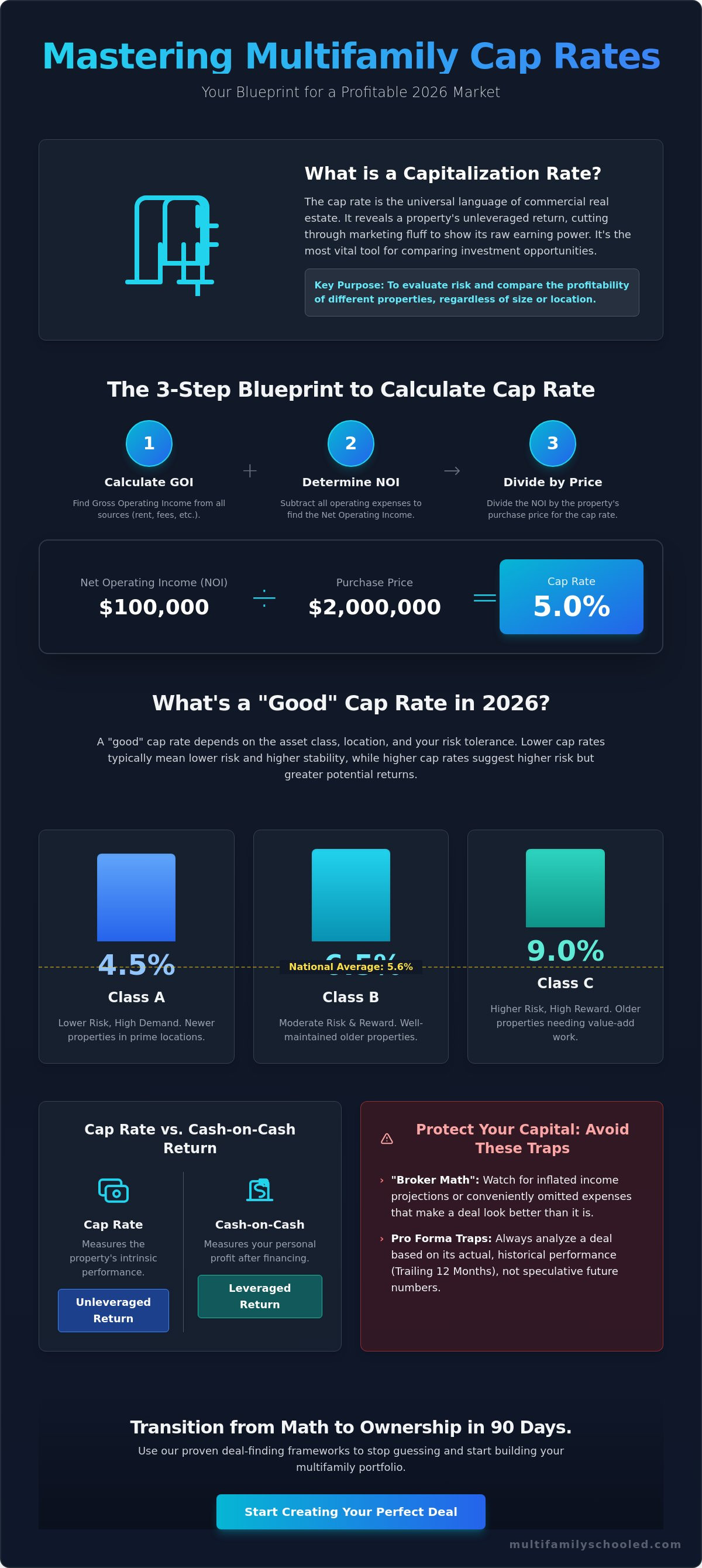
Did you know that while the national average multifamily cap rate currently sits at 5.6%, a single calculation error could mean the difference between a 4.5% Class A yield and a 9% Class C return? You've likely felt the pressure of analyzing a deal and worrying that you're overpaying for a property. It's common to feel confused by the gap between Net Operating Income and Gross Income, but mastering calculating cap rate for apartment buildings is the only way to move with total authority in the 2026 market.
This is your blueprint to stop the guesswork and take control of your financial future. We're handing you the exact system to calculate rates in seconds so you can secure your next multifamily property in just 90 days. You'll learn to identify high-value opportunities despite rising vacancy rates and use our Multifamily University frameworks to build a massive, scalable portfolio. Stop waiting for the perfect deal. Start creating it right now by following this proven methodology for investment mastery.
Key Takeaways
- Master the "universal language" of commercial real estate to evaluate every deal with total authority and confidence.
- Implement our high-speed, 3-step blueprint for calculating cap rate for apartment buildings using real-world Net Operating Income instead of inflated projections.
- Decode what a "good" cap rate looks like in the 2026 market across Class A, B, and C assets to ensure you never overpay.
- Protect your capital by identifying "Broker Math" and pro forma traps that can destroy your long-term exit strategy.
- Transition from math to ownership in just 90 days using the systematic Multifamily University deal-finding framework.
What is Cap Rate and Why Does it Rule Multifamily Investing?
You need a metric that cuts through the noise and reveals the truth about a deal. The Capitalization Rate, or cap rate, is the ratio of Net Operating Income (NOI) to the property's purchase price or current market value. It's the most vital tool in your arsenal while calculating cap rate for apartment buildings because it reveals the property's natural yield without the distortion of financing. Understanding What is Cap Rate allows you to strip away the marketing fluff and see the raw earning power of an asset. It's the foundation of every successful multifamily strategy.
To better understand this concept, watch this helpful video:
In 2026, the market has shifted. Speculation is over; consistent income is the new gold standard. Cap rate serves as the universal language of commercial real estate. It allows a mentor in New York and an investor in Texas to speak the same dialect of profitability. While Return on Investment (ROI) is a broad term that can be manipulated by specific debt structures, the cap rate stays pure. It measures the unleveraged return of the building itself. You must prioritize this income yield to protect your capital from market volatility. This isn't just math. It's your shield against bad deals.
The Core Purpose of the Cap Rate
This metric is your ultimate deal filter. It lets you compare a 50-unit complex in a secondary market to a 10-unit building in a primary hub. You aren't just looking at a price tag; you're evaluating the risk profile. A lower cap rate usually signals lower risk and higher demand. A higher cap rate indicates more risk and potentially higher reward. Use it to understand how the market values income streams in specific neighborhoods before you pull the trigger. Mastery of calculating cap rate for apartment buildings ensures you never enter a deal blind.
Cap Rate vs. Cash-on-Cash Return
Don't confuse these two metrics. Cap rate assumes you're buying the building with 100% cash. It's a snapshot of the property's performance in a vacuum. Cash-on-cash return, however, accounts for your mortgage and leverage. Debt changes your personal profit, but it doesn't change the building's inherent value. Master the math for both. Use cap rate to vet the asset and cash-on-cash to vet your financing strategy. This dual-lens approach is exactly what we teach in our Mentorship Program to ensure you build a bulletproof portfolio that lasts for generations.
The 3-Step Formula for Calculating Cap Rate
Stop guessing and start analyzing. Mastery of the numbers is what separates the legends from the amateurs. You need a fast, reliable way to vet every deal that hits your desk. Calculating cap rate for apartment buildings is a straightforward process, but it requires absolute precision in your data entry. One missed expense can lead to a disastrous overpayment. Follow this three-step blueprint to find the true value of any multifamily asset in seconds.
- Step 1: Determine the Gross Operating Income (GOI). This is the sum of all collected rents, laundry fees, and parking income before a single bill is paid.
- Step 2: Find the Net Operating Income (NOI). Subtract every operational cost from your GOI. Understanding What is a Good Cap Rate starts with having an accurate NOI that reflects the property's actual performance.
- Step 3: Divide the NOI by the purchase price. This final calculation reveals the unleveraged yield.
Here is the math in action. If you find an apartment building with a $100,000 NOI and a $2,000,000 price tag, your cap rate is exactly 5%. It's a clean, punchy metric that tells you exactly how hard that building is working for you. If you want to see how we apply this to institutional-grade deals, check out our Mentorship Program for a deep dive into advanced deal analysis.
Mastering Net Operating Income (NOI)
NOI is the total income minus only day-to-day operating costs. To get this right, you must account for property taxes, insurance premiums, maintenance repairs, and professional management fees. In 2026, management fees typically range from 8% to 12% of collected rent. Warning: Never include your mortgage payment or capital expenditures like a new roof in your NOI calculation. These are below-the-line items that don't impact the building's fundamental cap rate. Keep your NOI pure to keep your analysis accurate.
The Math in Action: A Worked Example
Imagine a 10-unit building where each unit rents for $1,500. Your annual GOI is $180,000. If your operating expenses are $72,000, your NOI is $108,000. At a $1.8M purchase price, you're looking at a solid 6% cap rate. However, if those expenses creep up to $90,000 due to poor management, your cap rate plummets to 5%. This illustrates why efficiency is the ultimate driver of value. You can accelerate this analysis by using the Multifamily Tool Kit to run these numbers with professional-grade speed.
What is a "Good" Cap Rate for Apartments in 2026?
A "good" cap rate isn't a fixed number. It's a reflection of the market's appetite for risk and your specific investment goals. In May 2026, with the Federal Reserve holding the funds rate between 3.50% and 3.75%, the national average multifamily cap rate has stabilized around 5.6%. If you are calculating cap rate for apartment buildings, you must understand that the spread between your mortgage rate and the cap rate determines your safety margin. With commercial mortgage rates currently ranging from 5.42% to 8.82%, a "good" cap rate is one that provides enough cushion to handle debt service and still produce cash flow. Don't fall for the trap of thinking low cap rates are always bad. A low rate often signals institutional-grade stability in a market that is built to last.
Class A vs. Class C Cap Rates
Your 90-day goal dictates which asset class you should target. Class A properties in primary markets are currently trading between 4.5% and 5.5%. These are luxury, stable assets with minimal maintenance headaches. If you want high-yield, high-intensity opportunities, look at Class C buildings in tertiary markets where cap rates hit 7% to 9% or higher. These older assets require more management grind but offer the massive cash flow needed to scale quickly. Choose the class that aligns with your risk tolerance and available time. We break down these specific targeting strategies inside Multifamily University so you can stop guessing and start acquiring.
Market Location and Cap Rate Variance
Location changes everything. A 5% cap rate in a high-growth Sun Belt city is often a better investment than an 8% cap rate in a town with a declining population. Primary markets like New York or Los Angeles command lower cap rates because the demand is relentless. However, emerging secondary markets are where the 2026 opportunity lives. These markets offer a sweet spot of 5.5% to 7% yields for Class B assets. You are trading immediate yield for long-term appreciation potential. When calculating cap rate for apartment buildings, always look at the vacancy trends. With national vacancy expected to reach 5.1% by late 2026, you need to ensure your chosen market can absorb new supply without crushing your NOI. Focus on markets where rent growth remains positive, even if it's currently at a modest 0.2% annually.
Why Cap Rates Can Be Misleading: Avoiding the Trap
Don't let a shiny brochure blind you to a bad deal. Real estate is full of traps for the uneducated investor. While calculating cap rate for apartment buildings is your primary weapon, you must know when the numbers are being manipulated. Brokers often use "Pro Forma" math to make a property look like a goldmine. They project future rents that might never happen and ignore the reality of the 2026 market. With national vacancy rates expected to climb to 5.1% by the end of Q3 2026, relying on "perfect world" numbers is a recipe for disaster. You need to see the property as it is today; not as a broker hopes it will be tomorrow.
You must also understand cap rate compression. This happens when property values rise faster than the income they produce, causing cap rates to shrink. While this is great for current owners looking to sell, it creates a high-pressure environment for buyers. If you buy at a 5% cap rate and the market shifts, your exit strategy could be in jeopardy. High cap rates can also be a mask for deferred maintenance. A building might show a 9% return on paper, but if the roof is failing and the HVAC systems are shot, that yield will vanish in your first year of ownership. Master the math and look past the surface to protect your capital.
The Pro Forma Trap
Never trust the cap rate on a broker's flyer. These numbers usually represent the property's potential after you do all the hard work. To find the truth, you must verify actual income and expenses through rigorous due diligence. Demand the T-12 (trailing 12 months) financial statements and check them against bank deposits. A high cap rate often signals high underlying risk. If a property is trading at a 10% cap rate while the market average is 6%, ask yourself why. The market is pricing in a problem you haven't seen yet. Stop guessing and start analyzing with precision by downloading our Multifamily Tool Kit to run your own unbiased numbers.
Underwriting the Exit Cap Rate
The exit cap rate is the most important number in your five-year projection. It's the rate at which you expect to sell the property in the future. To be safe, your exit cap should usually be higher than your entry cap. This accounts for an aging building and potential market shifts. If you buy at a 5.6% cap rate in 2026, underwriting an exit at 6.1% or 6.6% provides a necessary safety margin. Protect your downside by being relentlessly conservative with your projections. You want to be pleasantly surprised by your profits; not devastated by a market correction you didn't see coming.
Accelerate Your Analysis: The 90-Day Deal System
Knowledge without action is just a hobby. You've mastered the formula. Now you must apply it at scale. Calculating cap rate for apartment buildings is the first gear in a high-performance investment machine. It's the entry ticket to the big leagues. Our system is designed to take you from learning the math to owning the asset in exactly 90 days. This isn't a suggestion. It's a proven framework for economic empowerment. Stop viewing cap rate as a static number. Start using it as a dynamic tool to filter through the noise and find the gold.
Mentorship is the secret weapon that removes the paralyzing fear of the math. Most new investors stall because they don't trust their own underwriting. They worry about missing a hidden expense or miscalculating the NOI. When you have an expert coach looking over your shoulder, that uncertainty vanishes. You gain the confidence to move fast and make bold offers. You aren't just learning a skill; you're adopting a professional's mindset. This transition from student to owner is the most life-transforming journey you'll ever take.
Stop Guessing, Start Closing
Professional investors don't wait for the perfect deal to fall into their lap. They create it through volume. You must analyze 100 deals to find the one that actually works. This is a game of speed and precision. Don't waste weeks on a single property. Use the math you've learned to disqualify bad deals in seconds. If you want to fast-track this process and avoid the expensive mistakes that sink most beginners, join our Mentorship Program. We provide the strategic blueprint you need to secure your first building with total authority.
Tools for the Modern Investor
In 2026, manual spreadsheets are for amateurs. You need to automate your deal flow to dominate your market. Use Real Estate Radar to find off-market opportunities before they ever hit the public portals. This proprietary software can help you in calculating cap rate for apartment buildings across thousands of properties instantly. It allows you to spot Class B value-add plays while others are still fighting over overpriced Class A listings. Take the first step toward financial freedom today. The market is moving fast. Don't get left behind.
OWN YOUR DESTINY IN THE MULTIFAMILY MARKET
You now have the blueprint to dominate the 2026 market. You understand that a "good" yield is subjective and that broker math is a trap designed to steal your equity. By mastering calculating cap rate for apartment buildings, you've moved past the fear and into the realm of the professional investor. You aren't just looking at buildings; you're identifying income streams that will fuel your long-term independence. The math is your foundation, but decisive action is your fuel.
Don't let this knowledge sit on a shelf while others secure the best deals in your market. It's time to leverage our proven system for multifamily mastery. Our 90-day deal guarantee and proprietary deal-finding software are designed to put you in the owner's seat faster than you ever thought possible. Join the Mentorship Program and find your first deal in 90 days! Your prosperous future is waiting. The tools are ready. The system is proven. Take the leap and start building your legacy today.
Frequently Asked Questions
How do you calculate cap rate for an apartment building?
You calculate the cap rate by dividing the Net Operating Income (NOI) by the purchase price or current market value. This simple formula is the foundation for calculating cap rate for apartment buildings because it reveals the property's natural yield. Ensure you've subtracted all operating expenses from your gross income before dividing. This snapshot allows you to compare different assets without the distortion of specific financing terms.
What is a good cap rate for a multifamily property in 2026?
A good cap rate in 2026 depends entirely on your asset class and risk tolerance. The national average currently sits at 5.6%. Class A properties in prime markets trade between 4.5% and 5.5%, while Class C buildings in tertiary markets can reach 9% or higher. Your goal is to find a rate that exceeds your borrowing costs, which currently range from 5.42% to 8.82% for conventional commercial mortgages.
Is a higher cap rate always better for investors?
No, it isn't always better. A higher cap rate often signals higher underlying risk, such as older construction, high vacancy, or a declining neighborhood. While an 8% cap rate looks better on paper than a 5% cap, the 5% property might offer more stability and long-term appreciation. Always evaluate the risk profile of the asset before chasing the highest number. High yield usually demands high management intensity.
Can I calculate cap rate if I don’t know the NOI yet?
You cannot calculate an accurate cap rate without the Net Operating Income. You can use industry averages to estimate expenses, but this is dangerous guesswork. Professional investors demand the T-12 financial statements to verify every dollar of income and expense. If you're calculating cap rate for apartment buildings based on "Pro Forma" projections instead of real data, you're likely walking into a trap.
How does the mortgage affect the cap rate calculation?
The mortgage has zero impact on the cap rate itself. Cap rate is an unleveraged metric that measures the property's performance as if you paid 100% cash. Your mortgage payments are "below the line" items. While debt changes your personal cash-on-cash return, it doesn't change the building's inherent capitalization rate. This allows you to compare properties regardless of how they are financed.
What is the difference between a cap rate and a yield?
Cap rate is a static snapshot of the current year's return based on Net Operating Income. Yield is a broader term that often includes total returns, including appreciation and debt paydown over time. Think of cap rate as the speedometer showing how fast your investment is moving today. Yield is the total distance covered at the end of your journey. Both are essential for long-term mastery.
Why do cap rates vary so much by city?
Cap rates vary based on local supply and demand dynamics. Primary markets like NYC or LA have low cap rates because the demand is high and the risk is perceived as low. Tertiary markets have higher cap rates to compensate investors for the lack of liquidity and slower growth. In 2026, emerging secondary markets offer a sweet spot of 5.5% to 7% for investors seeking both growth and stability.



