

Building Credibility as a New Real Estate Investor: A Practical Guide
Building credibility as a new real estate investor starts with what you can verify: the research you’ve done, the questions you ask, and the commitments you keep. A closed deal isn’t the only proof that you’re serious about real estate. You may worry that experienced professionals won’t take you seriously without a track record, or that basic questions will reveal what you don’t know. That’s understandable. But pretending to know more than you do can undermine trust faster than admitting you’re still learning.
You can build a credible presence without overstating your experience. Present your goals clearly, prepare for evidence-based conversations, and demonstrate reliability through consistent follow-through. You’ll also learn how to ask thoughtful questions and describe your plans without promising results you can’t guarantee.
This guide covers practical ways to strengthen your knowledge, organize information for industry conversations, and create a repeatable learning process. Credibility takes time, but each prepared discussion and kept commitment helps build a foundation others can trust.
Key Takeaways
- Build a focused learning plan around property operations, market research, and core deal concepts such as net operating income and cap rate.
- When building credibility as a new real estate investor, show specific evidence of your preparation instead of making broad claims about your expertise.
- Shape a clear introduction around your current investment focus, relevant preparation, and practical next steps.
- Use a repeatable process to study, practice deal analysis, seek feedback, and follow through. Keep your records and claims current as your experience grows.
What Building Credibility as a New Real Estate Investor Really Means
Investor credibility is the trust you earn by showing preparation, honesty, reliability, and sound judgment through actions others can verify. Building credibility as a new real estate investor doesn’t require a long list of completed transactions. It means being clear about what you know, what you’re still learning, and how you make decisions. Confidence can help start a conversation, but polished language alone isn’t proof. Specific, checkable actions carry more weight.
You can begin before your first acquisition. Learn the language of the field, prepare thoughtful questions, and keep notes on what you’ve researched. A neutral overview of real estate investing can introduce concepts such as valuation, financing, and the deal life cycle. From there, focus your learning on the property type and investment approach you’re considering.
For another perspective on getting started, watch this video:
Can you be credible without owning an investment property?
Yes. Be transparent that you’re preparing for your first acquisition, then show what that preparation involves. For example, explain that you’re studying a particular property type, learning to review operating figures, and keeping a list of due diligence questions. Don’t suggest you’ve managed properties or closed deals if you haven’t. Trust develops through repeated behavior, such as being prepared, keeping commitments, and applying what you learn, rather than through one impressive introduction.
What signals make a new investor seem trustworthy?
Experienced professionals don’t expect you to know everything. They do notice whether you communicate carefully and respect their time. Be punctual, ask focused questions, and follow up when you say you will. When discussing a property or market, distinguish confirmed information from your own assumptions. If you’re unsure, say so and explain how you’ll check.
- Be accurate: Describe your experience and plans honestly.
- Show your work: Identify where information came from and label estimates or assumptions.
- Stay realistic: Ask for perspective without expecting others to validate a deal or guarantee an outcome.
A prepared question is stronger than a vague claim of expertise. For instance, ask which operating assumptions need further verification instead of insisting a property is a sure thing. Respectful, evidence-based conversations show sound judgment, even while you’re still learning.
Build Real Estate Knowledge You Can Demonstrate
Build knowledge around a clear focus, not a pile of disconnected facts. Choose a property type and market to study, then learn how properties operate, how local conditions affect demand, and how to assess a basic deal. Keep a learning log with the sources you consulted, questions that came up, and takeaways from each exercise. It gives you a record of your work and helps you explain how you reached a conclusion.
Which real estate concepts should beginners learn first?
Start with the operating picture. Net operating income (NOI) is a property’s income after operating expenses, but before debt service. Cap rate compares NOI with a property’s value or price, offering one way to assess income relative to value. These measures can help organize an initial analysis, but neither tells the whole story. The assumptions, property condition, local market, and financing all matter, so metrics shouldn’t replace property-specific due diligence.
Also learn the difference between owning property directly and investing through other vehicles. The SEC’s Investor.gov provides a neutral introduction to understanding Real Estate Investment Trusts. Knowing what a REIT is and how it differs from direct ownership can help you describe your investment focus more precisely.
How can you prove your knowledge before your first deal?
Practice with a sample property analysis. Use publicly available information where possible, record where each figure came from, and label estimates and assumptions clearly. For example, if you use an estimated operating expense, identify it as an estimate rather than presenting it as a verified property fact. Add a short note explaining your reasoning and what information you’d still need to confirm.
This work makes your learning visible. You can share the analysis as a discussion tool while being clear that it’s an exercise, not a recommendation or a completed transaction. That distinction shows initiative and sound judgment, both important to building credibility as a new real estate investor.
Review public market information consistently, and write down how it affects your questions or conclusions. If you’d benefit from a structured starting point for multifamily investing topics, explore the multifamily investor toolkit. Use learning resources to strengthen your understanding, not as a substitute for independently verifying a property’s details.
- Track sources: Record links, dates, and the information each source supports.
- Separate evidence from assumptions: Label estimates and note what still needs verification.
- Explain your reasoning: Show how you moved from the information you found to your conclusion.
Show Credibility in Investor Conversations Without Overstating Experience
In a conversation with a lender, potential partner, or experienced investor, specifics make your words easier to assess. “I’m an expert at finding great deals” is difficult to verify. “I’m studying small multifamily properties in this area and have prepared a sample analysis using publicly available information” describes work you’ve actually done. Building credibility as a new real estate investor means making your current experience and next steps clear, not presenting plans as a track record.
How should a new investor introduce themselves?
Keep your introduction brief and grounded in facts. State the property type or market you’re focused on, what you’ve done to prepare, and what you’re working toward. Mention professional experience only if it genuinely applies. For example: “I’m new to apartment investing and currently learning to evaluate operating income and local market conditions. I’ve reviewed public information on a sample property, and I’m looking to understand which assumptions I should verify first.”
Then ask one focused question that fits the conversation. You might ask which operating details a beginner should examine before drawing conclusions. A specific question invites useful discussion without turning your introduction into an inflated pitch.
What should you avoid saying when you lack a track record?
Don’t imply that a transaction has closed, funding is committed, or partners have agreed to participate unless that’s true and you can substantiate it. If you’re still exploring capital options, say so. If you’re speaking with potential partners, distinguish those conversations from a confirmed partnership. Never present a projected outcome as guaranteed.
When you don’t know an answer, acknowledge the gap and explain how you’ll investigate it. That’s more credible than guessing. Use the examples below to make your language more precise:
| Do | Don’t |
|---|---|
| “I’m evaluating my financing options and haven’t secured funding.” | “The money is lined up,” when no funding is committed. |
| “I’m exploring a potential partnership and will confirm details before describing it as an agreement.” | “My partner and I are ready to buy,” before there’s an agreement. |
| “I haven’t closed a deal yet. I’m practicing analysis and checking my assumptions.” | “I’ve got a proven system for finding profitable properties,” without evidence. |
| “I’m not sure. I’ll verify the figure and follow up.” | Guessing, or making a confident claim you can’t support. |
Clear language doesn’t weaken your position. It gives other people an accurate basis for responding and gives you a practical next step. Be confident about the work you’ve done, precise about what remains uncertain, and careful not to promise results you can’t control.
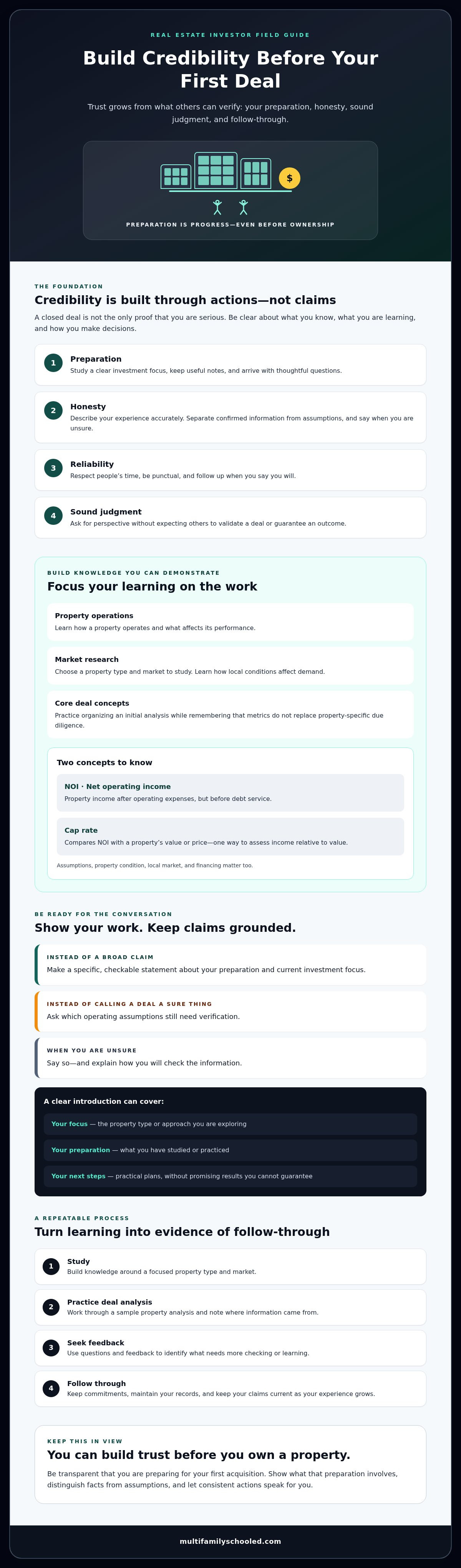
Follow a Practical Plan to Earn Trust Before Your First Deal
Credibility grows from a pattern others can observe: focused learning, careful analysis, thoughtful outreach, and reliable follow-through. Use a simple tracker, such as a spreadsheet or notebook, to record whom you contacted, what you committed to do, when you followed up, and what you learned. The goal isn’t to force a deal by a deadline. It’s to build habits that make your preparation visible.
What should your first 30 days of credibility-building include?
Choose one market or property type to study first. A defined focus makes it easier to ask relevant questions and compare information without jumping between unrelated opportunities. Set manageable weekly goals, then review your progress at the end of the month. Treat these as practice milestones, not proof that you’re an expert.
- Choose a focus: Write down the property type or market you want to understand and why.
- Study the basics: Set aside regular time to learn about property operations, local conditions, and deal analysis. Note your sources and questions.
- Observe the market: Review publicly available information on properties or market conditions in your chosen area. Record what you notice and what you can’t verify.
- Practice analysis: Work through a sample property using clearly labeled estimates and assumptions. Keep track of the information you’d need to confirm.
- Seek feedback and follow through: Ask a knowledgeable professional a specific question, apply relevant feedback, and report back on what you did.
At month-end, identify what you can now explain, what remains unclear, and which sources or skills you need to strengthen. A learning resource can add structure to your study. Explore these real estate learning resources as one possible starting point, and keep verifying information independently, especially before making decisions about a property.
How can feedback and follow-through strengthen your reputation?
Make outreach specific and respectful. Instead of asking someone to teach you everything about investing, ask a broker, lender, mentor, or experienced investor a focused question related to your research. Briefly explain what you’ve already reviewed. That shows you’ve made an effort and helps the other person respond usefully.
Then close the loop. If you promised to review a source, send a summary of what you learned. If you need more time, communicate that instead of going silent. In your tracker, note the advice, the action you took, and any new questions. Building credibility as a new real estate investor depends on this consistency, not on one impressive conversation.
If you’d like guided learning as you develop your approach, explore structured multifamily mentorship. The program is designed to help investors find a deal within 90 days or provide one. Review the program details and expectations, and use mentorship to support your learning and decision-making alongside independent due diligence.
Keep Building Credibility as Your Real Estate Investing Career Develops
Credibility isn’t a badge you earn once. As your role and experience change, keep your communication accurate, your records organized, and your decisions responsible. Be clear about what you’ve completed, what you’re working on, and what remains uncertain. Building credibility as a new real estate investor means developing habits you can carry forward as your responsibilities grow.
How do you protect credibility when plans or assumptions change?
Share meaningful changes promptly with the people they affect. If a timeline shifts, an assumption no longer holds, or your circumstances change, explain what changed and what you’re doing next. Don’t leave others to rely on outdated information. If you discover that you shared something inaccurate, correct it directly rather than hoping no one notices.
Keep a simple written record of information sources, decisions, and unresolved questions. This helps you retrace your reasoning and distinguish verified facts from estimates or speculation. For example, if new information changes your view of a property, note which assumption changed and why. Saying “I haven’t verified that yet” can build more trust than presenting a guess as fact.
When can education or mentorship help a new investor?
Education can help you build knowledge and improve how you approach decisions. It doesn’t replace independent judgment, property-specific research, or due diligence. Before committing to a course or mentorship program, check whether its stated curriculum matches your learning goals, what access or support is described, and what’s expected of you. Ask questions about unclear details, and be cautious of claims that promise a deal or guaranteed outcome without clear terms.
Look for a realistic fit. If you’re focused on apartment investing, learning support in that area may be more relevant than a broad program that doesn’t match your current needs. Review available information and confirm current program details before deciding. Multifamily Schooled offers education and mentorship for apartment and commercial real estate investors. These options support learning, but they don’t replace your own analysis.
Keep the next step manageable: continue studying, practice evaluating information, and seek appropriate guidance when you need it. If you want to explore one learning option, review the details of multifamily investor mentorship and consider whether it fits your goals. Trust is built through the decisions you make and the way you communicate them, one step at a time.
Make Your Next Step One You Can Stand Behind
Building credibility as a new real estate investor isn’t about sounding established before you are. It’s about making your preparation visible, communicating honestly, and following through as your knowledge and experience grow. A focused learning habit and careful, evidence-based decisions help you build trust without overstating what you’ve done.
Keep moving forward with a clear focus. Study the property types that interest you, practice evaluating information, and seek guidance when it can help you ask better questions. Multifamily Schooled offers education and mentorship for apartment and commercial real estate investing, with options that include mentorship, live workshops, online challenges, and deal-finding software. These resources can support your learning, but your independent judgment and due diligence remain essential.
Ready to explore a learning option that fits your goals? Explore practical multifamily investing education. Your track record starts with the thoughtful actions you take now. Keep learning, stay honest, and let consistent follow-through speak for you.
Frequently Asked Questions
Can you build credibility as a real estate investor without experience?
Yes, you can build trust before completing a transaction by showing how you prepare and make decisions. Building credibility as a new real estate investor starts with being honest about your experience, learning the terms and processes relevant to your focus, and keeping commitments. For example, bring a clearly labeled practice analysis to a conversation and explain which figures you verified, which are estimates, and what you still need to investigate.
How do new real estate investors build trust with brokers and lenders?
Be prepared, accurate, and respectful of their time. Tell a broker what property type or market you’re researching, and ask a focused question about a specific listing or local factor. With a lender, describe your current financing questions honestly instead of implying you’re qualified or approved. Follow up when you say you will, share requested information accurately, and clarify uncertainty rather than guessing. Consistency helps establish a dependable professional relationship.
What should a new real estate investor say when they have no track record?
State your current stage plainly, then point to relevant preparation and a realistic next step. For example: “I’m preparing for my first multifamily investment. I’ve been practicing property analysis using public information, and I’m working to understand which assumptions need verification. Could you suggest what operating information I should review next?” This introduction is confident without suggesting you’ve closed deals, secured funding, or formed partnerships that aren’t confirmed.
How can I prove I understand a real estate deal before buying one?
Prepare a sample analysis that shows your reasoning, not just a final figure. Identify the information source for each input, label estimates and assumptions, and explain how income, operating expenses, net operating income, and cap rate relate in your example. Then list the property-specific details you haven’t verified, such as actual operating records or physical condition. A practice analysis demonstrates your approach, but it isn’t a substitute for independent due diligence on a real property.
Does a real estate investing course make you more credible?
A course can support your learning, but enrollment alone doesn’t prove that you can evaluate a property or follow through responsibly. Credibility comes from applying what you learn, explaining your reasoning, and being clear about your limits. Before choosing education or mentorship, check whether the subject matter fits your goals, what the curriculum covers, what access or participation is expected, and whether the stated expectations feel realistic. Continue to verify information independently.
What mistakes can damage a new real estate investor’s credibility?
Misrepresenting experience, overstating available capital, or presenting an unconfirmed partnership as settled can quickly weaken trust. So can making confident claims from unchecked figures, promising investment outcomes, missing agreed follow-ups, or failing to correct inaccurate information. If you don’t know an answer, say so and explain how you’ll check. If plans or assumptions change, update the people relying on them. Honest, timely communication protects your reputation while you continue learning.



