

Avoiding Analysis Paralysis in Real Estate: The 2026 Action Guide
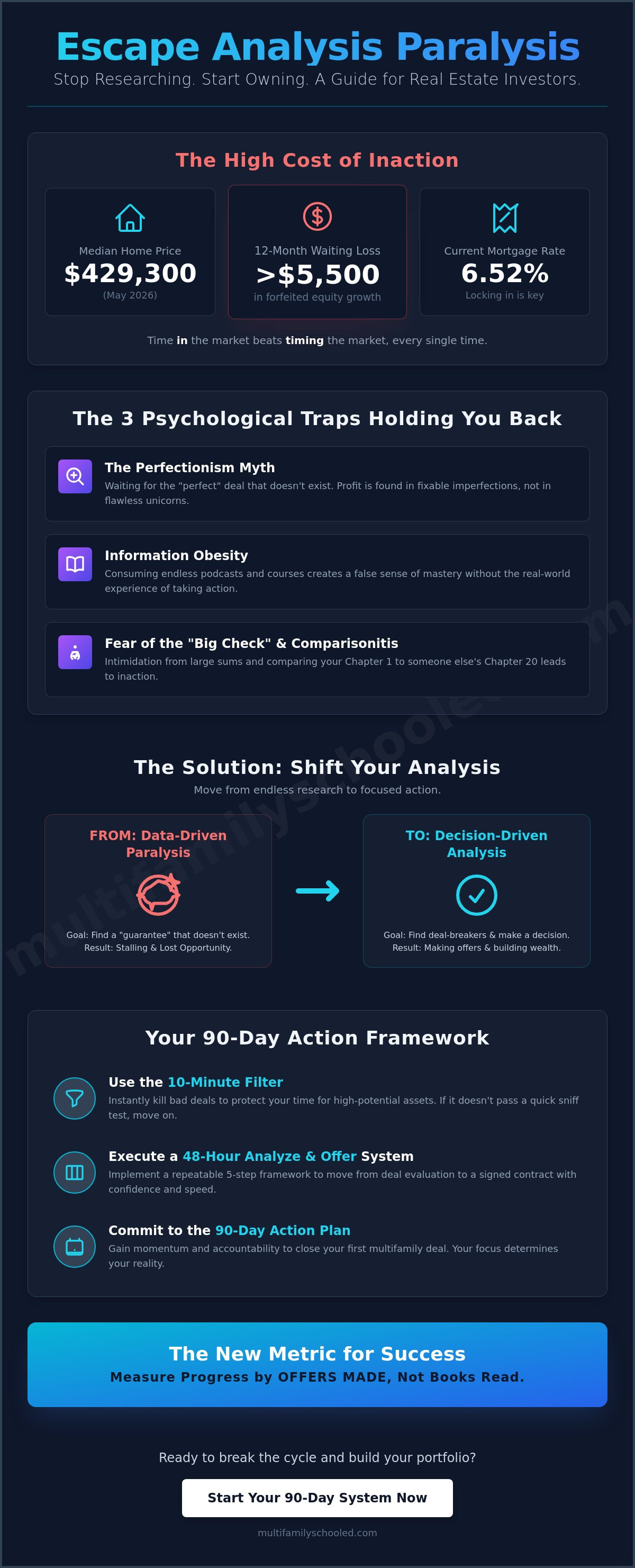
How many podcasts have you listened to this week while other investors were busy signing contracts? The truth is that information obesity is the silent killer of wealth. You might think you're preparing, but if you aren't making offers, you're just procrastinating. Mastering the art of avoiding analysis paralysis in real estate is the only way to bridge the gap between being a perpetual student and a confident property owner. With the median existing-home sales price hitting $429,300 in May 2026, the cost of waiting is higher than ever. Every day you spend stuck in research mode is a day you lose to inflation and rising equity.
It's natural to feel a knot in your stomach when looking at a 6.52% mortgage rate or worrying about losing capital on your first deal. You want to protect your future, and that's smart. However, you cannot build multi-generational assets from the sidelines while others close deals. This action guide promises to break your cycle of overthinking by providing the exact framework used to move from hesitation to a signed contract. We'll reveal a repeatable system for deal evaluation and the specific 2026 market strategies you need to secure your financial freedom immediately.
Key Takeaways
- Stop losing wealth to the "Opportunity Cost of Silence" and start measuring your progress by offers made rather than books read.
- Identify the psychological traps of perfectionism and information obesity that prevent you from avoiding analysis paralysis in real estate.
- Transition from passive data-driven research to a Decision-Driven Analysis system that focuses exclusively on the triggers needed to sign a contract.
- Use the 10-minute filter to instantly kill bad deals and protect your time for the high-potential assets that build long-term stability.
- Commit to a 90-day action framework to gain the confidence and accountability required to close your first multifamily deal.
What Is Analysis Paralysis in Real Estate and Why Is It Killing Your Wealth?
Analysis paralysis is a state of over-analyzing data to the point that no decision is ever made. It's a mental cage that keeps you poor while the market moves on without you. Psychologists define Analysis paralysis as the inability to move forward due to an over-complicated decision-making process. In the world of multifamily investing, this hesitation isn't just a mood; it's a financial drain. Avoiding analysis paralysis in real estate is the first step toward building a legacy that lasts for generations.
To better understand how this mental block stops your progress, watch this helpful video:
The "Opportunity Cost of Silence" is the silent killer of your bank account. Every month you wait, you lose thousands in potential cash flow. In 2026, speed is the new currency. With the median existing-home sales price reaching $429,300 as of May 2026, the market isn't waiting for you to feel ready. You must distinguish between productive due diligence and destructive paralysis. Due diligence is a focused search for deal-breakers; paralysis is a desperate search for a guarantee that doesn't exist. If you aren't making offers, you aren't doing due diligence. You're just stalling.
The High Cost of Doing Nothing
Hesitation is expensive. If you wait 12 months to pull the trigger on a median-priced property, you aren't just missing out on rental income. Based on the 1.3% price increase seen in early 2026, you're forfeiting over $5,500 in equity growth alone. Waiting for the "perfect time" is a statistically losing strategy because time in the market beats timing the market every single time. The Perpetual Student Trap is the most common barrier to entry in 2026, where investors substitute the comfort of learning for the risk of doing.
Symptoms of the Perpetual Student
Are you actually making progress, or are you just busy? Recognize these red flags before they bankrupt your ambitions:
- The Course Carousel: Buying yet another online challenge or eBook without applying the lessons from the last one.
- Spreadsheet Obsession: Tweaking formulas for the 50th time on a deal that was clearly dead at first glance.
- Risk Magnification: Focusing on "black swan" events or extreme market crashes instead of calculating probable returns based on current 2026 data.
Stop being a spectator. If you're ready to break this cycle, our Mentorship Program provides the strategic accountability you need to stop analyzing and start offering. Move now while others are still stuck in the spreadsheets.
The 3 Psychological Traps Stopping You From Buying Apartments
Most investors stay broke because they are fighting their own brains. It is not a lack of capital or a lack of deals. It is a surplus of fear. You don't need more data to succeed in 2026. You need a decision. Avoiding analysis paralysis in real estate starts by identifying the mental anchors holding you back from your first multifamily asset.
The first trap is the Perfectionism Myth. You are looking for a "perfect" first deal that does not exist. Every property has a flaw. If you wait for 100% certainty, you will never sign a contract. Successful owners know that profit is found in the imperfections you can fix, not in a unicorn deal that requires no work. Next is Information Obesity. Consuming endless podcasts and books feels like progress, but it is actually a form of stagnation. It creates a false sense of mastery without the scars of experience. Finally, the Fear of the "Big Check" stops many in their tracks. Writing a commercial-scale earnest money check is intimidating. Combine this with Comparisonitis, where you watch "gurus" on social media closing 100-unit deals, and your own progress feels insignificant. Stop measuring your Chapter 1 against someone else's Chapter 20.
Breaking the Perfectionism Loop
Adopt the 70% Rule immediately. If a deal looks 70% perfect, it is time to move. The remaining 30% is handled during your formal due diligence period. Neutralize irrational fear by using "Worst-Case Scenario" modeling. Ask yourself: what happens if the vacancy rate hits 15%? Usually, the answer is a lower return, not total financial ruin. Shift your mindset from "Buying a Building" to "Executing a Proven System." When you follow a blueprint, the building becomes secondary to the process. If you want to see how this system works in real-time, consider joining our Mentorship Program to gain the confidence to act.
Curing Information Obesity
Put yourself on a Low Information Diet. Focus only on the data points that move the needle: cash-on-cash return, debt coverage ratio, and seller motivation. Stop studying market history from five years ago. Start studying why sellers are moving properties in today's 2026 climate. Are they facing a 2026 conforming loan limit adjustment or shifting federal reporting rules? This is the only information that matters. A mentor acts as your ultimate filter, cutting through the noise so you can focus on the 48-hour offer cycle. Action is the only cure for overthinking.
Data-Driven vs. Decision-Driven Analysis: Building Your System
Data is a drug that makes you feel productive while you're actually standing still. Most rookie investors fall into the trap of Data-Driven Analysis. They collect every possible spreadsheet, demographic report, and historical chart. They get lost in the "what" without ever figuring out the "how." This is the primary cause of stagnation. If you want to start avoiding analysis paralysis in real estate, you must pivot to Decision-Driven Analysis. This means you only hunt for the specific data points that trigger an immediate offer. You aren't looking for a story; you're looking for a signal.
Standardized Underwriting is the secret to moving at elite speeds. It removes your feelings from the equation and replaces them with a mechanical process. When you use a fixed system, you stop asking "Do I like this building?" and start asking "Does this meet my criteria?" Our Deal Finding Software automates the heavy lifting of data collection. It filters the noise so you can focus entirely on the decision. In the fast-paced 2026 market, you don't have weeks to ponder. You have hours to decide.
The 5 Critical Metrics That Actually Matter
Stop over-complicating your math. Focus on the heartbeat of multifamily value: Net Operating Income (NOI). If the NOI is healthy, the asset is alive. Don't get stuck on a single Cap Rate number; market realities in 2026 shift faster than traditional reports can track. Your personal yield is found in the Cash-on-Cash Return. This is your ultimate filter. If the cash-on-cash doesn't hit your target, kill the deal and move to the next one in under 60 seconds.
Automating Your Analysis for Speed
You must learn to analyze 100 deals in the time it used to take to do one. Speed is your competitive advantage. By using Real Estate Radar, you can identify motivated sellers before the paralysis of competition sets in. Set your "Go/No-Go" thresholds before you even open a listing. If a property doesn't meet your pre-set debt coverage ratio or vacancy allowance, don't even look at the photos. High-speed analysis is about knowing what to ignore. When you master this, the fear of making a mistake vanishes because the system makes the choice for you.
The 5-Step Framework to Analyze and Offer in 48 Hours
Stop wasting weeks on spreadsheets. You need a clock, not a calculator. Avoiding analysis paralysis in real estate requires a rigid timeline that forces your hand. If you can't decide in 48 hours, you're not an investor; you're a hobbyist. Follow this 5-step framework to move from a lead to a signed Letter of Intent (LOI) without the mental friction.
Step 1 & 2: Filtering and Verifying
Kill the deal before it kills your time. Step 1 is the 10-Minute Filter. Use the "Back of the Napkin" test to check if the basic math even works for a multifamily asset. Your goal is to find a reason to say no in the first 5 minutes. If it passes, move to Step 2: The Deep Dive. You don't need 100% certainty here. Aim for 80% accuracy on income and expenses. Spot "Pro Forma" lies in 60 seconds or less by comparing the seller's numbers to actual 2026 market data. If the rents are listed significantly higher than the current $429,300 median price trends suggest, treat them as fiction. Move fast. The best deals in 2026 are gone before the weekend.
The Power of the LOI
Step 3 is your Reality Check. Consult your mentor or a high-level peer group to verify your assumptions. Don't ask your broke friends for advice. Ask people who actually own doors. Once they green-light your logic, move to Step 4: The Letter of Intent (LOI). Submit the offer immediately to start the real learning. Many rookies think they need to know everything before the offer. The truth is that the "real" analysis only starts once you have a signed LOI and access to the full books. Use the due diligence period as your safety net. It's your legal "get out of jail free" card if the numbers don't hold up. Grab the Multifamily Tool Kit to get the exact LOI templates we use to bypass the "paralysis" of drafting from scratch.
Finally, Step 5 is the 90-Day Deadline. Commit to the timeline or quit the game. If you haven't closed a deal or at least put three properties under contract within 90 days, your system is broken. Accountability is the only cure for hesitation. You are either building a legacy or making excuses. Choose one. If you want to stop guessing and start closing, our Mentorship Program provides the professional pressure you need to execute this framework with total confidence.
Break the Cycle: The Multifamily Schooled 90-Day System
Knowledge is not power. Execution is power. You can read every book on the shelf and listen to every podcast in your library, but your bank account will remain empty until you sign a contract. The cycle of overthinking ends when you stop trusting your own hesitation and start trusting a proven process. Avoiding analysis paralysis in real estate is not a mental trick. It is a result of professional accountability and a fixed timeline that leaves no room for excuses.
Our 90-day system is designed to force movement. We don't just teach you how to analyze; we show you how to close. We have seen investors who were stuck in "research mode" for years finally secure their first multifamily asset in under three months. They didn't get smarter. They simply stopped trying to solve the puzzle alone. By following a strategic blueprint, you replace the anxiety of the unknown with the certainty of a repeatable system. Your next step is to stop being a student and start being an owner.
The Mentorship Advantage
A mentor is the ultimate "Paralysis Killer." Having an expert looking over your shoulder removes the fear that you might miss a hidden deal-breaker. You gain access to a community that celebrates offers made rather than just data points collected. This environment shifts your focus from avoiding mistakes to achieving mastery. When you have a leader who has already built a legacy, you stop guessing and start executing with authority. Check out our Mentorship Program to see how our 90-day promise can transform your financial trajectory.
Take the 5-Day Challenge
You don't need a year to change your life. You need 120 hours of focused effort. Building an "Action Habit" starts with low-stakes wins that prove you are capable of making a move. Our challenge is designed to strip away the noise and get you back to the basics of deal finding and evaluation. In just five days, you will achieve more than most "perpetual students" do in five months. This is your entry point into a fast-moving movement of economic empowerment. Join the 5-Day Multifamily Challenge and make your first move today!
The 2026 market is moving. With national median family income at $106,800 and inventory stabilizing, the window for massive equity growth is open right now. You have the tools. You have the framework. Now, you must have the courage to act. Stop reading. Start offering. Your multi-generational legacy is waiting on the other side of your next decision.
Claim Your Future and Start Closing Today
You've seen the framework. You know the psychological traps. Now it's time to decide if you're an investor or just a reader. Mastering the art of avoiding analysis paralysis in real estate is the only path to the multi-generational wealth you desire. Stop letting information obesity stall your progress. Transition from passive data collection to decisive action by using a repeatable system that filters for profit in minutes. In the 2026 market, speed is your greatest asset.
Led by Justin Brennan, a multi-generational real estate expert, our program provides the professional clarity you've been missing. We include proprietary deal finding software to automate your search and a bold 90-Day Deal Guarantee. We find the deal or you don't pay. This isn't just another course; it's a life-transforming journey toward total financial independence. You have the tools and the blueprint. Don't let another month of potential cash flow slip through your fingers while you wait for the perfect moment.
Find Your First Deal in 90 Days; Join the Mentorship Now
Your legacy starts with a single signed contract. Move now. Success is waiting for those who choose action over hesitation.
Frequently Asked Questions
How do I know if I am doing enough due diligence or just over-analyzing?
You are over-analyzing if you are searching for 100% certainty before submitting a Letter of Intent. Real due diligence is a post-offer process where you verify the seller's books and physical assets. Avoiding analysis paralysis in real estate means accepting 80% accuracy to get the deal under contract. If you are still tweaking a spreadsheet on a property you haven't offered on, you are procrastinating.
What is the biggest risk of analysis paralysis for new real estate investors?
The biggest risk is the "Opportunity Cost of Silence." While you wait for the "perfect" deal, inflation and rising prices erode your purchasing power. With the median home price hitting $429,300 in May 2026, every month of hesitation costs you thousands in lost equity and rental income. You aren't just staying still; you are falling behind the market every single day.
Can I really analyze an apartment building deal in 48 hours?
You can absolutely analyze a deal in 48 hours by using a standardized 10-minute filter. Focus on the heartbeat of the asset: the Net Operating Income. If the basic math doesn't work on a back of the napkin test, kill the deal immediately. Speed is your competitive advantage in 2026. High-speed analysis is about knowing what to ignore so you can focus on the winners.
What financial metrics should I prioritize to avoid information overload?
Prioritize Net Operating Income (NOI), Cash-on-Cash Return, and the Debt Coverage Ratio. These three metrics tell you if the property can pay its bills and put money in your pocket. Don't get bogged down in 50-page demographic reports or historical charts. If the personal yield meets your pre-set "Go" threshold, move to the offer stage. Simplicity is the only antidote to information obesity.
Is it better to wait for market prices to drop in 2026 before investing?
Waiting for a market drop is a statistically losing strategy. Real estate is a long-term game where time in the market is more valuable than timing the bottom. With interest rates sitting around 6.52% for 30-year fixed mortgages in June 2026, the cost of debt is stable enough to build equity now. Buy for cash flow today and let appreciation take care of tomorrow.
How does a real estate mentor help with decision-making anxiety?
A mentor acts as your professional safety net. They verify your underwriting and provide the "Paralysis Killer" you need to sign a contract with total confidence. Knowing an expert is looking over your shoulder removes the fear of the unknown. They help you focus on probable returns rather than "black swan" risks that rarely materialize in the real world.
What tools can I use to speed up my property analysis?
Use proprietary deal finding software to automate the heavy lifting of data collection. Tools like Real Estate Radar identify motivated sellers and calculate basic metrics in seconds. This allows you to spend your time making decisions instead of building manual spreadsheets. Technology should be the engine that drives your offer cycle, not another source of mental distraction.
What happens if I make a mistake on my first multifamily deal?
Mistakes are part of the learning process, but the due diligence period is your legal protection. If you find a major issue during the inspection, you can renegotiate the price or walk away entirely. Avoiding analysis paralysis in real estate isn't about being perfect. It's about having a system that identifies errors before your capital is at risk. A mentor ensures your first mistake isn't your last.



