

Apartment Building Operating Expenses Checklist: The Investor’s 2026 Guide to Maximum NOI
What if the "great deal" you're underwriting right now is actually a financial sinkhole hidden behind a messy pro-forma? It's a nightmare scenario every investor fears. You see a solid cap rate, but you aren't sure if the seller is hiding "zombie" costs or misclassifying capital improvements to inflate the bottom line. It's frustrating to look at a property and wonder if it's truly efficient or just poorly managed. You need certainty to move fast. That's why having a comprehensive apartment building operating expenses checklist is your most powerful weapon for due diligence in 2026.
You're about to master the exact expense categories required to protect your cash flow and scale your portfolio with total confidence. We'll break down the 2026 benchmarks you can't afford to ignore, including the 6.71% spike in commercial insurance premiums and rising utility costs. This guide gives you the blueprint to distinguish between operating costs and capital expenditures so you can stop guessing and start closing. Stop leaving your Net Operating Income to chance. Follow this system to audit your next deal and prepare to close in the next 90 days.
Key Takeaways
- Stop leaving your wealth to chance; master the NOI formula to turn every expense category into a lever for forced appreciation.
- Leverage our definitive 2026 apartment building operating expenses checklist to track fixed and variable costs with total accuracy.
- Hunt down "zombie" expenses in T-12 statements to ensure you never overpay for a property with hidden deferred maintenance.
- Benchmark your performance using the Operating Expense Ratio to prove your management team is delivering maximum efficiency for your asset class.
- Build a bulletproof due diligence system that allows you to analyze deals at lightning speed and close with confidence within 90 days.
The Fundamentals of Multifamily Operating Expenses
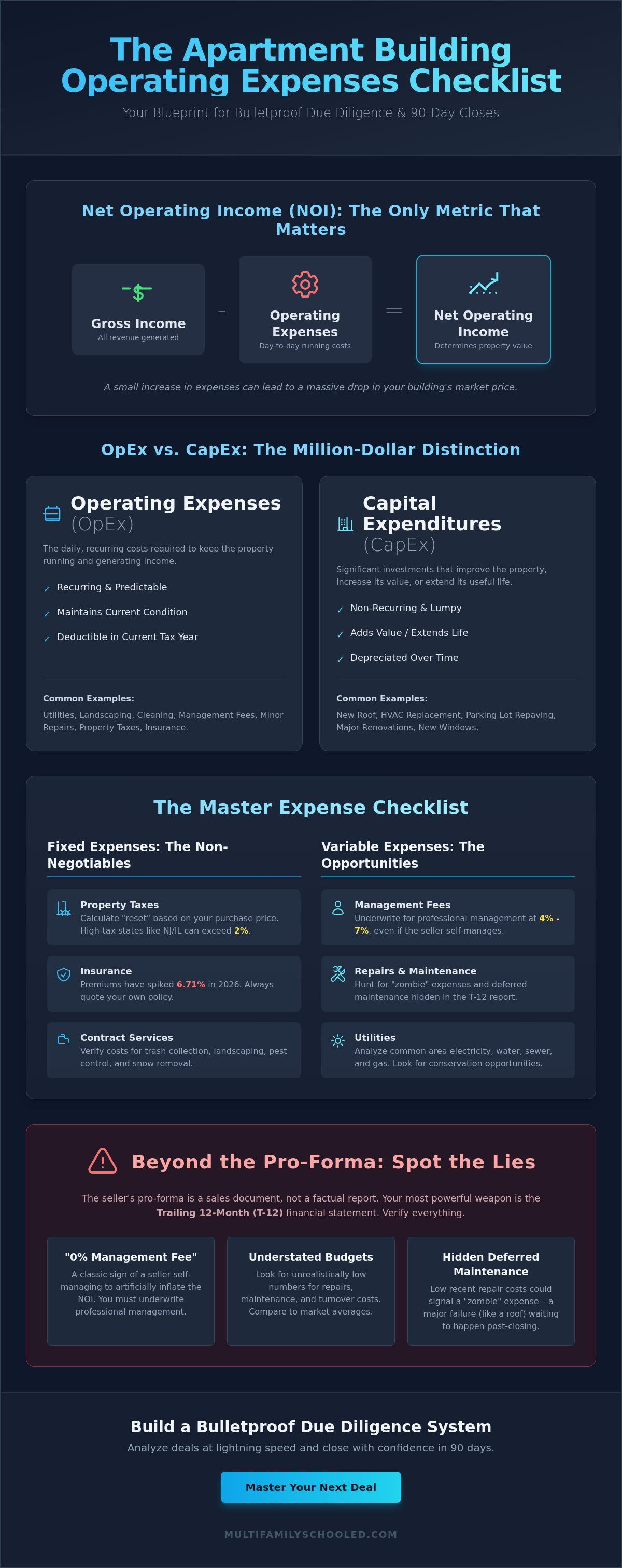
Your property value isn't decided by a gut feeling or a neighborhood trend. It's decided by the math. In the world of multifamily investing, Net Operating Income (NOI) is the only metric that truly matters for your wealth. The formula is simple but brutal: Gross Income minus Operating Expenses equals NOI. Every single dollar you leak through inefficient operations is a dollar stripped directly from your pocket. Even worse, it's a multiplier of lost value. Because commercial properties are valued based on a cap rate, a small increase in your expenses can lead to a massive drop in your building's market price.
Think about the stakes in 2026. With commercial property insurance rates jumping 6.71% recently and property taxes in states like New Jersey or Illinois exceeding 2%, your margin for error has vanished. You can't afford to guess. You must use a standardized apartment building operating expenses checklist to audit every cent. If you don't control these costs, you're not just losing cash flow; you're destroying your exit strategy. Remember that debt service and capital improvements aren't part of this calculation. They're separate line items that don't touch your NOI, but they're often the first places sellers try to hide "lumpy" expenses.
To better understand how these fundamentals impact your ability to close a deal, watch this helpful video:
OpEx vs. CapEx: The Million-Dollar Distinction
An Operating expense represents the daily costs required to keep your building running. This includes recurring items like landscaping, cleaning, and the 4% to 7% management fees typical for multifamily assets. Capital Expenditures (CapEx), however, are investments that extend the life of the property, such as a $50,000 roof replacement or new HVAC units. Misclassifying these is a rookie mistake that leads to major tax penalties. If you're serious about mastering these distinctions, our Mentorship Program provides the exact frameworks to categorize every expense with professional precision.
Why the Seller’s Pro-Forma is Often a Lie
Brokers want to sell. They often present a "pro-forma" that looks like a dream but acts like a nightmare. A common red flag is seeing a "0% management fee" or understated repair budgets. Sellers might self-manage to inflate the NOI, but you must underwrite for professional management. Don't trust the numbers they give you. Verify every line item on your apartment building operating expenses checklist against real bank statements and the Trailing 12-Month (T-12) report. If the numbers don't match the reality of 2026 costs, walk away. You're here to build a portfolio, not to bail out a mismanaged asset.
The Master Apartment Building Operating Expenses Checklist
Stop guessing. Start auditing. If you want to close deals in 90 days, you need a standardized apartment building operating expenses checklist that leaves no stone unturned. This isn't just a list of bills; it's your roadmap to identifying where a seller is leaking money. You need to categorize your costs into fixed and variable buckets to understand exactly how much cash stays in your pocket after the dust settles. According to the America's Rental Housing 2024 report, rising operating costs are the biggest threat to Net Operating Income, making this level of detail non-negotiable for the modern investor.
Fixed Expenses: The Non-Negotiables
Fixed expenses are the costs that hit your bank account regardless of occupancy. You must master these to avoid a financial wipeout. Don't rely on the seller's tax bill. Calculate the property tax "reset" based on your purchase price. If you're buying in high-tax states like New Jersey, your effective rate could be above 2%. Insurance is another danger zone. With average premium renewals rising 6.71% as of May 2026, you must quote your own policy during due diligence. Never assume you can inherit the seller's rate. Your checklist must also include contract services like trash collection, landscaping, and snow removal.
Variable Expenses: Where Profits are Won or Lost
Variable costs are where you find the fat to trim. Utilities are the primary culprit for NOI leakage. Look for spikes in water and sewer costs; they usually indicate hidden pipe leaks or inefficient fixtures. In 2026, electricity costs are surging, with some regions like Southern California seeing proposed hikes of 12.9%. You need to track common area lighting and heating gas separately to find efficiencies. Manage your variable costs with these items:
- Repairs and Maintenance: Budget for routine plumbing, electrical, and HVAC fixes.
- Property Management: Expect to pay 4% to 7% for larger multifamily assets in 2026.
- Turnover Costs: Include painting, cleaning, and lock changes between tenants.
- Marketing and Leasing: Account for listing fees and professional photography. New regulations like California's AB 747 now require upfront disclosure of all mandatory fees, so ensure your leasing budget covers compliance.
Administrative and Professional Fees
Don't ignore the "small" numbers. They add up fast. Legal reserves are essential for lease drafting and potential eviction processing. You also need to account for accounting software and bookkeeping fees to keep your T-12 statements clean. If your building requires on-site staff, include their payroll and benefits here. Mastering these details is the only way to scale with confidence. To streamline this process, you can download our Multifamily Tool Kit to access the exact templates we use for every deal.
Beyond the Pro-Forma: Uncovering Hidden and Misclassified Expenses
The pro-forma is a sales pitch. The Trailing 12-Month (T-12) statement is the reality. To truly master your apartment building operating expenses checklist, you must develop an auditor’s eye. You aren't just checking boxes; you're hunting for anomalies that signal mismanagement or deception. Sellers often "fatten the pig" before a sale by slashing maintenance or deferring critical repairs to artificially inflate the Net Operating Income. If you don't catch these "zombie" expenses during due diligence, you'll be the one paying for them on day 91.
Start by identifying the "Self-Management Bias." Many mom-and-pop owners do the landscaping, minor plumbing, and tenant screening themselves without recording a labor cost. This creates a dangerous illusion of profitability. When you take over, you'll likely hire a professional team, instantly increasing your OpEx by 4% to 7% for management alone. You must underwrite for the reality of your own operation, not the owner's weekend hobbies. Use our Deal Finding Software to benchmark these costs against similar assets in the market so you never overpay for a "hobby" property.
The "Lumpy" Expense Trap
Look for "lumpy" spending patterns. If the Repairs and Maintenance (R&M) line item drops significantly in the three months leading up to the listing, the seller is likely hiding deferred maintenance. They want the property to look "efficient" when it's actually deteriorating. You should also watch for capital improvements misclassified as operating expenses. A $10,000 roof patch might be buried in R&M to lower the tax burden, but for your valuation, it's a CapEx item. Scrutinize every invoice. Don't let the seller average out seasonal spikes in heating gas or snow removal; verify the actual usage for the coldest months of 2026 to see the true cost of ownership.
Utility Bill Auditing: The Low-Hanging Fruit
Utilities are the primary source of profit leakage. Compare the unit count to the actual water and sewer bills. If the usage doesn't align with the number of occupants, you likely have silent toilet leaks or even water theft. With commercial electricity rates in places like Texas expected to average 7 to 9 cents per kWh in 2026, you can't ignore the common area meters. Check if the building is "Master Metered." If the landlord pays for tenant electricity, your ROI is at the mercy of their thermostat habits. Evaluate the potential for a Ratio Utility Billing System (RUBS) to pass these costs back to the tenants. This single move can transform a struggling asset into a cash-flow machine. If you want to see how we implement these strategies in real-time, join our Online Challenges to sharpen your auditing skills.
Benchmarking Success: Analyzing Ratios and Performance Metrics
Data without context is just noise. You’ve audited the bills and verified the usage, but how do you know if your property is a finely tuned machine or a sinking ship? You must benchmark your results against the industry’s top performers to see where you truly stand. In 2026, simply "paying the bills" isn't enough to build a legacy. You need to leverage your apartment building operating expenses checklist to calculate your Operating Expense Ratio (OER) and compare it to asset-class standards. This is the only way to identify if a property is being mismanaged or if there’s hidden room to force appreciation through aggressive efficiency measures.
The "50% Rule" remains a vital tool for your back-of-the-napkin analysis. If you're looking at a deal and the expenses are significantly lower than 50% of the gross income, proceed with extreme caution. Unless it's a brand-new Class A build, a low OER usually signals that a seller is "starving" the property to inflate the sales price. You aren't just looking for low costs; you're looking for sustainable efficiency. Use these benchmarks to validate every deal you underwrite in the next 90 days. If the numbers don't align with reality, you have the data to negotiate a better price or walk away before you lose a dime.
The Operating Expense Ratio (OER) Framework
The OER is your ultimate efficiency scorecard. Calculate it by dividing your total operating expenses by your gross operating income. For Class A properties, aim for an OER between 35% and 42%. These assets command premium rents and feature newer systems that keep maintenance costs predictable. Class C properties, however, often see ratios climb between 50% and 60% due to constant repairs, higher turnover, and lower rental ceilings. Use this ratio to determine if a property is being over-managed with excessive staffing or neglected to the point of structural failure. If your OER is out of sync with the asset class, your apartment building operating expenses checklist will tell you exactly which line item is the culprit.
Leveraging AI and Software for Efficiency
The winners in 2026 are using technology to crush their OER and widen their margins. You can’t scale a massive portfolio using manual spreadsheets and guesswork. We recommend using Real Estate Radar to identify market anomalies and pinpoint exactly where your expenses are out of alignment with local benchmarks. This software allows you to see the "invisible" costs that competitors miss. Beyond software, consider these 2026 tech differentiators:
- Smart Building Systems: Implement smart thermostats and AI-powered leak detection sensors to slash utility OpEx by 10% to 15% almost instantly.
- Automated Leasing: Use AI-driven tools to handle tenant inquiries and screening, eliminating the administrative overhead of a full-time leasing agent.
- Predictive Maintenance: Use sensor data to fix a water heater before it bursts, turning a potential $10,000 emergency into a $200 service call.
Stop doing manual work that a machine can do better and faster. If you’re ready to master these high-level strategies and dominate your market, join our Mentorship Program today. We provide the exact blueprint and proprietary tools you need to achieve operational excellence and maximize your NOI on every single deal.
Mastering Expense Management for 90-Day Deal Success
Speed is your ultimate competitive advantage in the 2026 commercial market. If you can't underwrite a deal with surgical precision in minutes, you've already lost it to a faster, more prepared investor. Your apartment building operating expenses checklist is more than just a list of bills; it is the engine that drives your 90-day acquisition strategy. Mastery of these numbers allows you to move with the confidence of a seasoned pro while others are still scratching their heads over a broker's pro-forma. When you control the data, you control the deal.
Stop guessing. Start executing. The 2026 landscape is too volatile for "back-of-the-napkin" math to be your only tool. You've seen how insurance spikes and utility hikes can crush a property's value if left unchecked. By implementing a standardized system for tracking every fixed and variable cost, you transform from a passive observer into a strategic operator. This level of discipline is what separates the people who talk about financial freedom from the ones who actually achieve it. Your first building is closer than you think, but only if you have the right systems in place to catch the winners and kill the losers fast.
Standardizing Your Analysis Workflow
A 90-day timeline is a powerful filter. It forces you to become an expert at spotting bad data and "lumpy" expenses before they become your problem. You don't have time to build a new spreadsheet for every property. You need a proven, repeatable process that allows you to plug in the numbers and get an immediate "go" or "no-go" signal. This is where standardized templates become life-savers. Using our Multifamily Tool Kit gives you the exact underwriting framework we use to analyze thousands of units with total accuracy. When your workflow is standardized, your speed increases, and your risk vanishes. Don't let a messy spreadsheet be the reason you miss out on a legacy-defining asset.
The Path to Financial Freedom Through Mentorship
Operating expenses are the most common place for "zombie" costs to hide. A single misunderstood tax reset or a missed line item for legal reserves can easily become a $100,000 mistake that haunts your portfolio for years. You don't have to do this alone. The smartest investors in the room always have a coach who has already seen the pitfalls and knows how to navigate them. Our Mentorship Program provides you with direct deal guidance and the strategic blueprint you need to scale with confidence. We help you audit your apartment building operating expenses checklist in real-time so you never overpay for a property. Stop playing small and start leveraging a proven system. Your first building is 90 days away if you master the numbers today.
Take Command of Your Financial Future Today
You now possess the exact framework to audit any multifamily asset with the precision of a veteran operator. By leveraging a rigorous apartment building operating expenses checklist, you've moved past the guesswork that paralyzes most investors. You know how to hunt for hidden maintenance gaps in a T-12 and how to benchmark your OER against 2026 standards. This knowledge isn't just theory. It's the foundation of your legacy.
Don't let this momentum stall. Our system is designed for both novice and experienced investors who are ready to stop watching from the sidelines. When you Join the 90-Day Mentorship and Find Your Deal, you get immediate access to our proprietary Deal Finding Software and a battle-tested blueprint. We are so confident in this methodology that we guarantee you'll find a deal in 90 days or we'll provide one for you. Success is a choice. You have the tools, the tech, and the roadmap. Now, it's time to execute. Your first building is waiting.
Frequently Asked Questions
What is the most common hidden expense in an apartment building?
Administrative and payroll "leaks" are the most frequent hidden costs in multifamily deals. Sellers often omit the value of their own time spent managing the property or fail to record small office expenses and software subscriptions. When you transition to professional management, these "invisible" costs instantly reappear on your balance sheet. Always audit the T-12 for missing line items like legal reserves and professional bookkeeping fees to see the true cost of ownership.
Are property taxes considered an operating expense?
Yes, property taxes are a fixed operating expense that directly impacts your Net Operating Income. You must account for the "reset" value of these taxes based on your purchase price rather than the seller's historical bill. In 2026, national average effective rates range from 0.99% to 1.11%, but states like New Jersey and Illinois can exceed 2%. Failing to project this increase is one of the fastest ways to kill your cash flow.
How much should I budget for property management fees?
Budget between 4% and 7% of collected rent for professional property management on larger multifamily assets in 2026. While smaller residential properties might see fees closer to 10%, larger buildings benefit from economies of scale. Don't settle for the cheapest option; an elite management team will save you more in operational efficiency than they cost in fees. Ensure your budget also covers leasing commissions and background screening costs for new tenants.
What is a good operating expense ratio for a multifamily property?
A healthy Operating Expense Ratio (OER) typically ranges from 35% to 42% for Class A assets and 50% to 60% for Class C properties. You must use a detailed apartment building operating expenses checklist to ensure your OER reflects reality rather than a seller's fantasy. If your ratio is significantly lower than these benchmarks, you're likely looking at deferred maintenance or understated costs that will hit your pocket after the closing.
Can I include my mortgage payment in operating expenses?
No, your mortgage payment is considered debt service and is never included in operating expenses. Operating expenses only cover the costs required to run and maintain the property daily. You subtract OpEx from your Gross Income to find your Net Operating Income (NOI). It's only after you have the NOI that you subtract your debt service to determine your final cash flow. Mixing these up will give you a false sense of your property's market value.
How do I reduce operating expenses without hurting tenant satisfaction?
Implement smart building technology to slash utility costs without impacting the tenant experience. Installing leak detection sensors and smart thermostats can reduce water and energy waste by 10% to 15% almost immediately. You can also transition to a Ratio Utility Billing System (RUBS) to pass utility costs back to tenants fairly. These upgrades improve your bottom line while modernizing the building, which actually increases tenant retention in the long run.
What is the difference between OpEx and CapEx for tax purposes?
Operating expenses (OpEx) are recurring costs for daily operations that you can typically deduct in the year they occur. Capital Expenditures (CapEx) are investments that extend the life of the asset, such as a new roof or HVAC system. For tax purposes, CapEx items must be capitalized and depreciated over several years. Misclassifying these can lead to major IRS penalties, so track them separately on your financial statements to maintain professional compliance.
Should I use the seller’s utility numbers for my projections?
Never rely on a seller's utility projections without independent verification. Use your apartment building operating expenses checklist to audit actual usage and account for 2026 rate hikes, such as the 12.9% increase proposed by Southern California Edison. Sellers often average out costs or ignore rising delivery fees to make the pro-forma look better. Quote your own utility costs based on current regional data to protect your investment from unexpected margin compression.



