

Apartment Building Loan Requirements: The 2026 Investor’s Blueprint
Stop waiting for a "yes" from a bank that doesn't even understand your vision. Most new investors get rejected immediately because they don't understand the complex apartment building loan requirements that separate the pros from the amateurs. You likely feel the frustration of being stuck in a loop of "not quite ready" while your dream of building wealth sits on the sidelines. It's time to stop guessing and start winning. You need a system that works as hard as you do.
This is your 2026 blueprint to master the exact standards lenders demand so you can secure financing and own your first apartment building in 90 days. We're going to dive into the 1.25 debt service coverage ratios, the 10% liquidity benchmarks, and the net worth rules that turn you into a VIP borrower. This article provides the clear checklist and the confidence you need to walk into any bank and walk out with a closed deal. Let's get to work.
Key Takeaways
- Master the 2026 apartment building loan requirements to understand why lenders now prioritize property cash flow over your personal paycheck.
- Solve the "Experience Catch-22" immediately by leveraging strategic partnerships and a proven Personal Financial Statement blueprint.
- Unlock the "Golden Rule" of Debt Service Coverage Ratio (DSCR) to ensure your building qualifies for the most competitive market rates.
- Follow a high-speed, step-by-step roadmap to navigate the application process from your first Letter of Intent to a successful closing.
- Deploy creative financing and syndication methods to bridge capital gaps and own your first multifamily asset in just 90 days.
Understanding Apartment Building Loan Requirements in 2026
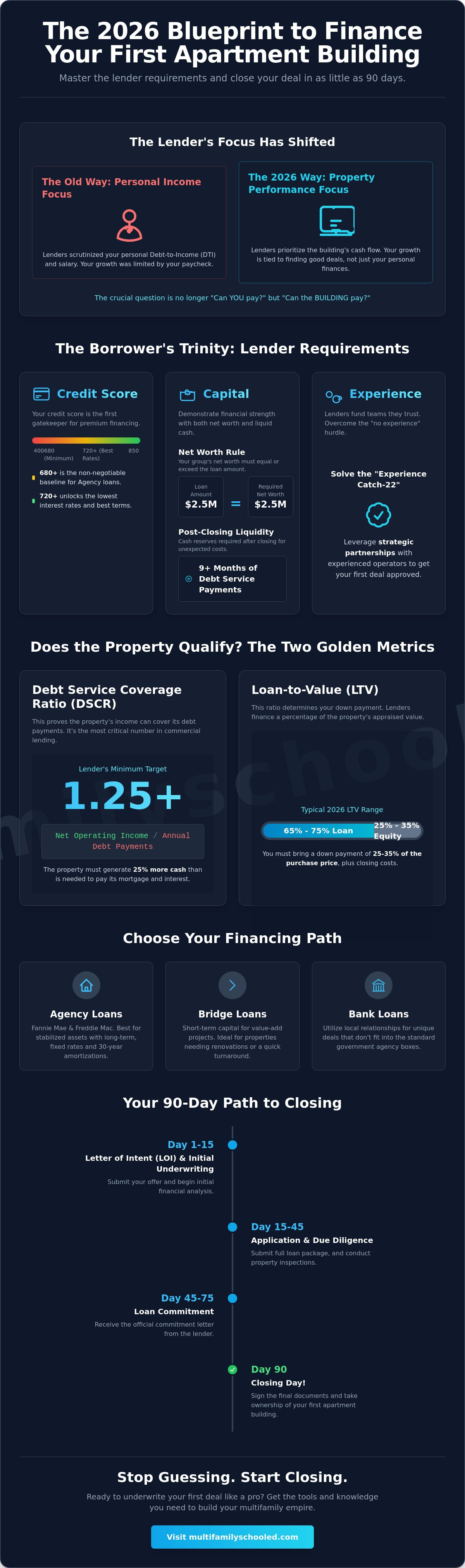
Stop playing small with single-family rentals. In 2026, real wealth comes from scale. Understanding apartment building loan requirements is your first step toward total financial empowerment. If you want to own 50 units instead of 5, you must change how you think about debt. Lenders in 2026 have shifted their focus. They don't care about your personal salary as much as they did five years ago. They care about the asset. They want to see a building that breathes cash flow every single month.
The transition from "can you pay" to "can the building pay" is the secret to scaling your portfolio at light speed. This mindset shift allows you to move past the limitations of your own paycheck. To better understand how this works in practice, watch this helpful video:
Commercial vs. Residential: The Rules Have Changed
The 5-unit threshold is a hard line in the sand for every investor. Anything with 5 units or more falls under commercial rules. This is where you unlock the power of commercial mortgage basics to fund your growth. In the residential world of 1 to 4 units, banks obsess over your personal debt-to-income ratio. In the commercial world, your personal DTI matters less than the property's performance. You also gain access to non-recourse loans. These loans protect your personal assets. If the deal fails, the lender only takes the building, not your personal home or your savings accounts.
The 2026 Lending Landscape
Lenders in 2026 are highly selective. They prioritize value-add opportunities where you can force appreciation through smart renovations. Most lenders currently cap loan-to-value (LTV) ratios between 65% and 75% to protect their downside. You must master the math to secure a "green light" on your financing. DSCR (Debt Service Coverage Ratio) is the mathematical proof that a property's net operating income exceeds its annual debt payments by a specific margin, typically 1.20 or higher.
You have three primary paths to secure your first or next deal:
- Agency Loans (Fannie Mae and Freddie Mac): These offer the best long-term rates with 30-year amortizations for stabilized assets.
- Bridge Loans: These provide short-term capital for properties that need a quick turnaround or heavy renovation.
- Bank Loans: Use these for local relationships and unique deals that don't fit the standard government boxes.
Ready to see if your deal stacks up against these 2026 standards? Use our Multifamily Tool Kit to analyze your first property in under 60 seconds. Stop guessing and start underwriting like a pro today.
The Big Three: Credit, Capital, and Experience Requirements
Lenders don't just fund buildings; they fund people they trust. To secure the best apartment building loan requirements, you must present a bulletproof financial profile. This starts with your Personal Financial Statement (PFS). This document is your financial resume. It lists every asset you own and every debt you owe. Lenders scrutinize this to see if you have the "staying power" to handle a multi-million dollar asset. If your PFS is weak, your deal is dead on arrival. You need to show you're a liquid, capable investor who can weather a market shift.
Personal Credit and Net Worth Standards
Your credit score is the first gatekeeper. For Agency financing through Fannie Mae or Freddie Mac, a 680 score is the non-negotiable baseline. If you want the lowest interest rates, aim for 720 or higher. A lower score suggests risk, and risk costs money. Beyond credit, lenders look at your net worth. Most banks require your total net worth to equal or exceed 100% of the loan amount. If you're borrowing $2,500,000, your ownership group needs a $2,500,000 net worth.
Liquidity is the second gatekeeper. You can't be "asset rich and cash poor." Lenders usually demand "post-closing liquidity" equal to 9 months of debt service. This cash must be in the bank after you've paid your down payment and closing costs. Understanding these commercial real estate loan requirements is vital for anyone moving from residential to commercial assets. It's about proving you have the reserves to handle a sudden roof repair or a spike in vacancies without missing a mortgage payment.
The Experience Factor: How to Qualify Without a Track Record
New investors often hit the "Experience Catch-22." Lenders want to see that you've managed similar properties, but you can't get experience without your first deal. You can solve this instantly through strategic partnerships. Bring in a Key Principal (KP) to join your GP (General Partner) team. A KP is an experienced investor who signs on the loan to provide the balance sheet and track record you lack. They provide the credibility; you provide the hustle.
You can also bridge the gap by building a "Pro" team. Hire a property management company that already manages at least 1,000 units in your specific sub-market. Use an attorney who has closed at least 50 multifamily transactions in the last 24 months. When you show up with an elite team, the lender's risk profile drops. Our Mentorship Program is designed to help you build this exact credibility and connect with the partners you need to win. Stop guessing and start using a proven system to satisfy apartment building loan requirements. Success in this game is about who you know and how you present your team. Take action today to build your investment dream.
Property-Specific Requirements: Does the Building Qualify?
Lenders don't just bet on you. They bet on the asset. Even if you have a perfect credit score, a failing building will kill your deal. To master apartment building loan requirements in 2026, you must view the property through the lender's eyes. They want proof that the building generates enough cash to cover the debt and then some. This is about risk mitigation and cash flow certainty.
Stabilized buildings get the best rates. Typically, this means the property has maintained at least 90% occupancy for the last 90 days. If the building is half-empty, you're looking at bridge debt or "hard money" with much higher interest. Lenders also categorize buildings by Market Class. Class A properties are luxury builds less than 10 years old. Class B is solid workforce housing. Class C properties are older, often requiring significant "Value-Add" work. Know your class before you apply.
Mastering the Math: DSCR and LTV
The Debt Service Coverage Ratio (DSCR) is the ultimate "Green Light." Most lenders require a minimum 1.25 DSCR. This means the property's Net Operating Income (NOI) must be 125% of the annual mortgage payment. It's your safety margin. If the math doesn't hit 1.25, the lender will slash your loan amount until it does.
Expect Loan-to-Value (LTV) ratios to sit between 65% and 75% in the 2026 market. You'll need more "skin in the game" than in previous decades. Don't guess these numbers. Use the Multifamily Tool Kit to analyze your deal in seconds and ensure you meet these strict apartment building loan requirements before you ever speak to a broker.
The Building's 'Resume': T12 and Rent Rolls
Lenders demand a "Trailing 12" (T12) statement. This is a month-by-month breakdown of the property's actual income and expenses over the last year. They'll look for "Deferred Maintenance" like leaking roofs or outdated electrical systems that could drain your cash. If the T12 shows skyrocketing utility costs or high turnover, be ready to explain why.
The Rent Roll is the building's heartbeat. Lenders verify that every tenant is real and every lease is signed. They'll also order a Property Condition Needs Assessment (PCNA). This is an intensive physical inspection that projects repair costs for the next 12 years. If the PCNA identifies $200,000 in immediate repairs, the lender might hold back that cash from your loan until the work is finished.
- DSCR: Aim for 1.25 or higher for the best terms.
- LTV: Prepare for a 25% to 35% down payment.
- Occupancy: 90% stabilization is the industry benchmark.
- Inspections: The PCNA report determines your "CapEx" budget.
The Step-by-Step Application Process: From LOI to Closing
Stop guessing. Start executing. The journey from a Letter of Intent (LOI) to holding the keys follows a rigid, four-phase blueprint. If you miss one document or blow one deadline, your deal dies. Speed is your greatest asset in 2026. Lenders want to see a professional operator who moves with purpose.
- Phase 1: The Pre-Flight. Gather your personal financial statement (PFS), two years of tax returns, and a detailed schedule of real estate owned (SREO). You must have these ready before you even talk to a lender.
- Phase 2: The Term Sheet. This is the bank's non-binding offer. You negotiate the interest rate, amortization, and leverage here.
- Phase 3: Underwriting. The bank's team scrutinizes every line item. They verify your income, the property's expenses, and the market's viability.
- Phase 4: Closing. This is the final 15 day sprint. You sign the loan docs, wire the remaining equity, and the title records.
Winning the Term Sheet
Lenders don't just fund properties; they fund borrowers they trust. To make banks compete for your business, present a "Green Light" deal package. This includes a professional executive summary and a 12 month pro-forma. Use Real Estate Radar to find off-market deals that already meet strict 1.25x Debt Service Coverage Ratio (DSCR) standards. This makes the lender's job easy.
Pay close attention to 'Carve-outs' and 'Bad Boy Guarantees.' Even in non-recourse debt, these clauses make you personally liable if you commit fraud or gross negligence. Understand these terms before signing. Meeting the apartment building loan requirements isn't just about the numbers; it's about proving you are a low-risk partner.
Surviving Underwriting Without Losing Your Mind
Underwriting is where the 60 day clock feels like 6 minutes. You must provide a clean 'Due Diligence' checklist. This includes a Phase I Environmental Report, a fresh Survey, and a certified Appraisal. If the appraisal comes in low, you must pivot. This might mean renegotiating the purchase price or bringing more equity to the table.
The bank will demand a 'Sources and Uses' table. This document shows exactly where every dollar comes from and where it goes. It must balance perfectly. Include a 10% contingency fund for unexpected repairs to show the bank you're prepared for the reality of ownership. Navigating apartment building loan requirements during this phase requires total transparency.
Ready to dominate the market? Download the Multifamily Tool Kit and get the exact templates the pros use to close deals fast.
How to Overcome Loan Hurdles and Close Your First Deal in 90 Days
Stop letting a bank's checklist kill your momentum. You see the apartment building loan requirements and think you're stuck. You aren't. You just need a better strategy. High-performance investors don't wait for the perfect credit score or a massive bank account. They use leverage. They use systems. They move fast. You can bypass traditional roadblocks by changing how you view the deal. If the bank says no, the seller might say yes. If your bank account is light, your network is heavy. Success in 2026 requires speed and creativity.
Bridging the Capital Gap
Raising capital is about trust and math. You can legally pool funds through syndication, bringing in VIP partners to cover the 25% down payment required by most lenders. This turns a solo struggle into a team win. Seller financing is your secret weapon. Ask for a seller carry-back where the owner acts as the bank for a portion of the equity. Data from 2023 showed that creative financing deals increased by 15% as interest rates fluctuated. This strategy lowers your out-of-pocket costs instantly.
Master Lease Options (MLO) are another powerful tool. You control the property and the cash flow today without an immediate bank loan. It's a "test drive" for ownership. Once you improve the Net Operating Income (NOI) by at least 10% or 15%, you transition to long-term Agency debt. Combining a short-term bridge loan with permanent Fannie Mae or Freddie Mac financing allows you to fix up the asset and then lock in a stable rate. This is how you scale without hitting a ceiling.
- Syndication: Raise the down payment from passive investors.
- Seller Carry-backs: Negotiate the seller into a secondary lien position.
- Master Lease Options: Gain control without the immediate need for a mortgage.
The Fast 5 Method to Ownership
Speed is your greatest asset. In a competitive market, the slow investor loses the deal every single time. The Fast 5 Method compresses years of learning into a 90-day sprint. It focuses on the five core levers: finding, analyzing, funding, closing, and managing. You don't have to guess. You don't have to stumble through the apartment building loan requirements alone. Join the Mentorship Program to get a deal found for you. We provide the blueprint to bypass the typical hurdles that stop beginners. You get the system. You get the support. You get the keys.
Stop waiting for "the right time." The right time was yesterday. The second best time is right now. Every day you wait is a day of passive income you've lost forever. Unlock your path to financial freedom today. Take the leap. Start owning.
Secure Your First Deal and Build Wealth in 2026
You now possess the exact blueprint to navigate apartment building loan requirements with total confidence. Success in 2026 demands more than just interest; it requires a mastery of the credit, capital, and experience trifecta that lenders crave. You've learned how to qualify both yourself and the property, ensuring you never waste time on dead-end deals. This 90-day ownership system is the same framework featured on major real estate platforms to help investors scale quickly. By following the step-by-step path from LOI to closing, you're cutting through the noise and positioning yourself for immediate growth. Don't let technical hurdles stop your momentum. We've distilled 3rd Generation Multifamily Expertise into a streamlined process that turns first-time buyers into confident owners. The market waits for no one, and the best deals are claimed by those who act with speed and precision. Your path to financial freedom is clear, and the tools are in your hands. It's your turn to dominate the multifamily space and lock in your future.
Take the 5-Day Multifamily Challenge and Unlock the System Today!
You have the drive and the data to succeed. Let's get out there and close your first deal!
Frequently Asked Questions
Can I get an apartment building loan with no experience?
Yes, you can secure a loan without personal experience by partnering with a seasoned property manager or an experienced co-signer. Lenders prioritize the asset's performance and the strength of your supporting team over your individual track record. Use our proven system to build a powerhouse team that gives banks the confidence to fund your first 20 unit deal. It's about following the blueprint, not just your resume.
How much of a down payment is required for an apartment building?
Expect to bring a 20% to 25% down payment for most multifamily acquisitions in 2026. Conventional apartment building loan requirements typically mandate this equity stake to mitigate lender risk. If you're using agency debt like Fannie Mae, the requirement often sits at exactly 20% for stabilized assets. Secure your capital early to ensure you can move fast when a 10% cap rate deal hits your desk.
What is the minimum credit score for a multifamily loan in 2026?
You generally need a minimum credit score of 680 to qualify for competitive commercial rates. Some bridge lenders might accept a 640 score, but you'll pay a premium in interest. High-tier agency programs often demand a 720 or higher to unlock the best terms. Clean up your report today to ensure you don't miss out on wealth building opportunities. This score is your passport to financial freedom in the 2026 market.
What is the difference between recourse and non-recourse loans?
A recourse loan makes you personally liable for the debt, while a non-recourse loan limits the lender's recovery to the property itself. Most agency loans for properties over $1,000,000 are non-recourse, protecting your personal assets from seizure if the deal fails. This is the ultimate tool for massive wealth. Choose non-recourse to scale your portfolio without putting your family's personal home at risk. It's a key strategy for savvy investors.
How many units do I need for a property to be considered commercial?
A property is considered commercial once it reaches 5 or more residential units. Properties with 1 to 4 units fall under residential lending rules, which rely on your personal income and credit. At 5 units, the game changes completely. The loan depends on the property’s income, allowing you to unlock massive scale that's impossible with single family rentals. Start looking at 5 unit buildings today to transform your financial future.
What does DSCR mean and why is it the most important number?
Debt Service Coverage Ratio (DSCR) measures the property's ability to cover its mortgage payments using its own annual net operating income. Lenders typically require a minimum DSCR of 1.25, meaning the property generates 25% more income than the debt costs. This is the most critical apartment building loan requirements metric because it proves the deal's cash flow. Master this number to get the green light on every deal you submit to a bank.
How long does it take to close on an apartment building loan?
Plan for a closing timeline of 45 to 60 days for standard commercial loans. Agency debt or complex bridge financing can extend this window to 90 days. Speed is your competitive advantage, so have your 3 years of tax returns and property P&L statements ready for instant submission. Don't let a slow paperwork process kill your momentum in a hot market. Taking action quickly ensures you secure the best interest rates available.
Can I use seller financing to cover my down payment?
Yes, you can use a seller carryback to cover a portion of your down payment if the primary lender allows a second lien. Most senior lenders require you to put at least 10% of your own cash into the deal to ensure you have skin in the game. This strategy is a powerful way to leverage other people's money. It helps you close deals with less out of pocket capital and increases your overall ROI.



