

5 Proven Steps to Finding and Buying Your First Apartment Building in 2026
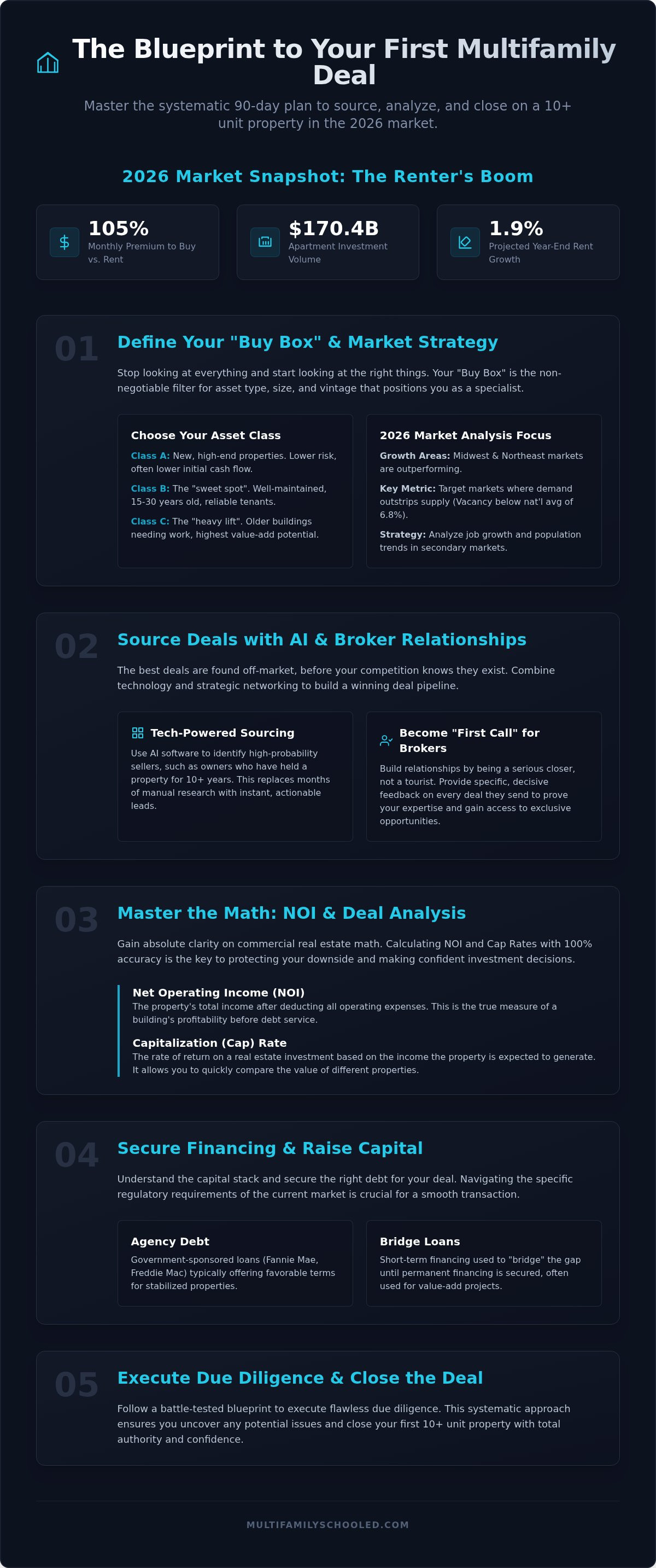
Stop waiting for the "perfect time" to enter real estate. In 2026, there is a massive 105% monthly premium to buy a home versus renting. This means the demand for apartments is explosive. You don't need a massive inheritance or a lucky break to win. You need a system. Learning how to find multifamily deals isn't about scouring Zillow for leftovers. It's about mastering a repeatable process that uncovers high-yield opportunities before your competition even wakes up.
You might feel paralyzed by shifting interest rates or the complexity of NOI and Cap Rates. Most new investors get stuck in analysis paralysis because they lack a clear roadmap. We're changing that today. You'll master the systematic 90-day blueprint to source, analyze, and close your first multifamily deal with total confidence. This guide breaks down the commercial math, shows you how to speak the language of brokers, and gives you the tools to secure off-market deals. Let's build your path to a 10+ unit property right now.
Key Takeaways
- Define your "Buy Box" and target markets using 2026 growth trends to ensure your investment is positioned for maximum appreciation.
- Master how to find multifamily deals by combining proprietary AI software with strategic broker relationships to access exclusive off-market opportunities.
- Gain absolute clarity on commercial math by calculating NOI and Cap Rates with 100% accuracy to protect your downside.
- Secure the right capital for your deal using agency debt or bridge loans while navigating the specific regulatory requirements of the 2026 market.
- Follow a battle-tested 90-day blueprint to execute flawless due diligence and close your first 10+ unit property with total authority.
Step 1: Define Your Buy Box and Market Strategy
Success in this industry isn't about luck. It's about precision. If you want to master how to find multifamily deals, you must stop looking at everything and start looking at the right things. Your "Buy Box" is your filter. It's the set of criteria that tells you exactly which properties deserve your time and which belong in the trash. Without a defined box, you'll drown in data. You'll suffer from analysis paralysis before you even make a phone call. Define your parameters now so you can move with speed later.
Start by picking your numbers. Are you looking for 10 to 20 units or 50 to 100? What vintage fits your risk profile? 1970s builds often offer value-add potential, while 2010s properties offer modern stability. When investing in multifamily residential housing, your box must be non-negotiable. This focus allows you to become an expert in a specific niche. It gives you the confidence to talk to brokers because you aren't just another "buyer." You're a specialist with a mission.
To better understand how to identify these opportunities, watch this helpful video:
Choosing Your Asset Class
Your asset class determines your lifestyle and your risk. Class A properties are shiny, new, and high-end. They offer lower risk but usually lower cash flow. Class B is the sweet spot for many first-time investors. These buildings are well-maintained, usually 15 to 30 years old, and attract reliable, long-term tenants. Class C is the "heavy lift." These are older buildings that need significant work. They offer the highest potential for appreciation through forced equity, but they require intense management. Decide which level of grind you're ready for right now.
Market Analysis for 2026
In 2026, the landscape has shifted. While the Sun Belt saw a massive construction boom in previous years, markets in the Midwest and Northeast are currently outperforming in rent growth. Look for the "path of progress." Analyze job growth and population trends in secondary markets. With a national vacancy rate of 6.8% in early 2026, you must be selective. Focus on pro-business environments with fair landlord-tenant laws. Verify that rent growth in your target city is trending toward the projected 1.9% year-end average. Use tools like Real Estate Radar AI to track these metrics and identify markets where demand outstrips supply.
Establish your investment goals early. Do you need immediate cash flow to secure your independence, or are you playing the long game for massive appreciation? Your unique competitive advantage might be your local knowledge or your ability to manage a complex renovation. Own that niche. Once your strategy is set, you're ready to start hunting for real deals.
Step 2: Source Deals with AI and Broker Relationships
Stop chasing leftovers on the MLS. If you want to dominate this market, you have to find the deals before they're public knowledge. Off-market sourcing is the only way to secure the best pricing and avoid bidding wars. Apartment investment volume for the 12 months ending in March 2026 reached $170.4 billion. You won't capture your share of that by being a passive observer. Master how to find multifamily deals by going exactly where your competition isn't looking.
Your secret weapon is technology. Use Real Estate Radar AI to identify high-probability sellers. This software filters for owners who have held their property for 10 or more years. These owners often have significant equity and may be ready to exit. This is the ultimate shortcut for anyone learning how to find multifamily deals in a competitive market. It replaces months of manual research with instant, actionable leads.
The Deal Sourcing Funnel
Success is a numbers game. You need a consistent funnel that feeds your pipeline every single day. Automate your outreach through direct mail and cold calling. Target "tired" properties with visible deferred maintenance. Use the Multifamily Tool Kit to score these leads rapidly. This allows you to focus your energy only on the opportunities that meet your Buy Box criteria. Consistency is your only path to "First Call" status with commercial brokers. Give them specific feedback on every deal they send. Show them you're a serious closer, not a tourist. To move even faster, our Mentorship Program provides the exact scripts and templates you need to win these conversations.
Finding Hidden Opportunities
Look for "mom and pop" owners who haven't raised rents in years. These properties represent massive upside through professional management. Search public records for owners in tax distress or pre-foreclosure. If you're looking at properties with existing regulatory agreements, understanding resources like the HUD Multifamily Program can help you navigate complex financing and preservation requirements. Focus on buildings with high vacancy but strong structural bones. These are the hidden gems where you can force equity through strategic renovations. Don't wait for the perfect deal to find you. Build the system that brings the deal to your doorstep.
Step 3: Master the Math: NOI and Deal Analysis
Math is your shield. It's the only thing standing between a massive payday and a financial nightmare. Learning how to find multifamily deals is only half the battle; the real victory happens in the spreadsheet. You must approach every property with a "guilty until proven innocent" mindset. If the numbers don't scream success, you walk away. Mastering commercial math gives you the power to dictate terms and the confidence to lead any negotiation.
Net Operating Income (NOI) is the heartbeat of your investment. It is your total income minus all operating expenses. It does not include your mortgage. This number determines the property's value. In early 2026, the average cap rate for apartment transactions was 5.8%. If you can increase the NOI by just $10,000, you've added over $172,000 in equity at that cap rate. This is how you build wealth fast. Your ability to master how to find multifamily deals hinges on your ability to spot a bad deal before you sign the Letter of Intent.
Crunching the Numbers
Don't get bogged down in the weeds during your first pass. Use the 50% rule for quick-fire estimation. If the owner claims expenses are only 30%, they're likely hiding something. Assume 50% of gross income will go to taxes, insurance, and maintenance. This keeps your projections grounded. Calculate your Cash-on-Cash return to ensure your investors get paid. Look for value-add opportunities like adding laundry, parking fees, or utility bill-backs. These small wins boost your NOI immediately. To streamline this, use the Multifamily Tool Kit to run these numbers in seconds rather than hours.
The Analysis Workflow
Trust but verify. Analyze the Trailing 12 months (T-12) statement and the Rent Roll side-by-side. Look for discrepancies in security deposits or sudden "repairs" that look like capital improvements. You must account for property management fees even if you plan to manage it yourself. The market demands this for valuation. Factor in a realistic vacancy reserve. With a national multifamily vacancy rate of 6.8% in early 2026, don't assume 100% occupancy. Refer to this Due Diligence Process Guide to understand how these numbers impact your legal and physical inspections. Run a "worst-case scenario" stress test. If interest rates spike or vacancy climbs, does the deal still breathe? If it does, you've found a winner.
If you want to stop guessing and start closing, our Mentorship Program provides the exact deal-scoring models we use to vet every property. Don't let a math error kill your momentum. Build your foundation on hard data and the results will follow.
Step 4: Secure Financing and Raise Private Capital
Money is never the real obstacle. The real obstacle is a lack of a proven deal. Once you master how to find multifamily deals that actually make sense, the capital will find you. In 2026, lenders are selective but active. Fannie Mae and Freddie Mac have massive $88 billion purchase caps each for the year. This means the money is available for those who know how to package a deal. Don't let your bank account limit your ambition. Use other people's money to build your empire.
For stabilized assets, agency debt is your primary target. As of July 2026, 10-year fixed agency rates are hovering around 5.67%. These loans offer the stability you need to sleep at night. If your property needs a major overhaul, look toward bridge loans. They carry higher interest but provide the flexibility to renovate and refinance once you've forced the equity. Stop thinking like a borrower and start thinking like a closer. You are the architect of the deal. Act like it.
Commercial Loan Requirements
Lenders care about two things: the property and you. Most multifamily lenders require a minimum Debt Service Coverage Ratio (DSCR) of 1.25x. This ensures the property can comfortably pay its own bills. You also need to prove your worth as a "Sponsor." Your personal net worth should generally equal the loan amount, and you need liquid post-closing reserves covering roughly 10% of the loan. Prepare a professional Personal Financial Statement (PFS) today. If you lack the experience, bring in a partner who has it. This is a team sport. Win together.
Raising Capital from Investors
This is how you scale to 10, 50, or 100 units. Real estate syndication allows you to pool capital from private investors to take down larger assets. You act as the General Partner (GP), managing the day-to-day operations and executing the business plan. Your investors are Limited Partners (LP), providing the capital in exchange for a share of the cash flow and equity. Create a compelling pitch deck. Show them the data. Highlight the 1.9% projected rent growth for late 2026. Build trust through transparency and strict SEC compliance. If you want to skip the trial and error of your first raise, join our Mentorship Program to get the exact investor templates we use to close eight-figure deals.
Your ability to raise capital is directly tied to your ability to source opportunities. When you can show an investor a high-quality, off-market property, you aren't asking for a favor. You're offering them a life-transforming opportunity to build generational wealth. Master how to find multifamily deals and you'll never worry about funding again. The market is moving fast. Secure your financing and take your seat at the table now.
Step 5: Execute Due Diligence and Close the Deal
You've done the hard work. You've learned how to find multifamily deals, mastered the math, and secured your funding. Now, you must finish the race. This is where most rookies blink. They let fear or sloppy paperwork kill a winning asset at the one-yard line. Don't let that be you. Execute with precision. Lock in your price with a firm Letter of Intent (LOI) that clearly outlines your timelines. This document is your shield; it ensures the seller takes the property off the market while you verify every single detail.
Your "boots on the ground" inspection is non-negotiable. You must walk every single unit. Check the plumbing, the electrical, and the HVAC systems. In 2026, specific regulations like the California balcony inspection requirements mean you can't afford to skip the exterior elements. Audit the lease files with an obsessive eye. You aren't just checking names; you're verifying that the income reported on the T-12 is actual cash hitting the bank. If the numbers don't match the reality of the rent roll, you have the leverage to renegotiate or walk away.
The Due Diligence Deep Dive
Protect your investment by looking under the hood. Review the Phase I Environmental report to ensure there are no commercial safety hazards that could haunt your exit strategy. Identify every dollar of deferred maintenance. If the roof needs replacement or the parking lot is crumbling, factor those costs into your first-year budget. Use these findings to negotiate seller credits. A $50,000 credit at closing is $50,000 of immediate capital you can use for renovations. Coordinate closely with your title company to ensure all FinCEN Beneficial Ownership Reporting is filed correctly for your LLC. This is a new requirement for 2026 that you cannot ignore.
Closing and the First 90 Days
Closing the deal is just the beginning of your wealth-building journey. You need a property management transition plan that starts on Day 1. Don't wait until you own the building to decide who collects the rent. Launch your value-add strategy immediately. Whether it's upgrading unit interiors or implementing utility bill-backs, every action you take must drive the NOI higher. This is the final step in mastering how to find multifamily deals that actually perform. You've built the system; now, reap the rewards.
Do not do this alone. The stakes are too high to guess your way through a multi-million dollar closing. Join our Mentorship Program and find your first deal in 90 days with a team of experts watching your back. We provide the checklists, the contracts, and the confidence you need to cross the finish line. Your first 10+ unit property is waiting. Take it.
Take Ownership of Your Financial Future Today
The 2026 multifamily market waits for no one. You now possess the exact blueprint to dominate this asset class. Success comes from filtering the noise through a strict Buy Box and leveraging technology to find what others miss. Mastering how to find multifamily deals is the single most important skill you can develop for long-term economic empowerment. This journey is about more than just numbers. It's about building a legacy of independence and securing your freedom.
You don't have to guess or struggle with analysis paralysis. You have immediate access to our proprietary Real Estate Radar AI software to uncover high-yield off-market leads instantly. We back your success with a bold 90-Day Guarantee; you will find a deal or we will provide one for you. The path to your first 10+ unit property is clear and systematic. Stop being a spectator and start being a closer. Your new life as a successful apartment owner is within reach. Take the first step toward your life-transforming journey right now.
Start Your Journey: Join the 5-Day Multifamily Challenge Now
Your legacy begins with one decisive action. We are ready to help you win.
Frequently Asked Questions
Can I buy an apartment building with no money down in 2026?
You generally cannot buy a commercial apartment building with zero down unless you bring in private partners. Most lenders require a down payment between 20% and 25%. However, you can master how to find multifamily deals and leverage a syndication model where private investors provide the capital. This allows you to close deals using other people's money while you earn equity for managing the asset and executing the business plan.
What is a good Cap Rate for a multifamily property right now?
A good Cap Rate in the current market typically ranges between 5.5% and 7.5% depending on the asset class and location. The national average cap rate for apartment transactions ending in March 2026 was 5.8%. If you find a property with a cap rate significantly higher than the market average, verify the risk levels. Always compare the cap rate to your interest rate to ensure you have positive leverage from Day 1.
How many units should my first apartment building have?
Aim for 5 to 20 units for your first building to break into the commercial space. Properties with 5 or more units use commercial financing based on the property's income rather than your personal salary. This is the fastest way to scale your portfolio. Smaller 2 to 4 unit buildings are residential and won't give you the same economic power or the professional experience required for larger, future syndications.
Do I need a special license to buy commercial multifamily real estate?
You do not need a real estate license to buy an apartment building for yourself. You are the principal in the transaction. However, you must comply with new 2026 regulations like the FinCEN Beneficial Ownership Reporting if you buy through an LLC. Focus on building a team of experts, including a commercial attorney and a CPA, to ensure your first deal is legally sound and fully compliant with federal law.
What is the difference between a residential and commercial multifamily loan?
Residential loans apply to 1 to 4 units and rely on your personal credit and debt to income ratio. Commercial loans cover 5 or more units and focus primarily on the property's Net Operating Income (NOI). Lenders look for a Debt Service Coverage Ratio (DSCR) of at least 1.25x. Understanding this shift is vital when learning how to find multifamily deals that lenders will fund with aggressive, non-recourse terms.
How much should I set aside for capital expenditures (CapEx)?
Set aside at least $300 to $500 per unit per year for ongoing capital expenditure reserves. This is in addition to your initial renovation budget. Lenders will often require these reserves as a condition of the loan. In 2026, costs for wood-supported exterior elements have risen due to new mandatory inspection laws. Always maintain a healthy rainy day fund to handle unexpected mechanical failures or roof repairs without impacting your investor distributions.
Should I hire a professional property manager or manage it myself?
Hire a professional property manager if you want to scale your wealth properly. Managing a 10+ unit building yourself is a full time job that distracts you from finding more deals. Lenders also prefer professional management because it reduces operational risk. A great manager will implement digital leasing tools and maintenance request systems. This centralization increases efficiency and drives your NOI higher, which directly increases the property's total market value.
What happens if a tenant stops paying during the due diligence period?
You must negotiate a seller credit or a price reduction if a tenant defaults during your due diligence phase. This is why auditing the rent roll and bank statements is critical. A non-paying tenant on Day 1 lowers your actual income and can jeopardize your DSCR. Don't ignore these red flags. Address the issue before you sign the final closing documents to ensure your first year cash flow and debt coverage remain protected.



