

1031 Exchange: Single-Family to Multifamily
Can a single-family rental become the starting point for a multifamily investment without triggering immediate tax on the gain? In many cases, yes. Using a 1031 exchange to move from single family to multifamily may work because both property types can qualify as like-kind real property when held for investment. But the transition involves more than finding a building you like. The transaction sequence and exchange deadlines matter.
It’s understandable to worry about identifying a suitable replacement property in time, especially when you’re moving into a larger, more complex asset. You’ll generally have 45 calendar days after selling to identify potential replacements and 180 days to complete the purchase. Those deadlines run at the same time, so preparing before closing can make a real difference.
This guide covers basic eligibility rules and the exchange sequence, including the role of a qualified intermediary and the risk of taxable “boot.” You’ll also learn what to coordinate with tax and exchange professionals, and how to build a focused multifamily search before your sale. A disciplined plan can help you pursue your next stage of investing with greater clarity.
Key Takeaways
- A qualifying single-family rental may be exchanged for multifamily real estate, but eligibility depends on how the properties are held and applicable tax rules.
- Plan the sale, exchange setup, replacement search, and acquisition as one coordinated sequence before closing on your current property.
- When using a 1031 exchange to move from single family to multifamily, assess tax requirements separately from the replacement property’s financial fit.
- Review property value, reinvested proceeds, debt, and potential taxable boot with qualified tax and exchange professionals.
- Strengthen your multifamily deal-sourcing and analysis skills so you can pursue a suitable replacement rather than rush into a poor-fit purchase.
Can a 1031 Exchange Move You from a Single-Family Rental to Multifamily?
Yes, it may be possible. A 1031 exchange can let an investor defer recognition of gain when exchanging qualifying real property held for investment or productive use in a business for other qualifying real property. A rental house and an apartment building may fit within the same exchange strategy, even though they represent different investment models. The property’s use, ownership, transaction structure, and other facts still matter.
In U.S. tax terms, a Section 1031 exchange is a way to defer gain on qualifying real property exchanged for other qualifying real property held for investment or productive use in a trade or business. The overview of Section 1031 of the Internal Revenue Code explains the broad like-kind principle, but an overview cannot determine whether your specific property and transaction qualify.
What does “like-kind” mean for these properties?
“Like-kind” generally describes the nature or character of real property, not whether the replacement is identical in size, quality, or type. For example, an investor selling a single-family home rented to tenants may be able to exchange it for a multifamily apartment property. The difference between one rental unit and several doesn’t automatically prevent like-kind treatment.
That doesn’t mean every property or ownership interest qualifies. Section 1031 is limited to qualifying real property held for investment or business use, and ownership structure can affect the analysis. A personal residence generally isn’t eligible simply because it’s real estate. If a property has both personal and rental use, or its use has changed over time, have a qualified tax professional review the facts before planning a sale around an exchange.
What a 1031 exchange does, and does not do
An eligible exchange generally defers tax on gain rather than making the gain disappear. The tax consequences depend on the transaction and the investor’s circumstances. Exchange qualification is only one part of the decision. It doesn’t establish that a particular apartment building is financially sound or aligned with your goals.
Evaluate the prospective multifamily property on its own merits. Consider its income assumptions, operating expenses, financing needs, condition, and risks. A property can be a possible replacement for tax purposes and still be a poor investment fit. Keep those two questions separate as you assess your options.
Using a 1031 exchange to move from single family to multifamily can open a path to a different scale of ownership, but eligibility and investment suitability require separate analysis. This guide is educational, not tax or legal advice. Before selling, get guidance tailored to your situation from qualified tax and legal professionals, and confirm current rules with IRS resources. Use that advice alongside careful property research, not as a substitute for evaluating the deal.
How the 1031 Exchange Timeline Works Before You Buy Multifamily
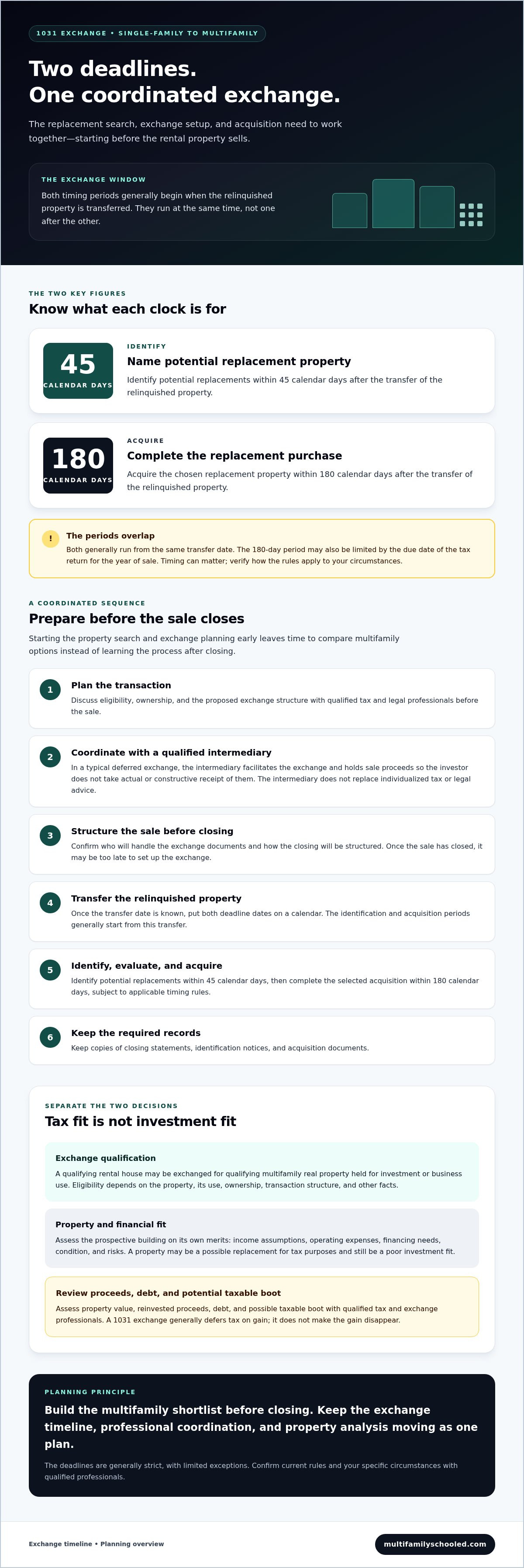
A smooth exchange starts before the single-family property sells. Treat the sale and multifamily search as one coordinated process, not two separate projects. A forward exchange generally follows this sequence: plan the transaction, arrange the exchange, transfer the relinquished property, identify potential replacements, acquire the chosen property, and keep the required records.
For investors using a 1031 exchange to move from single family to multifamily, deal sourcing should begin early. Waiting until after closing to learn the process or start evaluating properties can leave little time to compare options.
What must happen before the single-family property closes?
Before closing, discuss the proposed exchange structure with qualified tax and legal professionals and coordinate with a qualified intermediary (QI). In a typical deferred exchange, the QI facilitates the exchange and holds the sale proceeds so the investor doesn’t take actual or constructive receipt of them. The intermediary isn’t a substitute for individualized tax or legal advice.
Confirm who will handle the exchange documents and how the sale closing will be structured before signing final transaction instructions. Once the sale has closed, setting up the exchange may be too late. Get professional guidance on eligibility, ownership, and sequencing before the transfer, and keep copies of closing statements, identification notices, and acquisition documents.
How do the identification and closing windows affect deal sourcing?
Under the general federal timing rules, the investor has 45 calendar days from the transfer of the relinquished property to identify replacement property and 180 calendar days from that transfer to acquire it. These periods run concurrently, not one after the other. The 180-day period may also be limited by the due date of the tax return for the year of sale, so filing extensions and transaction timing can matter. The deadlines are generally strict, with limited exceptions, so verify how they apply to your circumstances.
The 45-day deadline is for identifying replacement property; the 180-day deadline is for completing the acquisition, and both generally run from the relinquished-property transfer.
Put the dates on a calendar as soon as the transfer date is known. Build a shortlist before listing or closing, then evaluate potential buildings against your investment criteria and the exchange requirements. A REIT investment is a different vehicle from directly acquiring real property, so don’t assume REIT shares can serve as replacement property; Understanding Real Estate Investment Trusts (REITs) can help clarify how they work.
Deadlines are not a reason to rush into a poor-fit acquisition. Use multifamily acquisition education and mentorship to strengthen your sourcing and analysis process while tax and exchange professionals guide the transaction. Confirm current rules, deadline calculations, exceptions, and tax-return interactions with qualified professionals and current IRS guidance before acting.
Does a Multifamily Replacement Property Fit Your Exchange and Investment Plan?
A replacement property has to clear two different tests. First, the exchange must meet applicable tax rules. Second, the multifamily deal must make sense for your investment goals, finances, and capacity to handle its operations. Passing one test doesn’t guarantee passing the other. A building might fit the exchange structure but still have weak operating assumptions, costly repairs, or financing terms that strain your plan.
Keep these reviews separate, then coordinate them. Your tax and exchange professionals can evaluate the transaction’s tax treatment. Your investment analysis should test whether the property’s actual and projected performance justifies the purchase. Don’t let a looming exchange deadline turn an unworkable deal into an acceptable one.
What should you compare between the rental and replacement property?
Start with verified information about the current rental: income, recurring expenses, debt, deferred maintenance, and recent capital work. Then examine the multifamily property using its rent roll, occupancy history, operating costs, repair records, and planned capital needs. Compare the assumptions behind each property rather than relying on a headline rent figure or a seller’s projection.
Look closely at unit mix and day-to-day complexity. A multifamily building may have multiple leases, shared systems, common areas, and more frequent maintenance decisions than a single rental house. Consider the location, condition, staffing or third-party management needs, and your ability to oversee the asset. Confirm financing feasibility separately, including the purchase terms, expected debt service, and funds needed for repairs or reserves. Underwrite conservatively, and make sure the property fits your goals without relying on an optimistic outcome.
Which exchange details can change the tax outcome?
Before committing to a purchase, have a qualified tax professional review how the numbers and ownership structure affect your exchange. In general, receiving cash or other non-like-kind value may create taxable boot. A reduction in debt can also affect the calculation. For full deferral, investors generally need to acquire replacement property of equal or greater value and reinvest all net equity, but the specific treatment depends on the facts and applicable rules.
Boot doesn’t automatically mean the entire exchange fails. It may instead make some portion of the gain taxable. The calculation can involve property values, proceeds, liabilities, and transaction details, so don’t rely on a simple price comparison to predict the tax result. Keep estimates provisional until your advisors review the exchange.
Ownership deserves the same care. If the relinquished property is held through an entity or partnership, changing who owns the replacement property or how it is held can raise complex questions. Get individualized tax and legal guidance before changing ownership or signing purchase documents.
Using a 1031 exchange to move from single family to multifamily calls for disciplined deal analysis and careful tax coordination. A suitable replacement isn’t just one that fits the exchange; it must also work as a real investment under realistic assumptions.
A Practical Checklist for Planning the Single-Family-to-Multifamily Transition
A prepared transition gives you more room to make clear decisions. Build two plans in parallel: one for exchange readiness with your tax, legal, and exchange professionals, and one for finding and evaluating multifamily deals. The goal isn’t to guarantee a purchase. It’s to be ready to act without sacrificing your investment standards.
Build your exchange-readiness checklist
Gather the facts your professional team will need to assess the transaction. Keep the information organized and update it as sale plans change.
- Ownership and use: Record who owns the property, how title is held, and how the property has been used.
- Sale and proceeds: Note the expected sale timing, estimated proceeds, outstanding debt, and likely transaction costs.
- People and decisions: Identify owners and other decision-makers who need to review the sale, exchange structure, or replacement purchase.
- Records: Gather property, ownership, loan, and transaction documents requested by your tax, legal, and exchange professionals.
- Milestones: Once the closing date and applicable rules are confirmed, add exchange deadlines to a shared calendar and set reminders well ahead of each one.
Keep one current file for key documents and decisions. This helps the professionals involved work from the same information and makes it easier to spot missing items early. Use the multifamily investing toolkit to help organize your acquisition research and deal review alongside your exchange preparation.
Prepare a replacement-property search before the clock starts
Write down your acquisition criteria before evaluating properties. Define target markets, acceptable property condition, unit mix, operating requirements, financing needs, and the capital you may need beyond exchange proceeds. Set clear deal-breakers, too. For example, decide in advance how much deferred maintenance or operational complexity you can realistically handle.
Build a shortlist of potential opportunities before selling, but treat each one as a lead to investigate, not a guaranteed replacement. A property can become unavailable, fail due diligence, or prove unsuitable after closer analysis. Multifamily deal-finding software can help organize a search and identify potential deals; it doesn’t replace property-specific research or underwriting.
Set a repeatable review process. Check available income and expense information, condition, financing assumptions, and operational demands against your criteria. Then compare the deal’s investment merits with the exchange requirements through your professional team. If no property meets both standards, don’t let the deadline alone justify a purchase you wouldn’t otherwise make. Discuss contingencies and alternatives with qualified advisors before the sale.
Using a 1031 exchange to move from single family to multifamily takes preparation on both fronts: transaction coordination and disciplined sourcing. Strengthen your multifamily acquisition skills with multifamily investing mentorship as you develop a search process that supports careful decisions.
Use Multifamily Education to Make the Next Acquisition More Deliberate
A 1031 exchange can create a narrow window to find and acquire replacement property. Education can help you use that time more purposefully by building your multifamily deal-sourcing and analysis skills before a sale is underway. It can’t determine whether your exchange qualifies or replace individualized tax and legal advice. Treat these as parallel workstreams: develop your investing judgment while qualified professionals guide the transaction.
Where mentorship can support the investing side
Moving from a single rental to a multifamily property may bring new decisions about evaluating multiple units, reviewing operating information, comparing financing concepts, and assessing the work required to run a larger asset. Multifamily mentorship can help you build a framework for learning these acquisition skills and asking sharper questions as you assess opportunities.
For example, practice testing rent and expense assumptions against available property information, identifying unanswered questions, and considering how repairs or operational demands could affect your plan. Use that work to refine your own investment criteria, not as a verdict on a specific deal. Coaching supports your learning, while tax and legal professionals provide guidance on your individual circumstances and the exchange.
That distinction matters if you’re using a 1031 exchange to move from single family to multifamily. Your education can inform what you search for and how you analyze a building, while tax and exchange professionals assess the transaction rules and your individual circumstances. Neither process guarantees a tax result, a completed exchange, or a successful investment.
What to do next
Take these steps before the sale closes:
- Start the professional conversation. Review the property, ownership, planned sale, and proposed exchange with a qualified tax professional and a qualified intermediary.
- Map the timeline. Confirm the applicable dates and build reminders into your calendar with the professionals handling the exchange.
- Set your acquisition standards. Define target markets, property requirements, financing considerations, operating capacity, and deal-breakers before evaluating replacements.
- Protect due diligence. Keep reviewing each potential purchase on its merits. A deadline should sharpen your preparation, not erase your standards.
Make the next move deliberate. Pair professional guidance on exchange requirements with disciplined multifamily sourcing and independent deal analysis. To build your acquisition skills alongside that professional guidance, explore the Multifamily Schooled mentorship program.
Build Your Multifamily Plan Before the Next Move
The move from a single rental to multifamily is a chance to grow as an investor, not just change property types. If you’re considering using a 1031 exchange to move from single family to multifamily, build your acquisition judgment before a sale puts pressure on your decisions. Set clear criteria, practice evaluating deals, and keep your investment analysis distinct from tax guidance. That preparation can help you make a more deliberate choice when opportunities arise.
Multifamily Schooled, led by Justin Brennan, offers multifamily education through mentorship, workshops, and deal-finding software. The Mentorship Program is designed to help investors find a deal within 90 days, or Multifamily Schooled will provide one. These resources focus on investing skills and complement, rather than replace, advice from qualified tax and exchange professionals. Educational resources cannot promise a particular tax result. Your next move is yours to assess against your goals, resources, and professional guidance.
Strengthen your acquisition skills for the road ahead. Explore multifamily investing education and take your next step with greater confidence.
Frequently Asked Questions
Can I use a 1031 exchange to buy a multifamily property with a partner?
Possibly, but review the ownership structure before the sale. For example, if you own the rental individually but plan to buy the apartment building through a partnership or a newly formed entity, the change in taxpayer or ownership may affect exchange treatment. Co-ownership arrangements can also raise questions about each investor’s share and responsibilities. Have your tax and legal professionals review the proposed structure before closing on the rental.
Can I use a 1031 exchange to buy a property that needs renovation?
Possibly, if the property itself qualifies and the exchange is structured correctly. Buying a building and renovating it after acquisition doesn’t automatically mean the renovation costs count toward the exchange’s replacement value. Work completed before you acquire the property may involve a more complex improvement-exchange structure. For example, a building with vacant units and planned repairs needs both property-condition due diligence and professional review of the exchange plan before you commit.
Does a 1031 exchange eliminate capital gains tax?
No. A qualifying exchange generally defers tax on gain rather than erasing it. The deferred gain may affect the tax treatment of a later sale, and other tax considerations can apply based on your situation. For instance, selling the replacement property later without another qualifying strategy may bring the deferred gain into the calculation. Ask a tax professional to model your circumstances instead of assuming that an exchange permanently removes tax.
Can I use a 1031 exchange for a property I live in?
Usually not if the property is held and used as your personal residence. A home doesn’t qualify merely because it could be rented or because you plan to buy an investment property afterward. If you’ve changed its use, such as moving out and renting it, the timing, rental activity, and evidence of investment intent may matter. Have a tax professional review the property’s history and current use before relying on exchange treatment.
What happens if I identify more than one multifamily replacement property?
You may be able to identify multiple candidates, but identification rules can limit how many properties you name or their combined value. The applicable limits depend on the identification method and transaction details. For example, a list of several possible apartment buildings should be prepared in the required form and delivered within the identification period, not treated as an informal shortlist. Coordinate the list with your qualified intermediary and tax professional before the deadline.
Can I receive some cash from a 1031 exchange?
Yes, but cash received from the exchange may be taxable as boot to the extent applicable rules treat it as non-like-kind value. That doesn’t automatically mean the whole exchange fails. For example, if you take some proceeds instead of reinvesting them, part of the gain may be recognized. Ask your tax professional to estimate the consequences before directing any exchange funds for personal use or another purpose.
Does a 1031 exchange apply to property outside the United States?
A U.S. property generally can’t be exchanged tax-deferred for real property located outside the United States under Section 1031. For example, selling a U.S. rental and buying an apartment building in another country doesn’t meet the domestic-to-domestic real-property approach. Cross-border ownership can also involve tax rules in more than one jurisdiction. Before planning an international transaction, get advice from a tax professional familiar with both the U.S. exchange rules and relevant foreign tax issues.



